

Turn recordings into transcripts and summaries in minutes
Upload audio or video for multilingual transcription, AI notes, and action items
I attend about 15 meetings a week—team meetings, project status updates, one-on-ones, and cross-departmental coordination. The worst part isn't the meetings themselves; it's what comes after: every meeting generates a pile of decisions and action items, so my work really starts when the meeting ends. I've tried handwritten notes (too slow), recording and listening back (too time-consuming), and asking my team to take notes (they're busy too).
Eventually, I started using AI transcription tools, from the early days of Notta to my current go-to, Tinrec, and I've hit plenty of bumps along the way. This article isn't about theory—I'll share my real experience to compare these two tools in 2026, especially if you're like me and deal with a lot of Chinese meetings, courses, or interview recordings. This should help you decide.
What Can AI Transcription Tools Do for You?
Before diving into feature comparisons, let's see if they solve your real pain points. In my case, Tinrec has helped me with three things:
Scenario 1: Meeting minutes ready within 5 minutes of the meeting ending Previously, after a two-hour meeting, I'd spend another hour organizing the minutes. Now, with Tinrec, the moment the meeting ends, the AI has already generated a summary, conclusions, and action items—who's responsible for what and deadlines are all clear. My team and I found that the 6 hours we used to spend weekly on meeting minutes has dropped to under 1 hour.
Scenario 2: When your boss suddenly asks about a past meeting's conclusions, no more digging through notes for 3 minutes You know the feeling: your boss asks in the hallway, "What was decided in that project meeting last time?" You flip through your notebook for 3 minutes and can't find it. Tinrec's AI Q&A lets you ask, "What was the conclusion about the budget in the last meeting?" It pulls the answer from your recording history, complete with timestamps. Now, before I report to my boss, I use Tinrec to pull up key points from relevant meetings.
Scenario 3: When you delegate something verbally, and two days later the person says they forgot It's not entirely their fault—verbal instructions are easy to miss. Now, I keep Tinrec running during one-on-ones, and it automatically generates an action item list that I send to the other person for confirmation. It's all in writing, no ambiguity, and easier to follow up.
What Are Tinrec's Core Capabilities?
Notta's price cut in 2026 makes its monthly fee competitive, but a tool isn't just about being cheap—it's about whether it can truly turn "recordings" into "usable data." In that regard, I think Tinrec does a better job.
Real-time transcription: Text appears as you record, not after Tinrec's real-time transcription has less than 1 second of latency, so during meetings, you can watch the text and confirm nothing's missed. Notta is similar, but Tinrec handles Chinese better, especially Taiwanese Mandarin and mixed Chinese-English content—I've noticed it's more accurate.
AI semantic summarization: Not just condensing the transcript, but structuring it Notta has a summary feature, but Tinrec's summaries are more workplace-friendly. It automatically breaks out meeting topics, conclusions, action items, and owners into separate sections. I tested both with the same meeting: Tinrec's summary was ready to paste into a report, while Notta's needed more editing.
AI conversation search: Ask questions about the recording like a database This is my most-used feature. After transcription, you can ask Tinrec, "Who mentioned the budget?" or "What was the client's feedback?" It answers based on semantic understanding, so you don't have to search manually. Notta has AI chat too, but Tinrec's answers are more precise, and it supports querying across multiple recordings at once—super useful for managing multiple projects.
Multiple input sources: Not just meetings, but online videos and local files Notta focuses mainly on meetings and file transcription, but Tinrec covers more ground. You can paste links from YouTube, Bilibili, or Xiaohongshu, and it transcribes and summarizes them. My team often needs to research competitor videos or industry talks; previously, we'd watch and take notes manually, but now Tinrec handles it—a 10-minute video is summarized in 2 minutes.
Agent post-processing: AI continues to generate deliverable content from the recording This is one of the biggest differences between Tinrec and Notta. Tinrec doesn't just give you a transcript and summary; it can also generate meeting minutes, reports, tables, and even mind maps. For my monthly department report, I now use Tinrec to organize meeting recordings and then have the AI draft the report—I just fine-tune it. Notta is more basic here; you still have to organize manually.
Stop organizing recordings by hand
Upload audio or video and automatically get a transcript, summary, and action items
Real-World Use Cases
Features are one thing, but let's look at how we actually use these tools daily. Here are four scenarios my team and I use every day.
Scenario 1: Weekly department meetings Every Monday morning, I start Tinrec's live recording during our department meeting. When it ends, the AI summary and action items are auto-generated, and I forward them to the team group. What used to take 40 minutes to write now takes 5. Notta can do this too, but Tinrec extracts action items more accurately and exports directly to Notion or Google Docs for easy tracking.
Scenario 2: Online course learning I'm taking online courses, and some videos are two hours long—I don't have time to watch them all. I drop the course link into Tinrec, and it transcribes the content, automatically splits it into chapters, and highlights key points. I review the summary during my commute and go back to the recording for details if needed. Notta supports file transcription, but Tinrec handles online video links more smoothly.
Scenario 3: User interview organization Our team does product research and often interviews users. Previously, after an interview, we'd listen to the recording and write transcripts—one hour of interview meant two hours of transcription. Now, with Tinrec, we get the transcript and key summary right after the interview, and the AI Q&A helps quickly find key pain points users mentioned. Notta has similar features, but Tinrec's transcription quality for Chinese interviews is better, and it can generate an interview report directly, saving me a lot of time.
Scenario 4: Podcast content repurposing I occasionally listen to industry podcasts, but I used to forget them. Now, I use Tinrec to transcribe the audio, then use AI Q&A to extract useful insights and turn them into my own notes or shareable content. Notta supports audio transcription too, but Tinrec's mind map feature helps me visualize the content structure more intuitively.
4 Things to Consider When Choosing an AI Transcription Tool
If you're deciding between Notta and Tinrec, or still exploring other options, here are four lessons I've learned the hard way.
1. Accuracy: Don't rely on official claims; test with your own recordings Notta is well-known for Japanese transcription, but for Chinese, I personally find Tinrec more tailored to Taiwanese usage. Especially in multi-person meetings, mixed Chinese-English, or with background noise, Tinrec's error rate is noticeably lower. I recommend trying both with your real meeting recordings to see the difference.
2. Organization: Transcription is just the first step; what matters is whether it helps you organize afterward Notta's strength is transcription, but you still have to digest the text yourself. Tinrec's AI summaries, chapters, action item extraction, and Q&A let you jump straight to "understanding" and "using" the content. If you have many meetings weekly, this difference becomes very apparent.
3. Language support: If you need Chinese content organization, check the tool's localization Notta supports multiple languages, but its product focus is on the Japanese market, so Taiwanese users might find the interface and feature preferences a bit clunky. Tinrec feels more natural in Chinese interfaces and Taiwanese Mandarin, and it excels at organizing Chinese audio/video, including online video link transcription.
4. Pricing: Don't just look at the monthly fee; calculate your actual usage After Notta's 2026 price cut, its Pro annual plan averages about 1,185 yen per month (roughly $8 USD), which is indeed affordable. But Tinrec's free plan offers basic transcription credits, so you can try it first. If you're like me with many weekly meetings and need to organize videos and files, Tinrec's Pro plan is more cost-effective because it gives you not just minutes but also full organization and post-processing capabilities. I've calculated that the time saved each month far exceeds the subscription cost.
FAQ
Q1: Is the free plan enough? If you only have 2-3 meetings a week, Tinrec's free plan basic transcription credits are enough to try. But if you have meetings daily like me, I'd recommend going straight to Pro—it's less than two Starbucks coffees a month. Notta's free plan includes 120 minutes, but the free version has more limitations, with very few AI summaries and Q&A credits.
Q2: What languages does Tinrec support? Tinrec supports Chinese, Traditional Chinese, English, and Japanese well, especially for Chinese content organization. Actual transcription quality can be affected by audio quality, accents, and technical terms, so it's best to review important content.
Q3: Can I upload existing recordings? Yes. Tinrec supports uploading audio and video files, and you can also paste online video links. I often upload old meeting recordings to organize them, turning historical data into a searchable knowledge base. Notta supports this too, but Tinrec is more flexible with file size and format support.
Q4: Can I export the organized content? Tinrec supports multiple export formats, including Word, PDF, and TXT, and can sync to tools like Notion, Google Docs, and OneNote. I usually export meeting minutes directly to Notion for team collaboration.
Conclusion
In 2026, AI transcription tools are nothing new, but choosing the right one can really make your work life easier. Notta's price cut is attractive, but if you're like me and need to handle a lot of Chinese meetings, courses, interviews, or want to turn online videos into usable data, Tinrec is the more comprehensive choice.
I'm not saying Notta is bad—it's just that Tinrec suits my needs better. Its AI summaries, Q&A, multiple input sources, and post-processing capabilities save me more time than the subscription costs. If you're still on the fence, I suggest downloading Tinrec's free plan and trying it with a real meeting to see what it's like to have meeting minutes ready within 5 minutes of the meeting ending.
References
Turn every recording into actionable outcomes
Get 60 free transcription minutes when you sign in. No credit card required.
Related Reading
You might also like

How to Use Notta for Chinese Translation? 2026 Test of 3 Tools: Tinrec Offers More Comprehensive Chinese Organization
Wondering how to use Notta for Chinese translation? This student's hands-on comparison of Notta, Otter.ai, and Tinrec reveals that Tinrec goes beyond transcription, offering Chinese audio organization, Q&A, and export features, making it better suited for students organizing lecture notes and reviewing.

2026 Tested: 5 Speech-to-Text Tools Compared—Tinrec's Chinese Summarization Surprised Us
After testing multiple speech-to-text tools, we found Tinrec stands out in Chinese content summarization, AI Q&A, and cross-platform use. This article shares buying tips, hands-on insights, and a guide to avoid common pitfalls, helping you find the best tool for your needs.

Tinrec Review 2026: AI Transcription for Chinese Meetings, Q&A Summaries
Tinrec (Miao Ting Lu Yin) is an AI recording and audio/video organization tool that supports Chinese meeting minutes, AI Q&A, and web video transcription. This hands-on guide covers how to use it and compares it with Notta, Otter, and other tools.
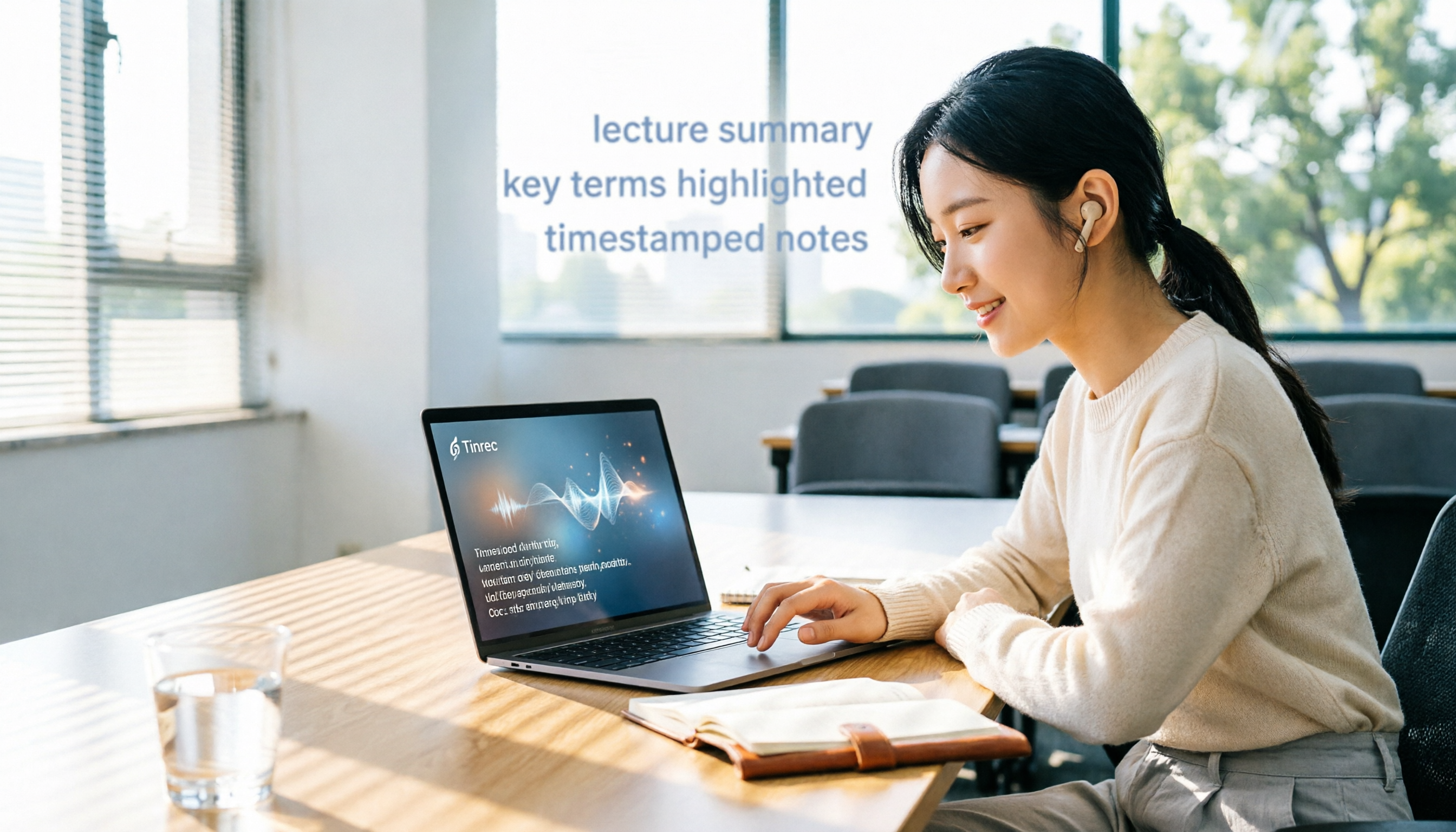
2026 AI Recording Tools Compared: Notta Tutorial & Pricing vs Tinrec for Students
A student's hands-on comparison of Notta and Tinrec for classroom recording and review. We break down Notta's tutorial and paid plans, assess whether the free tier is enough, and give real-world recommendations for students.

2026 Tested: 3 Best Recording-to-Text Tools Compared – Notta vs Tinrec vs Otter.ai
We tested three recording-to-text tools, addressing PTT users' discussions about Notta, and compared Notta, Tinrec, and Otter.ai in terms of features, pricing, and use cases, with recommendations.

2026 Hands-On Comparison of 4 AI Transcription Tools: Notta Pricing and Dcard Reviews Explained
Still searching Dcard for Notta pricing and user reviews? This article tests 4 AI transcription tools—Tinrec, Notta, Otter, and Fireflies—covering free tier limits, paid plans, and ideal use cases to help you find the best value.

5 Best Voice-to-Text Apps of 2026 Compared: Is Tinrec (Miao Ting Lu Yin) a Worthy Notta Alternative?
People on Dcard often ask if there's a better voice-to-text tool than Notta. This article tests 5 popular apps, comparing input sources, AI summarization, Chinese support, and pricing, to show why Tinrec (Miao Ting Lu Yin) might be a more comprehensive choice.

Notta vs Granola in 2026: How to Choose? A 5-Step Complete Comparison Guide
Notta and Granola serve very different purposes: one is cloud-based transcription, the other is an invisible meeting notes app for Mac. This article walks you through a 5-step comparison and introduces Tinrec, a more comprehensive third option, to help you find the best meeting notes tool for your needs.

3 Best Meeting Note Tools in 2026: Notta Pricing and Value Analysis
We tested Notta, Tinrec, and Otter to compare costs, free tiers, and core features, helping you avoid the 3-minute per recording trap and find the right choice for Chinese speakers.