
Turn recordings into transcripts and summaries in minutes
Upload audio or video for multilingual transcription, AI notes, and action items
How to Choose a Free Tool for Transcribing Lecture Recordings?
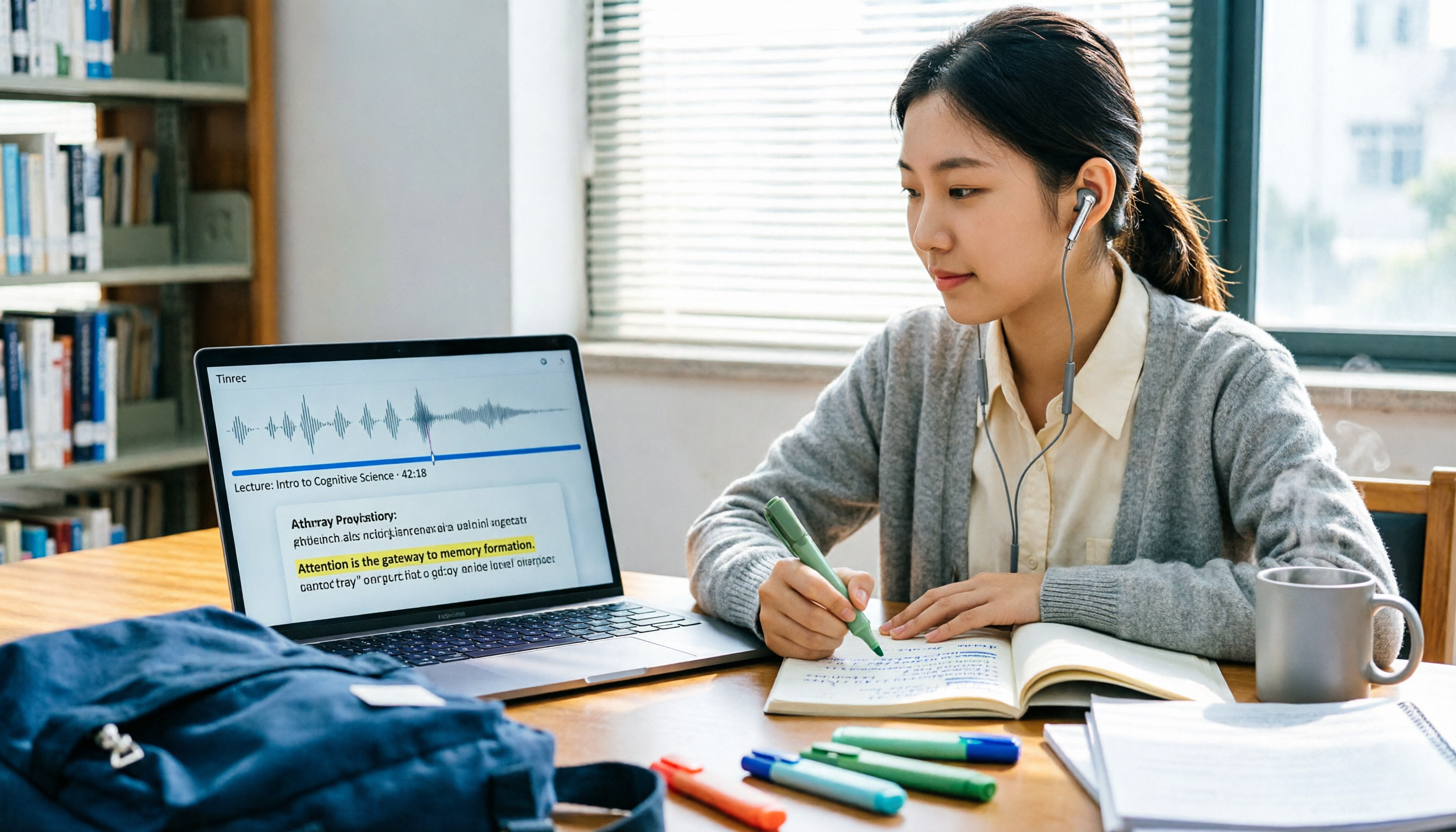
Last semester, I took a course where the professor talked fast and flipped through slides even faster. I tried taking handwritten notes—but when I opened my notebook before the midterm, I couldn't even understand what I had written. Later, I started using recording-to-text tools, but many free apps either have time limits or only support English, and their recognition of Chinese (especially Traditional Chinese) is inconsistent.
If you're like me and need to record lectures, meetings, or interviews without spending a fortune on paid software, this article is for you. I'll share my experience using Tinrec (秒听录音) for an entire semester, explaining whether the free plan is sufficient and how to maximize efficiency.
Before Choosing a Recording-to-Text Tool, Understand These 3 Key Points
1. Accuracy: Don't Just Trust the Official 98% Claim Many tools claim 98% accuracy, but that's measured in a quiet recording studio. In a real classroom with air conditioning, page flipping, and classmates whispering, accuracy drops significantly. My advice: test the free trial with your own recordings, don't just rely on ads.
2. What Can You Do After Transcription? A Transcript Alone Isn't Enough If a tool only gives you a transcript, you'll still have to read through it slowly. The features I use most now are AI summaries and Q&A—after recording, I just ask, "What are the key points of this lecture?" which is much more efficient than re-listening to two hours of audio.
3. Free Credits: What Students Care About Most With a limited monthly budget, you must test the free plan first. For example, Tinrec's free plan includes basic transcription credits, enough to experience the full features; if you need to record classes or meetings weekly, then consider a paid plan.
Tinrec (秒听录音)—My Top Choice for the Entire Semester
Tinrec is an AI recording and audio/video organization tool that supports iOS, Android, and web versions. It's not just a recording-to-text tool; it turns recordings and videos into searchable, summarizable, and queryable materials.
Lecture Recording: Transcribe While Recording, Capture Key Points Directly When I attend class, I open Tinrec, and it transcribes in real time. After class, the AI has already generated summaries and chapters, and I just copy the key points to my Notion notes, no more late-night organizing.
Group Discussions: AI Q&A Helps You Find Conclusions The most annoying thing about group discussions is that no one remembers the conclusions afterward. After recording, you can ask Tinrec directly: "What was the project deadline we just discussed?" It answers based on the content, not just keyword search. Currently, almost no competitor at the same price point has this feature.
Online Videos: Paste a Link and Get Text I often watch YouTube tutorials. I just paste the link into Tinrec, and it generates text and summaries, much faster than manually pausing and taking notes.
Pros
- Supports Chinese (Traditional Chinese), suitable for students and professionals in Taiwan and Hong Kong.
- Not just transcripts; it also generates summaries, chapters, to-dos, and even mind maps.
- Export to Notion, Google Docs, and other tools, seamlessly integrating with your note-taking workflow.
Limitations
- The free plan has a monthly basic credit limit; heavy users will need to pay. But for those recording 2-3 classes per week, the free plan is more than enough for a trial.
- Transcription quality is affected by the recording environment; for important content, it's recommended to cross-check with the original audio.
Stop organizing recordings by hand
Upload audio or video and automatically get a transcript, summary, and action items
Who Is It For? If you need to turn classroom recordings, meeting discussions, interviews, or online videos into notes, and want AI to help you find key points directly, Tinrec is currently the most convenient choice.
Alternatives to Tinrec
Otter.ai Otter is a powerhouse for English meetings, with a generous free plan of 300 minutes per month. However, it doesn't support Cantonese, and its ability to organize Chinese content is not as good as Tinrec's. If you mainly record English content, Otter is worth considering; but for Chinese lectures or meetings, Tinrec is more suitable, and Tinrec has AI Q&A, which Otter lacks.
Notta Notta has significant feature overlap with Tinrec. Its free plan offers 120 minutes per month, and the Pro plan costs about $8.17/month when billed annually. Its transcription is decent, but it lacks Tinrec's AI conversational query feature; after recording, you can only manually search keywords. If you only need simple transcription, Notta works; but if you want to "ask questions directly after recording," Tinrec wins.
PLAUD Note PLAUD is an AI recording hardware device with a pre-order price of $179, and you need to purchase a separate transcription plan. The advantage is that it's a standalone device with long battery life. But for students, spending extra on hardware isn't cost-effective, and Tinrec can achieve the same results with just a phone, plus it supports online video transcription, which PLAUD cannot do.
Pitfall Guide: 3 Common Mistakes When Choosing a Recording-to-Text Tool
Pitfall 1: Only Looking at Official Accuracy Claims Many tools claim 98% accuracy, but in real environments, it's lower. I recommend testing with your own recordings; Tinrec's free plan allows that, so don't be fooled by ads.
Pitfall 2: Ignoring Post-Transcription Organization Features If you only use the tool for "recording to text," you're only using a third of its capabilities. For example, after recording a lecture, I ask Tinrec to generate summaries and to-dos, which is much faster than manually going through the transcript.
Pitfall 3: Buying Hardware When Your Phone Is Enough Some classmates buy voice recorders or AI recording hardware, but a phone app can do the same thing without carrying an extra device. Tinrec is cross-platform, usable on both phone and computer, and the money saved can buy you a few late-night snacks.
Conclusion: Which One Should You Choose?
If you're a student like me with a limited budget and need recording-to-text, Tinrec is currently the best value for money. Its free plan is enough to try, and the paid plans are reasonable.
Scenario Recommendations
- Need Chinese lecture recording to notes → Tinrec (try the free plan first, upgrade if it works well)
- Want to use AI to find key points and generate summaries after recording → Tinrec (the only option with AI Q&A)
- Cross-platform use (phone + computer) → Tinrec (iOS + Android + web)
- Zero budget, only English recordings → Otter.ai (free 300 minutes, but no Chinese advantage)
I recommend downloading Tinrec's free plan first; it has a monthly basic credit, enough for a few classes or meetings. If you like it, consider the weekly card or Pro plan—no need to pay upfront.
References
- Tutorial: Free AI Offline Recording-to-Text App, Cantonese Colloquial to Written Language, Comparison with iPhone Built-in Transcription
- [Tutorial] iPhone Voice Memo to Text Transcript, Supports Cantonese, No Third-Party Software Needed - unwire.hk Hong Kong
- 《Free + Cantonese OK: How to Use Google AI Studio to Transcribe Your Recordings》 Finding a good transcript app is painful; Have you tried different recording-to-text apps? Either they're fake free, charging you after the first few minutes, or they only support English, not Cantonese, or you have to go through a lot of API setup. // Recently I discovered that Google Gemini is world-class in this regard: - 【Really Free】 No subscription fees after a few uses - 【Cantonese Friendly】 Gemini is accurate
- Online AI Speech, Video, and Audio File Auto-Transcription - Free Trial - cSubtitle
- Free Cantonese Voice-to-Text App 2025 | Subanana
Turn every recording into actionable outcomes
Get 60 free transcription minutes when you sign in. No credit card required.
Related Reading
You might also like

2026 Cantonese Audio-to-Text Free Solutions: 5 Options at a Glance
This article tests Cantonese audio-to-text tools, using Tinrec as an example, and introduces free plans, core features, use cases, and key selection points to help you quickly find the right Cantonese transcription tool.

2025 Tested: 5 Cantonese Voice-to-Text Tools Compared—Tinrec Wins with Multi-Source Organization and AI Q&A
We tested the top Cantonese voice-to-text tools used in Hong Kong in 2025, including Tinrec, Plaud Note, Otter.ai, and cSubtitle, comparing accuracy, AI features, cross-platform support, and pricing to help you find the best solution for transcribing meetings, interviews, and lectures.

2026 Tested: 4 Cantonese Voice-to-Text Tools Compared – Which Saves You the Most Time?
How do you choose a Cantonese voice-to-text tool? This article tests and compares four tools—Tinrec, Otter.ai, Notta, and PLAUD—covering accuracy, AI post-processing, cross-platform support, and free quotas, to help you find the best solution for organizing Cantonese meetings, interviews, and lecture recordings.

How to Convert Cantonese Recordings to Text in 2026? 5 Steps to Choose a Free Transcription Platform
Hong Kong office workers have meetings every day, and after meetings, they still have to listen to recordings and type transcripts? Looking for a free and reliable Cantonese recording-to-text platform? This article tests popular tools like Tinrec and tells you which one suits you best, saving you overtime hours.

2026 Tested: 4 Cantonese Voice-to-Text Tools Compared – Do AI Summaries and Q&A Really Save Time?
We tested Tinrec, Otter.ai, Notta, and PLAUD across Cantonese transcription accuracy, AI organization features, cross-platform support, and pricing to help you find the best solution for converting Cantonese recordings to text.

Tinrec vs UniScribe 2026: 5-Dimension Comparison for Cantonese Voice-to-Text
We tested two tools for transcribing Cantonese recordings, comparing them across five dimensions: transcription quality, AI organization, Q&A query, multi-source support, and export workflow, to help you decide which is more practical for professionals.

The Complete Guide to Cantonese Speech-to-Text in 2026: Free Tools and Practical Tutorial
This guide shows you how to use the free version of Tinrec to quickly convert Cantonese meeting, interview, and course recordings into text, with automatic summaries and to-do lists—perfect for mid-level managers and professionals looking to save time.

Tinrec Audio-to-Text in 2026: Cantonese Support and Automatic Meeting Minutes
A mid-level manager's hands-on comparison of Tinrec vs. Plaud Note across 4 key dimensions for Cantonese audio-to-text: accuracy, cross-platform, AI Q&A, and pricing. Learn how to use the free tier.
Tinrec vs Otter.ai 2026: 5-Dimension Comparison – Which Free Cantonese Voice-to-Text Tool Is Right for You?
We tested two popular voice-to-text tools across five dimensions: accuracy, Cantonese support, AI features, free tier, and cross-platform compatibility, to help Cantonese speakers decide between Tinrec and Otter.ai.