
Turn recordings into transcripts and summaries in minutes
Upload audio or video for multilingual transcription, AI notes, and action items
Facing endless meeting recordings or two-hour lectures, have you ever felt the anxiety of "not wanting to re-listen" yet fearing "missing key points"? Traditional voice recorders can save audio, but can't solve the "information retrieval" problem; simple handwritten notes often can't keep up with the speaker's pace.
This article compiles 7 noteworthy voice note apps in 2026, categorized into "handwriting sync type" and "AI voice-to-text type." We evaluate recording quality, transcription accuracy, AI summarization capabilities, and cross-platform support, with a detailed comparison table and hands-on tutorial.
Quick Navigation Conclusions:
- If you prefer handwriting on iPad and need audio playback syncing: go with Notability or GoodNotes 6.
- If you need to transcribe large amounts of audio, generate meeting minutes and action items: prioritize Tinrec (Instant Voice Notes) or NotebookLM.
- If you are a heavy Samsung or Microsoft ecosystem user: Samsung Notes or OneNote are the best free solutions.
Why Do You Need Voice Note Apps? Three Core Pain Points
Before choosing a tool, let's clarify the three main problems voice note apps solve:
- "Record but never review" archive waste: Audio files are linear; finding a specific sentence requires dragging the progress bar from the start, costing huge time, leading to many recordings becoming digital clutter.
- Transcription hell: Manual transcription of a 1-hour recording typically takes 3 to 4 hours, a major productivity killer for journalists, researchers, and administrators.
- Post-meeting action gap: Meetings often end with only a log, lacking clear "Action Items," causing decisions to stall.
2026 Top 7 Voice Note Apps Review
1. Notability: The Classic Handwriting and Audio Sync
Notability has long been a top choice for iPad users. Its standout feature is "audio and note syncing" — when you replay audio, the ink changes color to show what was written at that moment. This is great for students reviewing class notes, clearly seeing which part of the lecture corresponds to their notes. While the free version has theme limits and AI features require a subscription, it remains powerful for Apple Pencil users.
2. GoodNotes 6: Realistic Handwriting and AI Experimentation
Originally known for realistic handwriting, GoodNotes 6 now supports Android and includes recording. It offers unlimited folder levels and audio-note sync. Recording features are basic, but combined with new AI assistance (e.g., math formula recognition, spell check), it suits users who like beautifully organized digital notebooks.
3. Tinrec (Instant Voice Notes): AI-Driven Voice-to-Action Workflow
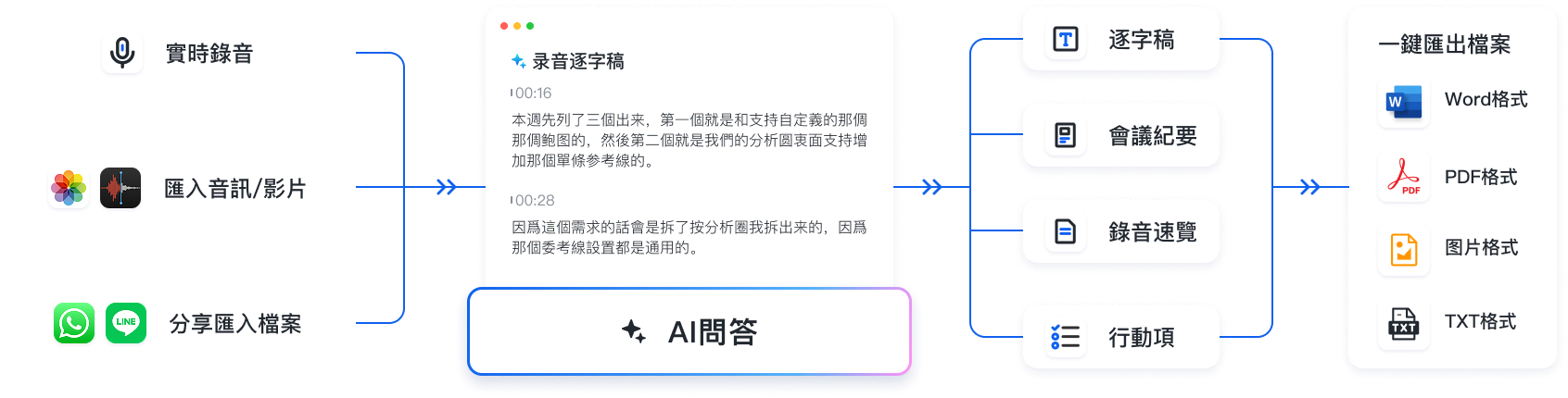
Unlike the first two focused on handwriting, Tinrec specializes in converting audio into usable text. It supports automatic recognition of 10 languages including Chinese, English, Japanese, and Cantonese, providing real-time transcription and AI-generated meeting minutes and action items.
Tinrec's differentiator is its emphasis on "understanding and action." For hours-long interviews or meetings, users can use the "AI Chat Query" feature to ask questions about the content (e.g., "What was the conclusion about the budget?"), and the system answers based on the recording, saving significant replay time. This is ideal for workplace meeting records, interview transcription, and learners needing quick key points.
4. NotebookLM: Google's AI Data Analysis Notebook
NotebookLM is an AI note tool centered on data analysis. It handles text files, audio files, and PDFs. Its highlight is integrating multiple sources in one project for cross-document summarization. It can even generate "audio summaries" simulating a podcast between two hosts, perfect for researchers deep-diving into extensive materials.
Stop organizing recordings by hand
Upload audio or video and automatically get a transcript, summary, and action items
5. OneNote: The Free Powerhouse in Microsoft Ecosystem
OneNote is a completely free cross-platform note app with unlimited canvas and hierarchy. Its recording feature is basic but integrates seamlessly with Microsoft 365. Powerful search recognizes text in images and handwriting. For enterprises already using Office, OneNote is the most seamless choice.
6. Samsung Notes: Galaxy AI-Enhanced Android Notes
Exclusive to Samsung users. With Galaxy AI, Samsung Notes now supports voice-to-text and auto-summarization (on certain high-end models). It syncs with desktop, supports PDF annotation and math formula calculation, making it a feature-rich note app for Android.
7. Apple Freeform: Infinite Canvas Creative Whiteboard
Apple Freeform is more like a large online whiteboard for team brainstorming. Though weak in traditional document organization, its infinite canvas allows inserting sticky notes, images, audio, and links. It supports iCloud sync and collaboration, ideal for creative ideation.
Tool Comparison Table: Voice Note App Feature Overview
To help you choose quickly, here is a comparison across 5 key dimensions:
| App | Core Strength | Voice-to-Text | Summary & Action Items | Best For | Pricing |
|---|---|---|---|---|---|
| Tinrec | Accurate transcription, AI chat query | Yes (live/file/video) | Yes (meeting minutes/to-dos) | Meetings, interviews, classes | Free trial / subscription |
| Notability | Handwriting & audio sync | Paid subscription | Paid subscription | Class notes, review | Free / subscription |
| GoodNotes 6 | Notebook organization, writing feel | Basic | Basic AI assistance | Digital planners, student notes | Free with limits / one-time or sub |
| NotebookLM | Multi-source integration analysis | Yes (strong on analysis) | Yes (incl. audio generation) | Research, literature review | Currently free |
| OneNote | Microsoft ecosystem, infinite canvas | Basic dictation | Requires Copilot | Enterprise collaboration, database | Free |
| Samsung Notes | Galaxy AI integration | Yes (specific models only) | Yes (specific models only) | Samsung phone users | Free |
Hands-On Tutorial: How to Efficiently Organize with AI Voice Note Apps
Choosing the right tool is just the first step; building an efficient workflow is key. Below, using Tinrec as an example, we show how to organize a 1-hour meeting in 5 minutes:
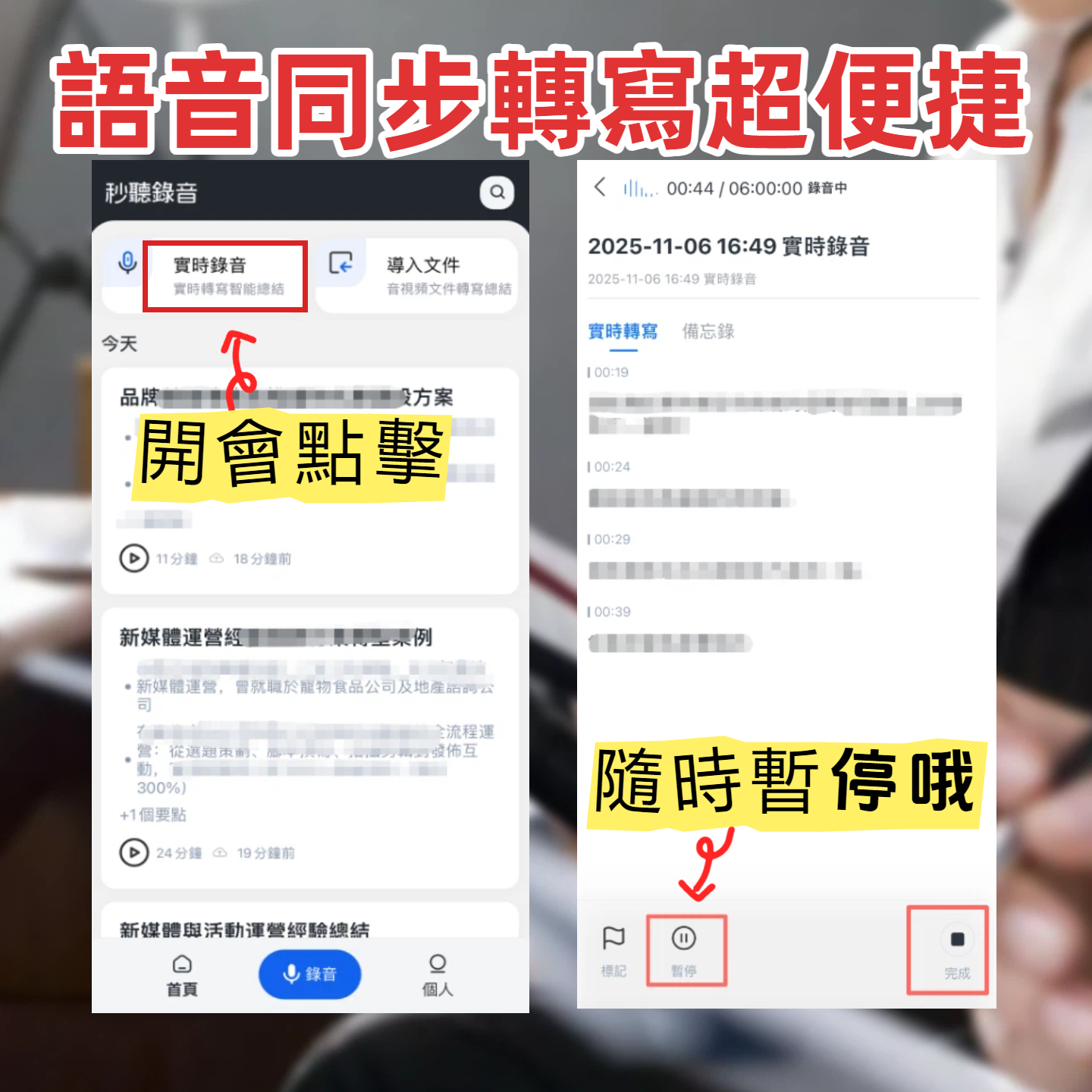
Step 1: Start Live Transcription
At the start of a meeting or class, enable "Live Transcription." Unlike traditional recorders, this lets you see text as it's recorded, allowing you to confirm unclear parts immediately.
Step 2: Import External Audio or Video Links
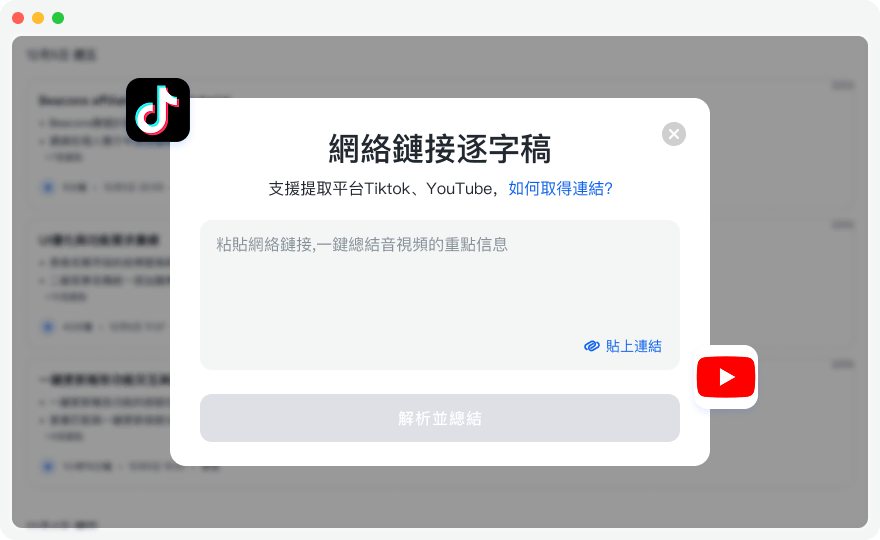
If you have pre-recorded audio or want to transcribe YouTube tutorials or podcasts, use the "Import Audio/Video" feature. Tinrec supports direct parsing of YouTube or podcast links — great for content creators and self-learners.
Step 3: AI Extract Summary and To-Dos
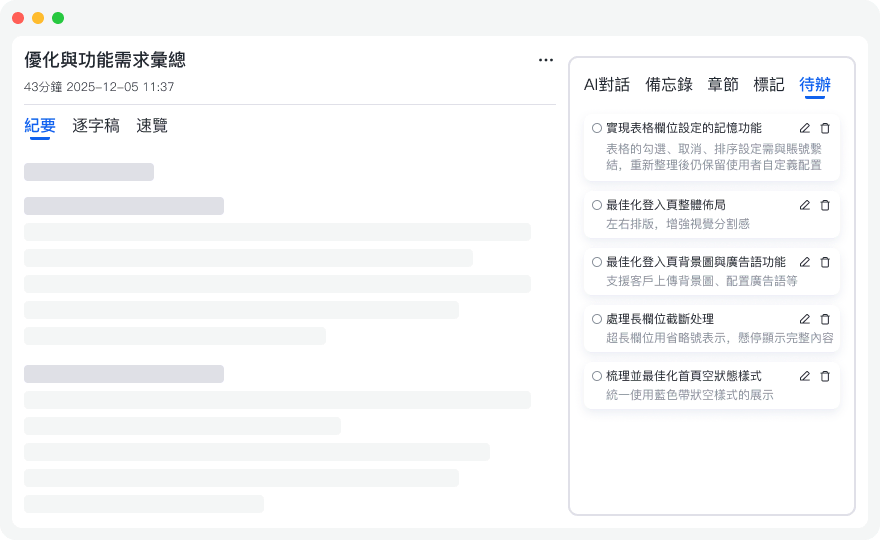
After recording, don't waste time re-reading thousands of words. Check the auto-generated "AI Summary" and "Action Items (To-Do List)." This quickly filters out filler, locking in key decisions.
Step 4: Use AI Chat Query for Details
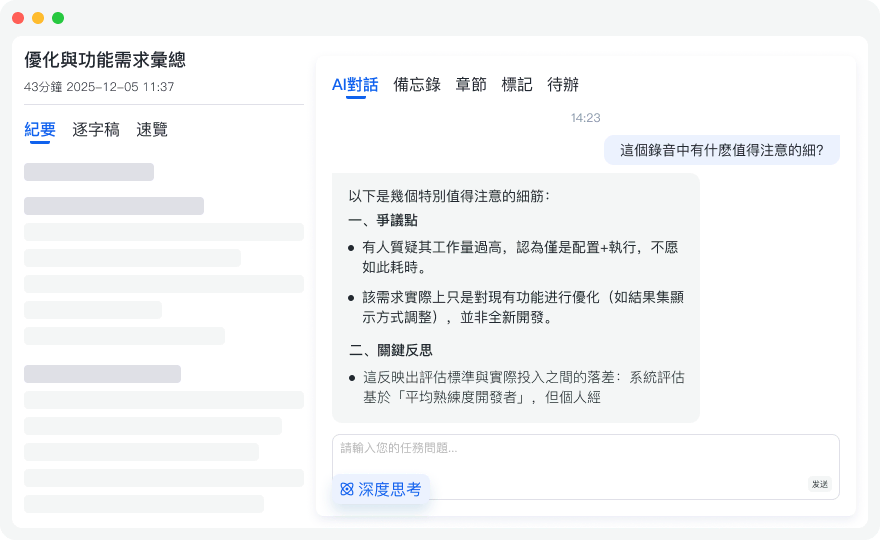
If the summary misses a detail (e.g., "When did Xiao Ming promise to submit the report?"), no need to scrub the timeline. Use "AI Chat Query" to ask directly. AI searches the recording and answers, making data retrieval as simple as chatting.
Frequently Asked Questions (FAQ)
Q1: How accurate is voice-to-text? Does background noise affect it? Current AI transcription tools (e.g., Tinrec, NotebookLM) achieve over 95% accuracy in clear environments. In noisy settings or with multiple speakers, accuracy drops. Keep the device near the speaker or use a directional microphone.
Q2: Can these apps record phone calls on iPhone? Due to iOS privacy restrictions, most third-party apps cannot directly record standard phone calls (including Line/WhatsApp). Use speakerphone or an external recorder, then import the file for transcription.
Q3: Can they record Teams or Google Meet meetings? For online meetings, OneNote requires manual recording start; Tinrec and NotebookLM allow importing meeting recordings or audio files for analysis. Some tools offer web versions for simultaneous recording.
Q4: What are the limits of free versions? Most free versions limit recording duration or transcription minutes. For example, Notability's free version limits edits and themes; Tinrec offers monthly transcription credit. Test core features with the free tier first.
Q5: What languages are supported? Notability and GoodNotes rely on system input or basic recognition; professional tools like Tinrec support Chinese, English, Japanese, Korean, German, and 10 other languages, with mixed Chinese-English recognition, suitable for international meetings.
Q6: How secure are my recordings? Choose reputable tools with encrypted transmission. For high confidentiality, check if software supports local processing or enterprise-grade security. Cloud note apps (OneNote, Apple Freeform) rely on their parent company's account security (Microsoft/Apple).
Turn every recording into actionable outcomes
Get 60 free transcription minutes when you sign in. No credit card required.
Related Reading
You might also like

How to Follow Up on Project Meeting Action Items in 2026: A Complete 5-Step Guide
After a project meeting, action items often get lost in chat threads and lack clear owners. This article breaks down a complete 5-step process for following up on project meeting action items, from pre-meeting preparation, bot-free recording, AI summaries and action item extraction, to export tracking and closure documentation. It uses Tinrec as a practical demonstration tool and also covers 5 key considerations and common questions when choosing a meeting follow-up tool.

Meeting Minutes Email Template 2026: 5-Section Structure + 3 Scenario Examples
Stuck with the task of emailing meeting minutes after a meeting wraps up? This guide offers copy-paste meeting minutes email templates covering routine weekly meetings, client meetings, and cross-departmental decision meetings, plus common mistakes and 6 practical FAQs.
2026 Comparison of 4 Meeting Action Plan Tools: Which One Best Tracks Post-Meeting Actions?
Meetings end, but action plans go nowhere—the problem is often not the people, but that the tool only gives you a transcript. This article starts from 'whether post-meeting actions are captured' and outlines 5 key factors for choosing a meeting action plan tool. It compares Tinrec, Otter.ai, Fireflies.ai, and Notta in terms of recording method, to-do extraction, Chinese language performance, and team ownership, and includes 4 common pitfalls and selection advice.
4 AI Meeting Task Extraction Tools Compared in 2026: From Transcript to To-Do List
You have the meeting transcript, but no one remembers who's responsible for what. This article compares four tools—Tinrec, Otter.ai, Notta, and TurboScribe—from a task extraction perspective, covering four key decision points, hands-on experience, common pitfalls, and scenario-based recommendations to help you find the one that turns meeting noise into actionable signals.

4 Meeting Notes Tools Tested for 2026: Which One Turns Discussions into Actionable Plans?
Even the most detailed meeting notes are useless if no one follows up. This article covers 4 key points for writing meeting action plans, 3 common mistakes, and hands-on comparisons of Tinrec, Notta, Granola, and PLAUD Note on task extraction, post-meeting follow-up, and team collaboration.

2026 Free Post-Meeting Email Automation Options: 5 Tools Compared
Always sending post-meeting emails the next day? The problem isn't your writing—it's that meeting content isn't captured well. This article reviews the free tiers and limitations of 5 post-meeting email automation and assistance methods, and tests how Tinrec turns transcripts, AI summaries, and action items into one-click email material. Suitable for students and small teams.

3 Meeting Recap Email Templates Compared for 2026: Which Format Best Moves Projects Forward?
We break down three meeting recap email template styles and how to choose one, covering structure, examples, and common mistakes. Plus, learn how Tinrec turns meeting recordings into citable minutes, to-dos, and action lists so your post-meeting emails don't get ignored.

2026 Comparison of 4 Meeting Note Tools: Which One Actually Turns Meeting Conclusions into Action Plans?
Meetings end with conclusions, but no one follows through? This article starts from the real need to turn meeting conclusions into action plans, outlines 4 key purchasing points, and compares Tinrec, Notta, Otter.ai, and Granola on bot-free recording, AI summaries and to-dos, post-meeting Q&A, and team data retention, with prices and limitations, to help you choose the one that truly connects to execution.

2026 AI Follow-Up Email Tools Comparison: Tinrec Ensures No Post-Meeting Follow-Up Is Missed
The meeting ending is just the beginning of follow-up. This article tests 3 AI tools related to post-meeting follow-up emails, including Tinrec, Manus, and Genspark, covering meeting transcription, action item extraction, and email draft generation, helping you bridge the last mile from the meeting room to the inbox.