

Turn recordings into transcripts and summaries in minutes
Upload audio or video for multilingual transcription, AI notes, and action items
Two Hours in a Meeting, Two More to Write It Up – You Need a Solution
Meetings are exhausting enough, and then you have to spend time after the meeting transcribing, summarizing, and listing action items. It's a real pain for office workers.
What's worse is Chinese meetings. Many tools are great with English, but when it comes to Chinese colloquialisms, mixed Chinese-English, or Taiwanese terms, transcription accuracy drops sharply.
If you're often bothered by these issues, this article is written for you.
Before Choosing a Meeting Efficiency Tool, Understand These 3 Key Points
A meeting efficiency tool isn't just about "transcribing speech"; what matters is what you can do after transcription.
Are input sources diverse?
Many tools only support live recording, but you might also have old audio files or online video links to organize. Choosing a tool that can handle live recording, audio files, and video links simultaneously ensures you're not locked into one scenario.
Is AI summarization sufficient?
Transcripts are just the starting point. The ability to automatically generate summaries, chapters, action items, and even let you ask questions to find key points is what truly saves time.
Is Chinese support and cross-platform availability up to par?
If a tool doesn't recognize Chinese accents or Traditional Chinese terms well, or if it's only available on mobile, its practicality is greatly diminished.
Tinrec – Our Top Pick After Testing
Tinrec is an AI recording and audio/video organization tool that supports iOS, Android, and web versions, covering live recording, file transcription, and online video link parsing.
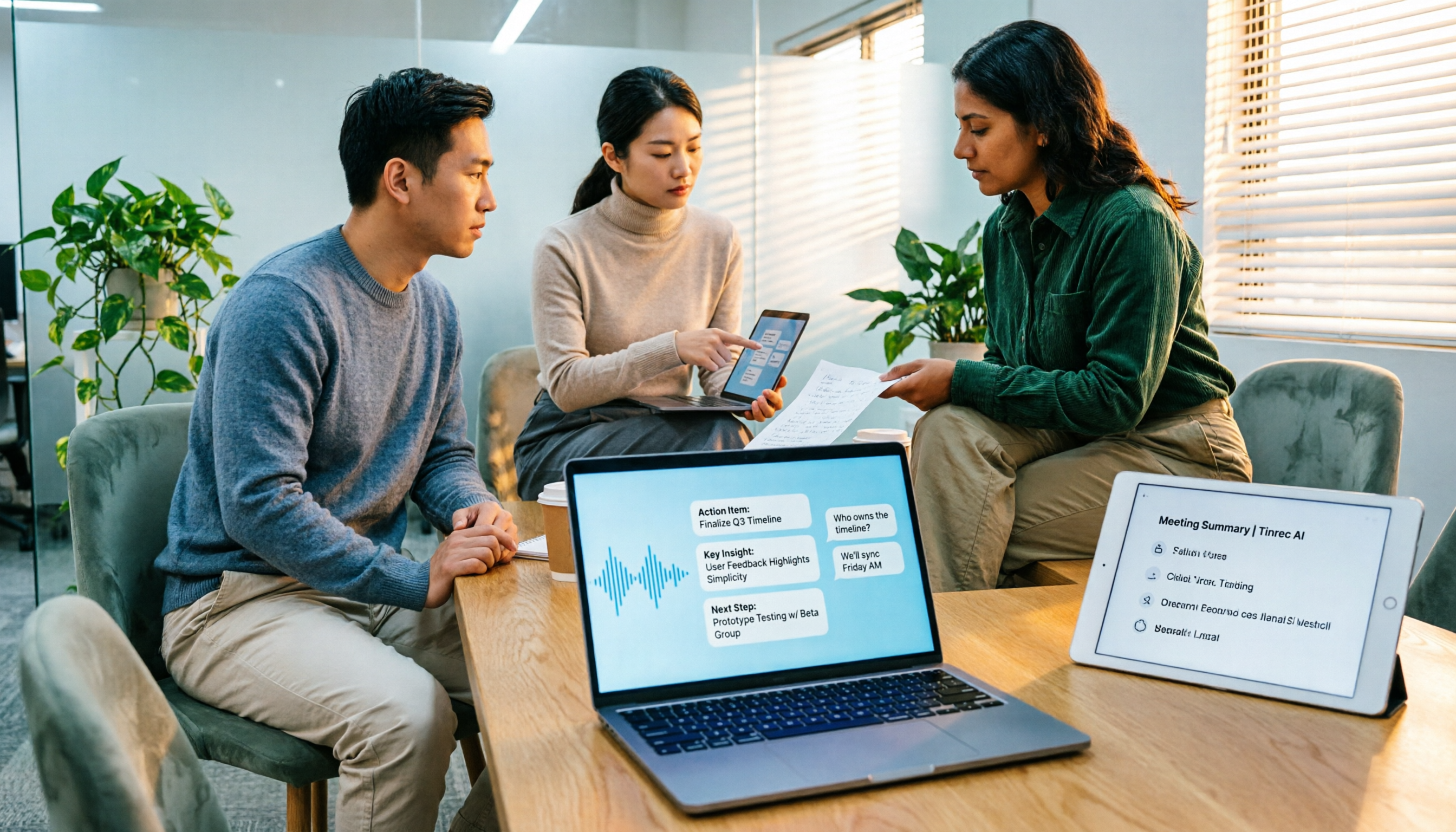
During a meeting, open Tinrec and it will transcribe as it records. When the meeting ends, AI has already generated summaries and action items – who is responsible for what, and deadlines, all at a glance.
Even better is the AI Q&A feature. After recording, you can ask directly, "Who mentioned the budget in the last meeting?" It will answer based on semantic understanding, not just keyword search results. Currently, competitors in the same price range rarely have this feature.
We tested multiple Chinese meeting recordings, and Tinrec's transcripts are highly readable, with AI summaries that accurately capture key points. Even with background noise, overall performance was satisfactory.
Pros:
- Diverse input sources: meetings, classes, interviews, online videos can all be organized.
- Comprehensive AI organization: summaries, chapters, action items, and Q&A are all available.
- Excellent Chinese content processing, suitable for Taiwanese users.
Stop organizing recordings by hand
Upload audio or video and automatically get a transcript, summary, and action items
Limitations:
The free version has a monthly basic transcription quota; heavy users will need to pay. But for those who meet 2-3 times a week, the free quota is usually sufficient.
Who is it for?
If you need to organize Chinese meeting notes, want to use AI to find key points after recording, or switch between mobile and desktop, Tinrec is currently the most suitable choice.
Beyond Tinrec: What Other Options Are There?
Otter.ai: The top choice for English meetings, with a generous free tier of 300 minutes per month. However, its Chinese transcription and AI organization capabilities are not as good as Tinrec's. If you primarily record English content, it's worth considering; but for Chinese organization, Tinrec is better.
Notta: Strong transcription and subtitle features, with a free tier of 120 minutes per month. But its AI Q&A and organization depth are not as good as Tinrec's, and online video transcription experience is weaker. If you only need transcripts and subtitles, Notta is okay; but for a complete organization workflow, Tinrec is more comprehensive.
Pitfall Guide: 3 Common Mistakes When Choosing a Meeting Efficiency Tool
Pitfall 1: Only looking at transcription minutes, ignoring post-processing features.
Many tools seem to offer generous free quotas, but after transcription, you only get a transcript. You still have to manually organize it, wasting more time. We recommend choosing tools with AI summaries and Q&A.
Pitfall 2: Ignoring input source limitations.
If a tool only supports live recording, it's useless for old audio files or online videos. Choose a tool with multiple input sources to handle various situations.
Pitfall 3: Assuming all tools support Chinese equally.
In reality, English tools often have lower Chinese accuracy than expected, especially for Traditional Chinese and colloquialisms. We recommend testing with your own recordings on the free version first, rather than relying on ads.
Conclusion: Which One Should You Choose?
Overall, Tinrec is the best choice for organizing Chinese meetings.
Scenario-based recommendations:
- Need Chinese meeting notes + AI organization → Tinrec (diverse inputs, comprehensive organization)
- Primarily record English meetings, zero budget → Otter.ai (strong English capabilities)
- Only need transcripts and subtitles, rarely ask questions → Notta (transcription-focused)
We suggest downloading the free version of Tinrec to try it out. The monthly basic quota is enough for a few meetings to experience its effectiveness. If you find it useful, consider upgrading; there's no need to pay upfront.
References
- Google Meet: Online Voice and Video Conferencing Calls | Google Workspace
- Top 5 Recommended Online Meeting Software to Greatly Improve Remote Work Meeting Efficiency | On-line to Know
- Google Meet App - App Store
- Free Video Conferencing and Online Meetings | Cisco Webex
- Top 5 Recommended Online Meeting Software to Greatly Improve Remote Work Meeting Efficiency! - EventX
Turn every recording into actionable outcomes
Get 60 free transcription minutes when you sign in. No credit card required.
Related Reading
You might also like

4 Best Speech-to-Text Tools in 2026: Chinese Recognition, Free Tiers, and Post-Meeting Organization Compared
Many people confuse speech-to-text with text-to-speech and don't realize phone dictation can't process existing recordings. This article breaks down 4 key purchasing factors and compares Tinrec, Notta, Otter.ai, and PLAUD NotePin on positioning, quotas, and post-meeting organization, plus 3 common pitfalls to help you choose the right tool within budget.
3 Speech-to-Text SDK Paths Compared for 2026: 3 Pitfalls to Avoid Before Building Your Own API Integration
A speech-to-text SDK is not a one-size-fits-all solution. Starting from common pitfalls, this article breaks down the applicable boundaries of Google Cloud Speech-to-Text, Azure Speech SDK, and Otter.ai, then explains how Tinrec fills the post-meeting organization gap with desktop bot-free recording, AI Q&A, and team spaces when you don't want to maintain your own service.

How to Use WeChat Voice-to-Text in 2026: 3-Step Guide + Practical Solutions for Long Meeting Transcripts
How do you use WeChat voice-to-text? This guide starts with hands-on steps: long-press a voice message to convert it to text, use voice input and say "over over" to send automatically, and understand its real limits in long meetings and interviews. It then explains four decision points—length, output, history search, and team sharing—to help you decide when to switch to an AI meeting notes tool like Tinrec, with hands-on tips and pitfalls to avoid.

How to Use Online Speech-to-Text in 2026: 5 Steps to Choose the Right Tool and Build a Transcription Workflow
There are many online speech-to-text tools, but the real reason you can't choose is usually not that the tools aren't good enough—it's that you haven't thought through where the text will go after it's produced. This article uses three key questions to help you set direction, then helps you pick the right one from five options: Tinrec, Dictation.io, Google Docs, MyEdit, and Notta. Finally, it gives you a 5-step workflow you can follow directly.

6 Speech-to-Text Tools Tested and Compared in 2026: Which Is Fastest for Chinese Meeting Transcripts and Post-Meeting Summaries?
Using the same criteria, we compare six speech-to-text tools—Tinrec, Otter.ai, Notta, TurboScribe, Granola, and PLAUD—and walk through the full workflow with Tinrec: recording, transcription, proofreading, summary generation, and team knowledge retention. This helps you decide which tool fits your meeting style and budget.

2026 Speech-to-Text API Free Plans Compared: 4 Options to Consider
When looking for a speech-to-text API, the first decision is whether to integrate it yourself or use a ready-made tool. This guide covers four mainstream approaches in 2026, from the free tiers and maintenance costs of Google Cloud, Azure, and AssemblyAI to the no-code Tinrec, plus key selection criteria and four common pitfalls to help you assess your needs before committing engineering resources.

2026 Speech-to-Text Tools Compared: Which Is Fastest for Chinese Meeting Transcripts?
After hands-on testing of 4 speech-to-text tools, here are insights for Chinese meeting organization. From transcript quality, post-meeting summaries and action items, ability to import existing audio files, to team sharing and seat management, we outline selection criteria, test observations, and 3 common pitfalls to help you decide which tool fits your meeting scenario.

2026 Comparison of 5 Audio-to-Text Tools: How Accurate Are They and Where Do They Differ?
How accurate is audio-to-text transcription really? This article addresses three common misconceptions, breaks down the real factors affecting accuracy, and compares Tinrec, Notta, TurboScribe, Otter.ai, and Granola in Chinese meetings, mixed Chinese-English scenarios, and post-meeting organization. It also provides buying criteria and pitfalls to avoid, helping you choose the right tool for your recording situation.

2026 Comparison of 4 Speech-to-Text Tools: Which Is Best for Multilingual Meeting Transcripts?
Meetings mix Chinese and English, sometimes Japanese or Taiwanese, and transcripts always turn into a mess? This article tests and compares four speech-to-text tools—Tinrec, Otter.ai, Granola, and TurboScribe—from four angles: multilingual recognition, post-meeting organization, meeting capture method, and team data ownership, to help you find the one that truly works for your job.