
Turn recordings into transcripts and summaries in minutes
Upload audio or video for multilingual transcription, AI notes, and action items
Facing hours of meeting recordings or interview MP3 files, have you ever felt overwhelmed? According to research, the average speaking speed is 150–250 words per minute, while typing speed is only 40–80 words per minute—meaning traditional manual transcription is not only inefficient but also prone to missing key information. The good news: with the maturity of AI technology in 2026, converting MP3 to text is no longer a challenge.
This article compiles the 7 mainstream solutions on the market and evaluates them from three dimensions: Chinese recognition accuracy, MP3 file upload support, and free credits. We’ll tell you straight up:
- Want completely free: Prioritize Google Docs voice typing (requires a virtual audio cable trick) or the built-in iOS 18 feature.
- Value Chinese & productivity: Choose Tinrec (Transcribe) or Yating, especially if you need AI summaries and action item extraction for work.
- Focus on English content: Otter.ai remains a good choice for international students or meetings with foreign clients.
Next, we’ll dive into the pros and cons of each tool and provide a hands-on tutorial for converting MP3 to text.
2026 Popular MP3 to Text Tools: Feature & Limitation Comparison Table
Before choosing a tool, it’s crucial to clarify your file source (live recording or existing MP3) and whether you need post-processing AI features. Here’s a spec comparison of mainstream tools in 2026:
| Tool | Languages | MP3 Upload | Key Feature | Free Credits / Pricing |
|---|---|---|---|---|
| Tinrec (Transcribe) | Multi (incl. Traditional Chinese) | ✅ Yes | All-in-one recording/understanding/action, AI summaries, action items, and conversational search | 100 min/month free, multi-device sync |
| LexiTranscript | Multi (incl. Traditional Chinese) | ✅ Yes | No per-file time limit, daily reset credits | Daily free credit limit, good for students |
| Google Docs | Multi | ❌ No (real-time only) | Completely free, integrates well with Google Cloud | Free (requires microphone input) |
| iPhone Voice Memos | Multi | ⚠️ App-recorded only | Built-in iOS 18, offline, fast conversion | Free (requires iPhone 12+ models) |
| Yating | Traditional Chinese / Taiwanese | ✅ Yes | Optimized for Taiwanese accent, supports Taiwanese recognition | First 20 min free, then prepaid |
| Otter.ai | English only | ✅ Yes | Strong English recognition, accurate speaker diarization | 300 min/month free (English only) |
| MyEdit | Multi | ✅ Yes | Online simple editing and transcription | 3 min/day free preview |
In-Depth Analysis: Which One Should You Choose?
1. Best for Students & Budget Users: LexiTranscript & Google Docs
For students on a budget, LexiTranscript is a very friendly choice. Its advantage is the daily reset free credit, unlike many tools that require payment after a trial, and no per-file time limit—practical for long lecture recordings.
If you only need to real-time turn ideas into text, Google Docs’ voice typing is the most convenient free option. But its pain point is that it does not support direct MP3 file upload. To use it for transcribing recordings, you must install a virtual audio cable on your computer so the PC can “hear” the playback—a high-maintenance and unstable workaround.
Stop organizing recordings by hand
Upload audio or video and automatically get a transcript, summary, and action items
2. Convenience for Apple Users: iPhone Voice Memos (iOS 18)
If you have an iPhone 12 or later updated to iOS 18, the built-in Voice Memos app now includes a transcription feature. The advantages: completely free, on-device processing (offline), and supports Traditional Chinese. However, it is primarily designed for live recordings; importing external MP3 files is cumbersome and editing/export is limited.

3. Workplace Productivity & Deep Usage: Tinrec (Transcribe)
If you need more than just “text”—you need understanding—then a simple transcription tool won’t cut it. Tinrec is designed to treat recordings as a database, offering not only high-accuracy Traditional Chinese transcription but also post-processing value.
- All-around transcription: Supports live recording, audio file upload (mp3, wav, m4a, etc.), and even YouTube/TikTok video links to text.
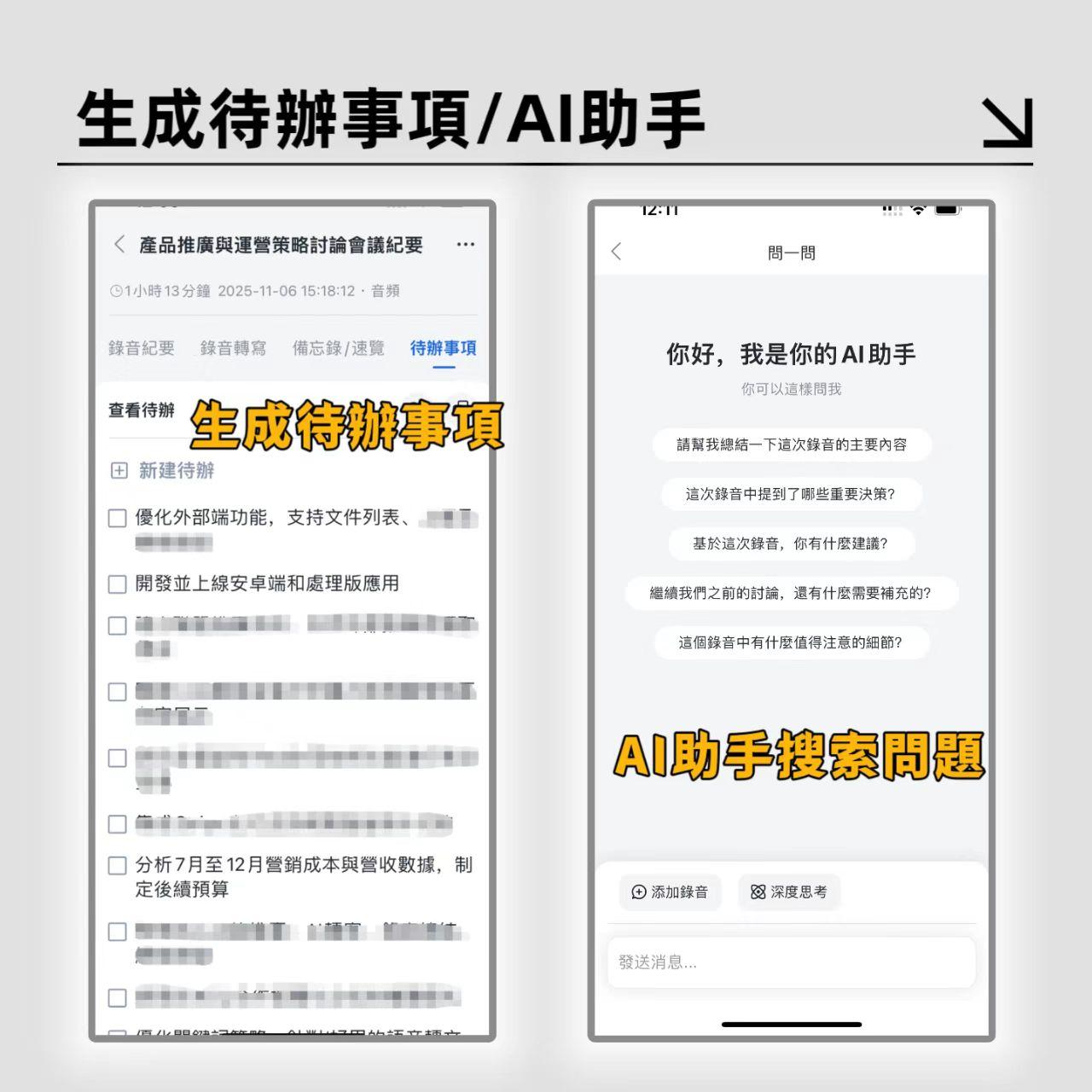
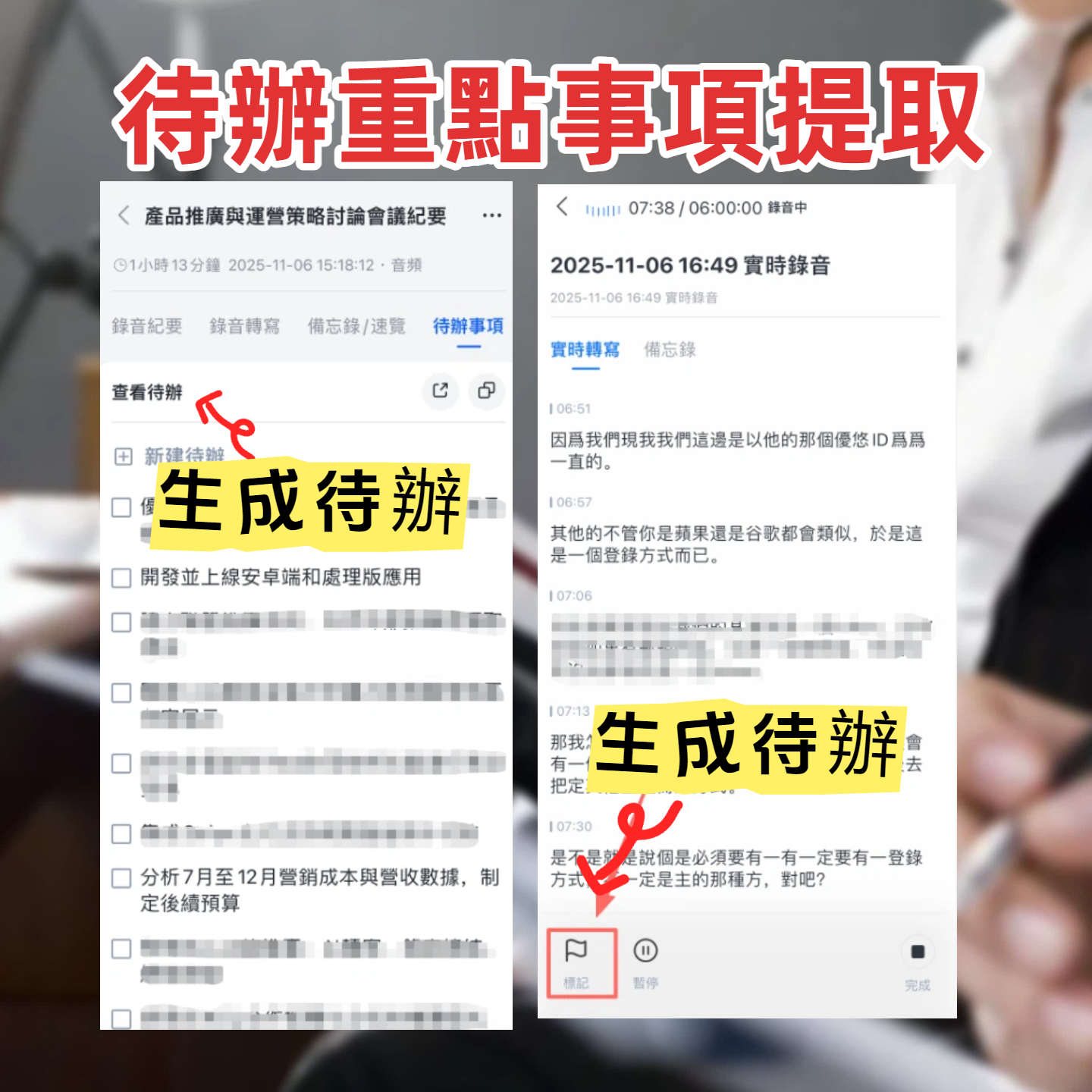
- AI Smart Summaries: Traditional transcripts can be tens of thousands of words and hard to read. Tinrec automatically generates meeting minutes, conclusions, and action items—telling you exactly “what to do next.”
- AI Conversational Search: This is the biggest difference from traditional tools. You can query the recording content like chatting with AI—for example, “What was the budget amount mentioned in the meeting?” The system answers based on the recording, saving you hours of rewinding.
Hands-On Tutorial: How to Convert MP3 to Text (Using Tinrec as an Example)
If you already have a recorded interview or meeting MP3 file and want to convert it to text and extract key points, follow these steps:
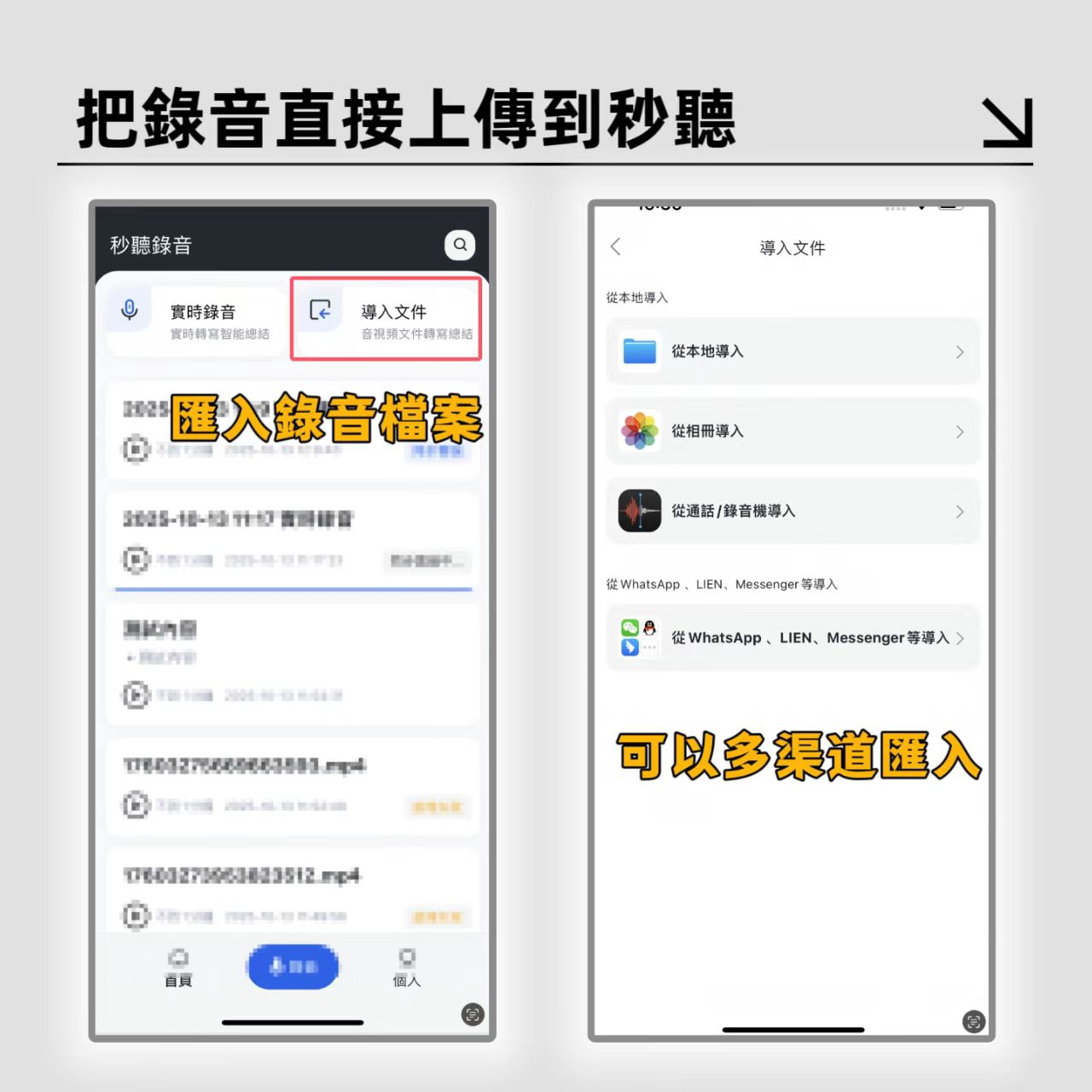
Step 1: Import the Audio File
Open Tinrec web or app, select the “Audio File to Text” feature. The system supports multiple common formats (MP3, WAV, M4A); after upload, AI starts processing immediately.
Step 2: Select Language & Speaker Diarization
Confirm the audio language is set to “Traditional Chinese” (for multilingual meetings, choose auto-detect—Tinrec supports 10 languages including Chinese, English, Japanese, Korean). The system has voiceprint recognition to automatically distinguish speakers (Speaker 1, Speaker 2), which is essential for organizing interview transcripts or meeting notes.
Step 3: Review Transcript & AI Summary
After transcription, you’ll see the full transcript with timestamps on the left, and automatically generated “Summary” and “Action Items” on the right. Click on any text and the audio will jump to that time point for easy proofreading.

Step 4: Use AI to Query Details
If the recording is long and you don’t want to read the whole thing, use the “AI Chat” feature. Type a question like “What feedback did the client give about Phase 2 timeline?” The AI will accurately locate relevant sections and summarize for you—much more intuitive than using Ctrl+F to search for keywords.
FAQ
Q1: Why can’t Google Docs voice typing directly transcribe my MP3 file?
Google Docs voice typing is designed for dictation—listening via microphone in real-time. It does not have a “file upload” entry. While you can trick the computer to capture system audio using technical means, it’s complicated. We recommend using a dedicated file upload tool like Tinrec or MyEdit.
Q2: What are the limitations of iPhone Voice Memos’ transcription feature?
This feature requires iPhone 12 or later and iOS 18. Additionally, it only works on recordings made within the app. For audio files from voice recorders, LINE, or other sources, support is poor.
Q3: How accurate is audio-to-text conversion?
Current mainstream AI tools (like Whisper, Tinrec, Yating) can achieve over 90% Chinese recognition accuracy in clear environments. However, accuracy drops with background noise, overlapping speech, or heavy jargon. We recommend using an external microphone and staying close to the speaker while recording.
Q4: Do free transcription tools have time limits?
Most do. For example, Yating gives 20 minutes free, MyEdit offers 3 minutes/day preview. LexiTranscript gives daily reset free credits; Tinrec provides 100 minutes per month free, suitable for light users.
Q5: How do I transcribe online meetings from Zoom, Google Meet, or Teams?
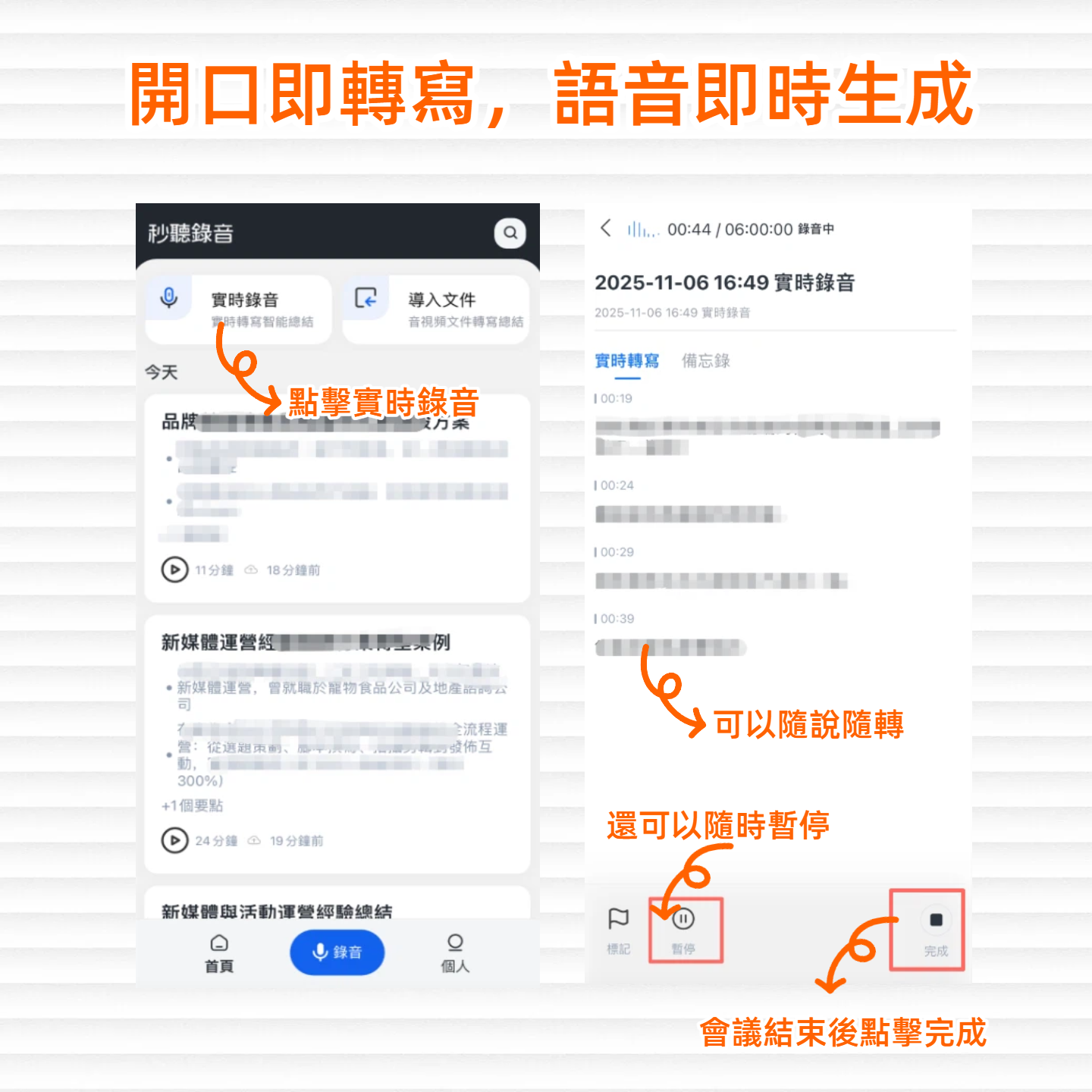
You can use tools like Tinrec’s “Live Recording to Text” feature (capture system audio on your computer) or upload the recorded video/audio file after the meeting.
Q6: How do I quickly turn a transcript into meeting notes?
Don’t read from start to finish. Use the built-in “AI Summary” to grab key points, click on unclear segments to jump to that time point in the audio, and then copy the “Action Items” section to create professional meeting notes.
Turn every recording into actionable outcomes
Get 60 free transcription minutes when you sign in. No credit card required.
Related Reading
You might also like

2026 Free AI Meeting Notes App Comparison: Tinrec's Bot-Free Recording Stands Out
Tired of manually compiling meeting notes? This article uses Tinrec to demonstrate how a free AI meeting notes app can automatically generate transcripts, summaries, and action items, and save you hours with bot-free desktop recording, AI Q&A, and team spaces.

Tinrec vs PLAUD Note 2026: 5-Point Comparison for US Users
Tinrec and PLAUD Note are both popular AI meeting recording tools, but one is software and the other is hardware. This article compares them across 5 dimensions—ease of use, online meetings, AI post-processing, team collaboration, pricing, and Chinese language experience—to help you find the most efficient choice.

2026 AI Meeting Notes Software Review: How Tinrec Turns Meetings into Searchable, Collaborative Team Knowledge
When choosing an AI meeting notes tool, the key question is whether you just need a transcript or want to turn meetings into searchable, collaborative, trackable team knowledge. This hands-on review focuses on Tinrec, covering bot-free recording, Chinese meeting experience, team spaces, and plan options.
5 Best AI Meeting Recorder Apps in 2026: Which Free Plan Is Worth It?
We tested 5 AI meeting recorder apps in 2026—Tinrec, Notta, Vocol.ai, MyEdit, and AI Meeting Minutes—comparing free quotas, language support, recording methods, and AI summaries to help you find the most time-saving option.

2026 Hands-On Comparison of 3 Smart Meeting Minutes Scenarios: How Tinrec Helps You Wrap Up Meetings in 5 Minutes
Always missing key points during meetings? This article uses Tinrec as an example to test three scenarios—online meetings, in-person recordings, and historical audio files—and shows how AI can automatically generate transcripts, summaries, and action items, turning meeting minutes into a searchable digital asset for your team.

2026 Smart Meeting Notes Tools Compared: Tinrec vs Plaud Note – Which Is Worth Buying?
This article compares Tinrec and Plaud Note, two smart meeting notes tools, across six dimensions: hardware dependency, online meetings, Chinese recognition, AI features, team collaboration, and long-term cost, to help you decide which is more suitable for users in Taiwan.

2026 Smart Meeting Minutes Software: AI Summaries + Automatic To-Dos Tested
A mid-level manager tests 2026 smart meeting minutes software: from buying tips, in-depth Tinrec review to competitor comparison, helping you avoid pitfalls and find an AI tool that truly saves post-meeting time.

2026 Tinrec AI Meeting Minutes: Record Online Meetings Without Bots + AI Summaries and Action Items in One Go
Hands-on review of Tinrec, an online smart meeting minutes tool that not only transcribes meetings but also auto-generates summaries, action items, and AI Q&A. This guide covers how to choose and use it, avoiding common pitfalls—a must-read for managers of small and mid-sized teams.

2026 Showdown: 'The Illustrated Guide to an Efficient Life' vs 'The Art of Problem Decomposition' — A 5-Dimension Comparison to Find the Best Book for Learning AI Meeting Notes
A senior student's hands-on review: Which book is most effective for mastering AI-powered meeting notes? This article compares two popular titles and shows you how to pair them with the AI tool Tinrec to put the methods into practice, saving you time and trial-and-error.