
Turn recordings into transcripts and summaries in minutes
Upload audio or video for multilingual transcription, AI notes, and action items
In this era of exploding video content, we consume a huge amount of YouTube videos daily to learn new things or gather information. However, the "information density" of video is usually lower than text. Finding the key 2-minute argument in a 30-minute speech often requires repeatedly dragging the progress bar and re-listening many times, which is very time-consuming.
This article offers an in-depth review of 5 popular "video-to-text transcription" tools on the market in 2026, comparing them across dimensions such as Chinese recognition accuracy, support for videos without subtitles (No CC), cross-device support, and AI summarization capabilities. It also includes a detailed specification comparison table and hands-on tutorial.
Quick Buying Guide:
- If you are a heavy Mac user and value privacy: Go with MacWhisper.
- If you need something completely free and are used to the Google ecosystem: Recommend NotebookLM.
- If you need cross-platform use (phone/computer) and care about extracting action items: Try Tinrec.
Why Do You Need a YouTube Video-to-Text Tool?
Transcription is not just for generating subtitles; it's about converting time-based content (Video/Audio) into searchable, scannable, editable text assets. Whether you are an office worker organizing meeting recordings, a student taking online course notes, or a creator quickly producing scripts, a good AI transcription tool can help you solve the following pain points:
- Time efficiency: No need to re-watch videos at double speed; read the key points directly.
- Precise search: Use keywords to instantly locate specific passages within a video.
- Structured organization: Automatically generate summaries and mind maps, turning unstructured speech into structured notes.
Pros and Cons Analysis of 5 Popular Transcription Tools
Based on current market feedback and actual testing, here are reviews of 5 popular tools for different needs:
1. NotebookLM: Google's Free AI Note-Taking Powerhouse
- Best for: Students or researchers who need to organize large amounts of information and enjoy mind maps. NotebookLM is a cloud-based AI tool from Google. Its biggest advantage is being completely free with no installation required. Simply import a YouTube link, and it quickly generates transcripts and summaries.
- Pros: Very fast, can transcribe videos without subtitles (No CC) via model recognition, supports generating audio summaries and mind maps.
- Cons: Occasionally fails for very long videos; primarily browser-based, mobile experience is average.
2. MacWhisper: On-Device Performance Beast for Mac Users
- Best for: Mac users who value privacy and need high Chinese recognition accuracy. This is an app designed specifically for macOS, utilizing the local hardware performance of your Mac. It supports the Whisper model, so Chinese speech recognition accuracy is quite high.
- Pros: Supports multiple formats, can transcribe videos without subtitles, supports multi-speaker recognition, and can export SRT subtitle files.
- Cons: Only available on Mac computers, model files take up local storage, and transcription speed depends on your computer's hardware specs.
3. Glasp: Social Highlighter for Browsers
- Best for: People who watch videos on Chrome/Safari on desktop and do light note-taking. Glasp is a browser extension that embeds itself alongside the YouTube page, allowing you to view and copy transcripts while watching.
- Pros: Ready to use, no need to switch windows, one-click to send content to ChatGPT for analysis.
- Cons: Highly dependent on existing subtitles. The video must have captions or auto-generated English subtitles to work; if the video has no subtitles at all, it cannot be used.
4. tactiq.io: Lightweight Option for Online Meetings and Videos
- Best for: Users who only need quick transcripts of English content. An online service that requires no software installation. Just paste a URL to generate content with timestamps.
- Pros: No registration required (basic features), simple interface.
- Cons: Similar to Glasp, strictly requires the video to have CC subtitles, and support for Chinese videos is poor; primarily designed for English and Latin-based content.
Stop organizing recordings by hand
Upload audio or video and automatically get a transcript, summary, and action items
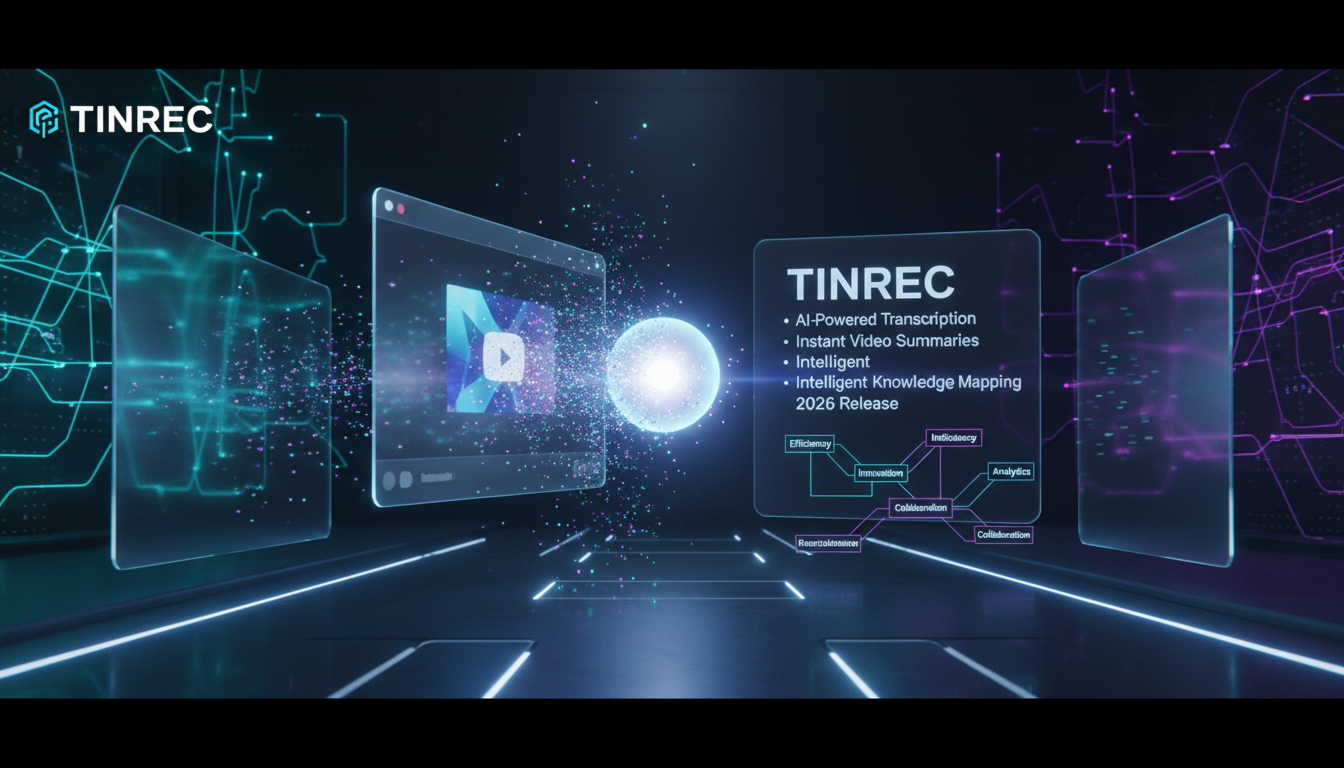
5. Tinrec: Cross-Platform and Mobile-Friendly New Choice
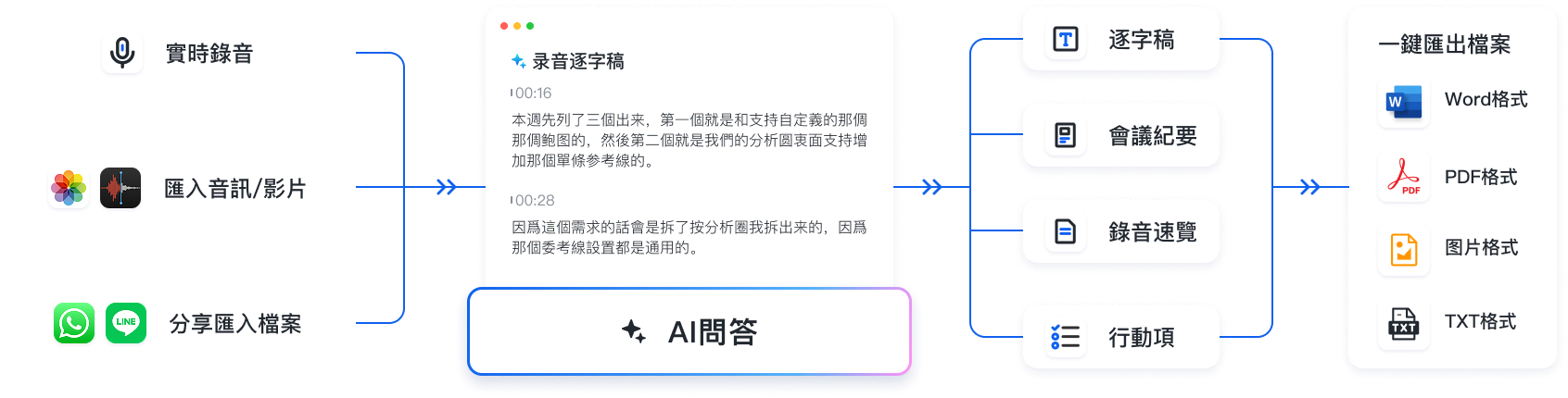
- Best for: Advanced users who need cross-device sync (phone/computer) or want to directly get "to-do action items." Tinrec is an integrated solution supporting iOS, Android, and web. Its core difference is that it goes beyond transcription, emphasizing the "Record → Understand → Act" workflow.
- Pros:
- Cross-platform support: Unlike MacWhisper which is Mac-only, Tinrec seamlessly switches between phone and web.
- AI conversational query: For long videos, you can directly ask the AI "What is the speaker's prediction for the second half of the year?" instead of using Ctrl+F.
- No subtitle support: Cloud-based analysis supports YouTube and podcast links without using phone performance.
- Cons: The free version has a monthly limit of 100 minutes; heavy users need to consider a subscription plan.
Specification Comparison Table of 5 Popular Video-to-Text Tools
To help you decide which tool is right for you, here is a detailed comparison:
| Feature | Tinrec | NotebookLM | MacWhisper | Glasp | tactiq.io |
|---|---|---|---|---|---|
| Platform Support | Web / iOS / Android (All platforms) | Web (Browser) | macOS (Mac only) | Chrome / Safari extension | Web / Chrome extension |
| Videos without subtitles (No CC) | ✅ Supported (AI speech recognition) | ✅ Supported | ✅ Supported (on-device model) | ❌ Not supported (requires subtitle file) | ❌ Not supported (requires subtitle file) |
| Chinese Support | High (supports 10 languages including Taiwanese, Cantonese) | High | Very high (Whisper model) | Depends on YouTube subtitles | Low (English-focused) |
| Core Output | Transcript + Action Items + AI Summary | Transcript + Mind Map | Transcript + SRT Subtitles | Transcript + Summary | Transcript |
| AI Interactive Features | AI Chat Query | AI Q&A | Requires OpenAI API integration | Integrates ChatGPT | Integrates AI |
| Best For | Cross-device learning, mobile work | Academic research, data organization | Video editors, Mac users | Lightweight browser notes | English meetings/videos |
Tutorial: How to Turn a YouTube Video into Key Notes in 1 Minute
Below is a demonstration of how to quickly process a YouTube video using a tool with multi-platform support (using Tinrec as an example). Steps apply to both web and app versions:
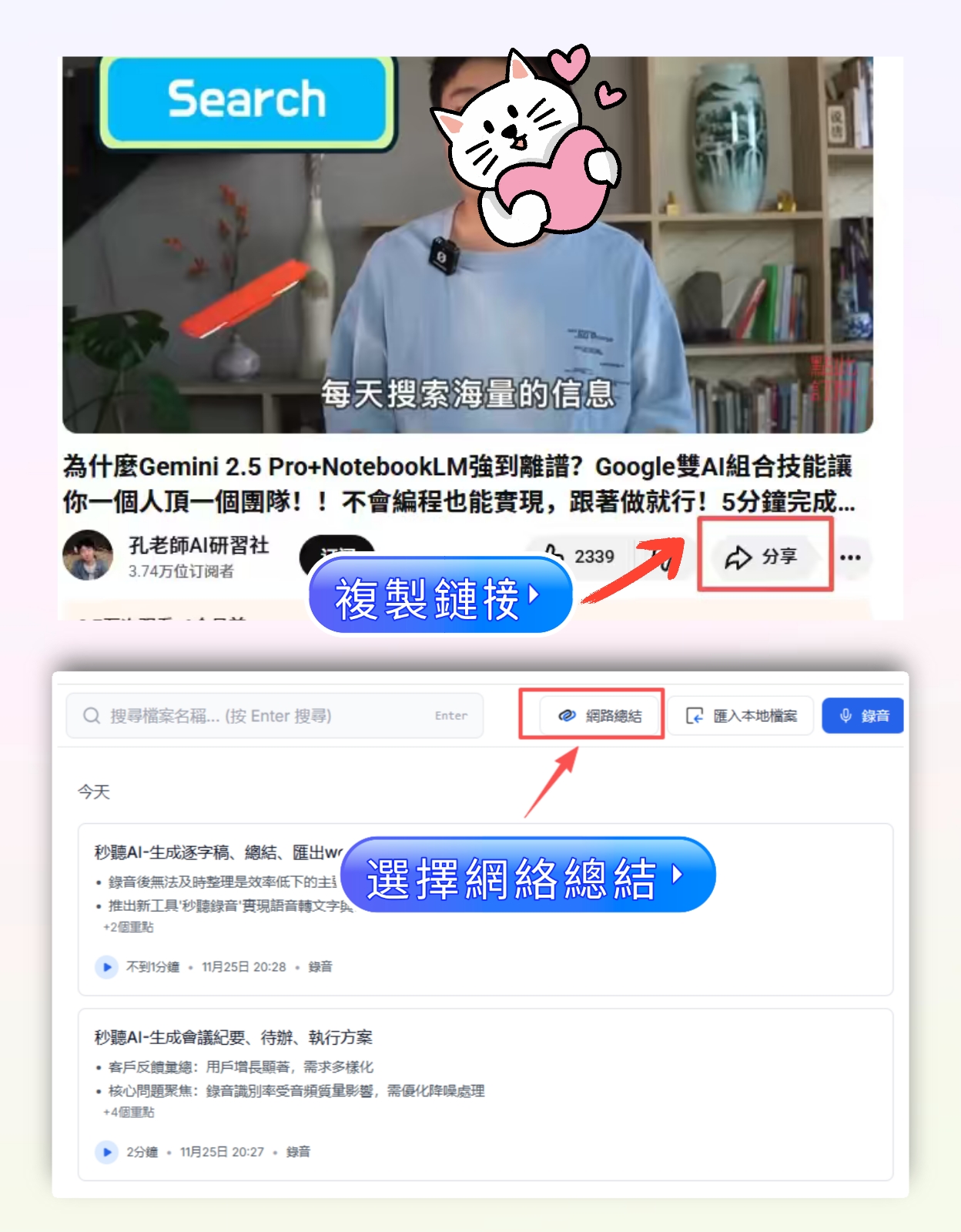
Step 1: Copy the video link
Find the video you want to process on YouTube (speech, interview, or tutorial), click "Share" and copy the link.
Step 2: Open the tool and paste
Go to the Podcast/Online Video to Text feature of Tinrec (web or app), and paste the link into the field. The system supports YouTube and various online video formats.
Step 3: Wait for AI parsing and summarization
Click start, and the system will automatically perform speech-to-text. This is done in the cloud, so you can close the window. You'll be notified within a few minutes (depending on video length) when it's done.
Step 4: View and interact
After conversion, you can:
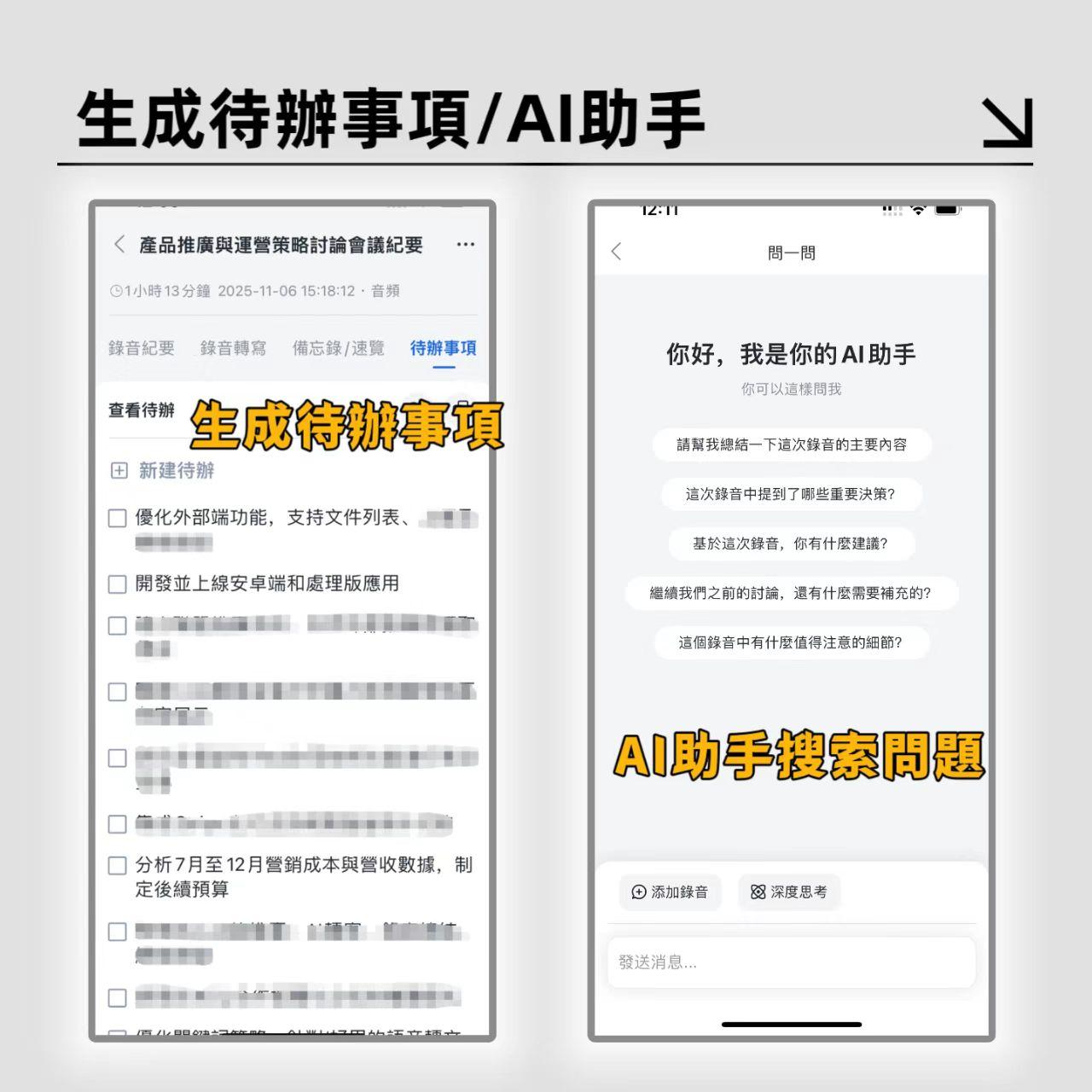
- Read the summary: Review the AI-generated key points and action items.
- Ask AI questions: Use the AI Chat Query feature to ask questions about the video content, e.g., "What are the three solutions mentioned in the video?" to quickly get answers.
- Export content: If you need subtitles or notes, export the transcript as a TXT or Word file.
Frequently Asked Questions (FAQ)
Q1: Why can some tools not convert videos without CC subtitles?
Tools like Glasp and tactiq.io primarily work by "scraping" the caption tracks provided by YouTube. Therefore, if the original video creator did not upload subtitles, these tools cannot generate content. In contrast, MacWhisper, NotebookLM, and Tinrec use "speech recognition models" to directly listen to the audio, so they can accurately produce transcripts without requiring subtitles.
Q2: If I mainly use an iPhone or Android phone, which tool do you recommend?
NotebookLM can be used via a mobile browser, but the experience is more desktop-oriented. If you need a native mobile app experience, Tinrec is a better choice. It supports both iOS and Android platforms, and data syncs automatically—ideal for taking notes while commuting or listening to podcasts/watching videos.
Q3: Can these tools export SRT subtitle files for video editing software?
MacWhisper and tactiq.io both explicitly support SRT export, making them great for editors. Tinrec focuses on notes and summaries, but it also allows exporting text content, which can then be converted into subtitle format.
Q4: For mixed-language videos (e.g., Chinese and English), which tool has the best recognition?
MacWhisper (Pro version) and Tinrec both have strong multilingual recognition capabilities. Tinrec specifically emphasizes support for Chinese, English, Japanese, Korean, and even Taiwanese and Cantonese, making it quite user-friendly for Asian users.
Q5: What is the use of the AI Chat Query feature?
Traditional transcripts only let you search for keywords with Ctrl+F across tens of thousands of words. Tools with AI Chat Query (like Tinrec) allow you to ask questions in natural language. For example, with a 2-hour interview, you can ask: "What is the interviewee's opinion on AI development?" and the system will summarize relevant passages to answer you—like asking a person instead of searching a document.
Q6: Do I need to pay for these tools?
- NotebookLM & Glasp: Currently mostly free.
- MacWhisper: Has a free version, but advanced models require a paid Pro upgrade.
- Tinrec: Offers a free trial (100 minutes per month). If you have heavy usage, you can subscribe to Basic or Pro plans, suitable for professionals who need long-term stable service.
Turn every recording into actionable outcomes
Get 60 free transcription minutes when you sign in. No credit card required.
Related Reading
You might also like

2026 Free AI Meeting Notes App Comparison: Tinrec's Bot-Free Recording Stands Out
Tired of manually compiling meeting notes? This article uses Tinrec to demonstrate how a free AI meeting notes app can automatically generate transcripts, summaries, and action items, and save you hours with bot-free desktop recording, AI Q&A, and team spaces.

Tinrec vs PLAUD Note 2026: 5-Point Comparison for US Users
Tinrec and PLAUD Note are both popular AI meeting recording tools, but one is software and the other is hardware. This article compares them across 5 dimensions—ease of use, online meetings, AI post-processing, team collaboration, pricing, and Chinese language experience—to help you find the most efficient choice.

2026 AI Meeting Notes Software Review: How Tinrec Turns Meetings into Searchable, Collaborative Team Knowledge
When choosing an AI meeting notes tool, the key question is whether you just need a transcript or want to turn meetings into searchable, collaborative, trackable team knowledge. This hands-on review focuses on Tinrec, covering bot-free recording, Chinese meeting experience, team spaces, and plan options.
5 Best AI Meeting Recorder Apps in 2026: Which Free Plan Is Worth It?
We tested 5 AI meeting recorder apps in 2026—Tinrec, Notta, Vocol.ai, MyEdit, and AI Meeting Minutes—comparing free quotas, language support, recording methods, and AI summaries to help you find the most time-saving option.

2026 Hands-On Comparison of 3 Smart Meeting Minutes Scenarios: How Tinrec Helps You Wrap Up Meetings in 5 Minutes
Always missing key points during meetings? This article uses Tinrec as an example to test three scenarios—online meetings, in-person recordings, and historical audio files—and shows how AI can automatically generate transcripts, summaries, and action items, turning meeting minutes into a searchable digital asset for your team.

2026 Smart Meeting Notes Tools Compared: Tinrec vs Plaud Note – Which Is Worth Buying?
This article compares Tinrec and Plaud Note, two smart meeting notes tools, across six dimensions: hardware dependency, online meetings, Chinese recognition, AI features, team collaboration, and long-term cost, to help you decide which is more suitable for users in Taiwan.

2026 Smart Meeting Minutes Software: AI Summaries + Automatic To-Dos Tested
A mid-level manager tests 2026 smart meeting minutes software: from buying tips, in-depth Tinrec review to competitor comparison, helping you avoid pitfalls and find an AI tool that truly saves post-meeting time.

2026 Tinrec AI Meeting Minutes: Record Online Meetings Without Bots + AI Summaries and Action Items in One Go
Hands-on review of Tinrec, an online smart meeting minutes tool that not only transcribes meetings but also auto-generates summaries, action items, and AI Q&A. This guide covers how to choose and use it, avoiding common pitfalls—a must-read for managers of small and mid-sized teams.

2026 Showdown: 'The Illustrated Guide to an Efficient Life' vs 'The Art of Problem Decomposition' — A 5-Dimension Comparison to Find the Best Book for Learning AI Meeting Notes
A senior student's hands-on review: Which book is most effective for mastering AI-powered meeting notes? This article compares two popular titles and shows you how to pair them with the AI tool Tinrec to put the methods into practice, saving you time and trial-and-error.