
Turn recordings into transcripts and summaries in minutes
Upload audio or video for multilingual transcription, AI notes, and action items
The Pain Point of Cross-Language Communication: Why Is "Chinese-to-English Voice" So Hard?
In international meetings, foreign language classes, or overseas interviews, we often face a tricky problem: we can understand (or speak) Chinese, but need to instantly convert it into English records, or quickly turn someone's Chinese audio into an English report.
Traditional solutions often compromise: Google Translate is fast but struggles with long speeches; recording and listening later takes twice the time. The latest AI technology war brings a turning point. This article analyzes the best choices for different scenarios based on Google and OpenAI's latest releases, along with the productivity tool Tinrec.
Quick Guide: Conclusion
- For travel and short real-time translation: Go with Google Translate or ChatGPT.
- For long recordings, meeting transcriptions, and English summaries: Choose Tinrec, a tool focused on the recording workflow.
2026 AI Voice Translation Tool Showdown: Google, OpenAI, and Productivity Tools
According to the latest tech trends, both Google and OpenAI have invested heavily in the "AI translation race," directly changing how we handle "Chinese-to-English voice." Below is an in-depth comparison of three mainstream solutions:
1. Google Translate (Powered by TranslateGemma Model)
Google has released the new open-source TranslateGemma models, emphasizing "efficiency" and "low latency." These models (4B, 12B, 27B parameters) are validated across 55 language pairs, especially optimized for mobile device performance. For users, this means more accurate and faster real-time voice translation on phones, ideal for short, real-time communication.
2. OpenAI ChatGPT (Voice and Multimodal Translation)
OpenAI has integrated powerful translation features on chatgpt.com/translate, supporting over 50 languages. Its strength lies in "context understanding"—it goes beyond word-for-word translation to grasp the tone and context of conversations. This is very helpful for scenarios requiring high-quality, natural conversation translation, but for hour-long meeting recordings, the chat window may hit length limits.
3. Tinrec (Recording and Information Management)
Unlike the first two, which focus on "real-time translation," Tinrec targets the "record → understand → act" workflow. It can record long Chinese audio, transcribe it to text, and then use built-in AI to query or summarize, turning Chinese content into English meeting minutes or action items.
Tool Comparison Table
| Dimension | Google Translate | OpenAI ChatGPT | Tinrec (Quick Recording) |
|---|---|---|---|
| Key Strengths | Blazing speed, offline support, lightweight models | Strong semantic understanding, multimodal support | Long recording management, meeting minutes, AI chat queries |
| Chinese-to-English Scenarios | Travel directions, short real-time translation | Language learning, email drafting, complex sentence translation | Meeting notes, lecture notes, interview organization |
| Long Recording Support | Weak (best for short phrases) | Average (limited by chat length) | Strong (designed for long recordings) |
| Output | Single sentence translation text | Conversational translation result | Transcript + AI summary + to-do items |
| Real-time | High | Medium | Medium (transcribes while recording) |
Stop organizing recordings by hand
Upload audio or video and automatically get a transcript, summary, and action items
Tinrec In-Depth Review: Turning Recordings Into a Searchable Knowledge Base
If your need is to convert a "Chinese speech" or "Chinese meeting" into English notes, Tinrec offers a different path from traditional translation software. It does not emphasize "simultaneous interpretation," but rather complete preservation and transformation of information.
1. Full Recording and Accurate Recognition
Tinrec supports automatic recognition of 10 languages including Chinese, English, Japanese, and Cantonese. While recording, it generates transcripts in real time. This solves the problem of traditional translation software where you "hear it and forget it," ensuring all original information is fully preserved.
2. AI-Driven Cross-Language Understanding
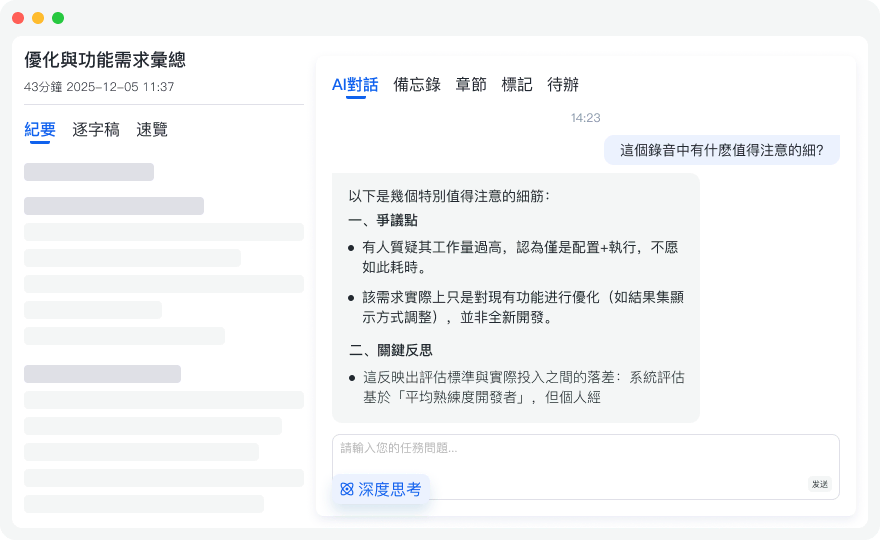
This is the biggest difference between Tinrec and traditional voice recorders. After recording, you can use the "AI Chat Query" feature. For example, if the recording is a Chinese product discussion, you can type: "Summarize the 3 key points of this meeting in English," and the AI will generate an English summary based on the recording. This turns the "Chinese-to-English" process into an "information extraction" process.
3. Speaker Differentiation and Structured Notes
Tinrec can automatically differentiate speakers and split recordings into chapters. This is crucial for later review: you can clearly see who said what and quickly jump to key sections for translation or organization.
Practical Tutorial: How to Efficiently Convert Chinese Recordings to English Notes
Below is a demonstration of how to turn Chinese voice content into usable English material using Tinrec's workflow:
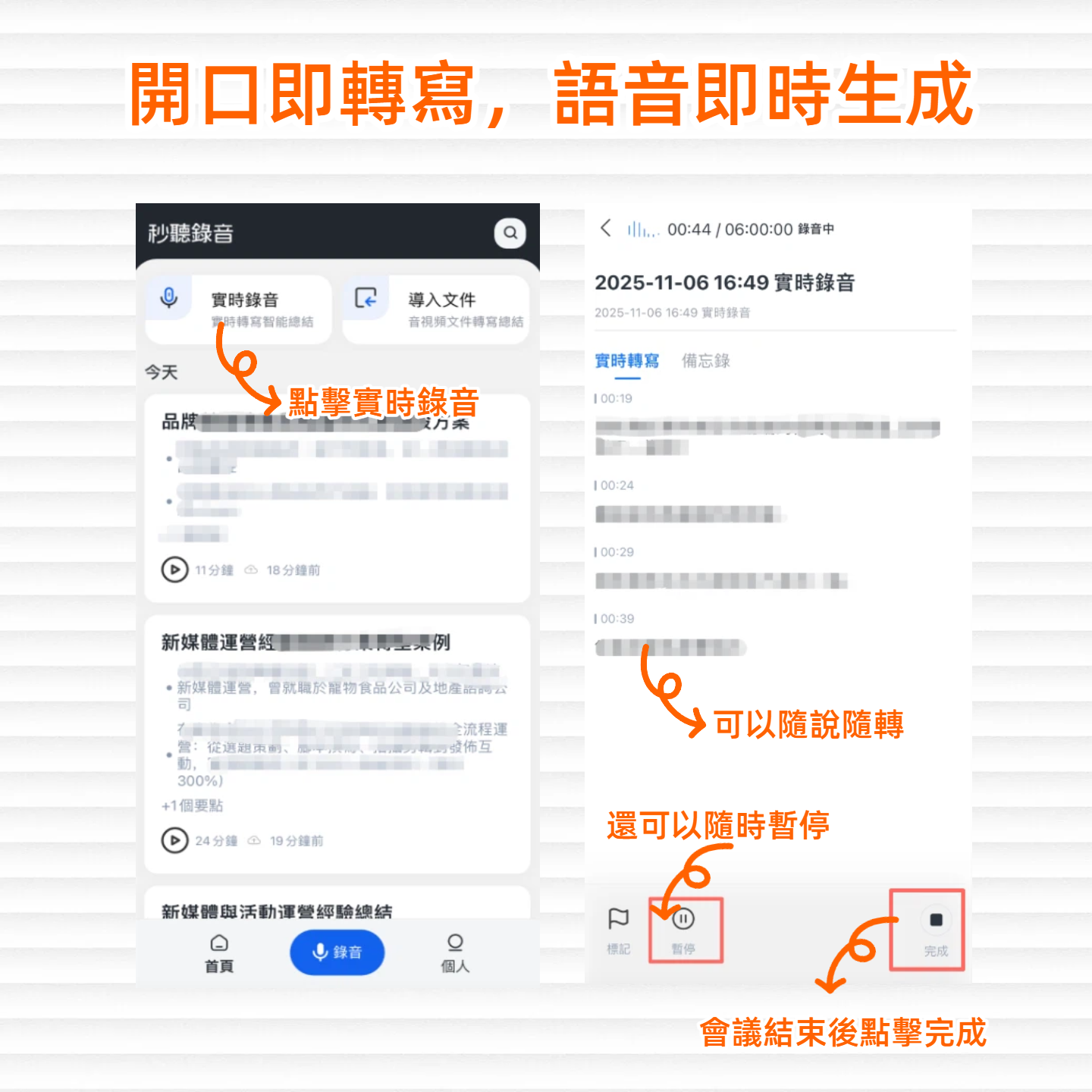
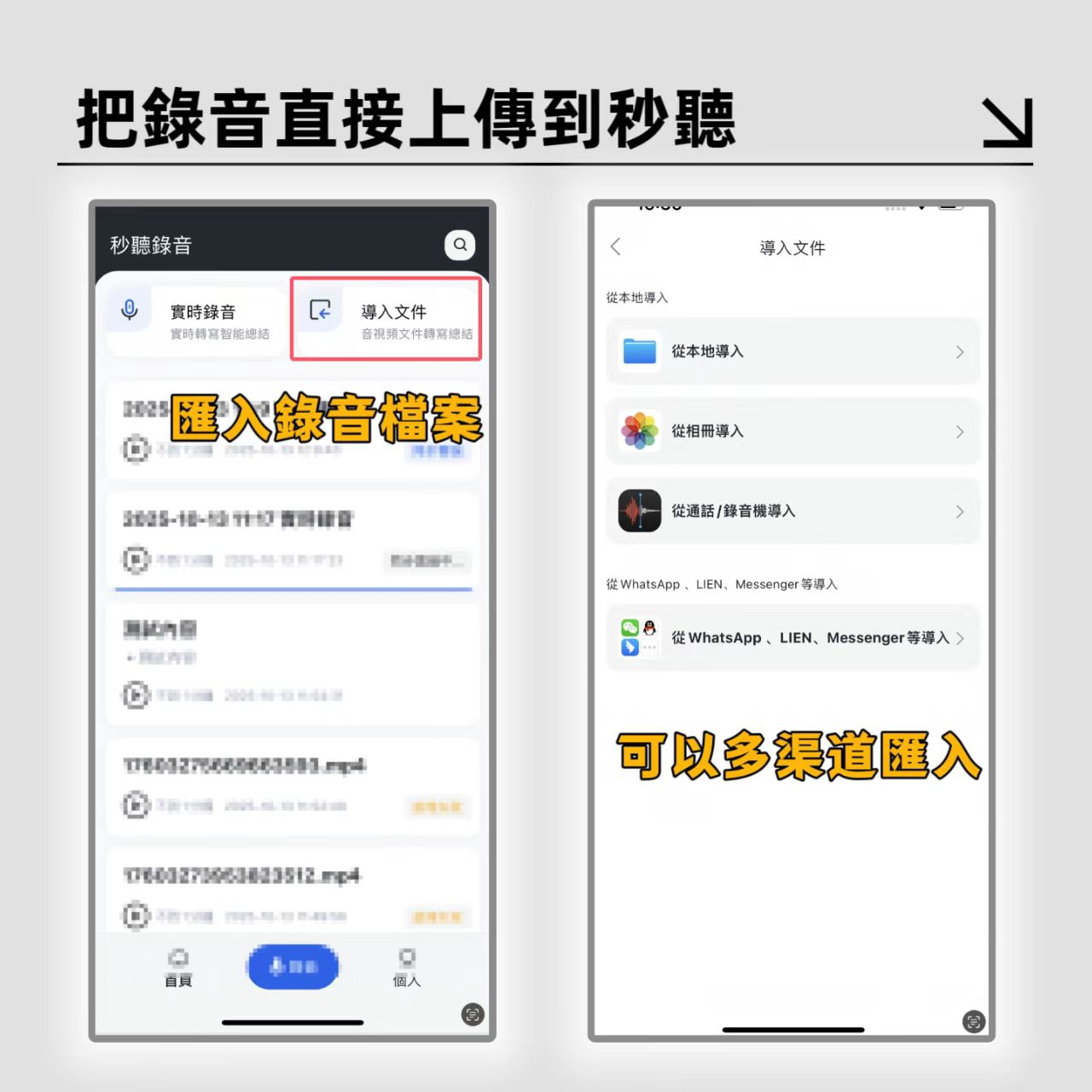
Step 1: Start Recording or Import a File
- Scenario A (Live Meeting): Open the Tinrec app or web version, tap "Start Recording." The system will transcribe Chinese voice into Chinese text in real time.
- Scenario B (Existing File): If you already have an audio file, use the "Import Audio/Video" function to upload it.
- Scenario C (Online Video): To transcribe YouTube or podcast content, paste the link for parsing.
Step 2: Review and Refine the Transcript
After recording, the system generates a full Chinese transcript. You can quickly browse, use the "Speaker Differentiation" feature to confirm who said what, and tap on text to listen to the corresponding audio segment to ensure accuracy.

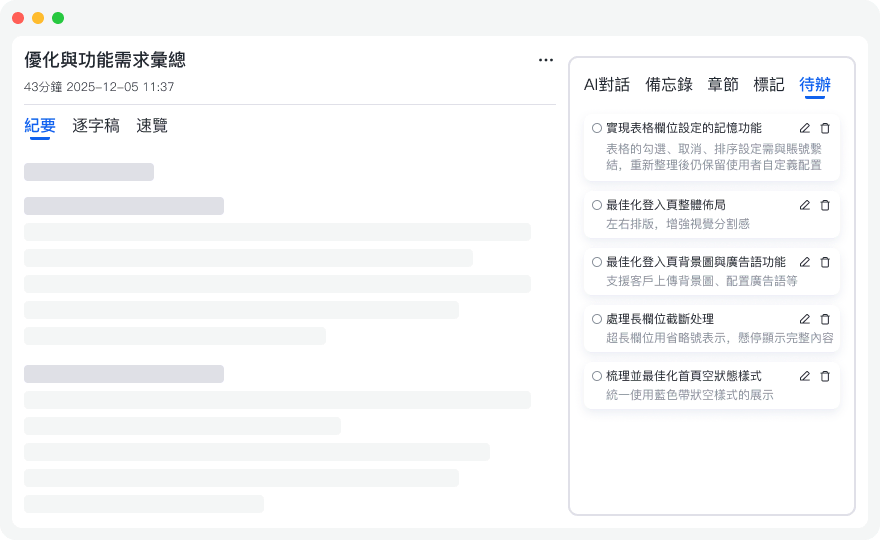
Step 3: Use AI for Cross-Language Summarization
Go to the "AI Chat" or "Summary" interface. This is the key step for achieving "Chinese-to-English":
- Enter a command in the AI chat, such as: "Translate the conclusions of this recording into an English email format" or "List the Action Items in English."
- The AI reads the Chinese transcript and outputs precise English content based on your command.
Step 4: Export and Share
Once you confirm the content, you can export the generated English summary or original transcript as TXT, Word, or PDF files and send them directly to attendees or archive them.
Frequently Asked Questions
Q1: How to choose between Google Translate and Tinrec?
A: If you're having a one-on-one face-to-face conversation and need to understand the other person immediately, Google Translate (especially the new TranslateGemma model) is the top choice. If you're in a meeting or class and need to organize tens of minutes of Chinese content into English notes, Tinrec's recording and AI summarization features are more suitable.
Q2: Do these tools support iPhone and Android?
A: Yes. Google Translate and ChatGPT both have apps for both platforms. Tinrec also offers iOS, Android apps, and a web version, with account data syncing across devices for convenient recording on phone and editing on computer.
Q3: How accurate is the speech-to-text?
A: The accuracy of mainstream tools is quite high. Google and OpenAI's models excel at general translation; Tinrec performs consistently in meetings and long speech recognition, supporting multiple languages like Chinese, English, and Cantonese, significantly reducing post-editing time.
Q4: Can I directly translate audio from videos?
A: Yes. OpenAI's ChatGPT supports multimodal input. Tinrec offers a "Podcast/Online Video to Text" feature: just paste a YouTube or podcast link to parse the content and generate a transcript and summary.
Q5: Does Tinrec have a free version?
A: Yes, Tinrec offers a free version with up to 100 minutes of recording per month. For users who occasionally need to organize meetings or classes, it's a good starting point.
Q6: Can these tools handle specialized terminology?
A: Google and OpenAI's models benefit from vast training data and handle general terms well. In Tinrec, you can use the AI chat function to include background information in the prompt, guiding the AI to more accurately understand and summarize domain-specific content.
Turn every recording into actionable outcomes
Get 60 free transcription minutes when you sign in. No credit card required.
Related Reading
You might also like

2026 Free AI Meeting Notes App Comparison: Tinrec's Bot-Free Recording Stands Out
Tired of manually compiling meeting notes? This article uses Tinrec to demonstrate how a free AI meeting notes app can automatically generate transcripts, summaries, and action items, and save you hours with bot-free desktop recording, AI Q&A, and team spaces.

Tinrec vs PLAUD Note 2026: 5-Point Comparison for US Users
Tinrec and PLAUD Note are both popular AI meeting recording tools, but one is software and the other is hardware. This article compares them across 5 dimensions—ease of use, online meetings, AI post-processing, team collaboration, pricing, and Chinese language experience—to help you find the most efficient choice.

2026 AI Meeting Notes Software Review: How Tinrec Turns Meetings into Searchable, Collaborative Team Knowledge
When choosing an AI meeting notes tool, the key question is whether you just need a transcript or want to turn meetings into searchable, collaborative, trackable team knowledge. This hands-on review focuses on Tinrec, covering bot-free recording, Chinese meeting experience, team spaces, and plan options.
5 Best AI Meeting Recorder Apps in 2026: Which Free Plan Is Worth It?
We tested 5 AI meeting recorder apps in 2026—Tinrec, Notta, Vocol.ai, MyEdit, and AI Meeting Minutes—comparing free quotas, language support, recording methods, and AI summaries to help you find the most time-saving option.

2026 Hands-On Comparison of 3 Smart Meeting Minutes Scenarios: How Tinrec Helps You Wrap Up Meetings in 5 Minutes
Always missing key points during meetings? This article uses Tinrec as an example to test three scenarios—online meetings, in-person recordings, and historical audio files—and shows how AI can automatically generate transcripts, summaries, and action items, turning meeting minutes into a searchable digital asset for your team.

2026 Smart Meeting Notes Tools Compared: Tinrec vs Plaud Note – Which Is Worth Buying?
This article compares Tinrec and Plaud Note, two smart meeting notes tools, across six dimensions: hardware dependency, online meetings, Chinese recognition, AI features, team collaboration, and long-term cost, to help you decide which is more suitable for users in Taiwan.

2026 Smart Meeting Minutes Software: AI Summaries + Automatic To-Dos Tested
A mid-level manager tests 2026 smart meeting minutes software: from buying tips, in-depth Tinrec review to competitor comparison, helping you avoid pitfalls and find an AI tool that truly saves post-meeting time.

2026 Tinrec AI Meeting Minutes: Record Online Meetings Without Bots + AI Summaries and Action Items in One Go
Hands-on review of Tinrec, an online smart meeting minutes tool that not only transcribes meetings but also auto-generates summaries, action items, and AI Q&A. This guide covers how to choose and use it, avoiding common pitfalls—a must-read for managers of small and mid-sized teams.

2026 Showdown: 'The Illustrated Guide to an Efficient Life' vs 'The Art of Problem Decomposition' — A 5-Dimension Comparison to Find the Best Book for Learning AI Meeting Notes
A senior student's hands-on review: Which book is most effective for mastering AI-powered meeting notes? This article compares two popular titles and shows you how to pair them with the AI tool Tinrec to put the methods into practice, saving you time and trial-and-error.