
Turn recordings into transcripts and summaries in minutes
Upload audio or video for multilingual transcription, AI notes, and action items
Have you ever struggled to transcribe meetings or interviews filled with "Taiwan Mandarin," Taiwanese dialect, or even Chinglish code-switching? Mainstream tools often fail to recognize localized accents, producing error-ridden text or being completely unusable.
This article reviews two tools that effectively solve this pain point: the dedicated local veteran Yating, which specializes in Taiwanese accents, and the productivity newcomer Tinrec, which focuses on AI summaries and action items after recording. Whether you need accurate Taiwanese dialect transcription or want automated to-do lists after meetings, this article provides detailed comparisons and recommendations.

Quick Navigation Conclusions:
- If you prioritize pure verbatim accuracy for Taiwanese dialect/Taiwan Mandarin → Choose Yating.
- If you value "post-meeting key takeaways," AI summaries, and cross-platform management → Try Tinrec.
Why "Taiwanese Dialect" and "Chinglish" Are a Nightmare for Voice-to-Text?
In Taiwan's workplace and academic settings, pure Chinese or English communication is rare. More often, you face these three high-difficulty scenarios, which is why most international voice-to-text tools (like Google Voice Typing or Apple's built-in dictation) often fail:
- Taiwan Mandarin & Mixed Accents: Intonation differs from standard Mandarin, leading to misinterpretation.
- Chinglish Code-Switching: For example, "This project's schedule is a bit delayed." Traditional tools usually lock onto one language, causing English words to become weird Chinese homophones.
- Taiwanese/Hokkien Interjections: Models that don't support dialects at all turn this part into gibberish or skip it entirely.
Therefore, choosing an app that "understands how Taiwanese people speak" is the first step to improving transcription efficiency.
Tool 1: Yating — A Localized Choice Designed for Taiwanese Accents
Yating is developed by Taiwan AILabs, claiming to be "100% Made In Taiwan," and is one of the few tools deeply optimized for Taiwanese accents.
Key Features
- Strong Localized Recognition: Officially supports Taiwan Mandarin, Taiwanese, Cantonese, and even Chinglish code-switching. This is its biggest moat.
- Privacy Focus: Emphasizes that data is not sold to third-party advertisers, and users can exercise the right to be forgotten. This is a big advantage for lawyers, psychologists, and others handling sensitive interview data.
- Cross-Platform: Besides iOS app, also offers a web version and Chrome extension, convenient for Google Meet remote teaching.
Use Cases & Limitations
Yating is ideal for users who need "verbatim accuracy," such as graduate students (interview transcripts), lawyers (court evidence), and people with hearing impairments (real-time captions). However, user feedback indicates that its "speaker separation" feature in multi-person meetings sometimes errors, and editing one speaker's name may affect others, limiting editing flexibility. Also, long audio files may take a while to transcribe.
Tool 2: Tinrec (MiaoTing) — AI Productivity Assistant from Recording to Action
If you need not just "turning audio into text" but also "turning content into decisions," then Tinrec offers a different solution. It supports Taiwanese dialect recognition and emphasizes a complete workflow of "Record → Understand → Act."
Key Features
- Multi-language & Dialect Support: Supports 10 languages including Chinese, English, Japanese, Korean, German, Taiwanese, Cantonese, etc. Suitable for cross-border or multilingual environments.
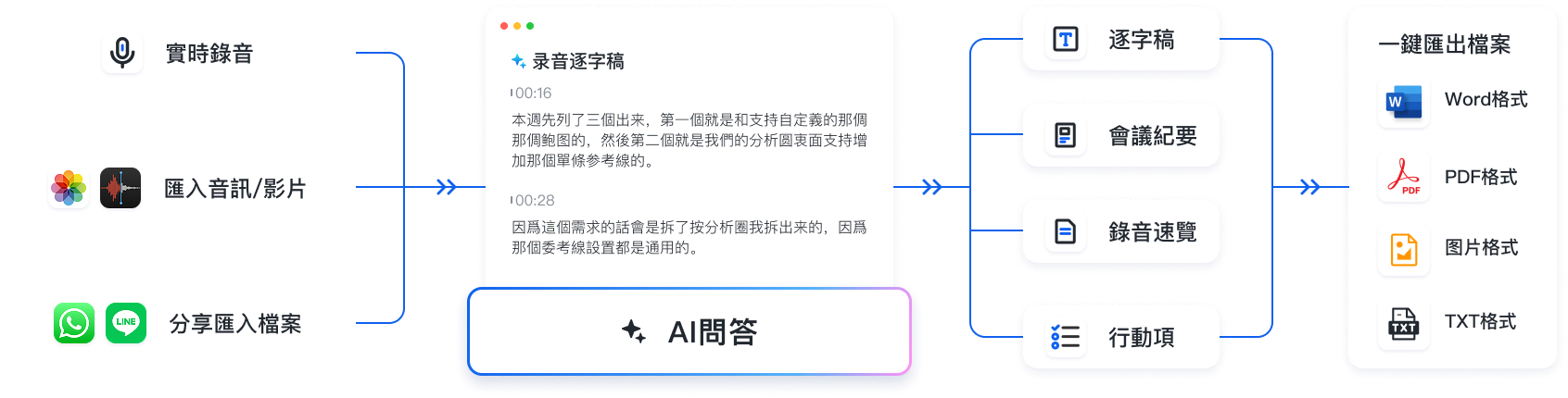
- AI Smart Summaries & Chat: This is Tinrec's biggest differentiator. It not only provides a transcript but also automatically generates "meeting minutes" and "action items." You can even use the AI chat feature to ask directly, "What was the final budget cap decided in this meeting?" saving you from replaying the audio.
- Diverse Inputs: Besides live recording, it supports uploading audio files, and even pasting YouTube/Podcast links to convert into text notes.
Stop organizing recordings by hand
Upload audio or video and automatically get a transcript, summary, and action items
Use Cases
Tinrec is particularly suitable for business professionals, project managers, and content creators. When a meeting ends, you don't have to stare at tens of thousands of words in a transcript; instead, you check the AI-generated highlights and next steps.
Deep Comparison: Yating vs. Tinrec Feature Comparison Table
To help you decide, here is a comparison of key dimensions:
| Dimension | Yating | Tinrec (MiaoTing) |
|---|---|---|
| Core Positioning | Taiwan-localized speech recognition expert | AI meeting productivity & knowledge management assistant |
| Language Support | Strengths: Taiwan Mandarin, Taiwanese, Chinglish | Multilingual: Taiwanese, Chinese/English/Japanese/Korean/German, etc. 10 languages |
| AI Intelligence | Basic speech-to-text, speaker diarization | AI key summaries, action item extraction, AI chat queries |
| Input Sources | App recording, web upload | App recording, file upload, video links (YouTube/Podcast) |
| Output Format | Pure transcript (with timestamps) | Transcript + structured notes (conclusions/action items) |
| Free Tier | Free app download (some advanced features require contact) | 100 minutes free transcription per month |
| Cross-Platform | iOS, Web, Chrome extension | iOS, Android, Web |
Practical Tutorial: How to Use AI Tools for Audio Transcription & Summarization
Below is a demonstration of using an AI-analysis tool (using Tinrec as an example) to process a meeting recording containing Taiwanese dialect or multiple languages, turning audio into actionable notes.

Step 1: Start Recording & Select Language
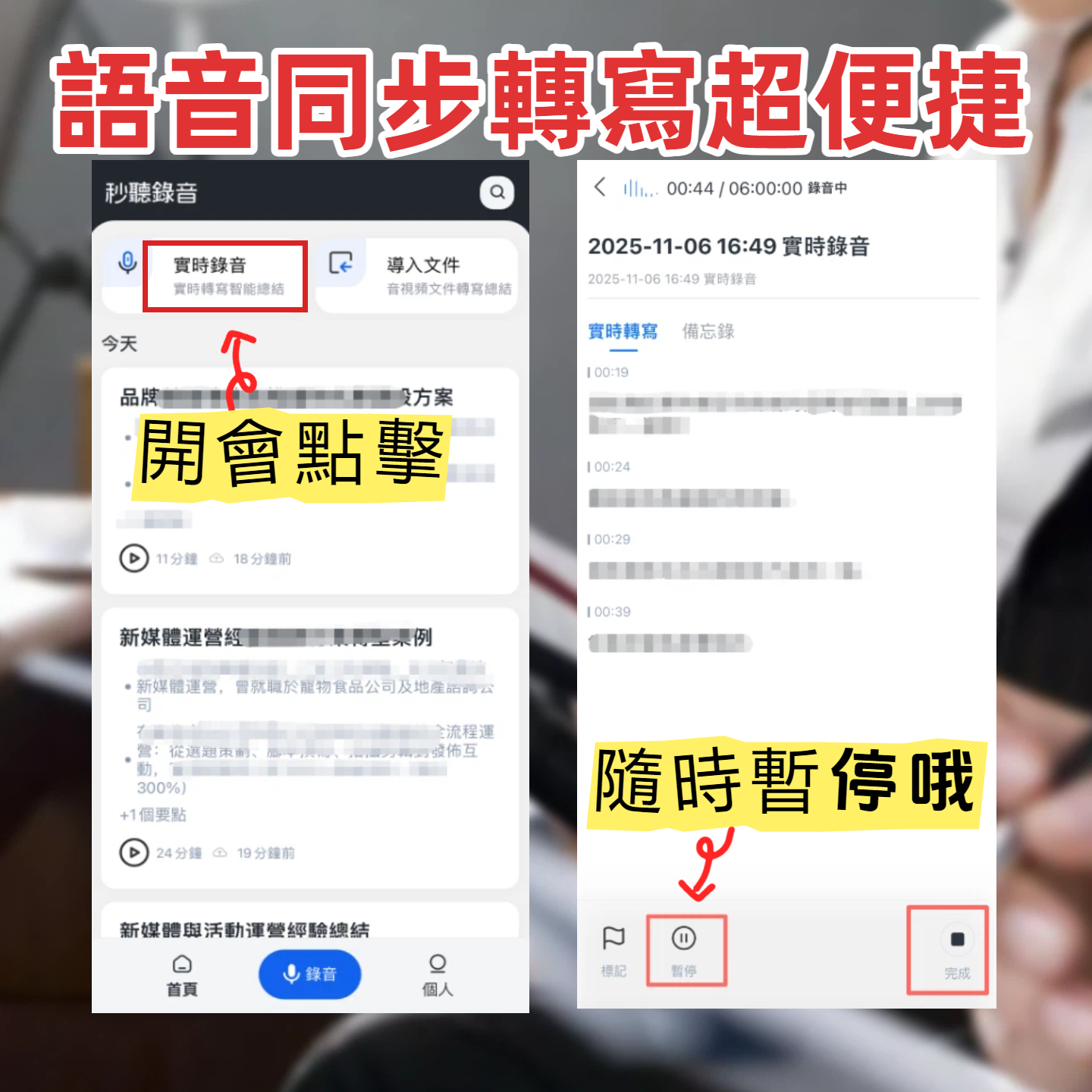
Open the app and select "Live Recording to Text." Before starting, ensure the language setting covers the primary languages you expect (e.g., Chinese or Taiwanese) to maximize accuracy.
Step 2: Record or Import Audio
- Live Meeting: Tap the microphone icon to start recording. You'll see text appear in real time. Pause when there are slide changes or breaks.
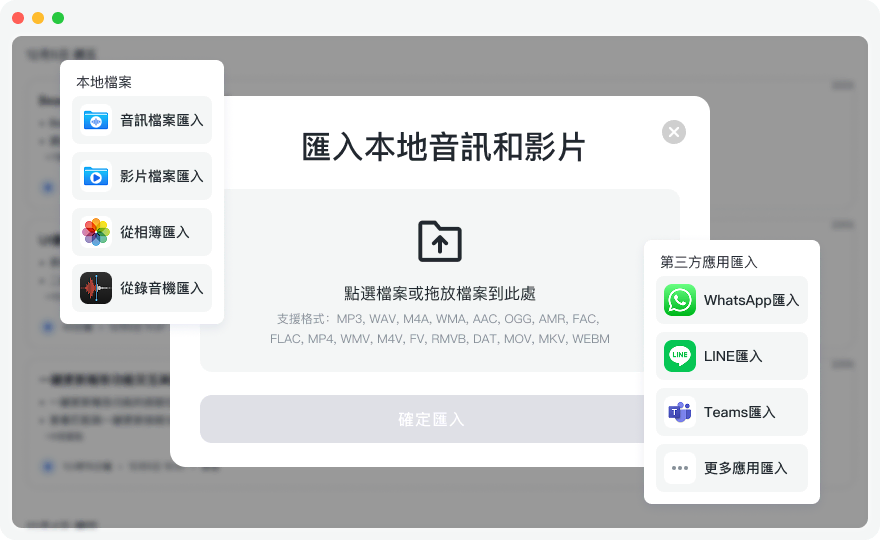
- Existing File: If you have a file from a voice recorder, use the "Audio File to Text" function to upload.
- Online Content: To transcribe a Taiwanese dialect speech or podcast from YouTube, use the "Podcast/Online Video to Text" function and paste the link.
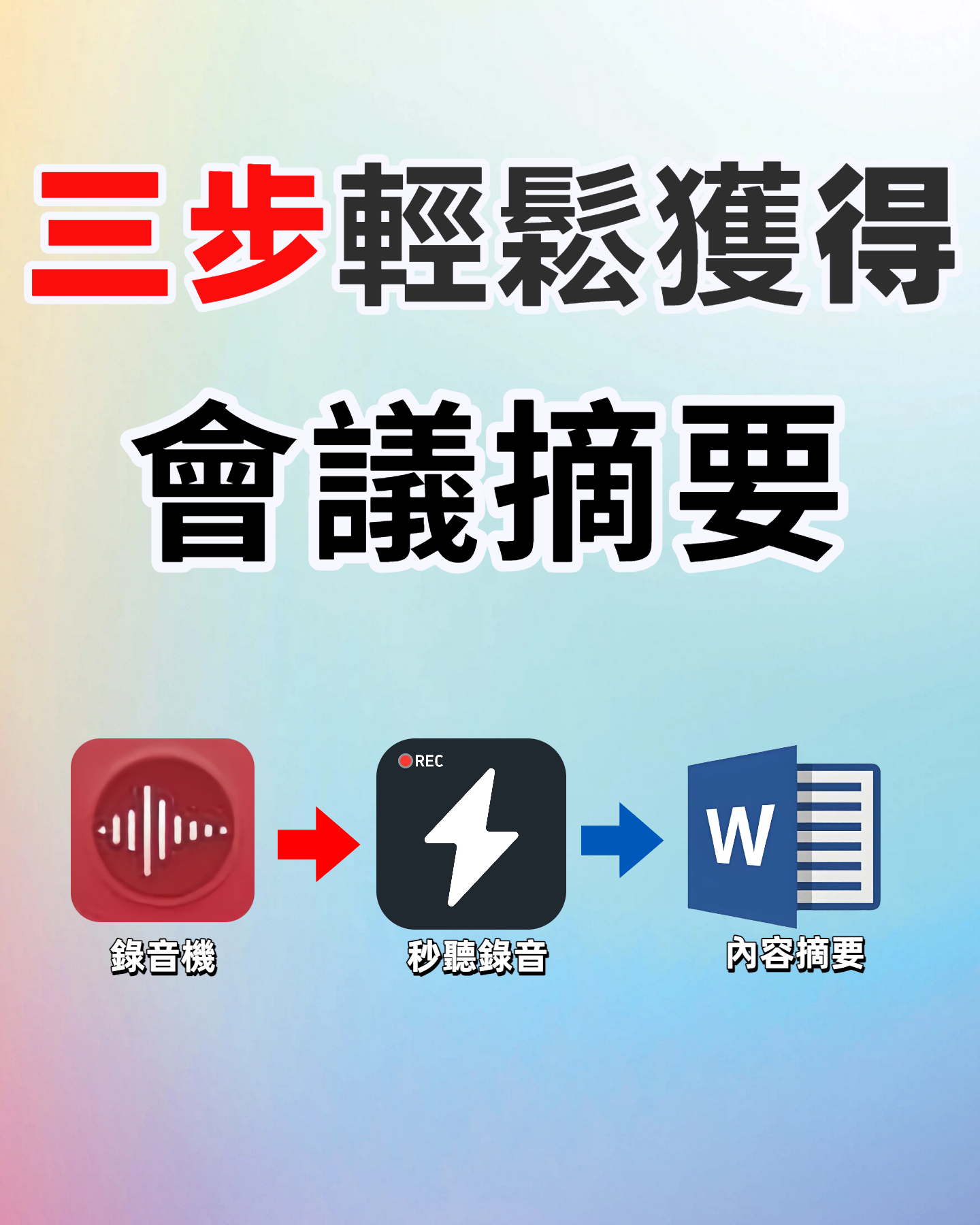
Step 3: View AI Summary & Action Items
After recording ends, the system automatically processes transcription. Don't just look at the transcript; click the "AI Summary" tab. You'll see:
- Meeting Summary: Quickly understand the key discussion points.
- To-Do Items: AI automatically extracts commands like "Submit the report by next Wednesday."
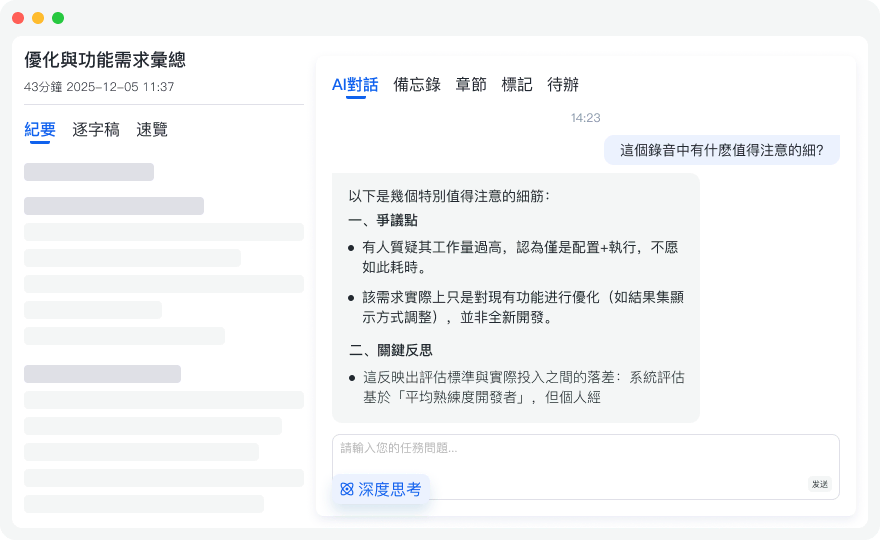
Step 4: Use AI Chat for Details
If you forget a detail (e.g., "How much did Manager Wang say to cut the budget?"), don't re-listen to the hour-long recording. Simply type your question in the "AI Chat" box; the system answers based on the recording and provides timestamps.
Frequently Asked Questions
Q1: Is there a time limit for recording on iPhone with these tools?
Generally, Yating and Tinrec's app recording is limited mainly by phone storage and battery; the software itself usually has no hard limit on single recording length. However, for long meetings (over 2 hours), it's recommended to record in segments for file safety. Tinrec's free version has a 100-minute monthly limit.
Q2: Does noisy environment affect Taiwanese dialect recognition accuracy?
Yes. All speech recognition engines depend on clear audio. In noisy settings, use a directional microphone or keep the phone close to the speaker. Yating and Tinrec have noise reduction algorithms, but physical recording quality is key.
Q3: Can these tools record Google Meet or Teams meetings?
Yes. Yating offers a Chrome extension for web recording; Tinrec suggests using the web version or placing the phone near the computer speaker (if internal recording isn't available), then using AI to summarize after recording.
Q4: How well does Chinglish (Chinese-English switching) recognition work?
Yating is specifically optimized for Taiwan's Chinglish and performs quite well. Tinrec supports multi-language mixed recognition and effectively captures common business English terms.
Q5: Can the transcripts be exported?
Both support export. Typically they support TXT, Word, or SRT (subtitle) formats for further editing or direct use in video subtitles.
Q6: How is audio privacy protected?
Yating emphasizes that data is not sold and users can exercise the right to be forgotten; Tinrec also values privacy, allowing users to delete accounts and data, and recording data is used only for the user's own transcription service.
Turn every recording into actionable outcomes
Get 60 free transcription minutes when you sign in. No credit card required.
Related Reading
You might also like

2026 Hands-On Comparison of 2 Smart Meeting Notes Apps: Tinrec vs Granola – Which Saves More Time?
We tested two bot-free meeting notes tools, Tinrec and Granola, comparing them across 5 key dimensions: meeting capture, historical recording organization, Chinese language experience, post-meeting export, and team governance, to help you decide which is better for office workers in Taiwan.
Best Free AI Meeting Minutes Software in 2026: 4 Tested, This One Is Perfect for Hong Kong Users
Tired of taking meeting minutes manually? We tested 4 free AI meeting minutes tools. Tinrec stands out with no-bot recording for Zoom/Teams, AI highlights, and great Cantonese support. Save your overtime hours. A must-read for Hong Kong professionals.
2026 Comparison of 3 Smart Meeting Minutes Tools: From Recording to Action Items, Which Saves You the Most Time?
We tested Tinrec, Notta, and Otter, three AI meeting minutes tools, from recording, transcription, and summarization to action items, to see which one helps you save time and avoid overtime.

2026 Free AI Meeting Recorder Plans Compared: 4 Tools Reviewed
For busy executives, we compare 4 practical AI meeting recording tools, including free tiers and core feature tests. Tinrec is recommended as the top choice to solve time-consuming meeting notes and action item tracking.
Tinrec vs Otter.ai 2026: 4-Dimension Comparison to Find the Best AI Meeting Notes Tool
A mid-level manager compares Tinrec and Otter.ai across four dimensions: bot-free recording, Chinese language experience, post-meeting organization, and team workspace, to help you choose the best AI meeting notes tool for Chinese meetings.

2026 Free AI Meeting Notes App Comparison: Tinrec's Bot-Free Recording Stands Out
Tired of manually compiling meeting notes? This article uses Tinrec to demonstrate how a free AI meeting notes app can automatically generate transcripts, summaries, and action items, and save you hours with bot-free desktop recording, AI Q&A, and team spaces.

Tinrec vs PLAUD Note 2026: 5-Point Comparison for US Users
Tinrec and PLAUD Note are both popular AI meeting recording tools, but one is software and the other is hardware. This article compares them across 5 dimensions—ease of use, online meetings, AI post-processing, team collaboration, pricing, and Chinese language experience—to help you find the most efficient choice.
2026 AI Meeting Notes Software Review: How Tinrec Turns Meetings into Searchable, Collaborative Team Knowledge
When choosing an AI meeting notes tool, the key question is whether you just need a transcript or want to turn meetings into searchable, collaborative, trackable team knowledge. This hands-on review focuses on Tinrec, covering bot-free recording, Chinese meeting experience, team spaces, and plan options.
5 Best AI Meeting Recorder Apps in 2026: Which Free Plan Is Worth It?
We tested 5 AI meeting recorder apps in 2026—Tinrec, Notta, Vocol.ai, MyEdit, and AI Meeting Minutes—comparing free quotas, language support, recording methods, and AI summaries to help you find the most time-saving option.