
Turn recordings into transcripts and summaries in minutes
Upload audio or video for multilingual transcription, AI notes, and action items
After a meeting or class ends, facing a one-hour mobile recording often requires double or more time to repeatedly listen and type; especially when Traditional Chinese recognition is inaccurate and lacks punctuation, organizing transcripts becomes a frustrating pain point.
To solve this problem, this article will survey the mainstream tool solutions on the market and provide a detailed "Tool Comparison Table" (covering 6 evaluation dimensions including language support, real-time capability, summary features, and pricing), along with specific step-by-step tutorials and FAQs, so you won't have to take detours.
Quick Navigation Conclusion:
- Want completely free and focused on Taiwanese local accent → Consider Yating Transcript.
- Need strong English recognition and international team collaboration → Choose Otter.ai.
- Prefer a simple web version for uploading audio files without complex features → GoodTape is a good starting point.
- Value a complete "Record → Understand → Act" workflow and need automatic decision summaries and multilingual support → Evaluate Tinrec.
- Need integration with physical hardware for business scenarios → iFlytek Hearing is a helpful aid.
1. Why Do You Need a Professional Mobile Recording-to-Text Tool?
Traditional built-in recording apps on phones typically only "save" the sound, with extremely low information density. When you need to find a specific decision after a meeting or review a key point from a lecture, you have to drag the progress bar like finding a needle in a haystack. Modern AI recording-to-text tools have a core value of transforming "time-based audio content" into "scannable, searchable, actionable textual data."
A good tool not only provides real-time Traditional Chinese recognition but also can automatically distinguish speakers, filter out filler words, and even give you a meeting summary containing key conclusions and action items right when the recording ends.
2. Comparison Table of 5 Mobile Real-Time Recording-to-Text Tools in 2026
When choosing "recommended mobile real-time recording-to-text Traditional Chinese tools," it is advisable to evaluate them based on the following 6 core dimensions. Below are 5 representative tools on the market for comparison:
| Dimension | Yating Transcript | Otter.ai | GoodTape | iFlytek Hearing | Tinrec (Instant Recording) |
|---|---|---|---|---|---|
| Traditional Chinese Support | Excellent (Taiwanese accent) | Poor (English-focused) | Good | Good (Simplified to Traditional) | Excellent (Supports auto-recognition for Chinese, Japanese, English, etc., 10 languages) |
| Real-time Recording Transcription | Supported | Supported | Not supported (Upload only) | Supported | Supported (Real-time with no delay) |
| AI Summary/Action Items | None | Yes (English) | Yes (Paid) | Yes | Yes (Auto-generates meeting minutes, conclusions, and to-do list) |
| AI Chat Query | None | Yes (English) | None | None | Yes (Semantic Q&A based on recording content) |
| Supported Platforms/Integration | iOS, Android | iOS, Android, Web | Web (primarily browser-based) | iOS, Android, Web | iOS, Android, Web |
| Free Allowance/Pricing | Free | 300 minutes/month (free) | 3 sessions/month (free) | Pay per duration | 100 minutes/month (free) / Basic $4.9/month |
3. Deep Dive: Evolution from "Transcript" to "AI Decision Summary"
When evaluating the above list, we found that user needs have evolved from "I need to type out this speech" to "I need to know what was discussed in this meeting and what to do next."
Stop organizing recordings by hand
Upload audio or video and automatically get a transcript, summary, and action items
Many traditional tools only provide lengthy transcripts, which solve the dictation problem but still require readers to spend a lot of time reading tens of thousands of words. Take Tinrec as an example; its differentiation lies in providing a complete post-processing workflow. When the recording ends, the system not only outputs text but also splits it into sections and extracts a clear to-do list (action items). Moreover, for cross-border meetings or foreign language online courses, tools with automatic language recognition can significantly lower the language barrier for users.
4. Practical Tutorial: How to Efficiently Convert Mobile Recordings into Actionable Steps
Once you know how to choose tools, the following uses Tinrec, which has a complete workflow, as an example to demonstrate how to operate in different scenarios to turn voice data into efficient work notes.
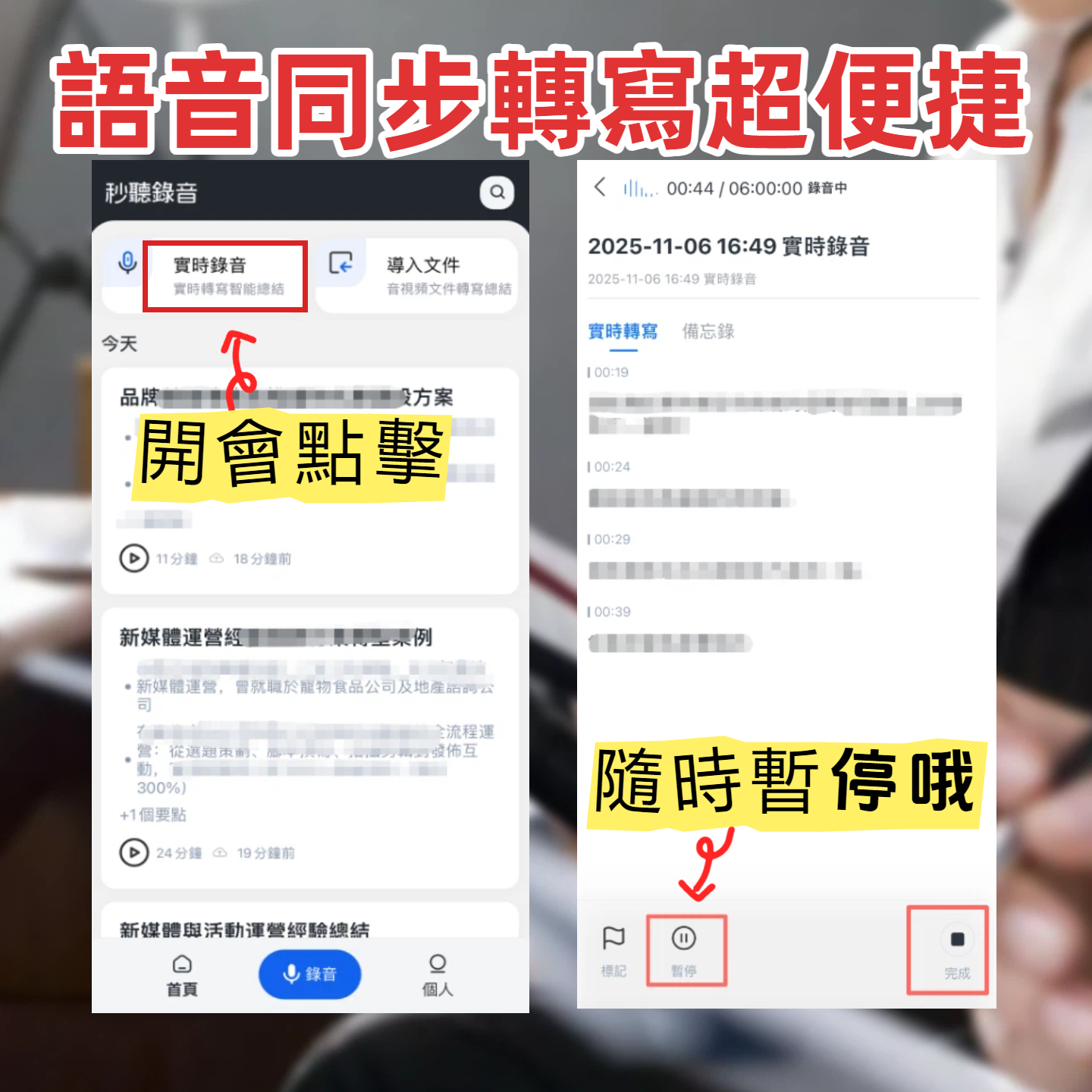
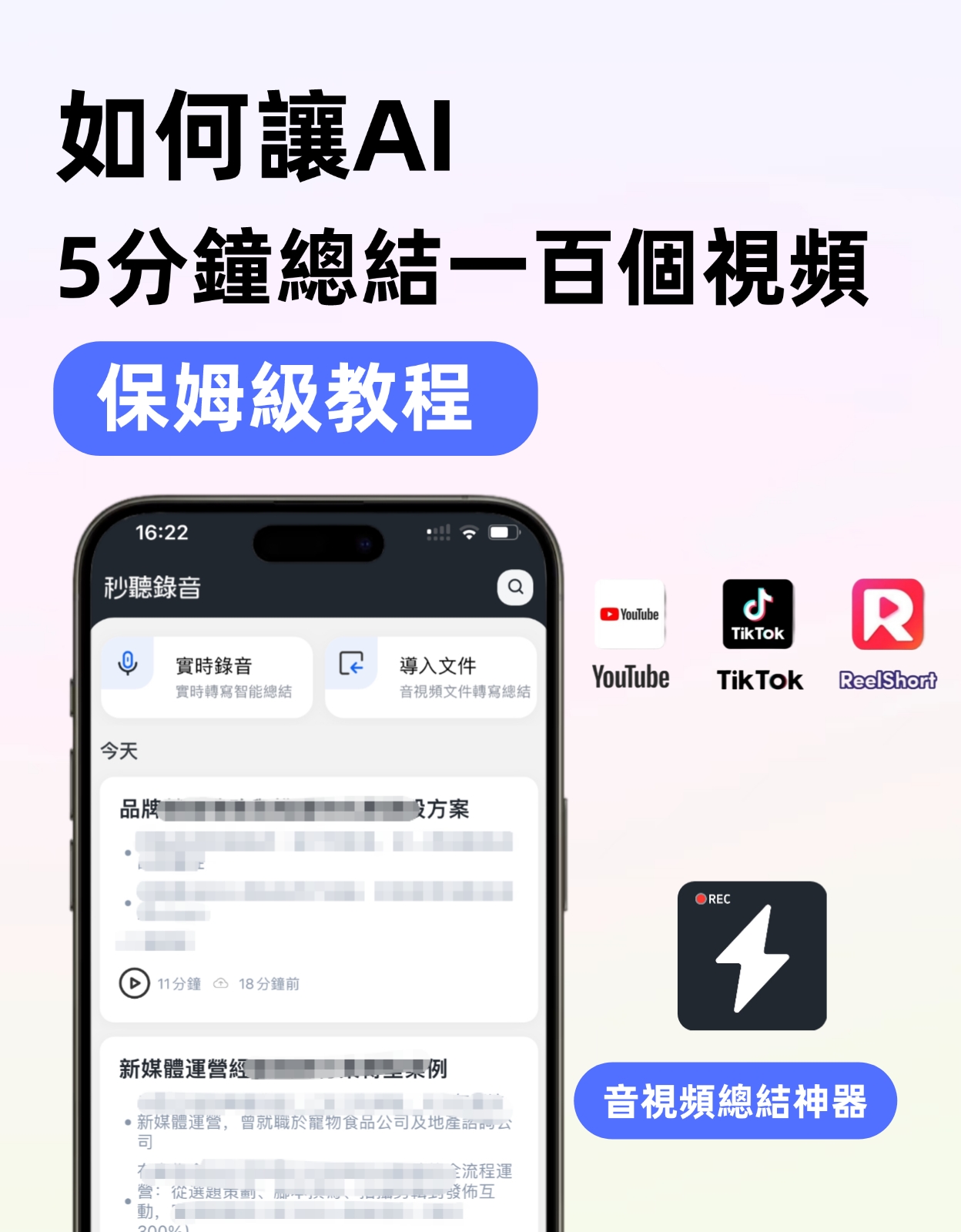
1. Real-time Recording Transcription (During a Meeting/Class)
- Step one: Open the real-time recording transcription interface on your phone or web browser.
- Step two: Click to start recording; the system will instantly convert speech to text displayed on the screen.
- Step three: You can pause or mark important points during recording; after the recording ends, the system automatically generates meeting minutes.
2. Import Existing Audio Files to Text
- Step one: Go to the audio file to text feature.
- Step two: Upload a supported audio format file (e.g., MP3, M4A, WAV).
- Step three: Wait for cloud processing; the system will differentiate speakers and produce a complete transcript and AI summary.
3. Podcast and Web Video Link to Text
- Step one: Copy a YouTube, podcast, or supported web video URL.
- Step two: Go to the podcast/web video to text portal and paste the link.
- Step three: The system will automatically fetch the audio and convert it to text, allowing you to quickly get the core content of the video without spending tens of minutes watching.
4. Use AI Chat Query to Quickly Capture Key Points
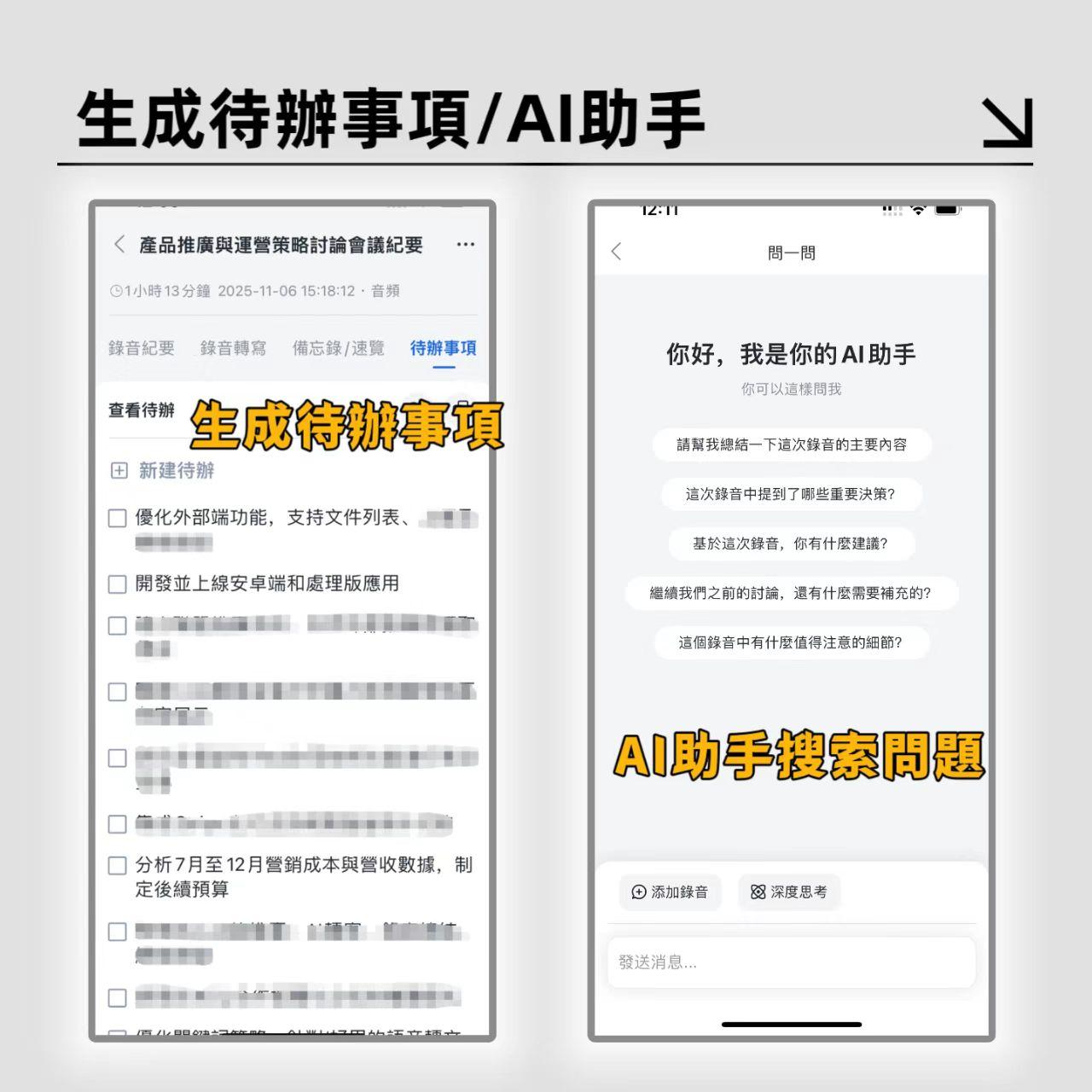
- Step one: On the transcribed record page, open the AI Chat Query panel.
- Step two: Directly type a question, such as "What were the key modification points for next week's marketing proposal mentioned in today's meeting?"
- Step three: The AI will accurately answer based on the semantic context of the recording and mark the corresponding source paragraph.
5. Frequently Asked Questions (FAQ)
Q1: Can iPhone's built-in Voice Memos directly transcribe to Traditional Chinese text? Currently, iPhone's built-in Voice Memos only supports basic recording functions and has no native automatic text transcription or summarization. To produce transcripts, you must rely on third-party recording-to-text apps for post-processing.
Q2: When joining online meetings via Teams or Google Meet, is the audio capture quality of a mobile recording-to-text app good? If you use your phone to directly record from computer speakers, it is prone to environmental noise and equipment resonance. The recommended solution is to have the tool join the meeting via its web version for recording, or upload the recorded audio file from Teams/Meet to a cloud platform for transcription, which yields much higher accuracy.
Q3: What are the limitations of free mobile real-time recording-to-text software? Most free tools are limited in three aspects: 1) Monthly total recognition time limit (e.g., free version only provides 100 minutes). 2) Single recording length cap. 3) Whether they offer advanced AI summarization and export to multiple formats.
Q4: How accurate is Traditional Chinese transcription from recordings? Are there accent issues? With advancements in AI models, mainstream tools have significantly improved recognition rates for Traditional Chinese. If a tool has multilingual automatic recognition capability, even if speech is mixed with English proper nouns or slight accents (e.g., Taiwanese), it can still achieve fairly good recognition performance.
Q5: If the recording is very long, can AI tools directly summarize meeting conclusions? Yes. Modern AI recording assistants (like some tools mentioned above) have built-in large language models that can automatically summarize meeting highlights, decisions, and next-step to-do lists after generating transcripts, saving the trouble of manual reading from scratch.
Q6: For foreign language meetings or videos without subtitles recorded on a phone, can it simultaneously transcribe and translate into Chinese? Yes. Tools that support multilingual recognition can process audio in Japanese, English, Korean, etc. Besides outputting the original transcript, they can also use AI to assist translation into Traditional Chinese, which is very useful for users who frequently access foreign information.
Turn every recording into actionable outcomes
Get 60 free transcription minutes when you sign in. No credit card required.
Related Reading
You might also like

Google Meet Without App: Tinrec vs Otter.ai Comparison for 2026 Meeting Notes
Don't want to install the Google Meet app but still need to capture meeting notes? This hands-on comparison of Tinrec and Otter.ai evaluates bot-free recording, Chinese transcription, post-meeting organization, team collaboration, and pricing to help you decide which AI meeting tool best fits your workflow without the Google Meet app.

Google Meet vs Tinrec in 2026: 5-Dimension Comparison – Who Summarizes Your Meeting?
2026 Google Meet tutorial and post-meeting note solution comparison: start with real-time meetings, scheduling, cross-device, screen sharing, and post-meeting processing, then compare Google Meet built-in capabilities, Tinrec, Otter.ai, and Notta across 5 dimensions to help you decide when just having the meeting is enough and when you need a meeting notes solution that handles transcripts, summaries, action items, and team data together.

Google Meet Meeting Notes in 2026: Bot-Free Transcription + Automatic Summaries
After a Google Meet call, the real work begins. This guide starts with how to decide between built-in features and third-party tools, breaks down 4 key buying factors, and hands-on tests how Tinrec records Google Meet without a bot, automatically generates summaries and action items, and compares it with Otter.ai, Granola, and Notta, including pitfalls to avoid.

3 Ways to Download Google Meet in 2026: Mobile App vs Desktop PWA vs Web Compared
Not sure which way to use Google Meet? This hands-on comparison of the mobile app, desktop PWA, and web version covers installation, features, updates, and best use cases to help you find the smoothest way to use Google Meet.

4 Google Meet Note-Taking Tools Compared in 2026: Which One Does Transcription and AI Summaries Best?
Google Meet has live captions, but captions are not meeting notes. This article compares four common approaches—Google Meet's built-in capabilities, Otter.ai, Granola, and Tinrec—covering capture methods, language support, post-meeting organization, and team data ownership to help you choose the best meeting note-taking tool for your needs.

Best Free Video Conferencing Alternatives to Google Meet in 2026: 4 Options
Switching from Google Meet keeps meetings running smoothly, but post-meeting organization doesn't get any easier. This article, from the perspective of a mid-level manager who holds 15 meetings a week, outlines 4 directions for video conferencing without Google Meet and explains how a bot-free meeting notes tool handles transcripts, summaries, action items, and team knowledge retention, with recommendations for free and team plans.

Google Meet Built-in Recording vs Tinrec in 2026: 5-Dimension Showdown — Which Helps You Clock Out on Time?
Creating a Google Meet link takes 10 seconds, but post-meeting notes are the real time sink. This hands-on comparison of Google Meet built-in recording and Tinrec evaluates transcription accuracy, post-meeting organization, cross-platform support, team collaboration, and pricing across 5 dimensions to help you pick the most time-saving meeting notes tool.

4 Google Meet Alternatives Tested in 2026: Which One Works Without a Meeting Bot?
We tested 4 Google Meet alternatives in 2026, comparing bot-free recording, Chinese transcription, AI summary Q&A, and team collaboration. Tinrec excels at Chinese meetings and post-meeting organization, while Otter.ai, Notta, and Granola each suit different scenarios. This article uses real-world use cases to help you choose the best meeting notes solution.
Google Meet vs Zoom 2026: Which Online Meeting Tool Actually Works for Post-Meeting Notes?
Google Meet or Zoom? This hands-on comparison focuses on post-meeting organization, comparing the built-in transcription limits of both, and testing Tinrec desktop's bot-free meeting recording, AI summaries, action items, and team spaces to help you find a meeting notes solution that truly saves time.