
Turn recordings into transcripts and summaries in minutes
Upload audio or video for multilingual transcription, AI notes, and action items
Facing Cantonese meetings filled with code-switching or hours-long dialect interviews? Generic speech recognition software often produces gibberish, turning transcript review into a time-consuming nightmare. For administrative staff, students, and content creators, choosing a tool that understands dialects is key to saving hours of manual transcription.
This article provides an in-depth review of 2026's market-leading dialect-optimized transcription tools, along with a multi-dimensional comparison table, practical steps, and FAQs. If you need ultra-precise video subtitles, consider Subanana; if you prioritize meeting efficiency and need a seamless workflow from recording to action items, Tinrec is worth evaluating; for lightweight video creators, Taption offers a convenient web-based service.
Why Cantonese Speech-to-Text Is Especially Difficult (Current Pain Points)
General speech recognition engines are mostly trained on standard Mandarin or English. When faced with Cantonese—a language with strong regional characteristics and grammatical habits—they often encounter the following pain points:
- Frequent Code-Switching: For example, in tech product launches or international corporate meetings, speakers naturally switch between Cantonese and English technical terms, causing single-language models to fail instantly.
- Gap Between Spoken and Written Language: Cantonese contains many colloquial characters (e.g., "嘅", "喺"). If the tool lacks a "spoken-to-written" conversion feature, the resulting transcript is difficult to use directly for formal meeting minutes or articles.
- Background Noise Interference: In real meeting or interview environments with poor recording conditions, generic software accuracy drops sharply.
2026 In-Depth Review of Mainstream Cantonese Speech Recognition Tools
Available tools mainly fall into two categories based on use case: "video post-production" and "productivity notes." Below is an overview based on actual test data and features:
1. Subanana: The Specialized King of Cantonese Video Subtitles
According to Subanana's official in-depth review, this tool developed by a Hong Kong team excels in Cantonese recognition. In code-switching scenarios, its accuracy reaches 97.5%; even in noisy environments, it maintains 93.4%. Its biggest advantage is supporting "spoken-to-written conversion," automatically turning Cantonese slang into fluent written Chinese—perfect for YouTubers and video creators adding subtitles.
2. Taption: A Choice for Lightweight Video Creators
Taption, an online tool from Taiwan, offers a user-friendly interface without complicated installation. Although its accuracy in Cantonese code-switching tests is about 85.3%—slightly inferior to specialized Subanana—it supports bilingual recognition and direct YouTube link import, making it a convenient alternative for video creators accustomed to Taiwanese terminology with lighter needs.
3. Premiere Pro & ArcTime: Challenges of Traditional Post-Production Software
Adobe Premiere Pro is the industry standard for professional editing, but its built-in speech recognition accuracy drops to about 75.6% for Cantonese with noise, requiring extensive manual correction. ArcTime requires purchasing credits; if you simply need a "transcript" for meeting notes rather than a "timed subtitle file," traditional post-production software has a higher learning curve.
4. Tinrec (秒聽錄音): A Productivity Dark Horse Crossing Languages
If your core need is not "creating subtitles" but "taking meeting, class, or interview notes," Tinrec (秒聽錄音) offers a workflow from recording to understanding. It covers 10 languages including Chinese, English, Taiwanese, and Cantonese, solving cross-language meeting pain points. Unlike tools that require uploading after recording, it supports real-time transcription while recording, and its built-in AI automatically generates summaries and action items, helping you skip re-reading lengthy transcripts.
Cantonese Speech-to-Text Comparison Table: How to Choose?
To simplify decision-making, here is a comparison table across 5 core dimensions to help you quickly find the right tool:
Stop organizing recordings by hand
Upload audio or video and automatically get a transcript, summary, and action items
| Dimension | Subanana | Tinrec (秒聽錄音) | Taption | Premiere Pro |
|---|---|---|---|---|
| Key Strength | Cantonese subtitles, spoken-to-written conversion | Meeting notes, multi-language/dialect support, AI chat | Video subtitles, Taiwan-based team | Professional video editing & timeline integration |
| Real-Time Transcription | No (requires file upload) | Yes (record & transcribe simultaneously) | No (requires file upload) | No (analysis after recording) |
| Language Support | Cantonese-optimized (high accuracy) | 10 languages including Cantonese, Taiwanese | Traditional Chinese, English | Multiple languages (weaker dialect noise resistance) |
| AI Summary/Action Items | No | Yes (auto-generate meeting minutes & to-do) | No | No |
| Best For | YouTubers needing professional subtitles | Meetings, classes, interview organization, work notes | Short video subtitle creation | Professional film post-production workflows |
| Pricing & Free Tier | Basic free plan available | Free version (up to 100 minutes/month) | Pay per minute | Requires Adobe subscription |
Hands-On Tutorial: How to Efficiently Process Dialect Meetings & Interviews with AI
In the past, dealing with long Cantonese recordings meant pausing and manually transcribing. Now, AI tools can greatly shorten the process. Using Tinrec as an example, here are 4 key steps from recording input to extracting key points:
Step 1: Choose the Right Recording Input Method
Select the appropriate audio import method based on your situation:
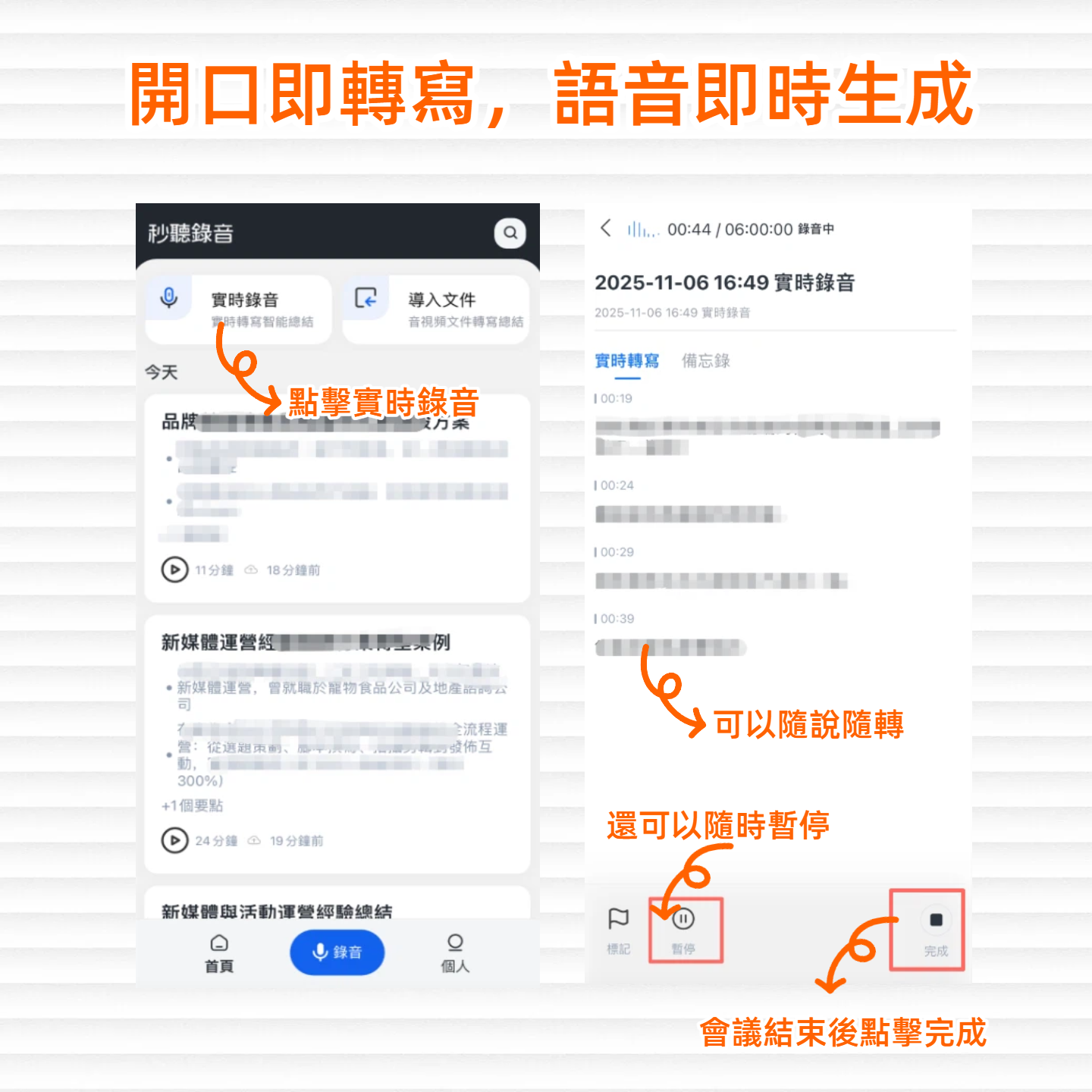
- Real-Time Recording to Text: For ongoing in-person meetings or classes, open the mobile or web version and tap this function. The system will generate a live transcript as it records, allowing you to mark key points on the fly.
- Audio Files: If you have existing recordings from a voice recorder or iPhone Voice Memos, use the audio file upload feature. It supports batch import of common formats like mp3, m4a, wav.
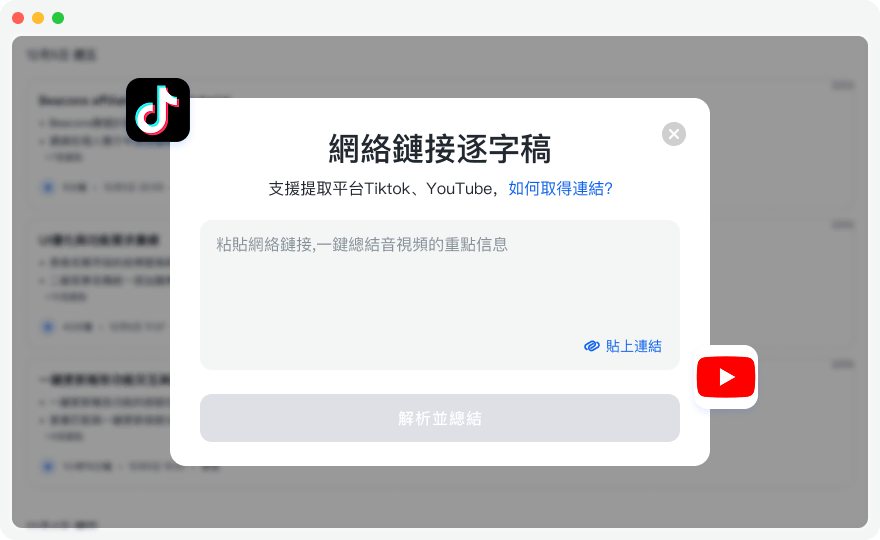
- Video Links: To transcribe Cantonese interviews or podcasts on YouTube, no download needed—just paste the link into the "Podcast/Online Video to Text" feature for cloud parsing.
Step 2: Confirm Language Settings (Ensure Dialect Accuracy)
Before starting transcription, make sure the system's language setting includes the target dialect (e.g., Cantonese or Taiwanese). Precise language settings help the engine better handle code-switching and special colloquial terms.

Step 3: Auto-Extract Meeting Summaries & Action Items
Once you have the transcript, don't read it from start to finish. Use the tool's auto-summarization feature:
- View AI Summary: The system automatically distinguishes different speakers and organizes the core ideas of each section.
- Extract Action Items (To-Do List): For business meetings, the tool can automatically capture discussion conclusions and follow-up tasks, turning "recordings" directly into "executable work lists."
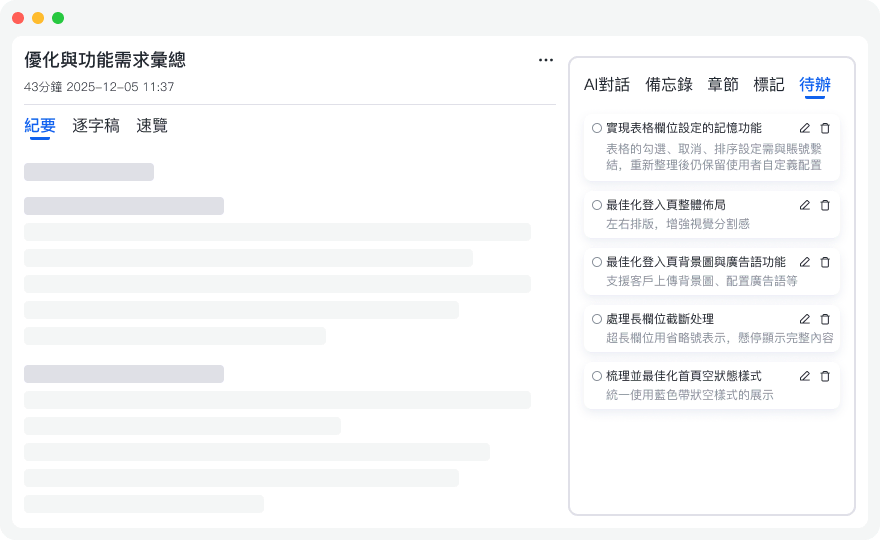
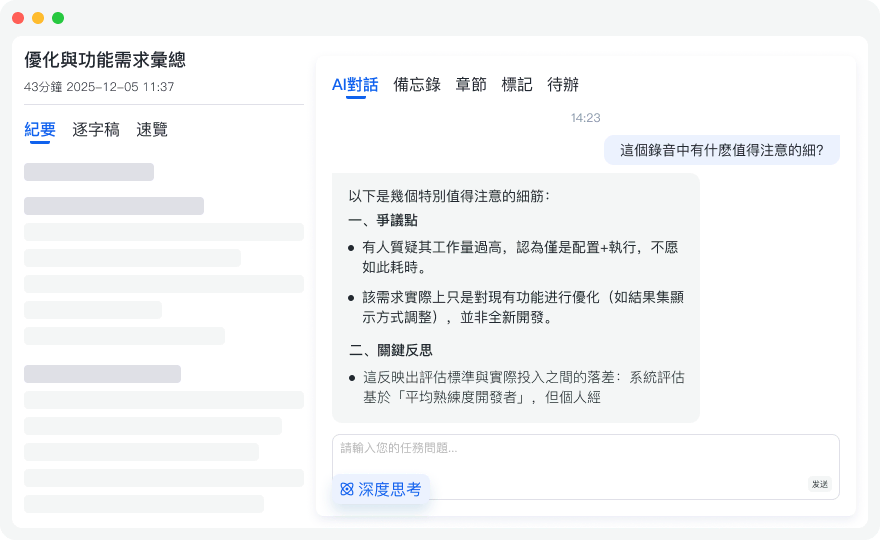
Step 4: Use AI Chat to Query Key Details
If you have a 2-hour interview recording and need to find a specific piece of data quickly, the traditional method is Ctrl+F to search keywords. But now you can use the AI Chat Query feature.
Simply type in the chat: "What was the Q3 market revenue mentioned by the interviewee?" The AI will perform semantic retrieval across the entire recording and answer directly—like asking an assistant who attended the entire meeting.
Cantonese & Dialect Transcription FAQ
Q1: Can iPhone recordings be directly transcribed into Cantonese text?
iPhone's built-in Voice Memos cannot directly and accurately export dialect-recognized transcripts. We recommend exporting the iPhone recording (e.g., as m4a) and uploading it to a web-based tool that supports dialect recognition, or using an iOS app that supports "real-time recording to text" during the meeting.
Q2: What's the fastest way to transcribe online meeting recordings from Teams or Meet?
If the meeting platform's built-in transcription doesn't support Cantonese, download the meeting recording (mp4 or mp3) and upload it to a third-party speech-to-text tool. If the tool supports "speaker identification," it can clearly distinguish different colleagues' speech, making it easier to organize meeting minutes.
Q3: Do these Cantonese speech-to-text tools offer free trials?
Most tools provide free tiers. For example, Subanana has a basic free plan; pyTranscriber is completely open-source and free (but requires manual installation and lacks AI summary); Tinrec offers a free version with up to 100 minutes of recording processing per month, including full features like AI summarization.
Q4: Why is Cantonese recognition accuracy low in editing software like Premiere Pro?
Cantonese contains many specific colloquial words (e.g., "嘅", "喺") and frequent code-switching. Traditional editing software typically uses general language models. Without specialized training on Hong Kong or Cantonese region corpora, accuracy drops significantly in the presence of background noise.
Q5: What's the difference between video subtitle tools and meeting transcript tools?
Their core design intentions differ. "Video subtitle tools" (e.g., Subanana, ArcTime) prioritize timeline precision and perfect export of SRT/VTT formats. "Meeting transcript tools" focus more on content understanding and subsequent application, offering features like auto-generated summaries, action item extraction, and AI queries—more suited for workplace and learning scenarios.
Q6: Will processing long recordings with Cantonese code-switching take a long time?
It depends on the tool's processing mechanism. Standalone software can heavily tax computer hardware; cloud-based tools typically resolve hours of audio in minutes. Additionally, if the audio source is a public YouTube video or podcast, some tools offer "URL parsing" that instantly processes the link, saving download time for large files.
Turn every recording into actionable outcomes
Get 60 free transcription minutes when you sign in. No credit card required.
Related Reading
You might also like

What Is AI Meeting Minutes in 2026? A 4-Step Comparison of Tinrec vs. Otter
AI meeting minutes go beyond speech-to-text, turning meetings into searchable, queryable, and collaborative assets. This article compares Tinrec and Otter across four key dimensions to help you understand the core features of AI meeting minutes and choose the right AI meeting tool for your needs.

5 Best AI Meeting Note Apps Tested in 2026: No-Bot Recording, Chinese Meetings & Team Collaboration
Tired of manually writing meeting minutes? This article tests Tinrec (秒听录音) as the main focus, covering no-bot recording, Chinese meeting transcription, AI summaries, and team collaboration. It provides buying tips and FAQs to help you find a truly time-saving AI meeting notes tool.
How to Create Smart Meeting Minutes in 2026: 5 Steps to Choose the Right Software for Automatic Transcripts and Summaries
A practical guide for mid-level managers and professionals on using AI meeting minutes software to automatically generate transcripts, summaries, and action items. It highlights hands-on testing of Tinrec (秒听录音), briefly reviews Notta, Otter.ai, and Plaud Note, and offers tips to avoid common pitfalls and make the right choice.
2026 Smart Meeting Recorder Alternatives: 5 Tested Advantages of Tinrec
Still considering buying a smart meeting recorder? This article tests Tinrec, an AI meeting notes tool, comparing it with hardware voice recorders. From bot-free online meeting recording, AI summaries, team collaboration to cost, find out why a software solution is better for most office workers.
Tinrec vs Notta 2026: 5-Dimension Comparison - Which Is Worth Buying?
Spending two hours in a meeting and another two hours writing up the minutes? This article tests Tinrec and Notta smart meeting note tools, comparing them across 5 dimensions: meeting capture, Chinese transcription, AI post-processing, team collaboration, and value for money, to help you find the most time-saving solution. It also includes book recommendations for meeting notes at the end.
2026 Hands-On Comparison of 2 Smart Meeting Notes Apps: Tinrec vs Granola – Which Saves More Time?
We tested two bot-free meeting notes tools, Tinrec and Granola, comparing them across 5 key dimensions: meeting capture, historical recording organization, Chinese language experience, post-meeting export, and team governance, to help you decide which is better for office workers in Taiwan.
Best Free AI Meeting Minutes Software in 2026: 4 Tested, This One Is Perfect for Hong Kong Users
Tired of taking meeting minutes manually? We tested 4 free AI meeting minutes tools. Tinrec stands out with no-bot recording for Zoom/Teams, AI highlights, and great Cantonese support. Save your overtime hours. A must-read for Hong Kong professionals.
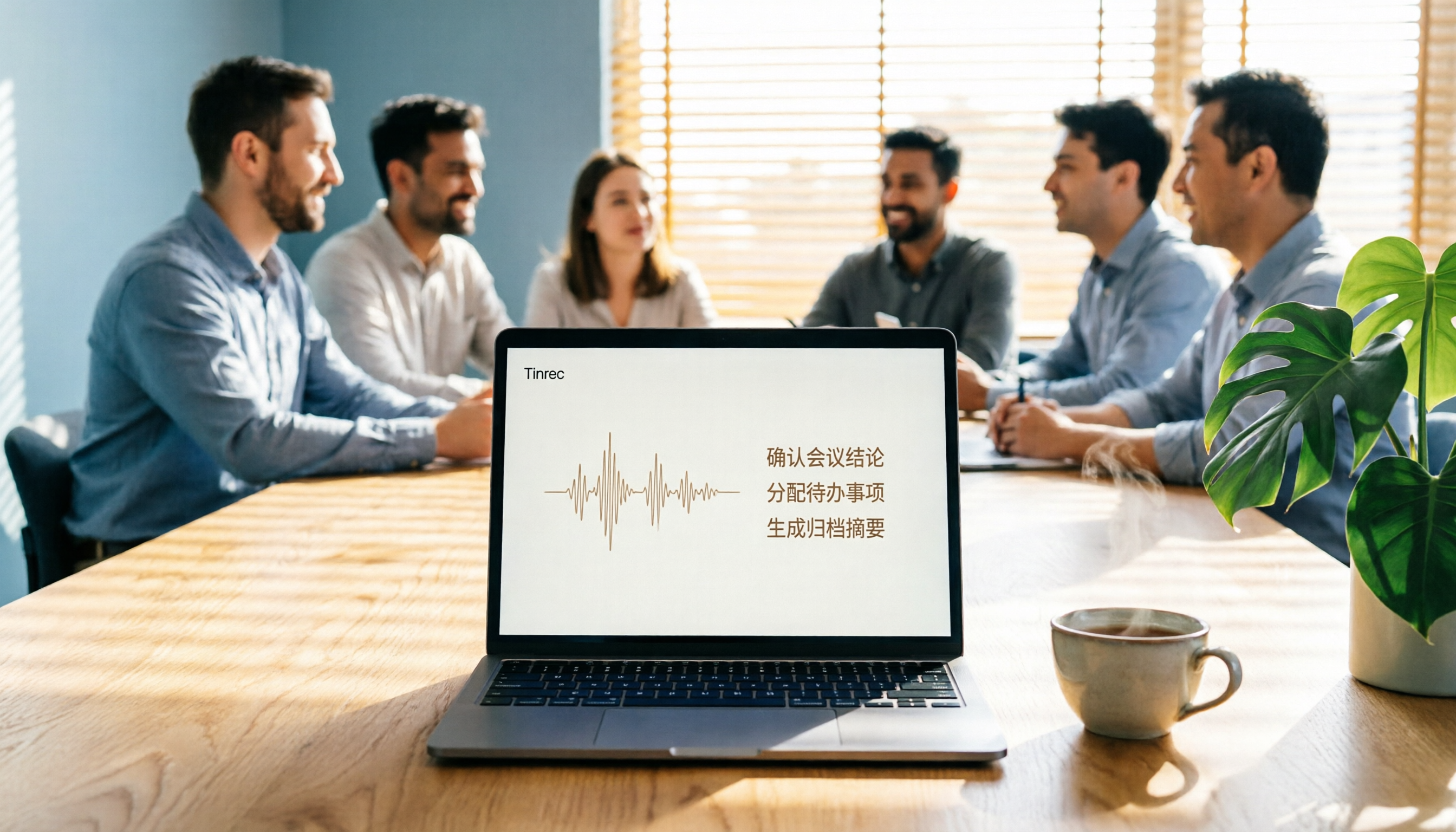
2026 Comparison of 3 Smart Meeting Minutes Tools: From Recording to Action Items, Which Saves You the Most Time?
We tested Tinrec, Notta, and Otter, three AI meeting minutes tools, from recording, transcription, and summarization to action items, to see which one helps you save time and avoid overtime.

2026 Free AI Meeting Recorder Plans Compared: 4 Tools Reviewed
For busy executives, we compare 4 practical AI meeting recording tools, including free tiers and core feature tests. Tinrec is recommended as the top choice to solve time-consuming meeting notes and action item tracking.