

Turn recordings into transcripts and summaries in minutes
Upload audio or video for multilingual transcription, AI notes, and action items
2026 AI Meeting Notes Tools Compared: Is the Free Version Enough? Dcard Users Are Asking
On Dcard, discussions about AI meeting notes often revolve not around "which tool is the best," but rather: "Is the free version enough?" "Is Chinese transcription accurate?" "Is it easy to learn?" Behind these three questions lies a common decision: you don't want to spend two hours organizing a two-hour meeting recording. This article focuses on Tinrec (秒聽錄音) and compares 3 tools, clearly outlining the key points to consider.
Meeting Notes Are Time-Consuming: You Need a Solution, Not Just a Tool
Two hours of meetings, then two more hours to organize the notes—this is a daily reality for many office workers. What's worse, discussions that mix Chinese and English make it hard to catch key points even after listening once. If you also need to send a proper meeting summary to your boss afterward, the time cost nearly doubles. Many Dcard users complain: it's not that they don't want to take notes, but manual transcription is truly exhausting. Choosing the right AI meeting notes tool should at least save you from repeatedly listening to recordings and manually editing transcripts.
Before Choosing an AI Meeting Notes Tool, Understand These 3 Key Points
First: Can you use it without adding a bot to the meeting?
Many AI meeting tools require a bot to join as a participant, but some people find this intrusive or their company policy doesn't allow it. Tinrec's desktop version directly captures system audio, so you don't need to invite a bot. It works with online meetings like Zoom, Google Meet, Teams, and Webex—a practical consideration when choosing.
Second: After transcription, how much can it do for you?
Simply converting to a transcript is just the first step. If the tool can automatically generate summaries, chapters, action items, and even let you ask questions like "Who mentioned the budget in the last meeting?", it saves a lot of time in follow-up. Tinrec's AI Q&A feature works this way: after recording, you can ask follow-up questions without re-reading the entire transcript.
Third: Does the free plan's quota match your meeting frequency?
The most common question on Dcard is about free plans. For example, Otter.ai's free plan offers 300 minutes per month, and Notta's free plan offers 120 minutes per month. But if you mainly have Chinese meetings, you also need to consider Chinese recognition accuracy and the overall experience. Tinrec's free plan includes a basic quota, so you can test it with your own meeting scenarios before deciding whether to upgrade to Pro or Team.
Tinrec (秒聽錄音)—Our Top Pick After Testing
Tinrec is an AI meeting notes tool designed for individuals and teams, supporting real-time recording, audio upload, and bot-free online meeting transcription.
In practice, what I like most is its post-meeting organization. When you open Tinrec during a meeting, it transcribes in real time; as soon as the meeting ends, summaries, chapters, key points, and action items are automatically generated. You no longer need to search through recordings to figure out "who is responsible for what"—just look at the action items and continue your work.
What's more special is the AI Q&A feature. For example, after recording a client meeting, I can type "What concerns did the client have about the pricing?" and Tinrec will answer based on the meeting content, rather than just giving you a list of keywords. Currently, most tools in the same price range don't offer such direct post-meeting Q&A.
Another point worth mentioning is export and further processing. You can export summaries or transcripts to Notion, Google Docs, OneNote, Dropbox, and other tools, or ask Tinrec to generate reports, tables, or more formal meeting minutes. This is very useful for office workers who need to report to their boss or compile documents.
Stop organizing recordings by hand
Upload audio or video and automatically get a transcript, summary, and action items
I should also be honest about limitations: the free plan has a basic quota, and heavy users will need Pro or Team. Accuracy can be affected by recording quality, accents, and overlapping speech, so for important decisions, you should still verify against the original audio. However, if your needs are "Chinese meetings, no bot, and want to ask questions after," Tinrec is a very smooth choice.
The Team plan is suitable for departments or project groups: meeting data is centralized in a team space, with role and seat management, and when a member leaves, data isn't taken away individually. Admins can view usage, hot words, and operation logs—something the personal plan can't offer.
Beyond Tinrec: What Other Options Are There?
Otter.ai: It's mature for English meetings, and the free plan's 300 minutes is generous. But if you mainly have Chinese meetings, it may not feel as tailored as Tinrec; also, Otter is more associated with meeting bots, unlike Tinrec's desktop version that doesn't require inviting a bot. If your meetings are all in English, Otter is a reasonable choice.
Notta: Transcription and translation are decent, but the integration of team spaces and bot-free recording isn't as complete as Tinrec. It's suitable for those who just want quick text conversion; if you want to ask AI questions after recording or export to other note tools, Tinrec's workflow is smoother.
Granola: It doesn't retain meeting audio files and doesn't allow uploading pre-recorded audio, which can be restrictive if you need to review recordings later. Tinrec retains audio and allows importing old recordings, making it better for situations where you need to keep records or organize historical meetings.
Pitfall Guide: 3 Common Mistakes When Choosing AI Meeting Notes Tools
Pitfall 1: Only looking at officially claimed accuracy rates.
Many tools claim "98% accuracy," but that's tested in a quiet recording studio. Real meetings have air conditioning noise, keyboard sounds, and people talking over each other, so accuracy will be lower. Instead of relying on numbers, test with your own meeting recordings on the free plan to see what works best.
Pitfall 2: Treating the tool only as "audio-to-text."
If you only use the tool to generate transcripts, you're using only a third of its capabilities. Features like Tinrec's AI Q&A, action item extraction, and export are what truly save time. Asking "What was the meeting conclusion?" right after recording is much faster than manually scanning 30 minutes of text.
Pitfall 3: Ignoring data ownership and team collaboration.
Personal tools are convenient, but if meeting data is scattered across personal accounts, it becomes a hassle when colleagues leave or during handovers. If you need team sharing, choose a plan with team spaces and member/permission management, rather than forcing a personal plan to serve as a team solution.
Summary: Which One Should You Choose?
If you need a conclusion: for most Taiwanese workplaces, Chinese meetings, and mixed Chinese-English scenarios, Tinrec is the most direct choice.
Scenario breakdown:
- Chinese or mixed Chinese-English meetings, want better accuracy → Tinrec
- Don't want an AI bot to join meetings → Tinrec
- Want to ask AI about key points and action items after recording → Tinrec
- Need to keep meeting data for the team and manage permissions → Tinrec Team
- Zero budget, only English meetings, under 300 minutes per month → Otter.ai free plan (the only exception)
We recommend starting with Tinrec's free plan to see if it fits your meeting rhythm and free quota, then consider upgrading if it feels right. No need to pay upfront.
References
- Meeting Ink - 2026 AI Meeting Notes Tools Tested|7 Voice-to-Text and Summary Speed Comparison | Meeting Ink - AI Meeting Notes Assistant Auto-Transcribe and Summarize
- Struggling with Meeting Notes? 5 NotebookLM "AI Note Transformation" Tricks for Accurate Transcription of Mixed Chinese-English and Technical Terms | Digital Times BusinessNext
- AI Meeting Notes - Google Play App
- How to Use AI for Meeting Minutes? How to Organize Meeting Transcripts?|AI Voice-to-Text Tutorial|104 Career Center
- AI Meeting Notes Tool|Real-time Recording, Summary Organization! 3 Handy Tools to Let You Focus on Meetings
Turn every recording into actionable outcomes
Get 60 free transcription minutes when you sign in. No credit card required.
Related Reading
You might also like

2026 AI Meeting Notes Table Tools Compared: Which One Actually Produces a Ready-to-Use Table?
A meeting notes table isn't just about downloading a template—the real question is whether you can produce something you can hand off right after the meeting ends. This article starts with three ways to get a meeting notes table, provides a copy-ready table structure, and walks through the full workflow with Tinrec from recording to transcript, summary, action items, and team knowledge retention. It wraps up with 5 key buying criteria and FAQs.

2026 AI Meeting Notes Showdown: Tinrec vs Otter.ai — Which Is Better for Chinese Meetings?
In 2026, Dcard discussions about AI meeting notes focus on free transcription and summary tools. This article narrows the scope to Tinrec and Otter.ai, comparing them across meeting capture methods, Chinese transcription, post-meeting outputs, team governance, and pricing to help you decide which fits your meeting scenarios.

How to Create AI Meeting Minutes Tables in 2026: 5 Steps from Recording to Table
Still manually pasting transcripts into tables after meetings? This guide starts with how to decide between a transcript and a table, then covers 4 key factors for choosing an AI meeting minutes table tool in 2025, Tinrec's actual workflow, 3 alternative solutions, and the 3 most common pitfalls, plus a 5-step process.

Best AI Meeting Notes Tools in 2026: 4 Tested, This One Excels for Chinese Meetings
We tested 4 AI meeting notes tools in 2026, comparing recording methods, post-meeting output, Chinese recognition, and team data management. Here's why Tinrec suits Chinese and mixed Chinese-English meetings, and which tools fit other needs or budgets better.

Tinrec vs Google Translate 2026: 5-Dimension Comparison — Which Is Better for Real-Time Transcript Translation?
The most time-consuming part of cross-language meetings is often not the meeting itself, but re-listening to recordings and translating them into Chinese afterward. Based on my own trial-and-error experience, this article compares Tinrec and Google Translate on real-time transcript translation across 5 dimensions, and outlines 5 things to consider when choosing a tool, plus FAQs.
6 AI Meeting Transcription Tools Compared for 2026: From Transcripts to Post-Meeting Summaries
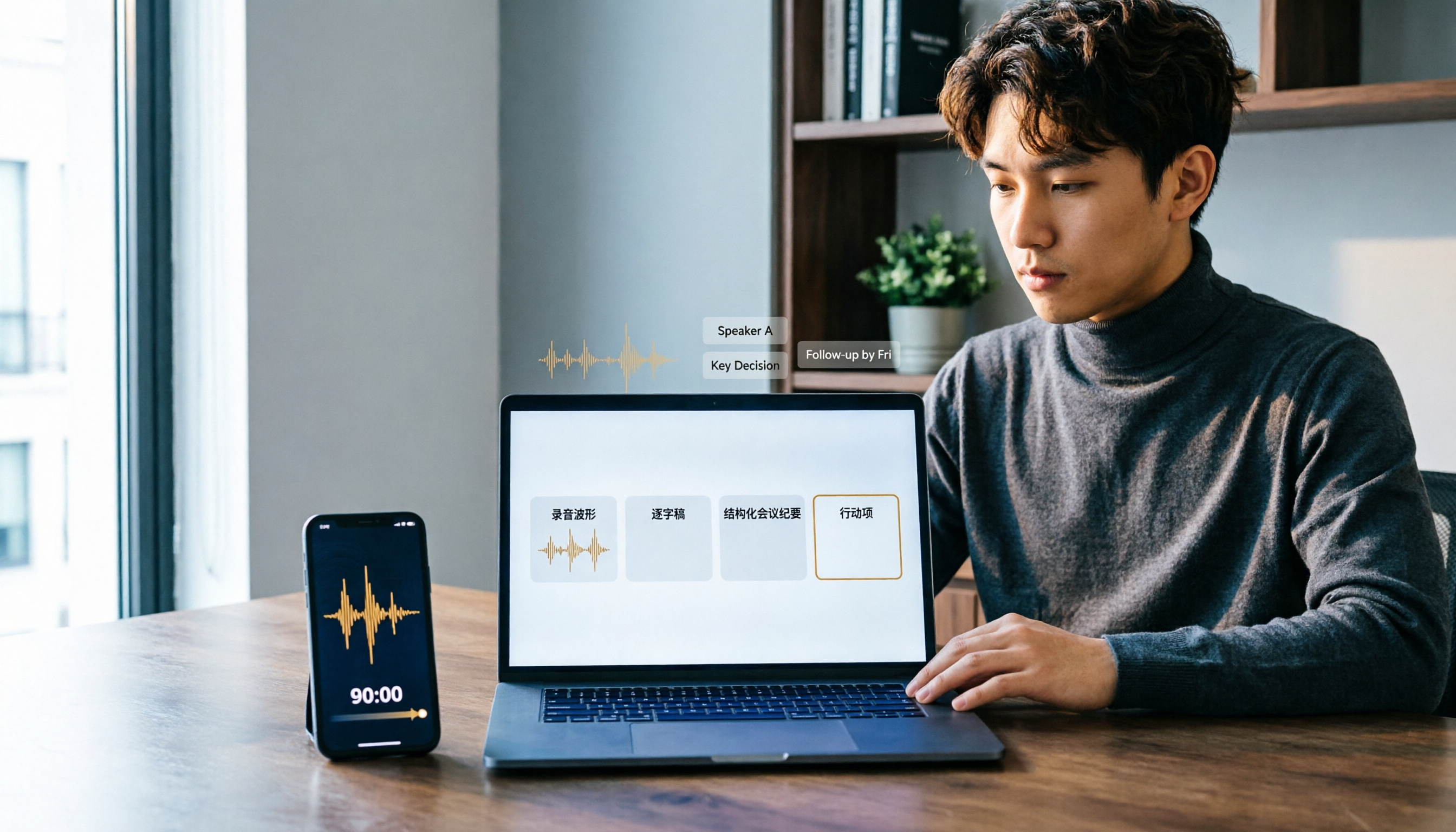
A 90-minute interview recording is sitting on your phone, and the transcript is due tomorrow morning. This article breaks down AI meeting notes into two steps—transcription and organization—and compares six practical solutions, including bot-free recording, multilingual transcription, hardware recorders, and free post-meeting organization tools, to help you choose the right one for your scenario.

2026 AI Meeting Notes Comparison: Tinrec vs Granola for Chinese Transcription and Free Tiers
In Dcard's 2024 AI meeting notes discussions, the most common questions are whether free tiers are sufficient, how well Chinese transcription works, and whether post-meeting summaries can be shared directly. This article compares Tinrec and Granola, two bot-free meeting note tools, across recording retention, old file import, Chinese and bilingual support, post-meeting outputs, team data governance, and pricing to help you decide which fits your meeting scenario.

How to Choose AI Meeting Notes Tools in 2026: 5 Steps to Understand Comparison Tables and Key Selection Criteria
2026 AI meeting notes tool comparison and buying guide: use 5 steps to understand meeting capture, post-transcription processing, Chinese language support, team governance, and pricing quotas, and compare use cases for Tinrec, Otter.ai, Notta, Granola, TurboScribe, and PLAUD.

2026 AI Meeting Notes Comparison: Tinrec vs Notta — Which Is Better for Chinese-Speaking Teams?
A meeting notes table isn't just pasting a transcript. This article uses a typical weekly meeting workflow to compare Tinrec and Notta across five dimensions: meeting capture methods, table output, free quota and pricing, Chinese and real-time translation, and team governance. It also includes a ready-to-use meeting notes table template with fields and a manual verification checklist.