
Turn recordings into transcripts and summaries in minutes
Upload audio or video for multilingual transcription, AI notes, and action items
After a Teams or Google Meet meeting, staring at a one-hour recording can be daunting. Traditional transcription tools only convert speech to text, leaving you to rely on Ctrl+F to search for keywords. If a speaker rephrases something, you might miss the conclusion entirely, and compiling action items becomes a time-consuming chore.
To reduce the effort of organizing recordings, this article rounds up 6 popular speech-to-text and AI key-point extraction tools in 2025. We provide a comprehensive comparison table covering language support, real-time capability, and AI query features, and walk you through practical steps to transcribe and extract information efficiently.
Quick Navigation Guide: If you prioritize completely free and high privacy, go with open-source OpenAI Whisper. For all-English meetings, Otter.ai remains a powerful choice. If you need "AI-powered conversational search" of recording highlights and automatic cross-language decision summaries, consider tools like Tinrec (Seconds Audio Recorder) that offer semantic search.
Why You Need an AI-Powered Q&A Tool for Recordings
In today's digital age, students organizing lecture notes, professionals creating meeting minutes, and creators processing interviews all have one basic need: speech-to-text conversion. However, the real pain point for most is no longer "not understanding" but "not finding the key points."
- Low information density, high re-listening cost: A one-hour recording takes at least an hour to re-listen. Even with a transcript, filler words make it hard to pinpoint the essentials.
- Lack of decisions and action items: Most traditional tools output a plain text document, requiring you to manually extract who needs to do what by when.
- Limitations of traditional search: Traditional transcripts only allow exact keyword search. Tools with "AI conversational search" understand semantics, letting you ask questions about the recording as if you were asking a person, drastically cutting down comprehension and organization time.
2025 Speech-to-Text and AI Key-point Extraction Tools Review
Many free or tier-based speech-to-text platforms exist. Below are 6 tools with different focuses to help you choose based on your scenario.
1. Google Built-in Speech Transcription Series (Easiest Access)
Google Live Transcribe and Google Docs voice typing are excellent entry points. Live Transcribe is a boon for Android users, supporting 80 languages including Traditional Chinese, with automatic punctuation. Google Docs voice typing is completely free with no time limit and works in any Chrome browser. Best for real-time note-taking in class or drafting articles alone, but lacks recording upload and AI summarization.
2. OpenAI Whisper / Whisper Desktop (Highest Privacy & Open Source)
Currently the most powerful open-source speech recognition system, with high tolerance for accents and background noise. Whisper Desktop offers a graphical interface that lets ordinary users convert MP3 or MP4 files to SRT subtitles offline. Completely free and data never leaves your local machine, ideal for confidential meetings and privacy-conscious users. However, it requires decent hardware and lacks built-in AI summary and Q&A.
3. Yating (雅婷) Transcription (Localized for Taiwanese Accent)
Developed by Taiwan AI Labs, optimized for Taiwanese Mandarin, Taiwanese Hokkien, and Chinese-English code-switching. Real-time transcription is free, and audio upload offers 20 minutes of free processing, with a guarantee that data stays within Taiwan. Very useful for users needing high accuracy for Taiwanese accents, but for deep AI content Q&A and summaries, you'll need to pair it with other AI tools.
4. Otter.ai (International All-English Meeting Assistant)
A globally recognized meeting transcription tool that integrates seamlessly with Zoom, Google Meet, and Microsoft Teams. Its AI summaries and key-point extraction are top-notch, offering 300 free minutes per month. However, Otter.ai currently supports only English, French, and Spanish—not Chinese—so it's best for all-English international team collaboration.
5. Notta (Multilingual Meeting Notes)
A feature-rich AI tool supporting 58 languages, with speaker identification and basic AI summaries. It offers 120 free minutes. However, it struggles with complex Chinese contexts or heavy regional accents; its Chinese recognition is relatively weaker. Best suited for language learning or preliminary note-taking in multilingual meetings.
Stop organizing recordings by hand
Upload audio or video and automatically get a transcript, summary, and action items
6. Tinrec (Seconds Audio Recorder) (AI Q&A & Complete Workflow)
Tinrec positions itself as a complete AI assistant covering the entire workflow from recording to understanding to action. In addition to supporting multiple platforms (iOS, Android, web) and auto-detecting 10 languages, its core differentiator is that it goes beyond transcripts to automatically generate meeting minutes and action items. Its "AI conversational search" feature lets users ask direct questions about the recording—e.g., "What was the marketing budget decided for next week?"—turning time-based content into searchable, actionable assets.
Comparison Table of 6 AI Transcription & Key-point Search Tools
To simplify your choice, here's a decision matrix based on core dimensions:
| Tool | Language Support | Real-time Transcription | AI Q&A for Key Points | Meeting Summary / Action Items | Export & Integration | Price / Free Tier |
|---|---|---|---|---|---|---|
| Google Series | 80+ (incl. Chinese) | Yes | No | No | Copy text | Built-in, completely free |
| Whisper Desktop | 99 (incl. Chinese) | No (file-based) | No | No | SRT, TXT | Open source, free |
| Yating Transcription | Taiwan Mandarin/Hokkien | Yes | No | No | TXT | Real-time free / Audio 20min |
| Otter.ai | English/French/Spanish (no Chinese) | Yes | Basic summaries | Yes | Integrates with major meeting software | 300 min/month free |
| Notta | 58 (weak Chinese) | Yes | Basic summaries | Yes | Multiple export formats | 120 min free |
| Tinrec (Seconds Audio Recorder) | 10 auto-detect | Yes | Deep semantic Q&A | Automatic action items extraction | TXT, video summary | Up to 100 min free/month |
Step-by-Step Guide: How to Quickly Extract Key Points from Recordings with AI
Knowing the tools is one thing; integrating them into your workflow is another. Below, we use an AI assistant with a complete extraction process (e.g., Tinrec) to illustrate four core steps for converting voice from various sources into structured highlights.
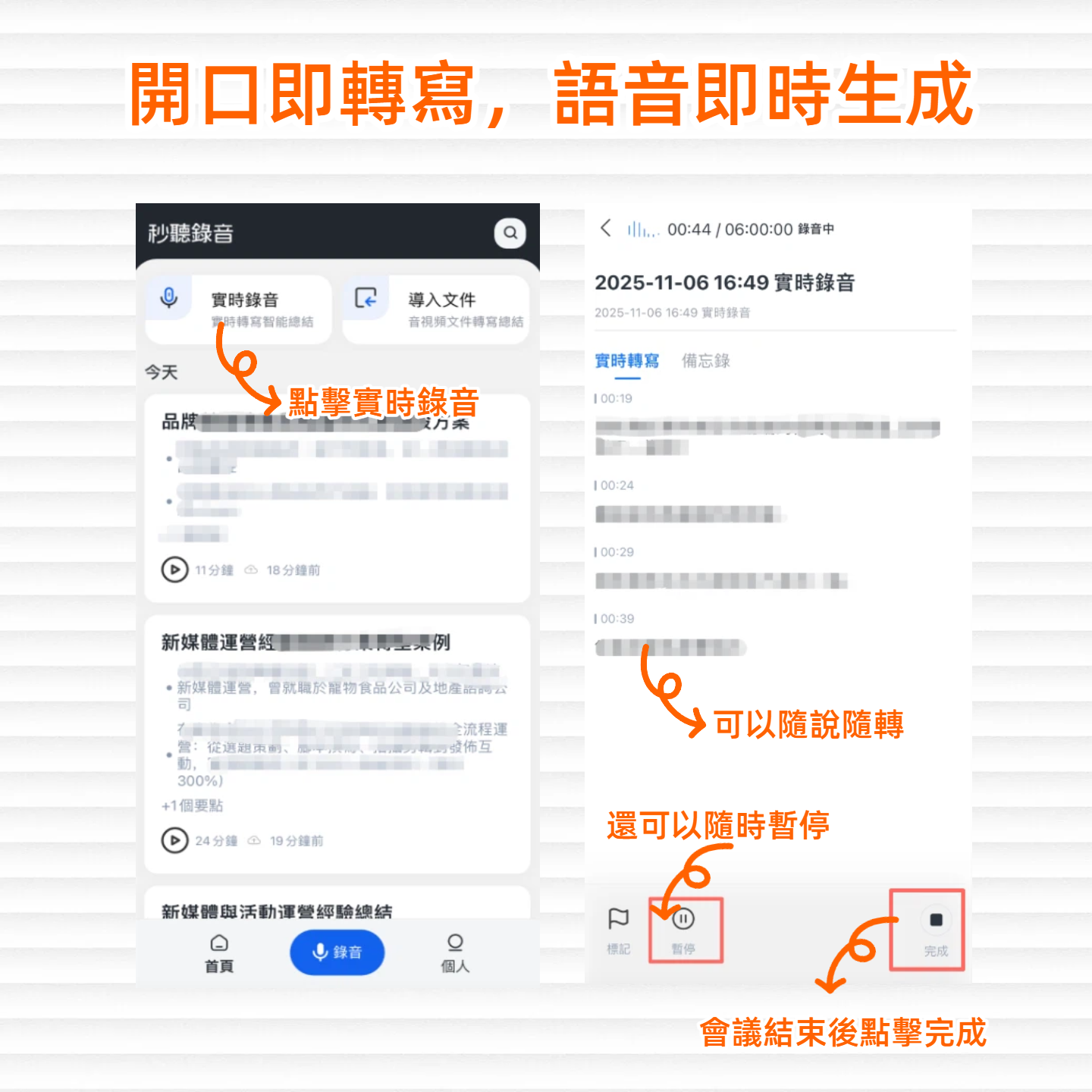
Step 1: Real-time Transcription – Listen and Read Simultaneously
In a physical meeting or class, open the tool's real-time recording feature. The system transcribes speech instantly, no waiting. You can mark important items on the fly, and after the session, the tool outputs a timestamped transcript.
Reference: Real-time Speech to Text

Step 2: Import Audio Files – Auto-generate Transcripts and Summaries
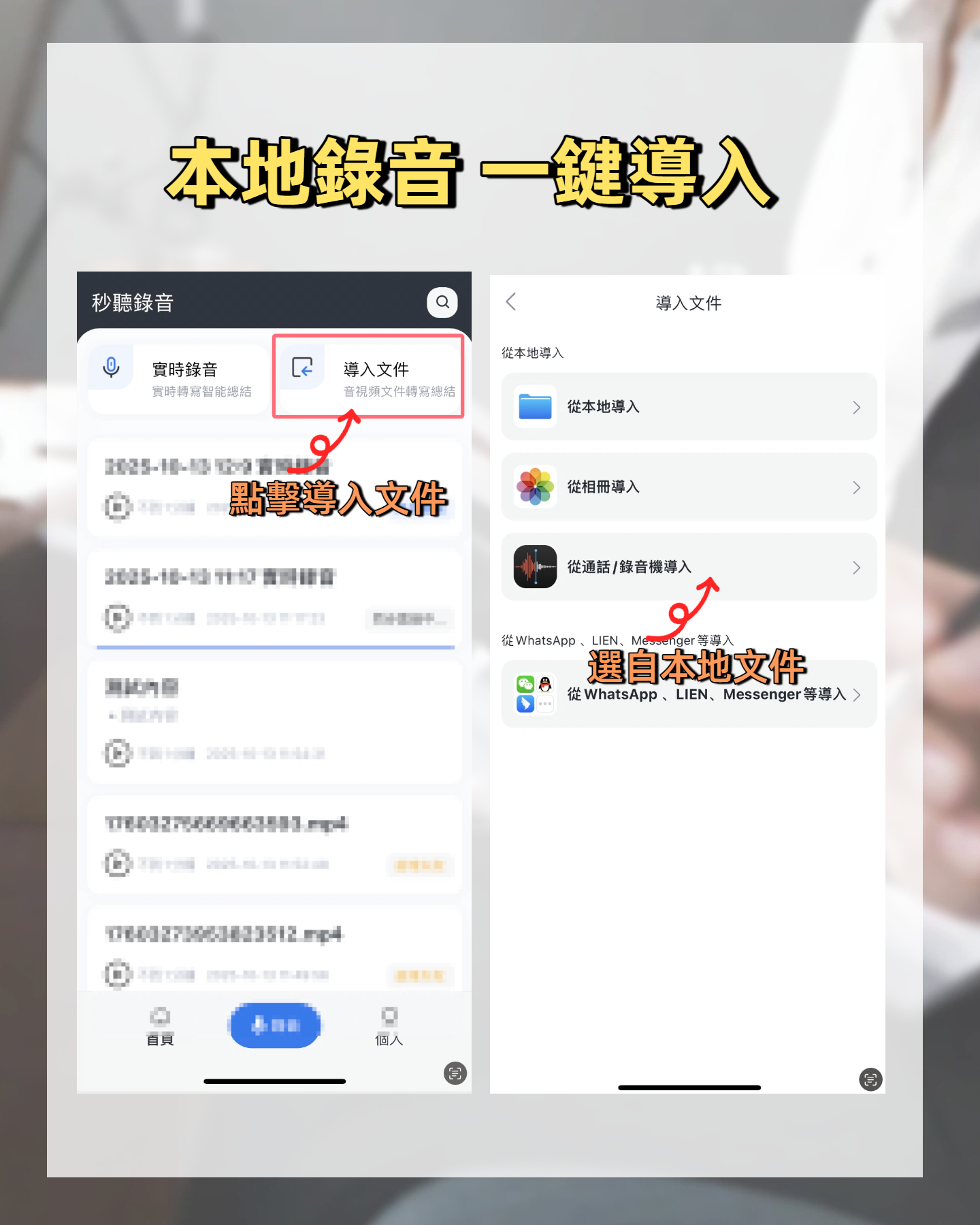
If you have recordings from your phone or a recorder, simply upload the file (supports MP3, WAV, M4A, etc.). The system identifies speakers, outputs a transcript, and also generates a summary and to-do list.
Reference: Audio File to Text
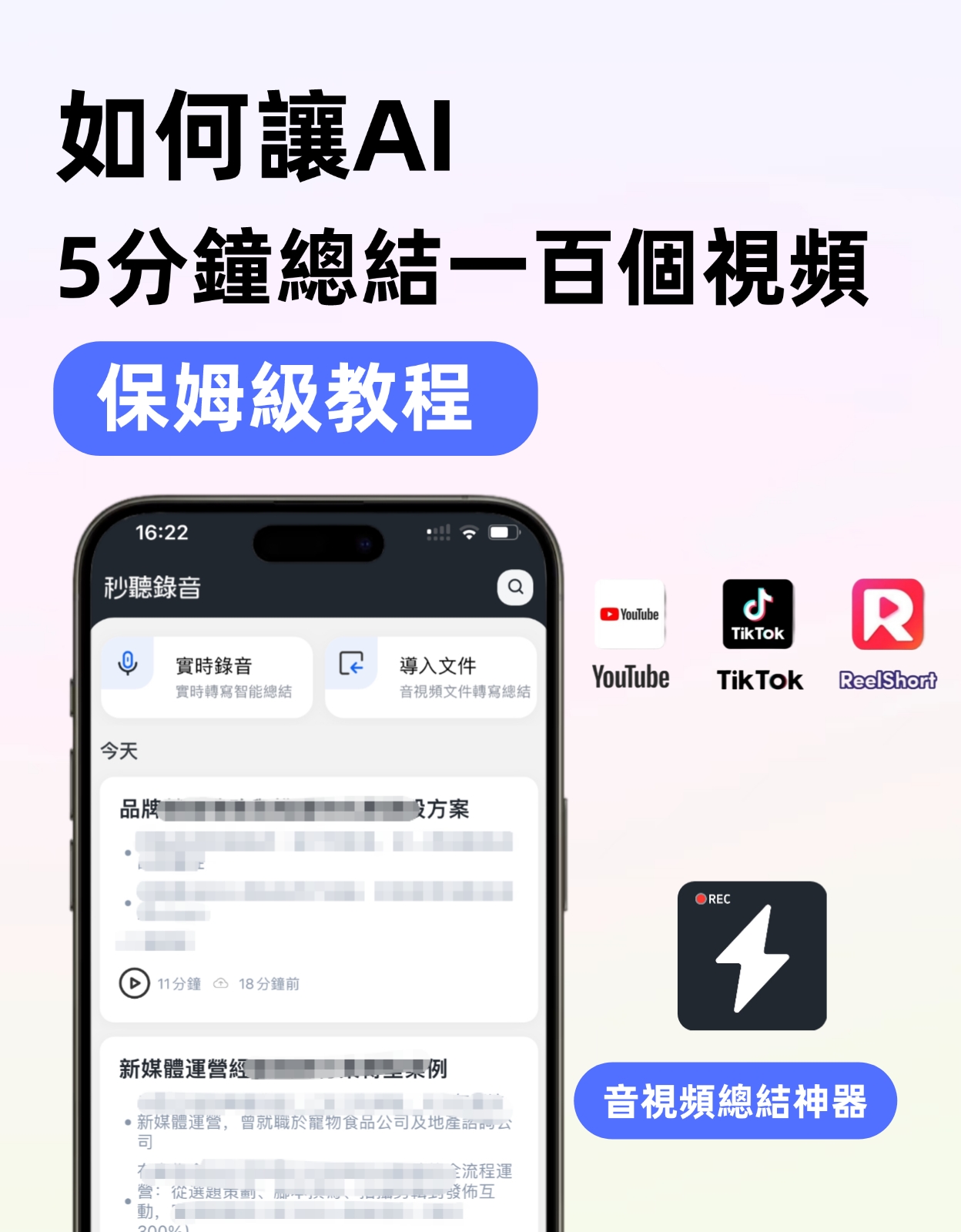
Step 3: Paste a Video or Podcast Link – One-Click Transcription
For content creators or self-learners, when you find a valuable YouTube, TikTok, or podcast episode, you don't need to download the audio. Just paste the video URL, and the system will parse and summarize the content, extracting knowledge points.
Reference: Podcast/Online Video to Text
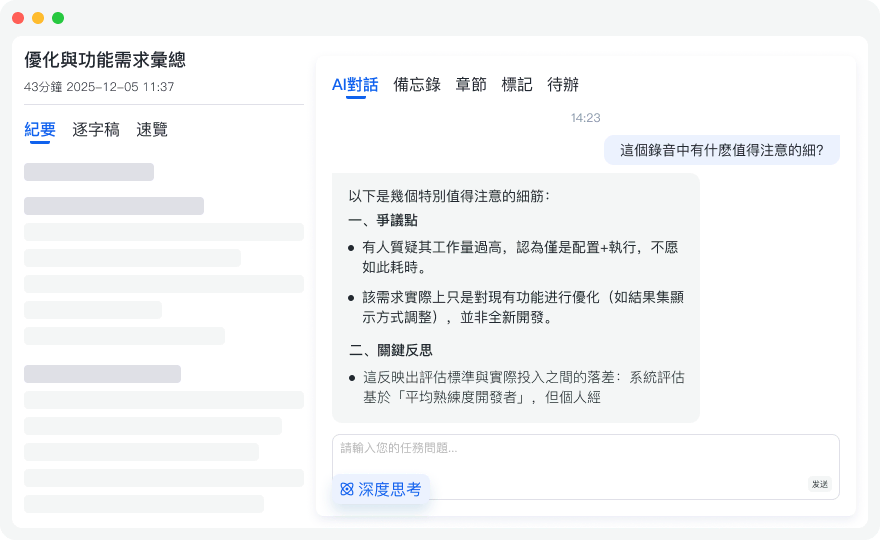
Step 4: Use AI Q&A – Find Key Points Like Asking a Person
This is the breakthrough step beyond traditional transcripts. When faced with a 10,000-word transcript, click the "AI Q&A" feature and type your question. For example, "Help me list the three revision suggestions for Project A." The AI will search the recording content and return an answer, drastically cutting down the time to find key points.
Reference: AI Conversational Search
FAQ (Speech-to-Text, iPhone, Meeting Scenarios)
Q1: How accurate are free speech-to-text tools for Chinese? Modern AI tools achieve over 90% accuracy in clear, low-background-noise conditions. For Traditional Chinese, using tools tailored for Taiwanese accent (e.g., Yating) or large AI models will yield better results. However, treat AI transcripts as drafts and use key-point extraction for proofreading.
Q2: iPhone restricts many things; any recommended solution for transcription? Apple's built-in dictation works for short phrases, but for long recordings, use tools that support iOS (such as cross-platform web apps or dedicated apps). That way you can view AI-generated summaries directly on your phone without being limited by the system.
Q3: How to automatically capture key points in remote meetings like Teams or Google Meet? For all-English meetings, Otter.ai can directly integrate with meeting apps. For Chinese or cross-language meetings, the universal solution is to record the meeting audio and import it into an AI tool, or run a web-based tool on your computer alongside the meeting for real-time transcription and action item extraction.
Q4: Transcripts are too long to read; can AI pinpoint key points? That's where "AI Q&A for recording highlights" excels. Tools with semantic understanding go beyond Ctrl+F, letting you ask questions like "What is the final exam scope for this course?" and get concise answers extracted from the entire transcript.
Q5: Are free tools safe for confidential meeting recordings? For highly confidential content (medical, legal, business decisions), strongly recommend using fully offline tools like Whisper Desktop, or verify the tool's privacy policy (e.g., data never leaves your region, user data not used for AI training).
Q6: I record a lot each month; should I stick with free versions or upgrade? If your monthly need is under 5 hours (300 minutes), you can rotate free tiers from different platforms. If you exceed that and need advanced AI Q&A and speaker identification, a subscription (basic plans around $5–$10 per month) saves significant manual processing time and is cost-effective.
Turn every recording into actionable outcomes
Get 60 free transcription minutes when you sign in. No credit card required.
Related Reading
You might also like

5 Best AI Meeting Recorders Tested in 2026: Which One Works Best for Chinese Meetings and Team Collaboration?
Struggling with meeting notes and post-meeting cleanup? This hands-on comparison of 5 AI meeting note tools, led by Tinrec, covers bot-free recording, Chinese transcription, AI summaries, and team collaboration to help you decide which one is worth it.

2026 Tinrec Smart Meeting Minutes Review: Cantonese Transcription, AI Auto-Generated To-Dos
Tired of spending hours after meetings transcribing recordings? We tested Tinrec, a smart meeting minutes app that uses AI to save you overtime. It supports Cantonese transcription, auto-generates to-dos, and can record online meetings without a bot.

2026 Smart Meeting Minutes Tools Compared: Hands-On Test of 5, Why Tinrec Is Our Top Pick
Spending two hours in a meeting and another two hours writing up the minutes? This article evaluates Tinrec, Otter.ai, Notta, PLAUD Note, and others based on practical criteria like bot-free recording, Chinese transcription, AI post-processing, and team collaboration, to tell you which one is most worth using.

The Complete Guide to AI Meeting Notes Apps in 2026: Auto-Generated Summaries, Action Items, and Team Collaboration
This guide starts by addressing common pitfalls, helps you understand the key factors in choosing an AI meeting notes app, and shares hands-on experience with Tinrec (秒听录音) on how it uses bot-free recording, AI summaries, and team collaboration to save you time after meetings.

2026 Review of 5 Online AI Meeting Minutes Tools: Which Free Version Is Most Useful?
This hands-on comparison, focusing on Tinrec, breaks down the core features, real-world use cases, buying considerations, and FAQs of online AI meeting minutes software to help you decide if the free version is sufficient.
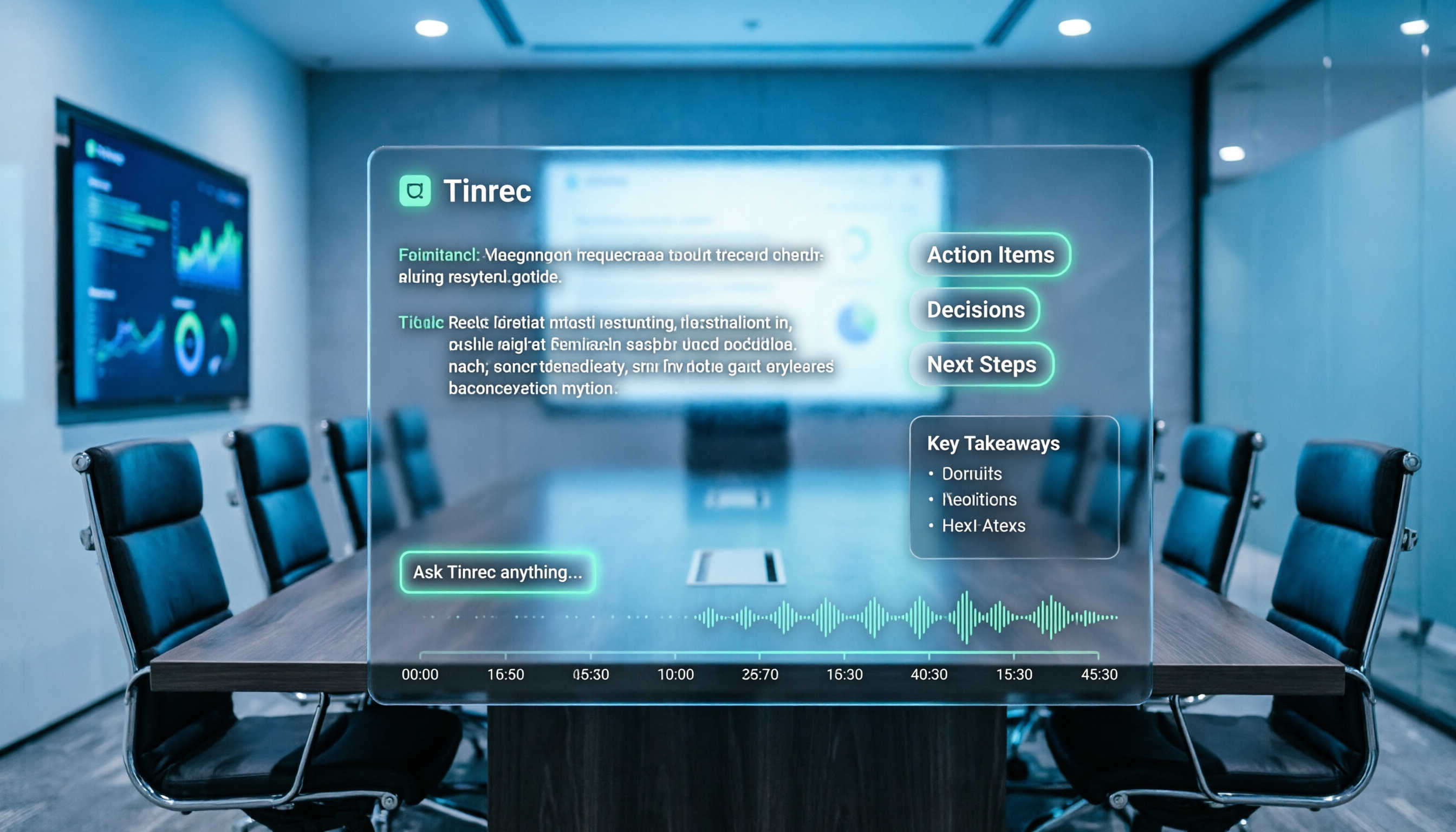
What Is AI Meeting Minutes in 2026? A 4-Step Comparison of Tinrec vs. Otter
AI meeting minutes go beyond speech-to-text, turning meetings into searchable, queryable, and collaborative assets. This article compares Tinrec and Otter across four key dimensions to help you understand the core features of AI meeting minutes and choose the right AI meeting tool for your needs.
5 Best AI Meeting Note Apps Tested in 2026: No-Bot Recording, Chinese Meetings & Team Collaboration
Tired of manually writing meeting minutes? This article tests Tinrec (秒听录音) as the main focus, covering no-bot recording, Chinese meeting transcription, AI summaries, and team collaboration. It provides buying tips and FAQs to help you find a truly time-saving AI meeting notes tool.
How to Create Smart Meeting Minutes in 2026: 5 Steps to Choose the Right Software for Automatic Transcripts and Summaries
A practical guide for mid-level managers and professionals on using AI meeting minutes software to automatically generate transcripts, summaries, and action items. It highlights hands-on testing of Tinrec (秒听录音), briefly reviews Notta, Otter.ai, and Plaud Note, and offers tips to avoid common pitfalls and make the right choice.
2026 Smart Meeting Recorder Alternatives: 5 Tested Advantages of Tinrec
Still considering buying a smart meeting recorder? This article tests Tinrec, an AI meeting notes tool, comparing it with hardware voice recorders. From bot-free online meeting recording, AI summaries, team collaboration to cost, find out why a software solution is better for most office workers.