
Turn recordings into transcripts and summaries in minutes
Upload audio or video for multilingual transcription, AI notes, and action items
In an era of frequent cross-border meetings, online courses, and remote collaboration, many people still suffer from the pain of "one hour of recording, three hours of re-listening." Particularly, users accustomed to iPhone's built-in Voice Memos often encounter limitations such as lack of Chinese punctuation, inability to automatically distinguish speakers, or lack of background real-time transcription.
This article will walk you through the 6 most representative real-time recording-to-text apps on the market in 2026, providing detailed comparison dimensions, hands-on steps, and frequently asked questions to help you understand how to choose and use them.

Quick Navigation Guide:
- If you just need a completely free transcription tool, consider Google Live Transcribe.
- If you primarily work in an English-only meeting environment, Otter.ai is a tried-and-true choice.
- If you value "post-meeting action items" and "AI-powered Q&A" for a complete workflow, consider tools like Tinrec (Instant Recording) that offer deep understanding capabilities.
Why You Need to Upgrade to an AI Speech-to-Text Tool (Pain Point Analysis)
Traditional recording methods have extremely low information density and no longer meet the needs of modern workplaces and efficient learning. Common pain points include:
- Transcription is too tiring, re-listening costs too much: A 60-minute meeting recording often requires 2 to 3 times the time for transcribing and proofreading.
- No actionable items after the meeting: Many basic tools only output dense plain text transcripts without "decision conclusions" or "to-do lists," leaving you unclear on who is responsible for next steps.
- Ctrl+F cannot search semantic highlights: Traditional documents can only be searched by exact keyword matches. When you forget the specific wording, you cannot find the core content of that discussion.
Comparison of 6 Must-See Real-Time Recording-to-Text Apps in 2026
There are many tools on the market. We selected 6 solutions that are most discussed in the workplace and education sectors and compared them across 6 core evaluation dimensions to help you reduce decision-making costs.
| Tool Name | Supported Languages | Real-time Transcription | AI Summary & Action Items | AI Q&A | Export & Integration | Price & Free Allowance |
|---|---|---|---|---|---|---|
| Google Live Transcribe | 80+ languages | Yes | No | No | Text only retained for 3 days | Completely free |
| Otter.ai | English only | Yes | Yes | Yes | Multiple formats supported | Free 300 min/month |
| Vocol.ai | Chinese, English, Japanese, etc. | Yes | Yes | No | Export supported | Token or time-based pricing |
| Yating Transcription | Specializes in mixed Chinese/English/Taiwanese | Yes | No | No | Basic export supported | Monthly base free allowance |
| Good Tape | 90+ languages | No (file only) | Yes (simple summary) | No | Export supported | Free 3 files/month |
| Tinrec (Instant Recording) | 10 languages including Chinese, Japanese, English, Taiwanese, Cantonese | Yes | Yes (meeting minutes/to-dos) | Yes | Multi-format file export | Free 100 min/month |
In-depth Review of Tinrec: A Differentiated Workflow from "Recording" to "Action"
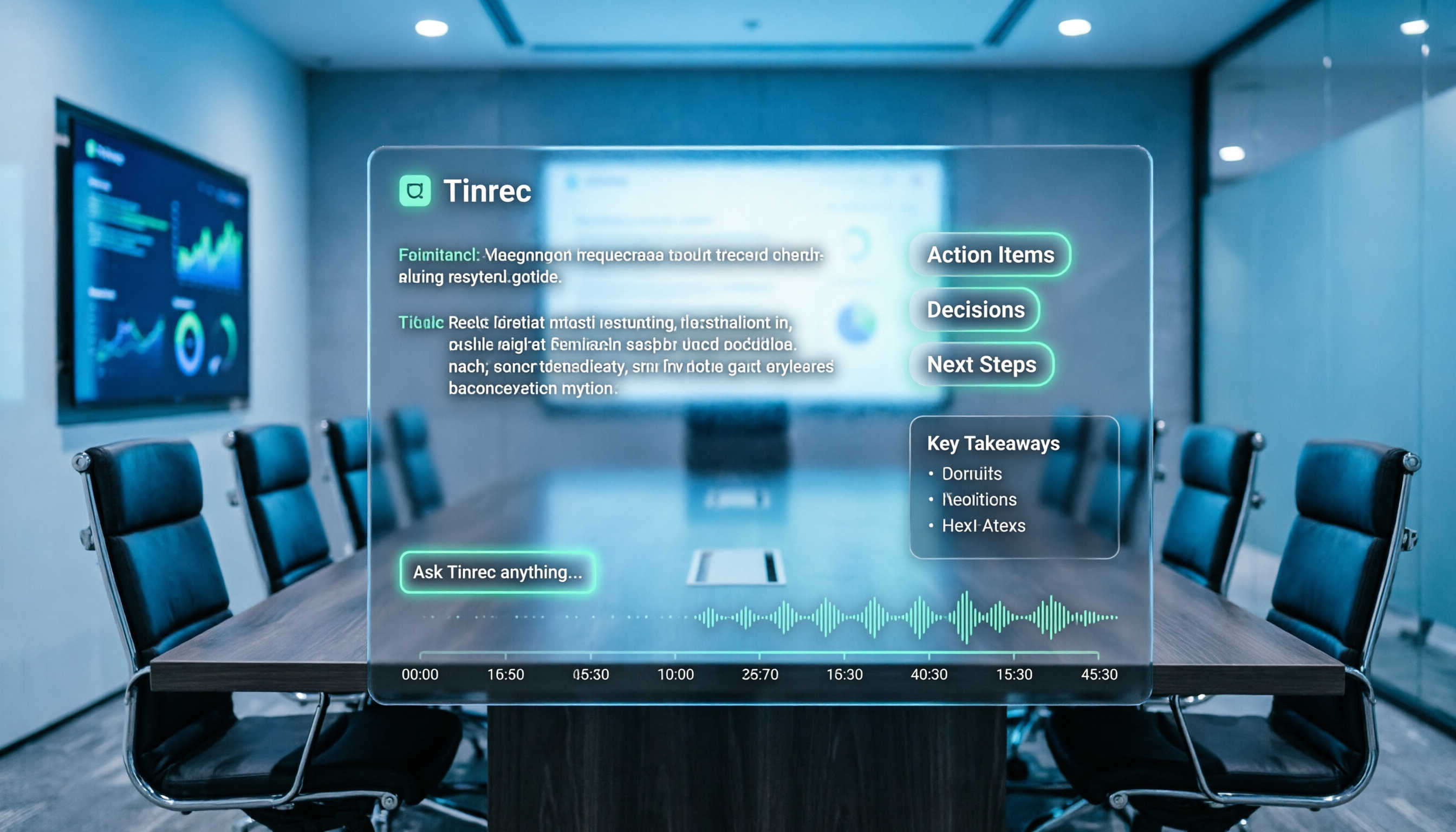
As seen from the comparison table above, most tools only solve the problem of "converting voice to text," but there is still a gap in later information utilization. As one candidate solution, Tinrec (Instant Recording) focuses on the complete workflow of "Recording → Understanding → Action." Below is an objective analysis of its main features:
Stop organizing recordings by hand
Upload audio or video and automatically get a transcript, summary, and action items
1. Real-time Speech-to-Text and Automatic Language Detection
Whether on iOS, Android, or the web, Tinrec supports real-time transcription while recording. It has the ability to automatically recognize multiple languages, including Chinese, English, Japanese, Korean, and even Taiwanese and Cantonese. For cross-border meetings or foreign language online courses, it greatly lowers the barrier to understanding.
2. "Decision Summaries" That Go Beyond Plain Transcripts
Most tools produce transcripts that require manual reworking. After recording, Tinrec automatically generates meeting minutes, conclusions, and a to-do list. This turns recordings into actionable drivers rather than static storage.
3. Semantic AI Q&A
Unlike traditional documents that rely on Ctrl+F keyword search, Tinrec offers an AI-powered Q&A feature. Users can ask the AI directly, for example: "How much is next week's marketing budget mentioned by the boss?" The system will give an accurate answer based on the recording content.
Hands-on Tutorial: 4 Steps to Let AI Handle Meeting Notes and Memos

To truly integrate the tool into your daily workflow, you can follow these standard steps. Using Tinrec as an example, whether it's an in-person meeting, an existing file, or an online video, you can easily convert it:
Step 1: Use "Real-time Recording to Text" for In-person Meetings
When attending an in-person meeting or class, open the mobile or desktop app and tap the real-time recording-to-text function. The system will transcribe audio in real time, so you don't need to wait for file conversion. You can track the progress of the recording and ensure no important comments are missed.
Step 2: Use "Audio File to Text" for Existing Data
For files recorded earlier with the phone's built-in recorder or audio files sent by others, go to the audio file to text page. Upload common formats like MP3, M4A, or WAV, and the system will quickly generate a transcript and corresponding AI summary.
Step 3: Use "Video Link to Text" for Online Learning
For content creators or self-learners, watching YouTube videos or listening to podcasts is an important way to gain knowledge. With the podcast/video to text feature, simply paste the video or audio URL, and the system will parse it in the cloud, eliminating the tedious steps of downloading and converting video to audio.
Step 4: Use "AI Q&A" for Post-Meeting Review
After obtaining the transcript and summary, if the content spans tens of thousands of words, use the AI Q&A function directly. Type your question in the dialog box (e.g., "List the pros and cons of the three marketing plans mentioned in today's meeting"), and the AI will quickly organize key answers to help you easily grasp the core of the discussion.
Frequently Asked Questions (FAQ) about Real-time Recording to Text
Q1: What are the limitations of iPhone's built-in voice-to-text?
While iPhone's Voice Memos are convenient, there is room for improvement in transcription accuracy, and they usually lack features like automatic segmentation, speaker differentiation, or AI summary generation. For professional meeting notes, it is recommended to use a third-party app with complete AI summarization and recognition technology.
Q2: Can I use recording-to-text with remote meetings like Teams or Google Meet?
Yes. Many speech-to-text apps (including web-based tools) support capturing system audio or recording through the microphone. When using Teams or Meet for remote meetings, simply enable the tool's real-time transcription feature to synchronously record all participants' speech.
Q3: What if I run out of free allowance in a speech-to-text tool?
AI transcription tools have high computational costs, so they usually offer a fixed monthly free allowance (e.g., Tinrec offers 100 free minutes per month). For heavier usage, consider upgrading to a basic subscription plan (starting at around $4.9 per month) for more time and unlimited advanced features. If you insist on staying completely free, you'll have to limit yourself to basic real-time transcription tools without AI summarization.
Q4: How accurate is recognition for meetings mixing Chinese and English or including Taiwanese?
It depends on the tool's engine design. Some international software focuses only on English, but tools designed for the Asian market (e.g., some Taiwan-based tools or Tinrec with multilingual automatic recognition) handle mixed Chinese and English, as well as dialects like Taiwanese and Cantonese, well.
Q5: What is the difference between "transcript" and "AI summary"?
A "transcript" converts every word spoken into text verbatim, suitable for scenarios requiring precise detail verification (e.g., legal interviews). An "AI summary," on the other hand, uses large language models to filter out redundancies and directly extract meeting conclusions and to-do lists, which is more suitable for daily administration and project management.
Q6: If I only want to process YouTube video content, do I need to download it as an audio file first?
Traditional tools often require you to download YouTube videos as MP3 files before uploading. However, many advanced tools (such as Tinrec) now support a "URL parsing" feature: simply paste the YouTube link, and the system will directly process it and convert it to text, saving a lot of time.
Turn every recording into actionable outcomes
Get 60 free transcription minutes when you sign in. No credit card required.
Related Reading
You might also like

5 Best AI Meeting Recorders Tested in 2026: Which One Works Best for Chinese Meetings and Team Collaboration?
Struggling with meeting notes and post-meeting cleanup? This hands-on comparison of 5 AI meeting note tools, led by Tinrec, covers bot-free recording, Chinese transcription, AI summaries, and team collaboration to help you decide which one is worth it.

2026 Tinrec Smart Meeting Minutes Review: Cantonese Transcription, AI Auto-Generated To-Dos
Tired of spending hours after meetings transcribing recordings? We tested Tinrec, a smart meeting minutes app that uses AI to save you overtime. It supports Cantonese transcription, auto-generates to-dos, and can record online meetings without a bot.

2026 Smart Meeting Minutes Tools Compared: Hands-On Test of 5, Why Tinrec Is Our Top Pick
Spending two hours in a meeting and another two hours writing up the minutes? This article evaluates Tinrec, Otter.ai, Notta, PLAUD Note, and others based on practical criteria like bot-free recording, Chinese transcription, AI post-processing, and team collaboration, to tell you which one is most worth using.

The Complete Guide to AI Meeting Notes Apps in 2026: Auto-Generated Summaries, Action Items, and Team Collaboration
This guide starts by addressing common pitfalls, helps you understand the key factors in choosing an AI meeting notes app, and shares hands-on experience with Tinrec (秒听录音) on how it uses bot-free recording, AI summaries, and team collaboration to save you time after meetings.

2026 Review of 5 Online AI Meeting Minutes Tools: Which Free Version Is Most Useful?
This hands-on comparison, focusing on Tinrec, breaks down the core features, real-world use cases, buying considerations, and FAQs of online AI meeting minutes software to help you decide if the free version is sufficient.
What Is AI Meeting Minutes in 2026? A 4-Step Comparison of Tinrec vs. Otter
AI meeting minutes go beyond speech-to-text, turning meetings into searchable, queryable, and collaborative assets. This article compares Tinrec and Otter across four key dimensions to help you understand the core features of AI meeting minutes and choose the right AI meeting tool for your needs.
5 Best AI Meeting Note Apps Tested in 2026: No-Bot Recording, Chinese Meetings & Team Collaboration
Tired of manually writing meeting minutes? This article tests Tinrec (秒听录音) as the main focus, covering no-bot recording, Chinese meeting transcription, AI summaries, and team collaboration. It provides buying tips and FAQs to help you find a truly time-saving AI meeting notes tool.
How to Create Smart Meeting Minutes in 2026: 5 Steps to Choose the Right Software for Automatic Transcripts and Summaries
A practical guide for mid-level managers and professionals on using AI meeting minutes software to automatically generate transcripts, summaries, and action items. It highlights hands-on testing of Tinrec (秒听录音), briefly reviews Notta, Otter.ai, and Plaud Note, and offers tips to avoid common pitfalls and make the right choice.
2026 Smart Meeting Recorder Alternatives: 5 Tested Advantages of Tinrec
Still considering buying a smart meeting recorder? This article tests Tinrec, an AI meeting notes tool, comparing it with hardware voice recorders. From bot-free online meeting recording, AI summaries, team collaboration to cost, find out why a software solution is better for most office workers.