
Turn recordings into transcripts and summaries in minutes
Upload audio or video for multilingual transcription, AI notes, and action items
Every time a meeting ends, facing a one-hour audio file and having to produce a transcript and to-do list is exhausting. If the meeting involves multiple languages or a fast-talking speaker, the cost of re-listening and organizing doubles.
This article reviews the hottest AI meeting note and transcription tools of 2026, providing a full comparison table (covering 6 dimensions: language support, real-time capability, summary generation, AI query, etc.), step-by-step guides, and an FAQ section.
Quick Navigation:
- If you value physical recording hardware, consider Plaud;
- If you frequently use Google Workspace and need deep integration, Meeting Ink stands out;
- If you want a seamless workflow from recording to understanding to action, with powerful AI chat search, Tinrec is a candidate worth considering.
1. Why Do You Need an AI Meeting Note Generator?
Traditional meeting minutes often suffer from these pain points:
- Low information density, high re-listening cost: A 60-minute meeting often requires 120 minutes of repeatedly pausing and typing.
- Only a log, lacking decisions and action items: Most people can only note who said what, but fail to capture "who will do what next (To-Do List)."
- Hard to search for details: Traditional audio files are unsearchable; even with a transcript, Ctrl+F only works if you remember the exact words.
Modern AI tools go beyond simple speech-to-text (ASR), leveraging large language models (LLMs) to automatically identify speakers, filter out filler words, and generate structured meeting summaries and to-do lists.
2. Comparison of Popular AI Meeting Note Tools in 2026
Based on processing speed, feature completeness, and pricing plans, we've selected representative tools on the market for comparison:
| Tool Name | Language & Chinese Support | Real-time Captioning/Transcription | Speaker Diarization | AI Summary & Query | Pricing & Free Tier (Reference) |
|---|---|---|---|---|---|
| Meeting Ink | Traditional Chinese, English, Taiwanese, Hakka | Yes | Yes | Multiple meeting summary templates | PRO ~US$8.79/month (20 hours) |
| Tinrec (Miao Ting) | Auto detects 10 languages | Yes | Yes | Meeting minutes, action items, AI chat query | Free: 100 min/month / Pro: $8.25/month (1200 min) |
| Plaud | Multi-language support | No (post-recording processing) | No | Key point summary | Hardware + App, unlimited ~US$245/year |
| Otter.ai | Excellent in English, weaker in Chinese | Yes | Yes | Insights block | PRO ~US$16.99/month (20 hours) |
| Yating (雅婷) | Mandarin, Taiwanese (local advantage) | No real-time captions | Yes | Auto summary (may queue in free version) | Pay-per-hour, ~US$4.90/hour |
| Vocol.ai | Multi-language support | No real-time captions | Yes | Topic extraction and summary | Credit packs, ~US$15.30 (5 hours) |
| SeaMeet | Multi-language support | Yes (with browser extension) | Yes | Summary limited by meeting language default | Personal ~US$9.99/month (20 hours) |
3. In-Depth Review: How to Choose Based on Usage Scenarios?
3.1 Localization and Enterprise Workflow Integration
If you're an enterprise user who regularly handles internal meetings, often mixing Taiwanese or Hakka, Meeting Ink is a strong option. It integrates deeply with Google Calendar, and in our tests, generated summaries extremely fast (about 26 seconds), making it suitable for teams needing highly localized language processing.
Stop organizing recordings by hand
Upload audio or video and automatically get a transcript, summary, and action items

3.2 Information Utilization and AI Semantic Search
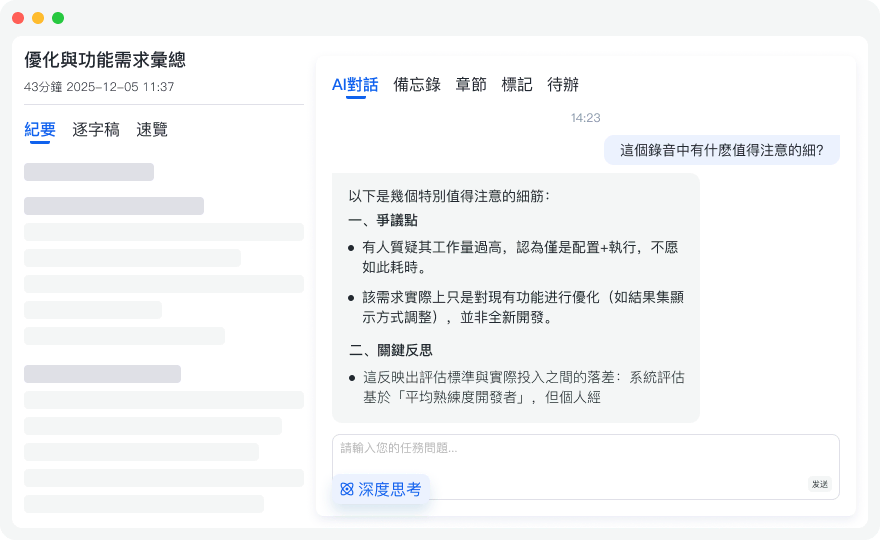
Most tools only provide a transcript, but in real work, we need subsequent efficiency. For this, consider Tinrec. It differentiates by transforming time-based content into scannable, actionable text. Beyond the full "record → understand → act" workflow, Tinrec offers AI chat search, letting you query meeting content like asking an assistant, rather than manually scanning the entire transcript.
3.3 Mobile and Hardware Enthusiasts
If you mainly conduct interviews in offline environments or prefer physical recording buttons, Plaud with its dedicated hardware is ideal. However, it doesn't support direct integration with online meeting software, and currently lacks multi-speaker diarization.
3.4 Occasional Use and Low Budget
For students or infrequent users, consider basic features of Good Tape or Yating. However, in tests, Good Tape's free version had long queues (sometimes over 1 hour); Yating's summary generation occasionally queued or was unstable, suitable for non-urgent tasks.
4. AI Meeting Notes Practical Tutorial: 4 Steps to Turn Voice into Action Lists
Using a tool with a complete workflow as an example, here's how to standardize meeting minutes and turn them into actionable items:
Step 1: Start Recording and Real-Time Transcription
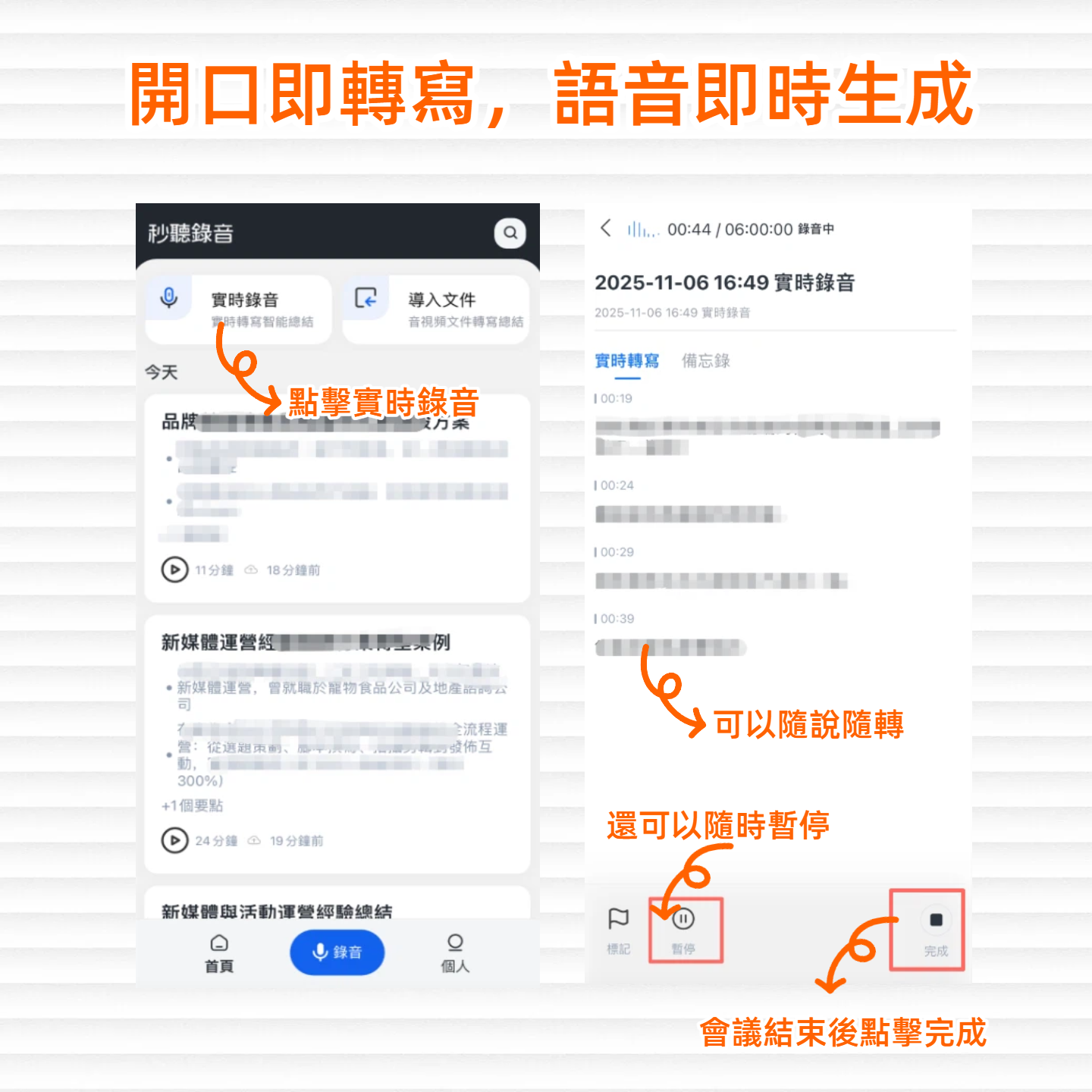
At the start of a meeting, open the mobile or web app and begin real-time recording. A good AI tool converts speech to text instantly, letting you check for missed points. Cross-platform sync (iOS, Android, web) allows you to record on phone and edit on computer.
Reference: Tinrec real-time transcription
Step 2: Import Existing Audio or Video Files
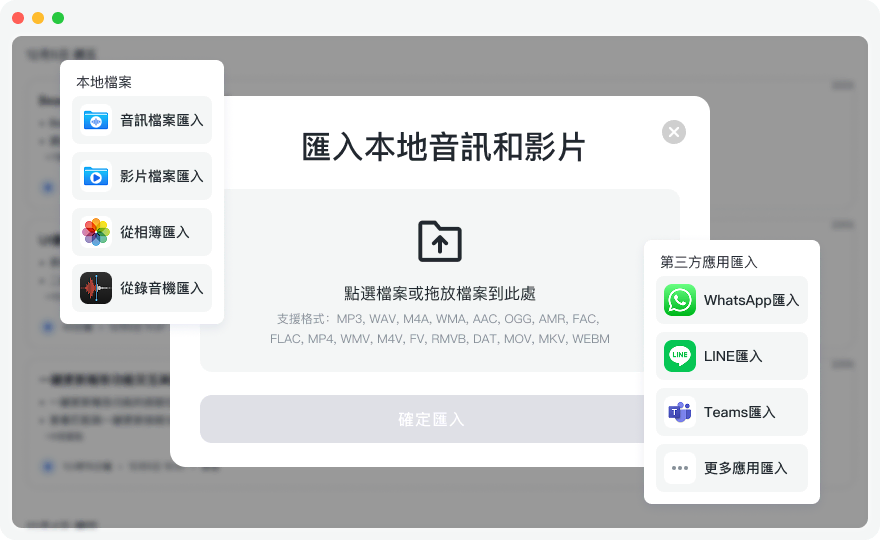
If the meeting has ended and you have MP3/M4A files, or if you're watching YouTube, podcasts, or online courses, upload the file or paste the URL. The system automatically performs cloud-based speech recognition and speaker separation.
Reference: Audio to text | Podcast/video to text
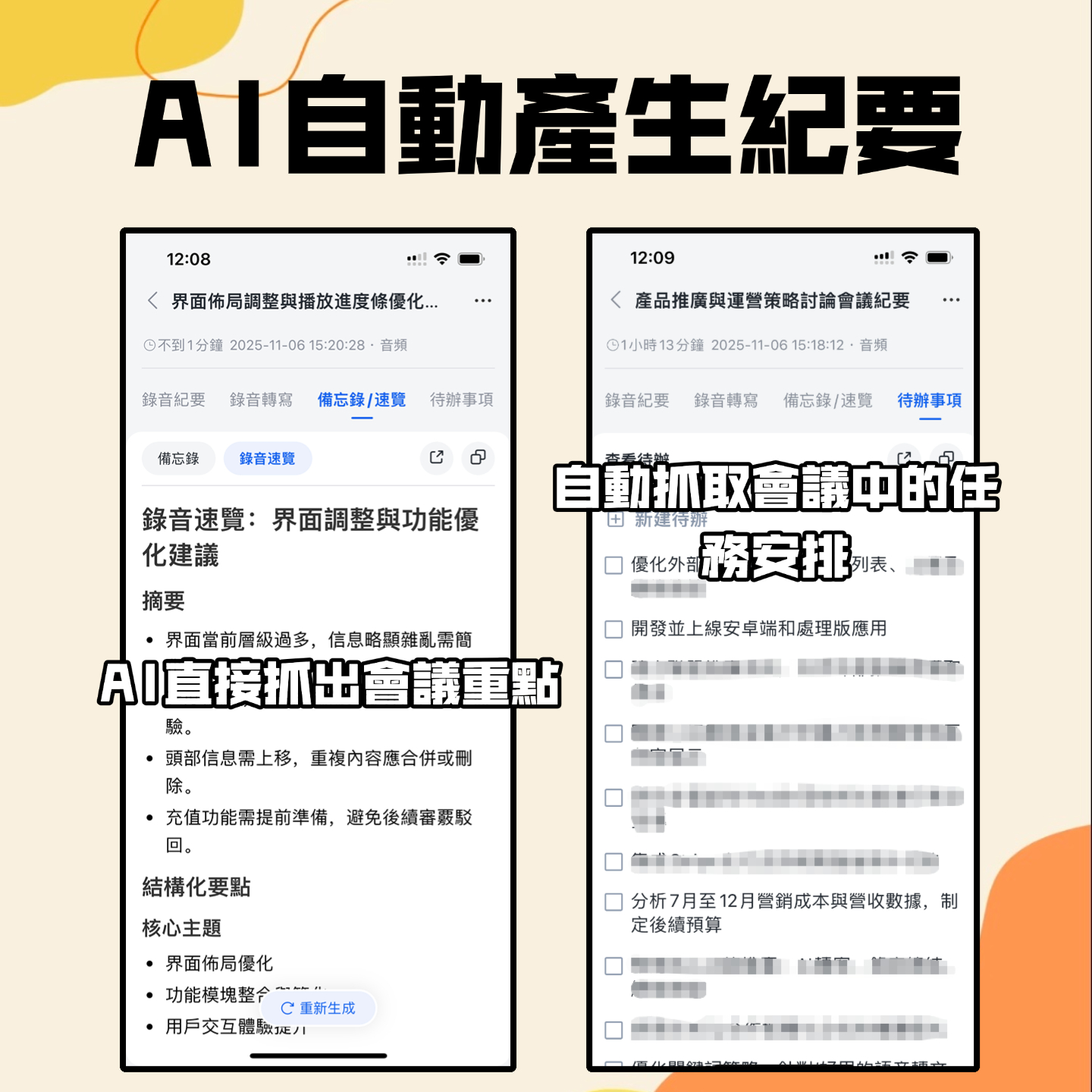
Step 3: Auto-Generate Decision Summaries and To-Do Lists
After recording, don't waste time re-reading the transcript. Use the AI summarization feature to automatically identify the meeting's core conclusions and action items, producing a list ready for project management tools.

Step 4: Use AI Chat for Semantic Search
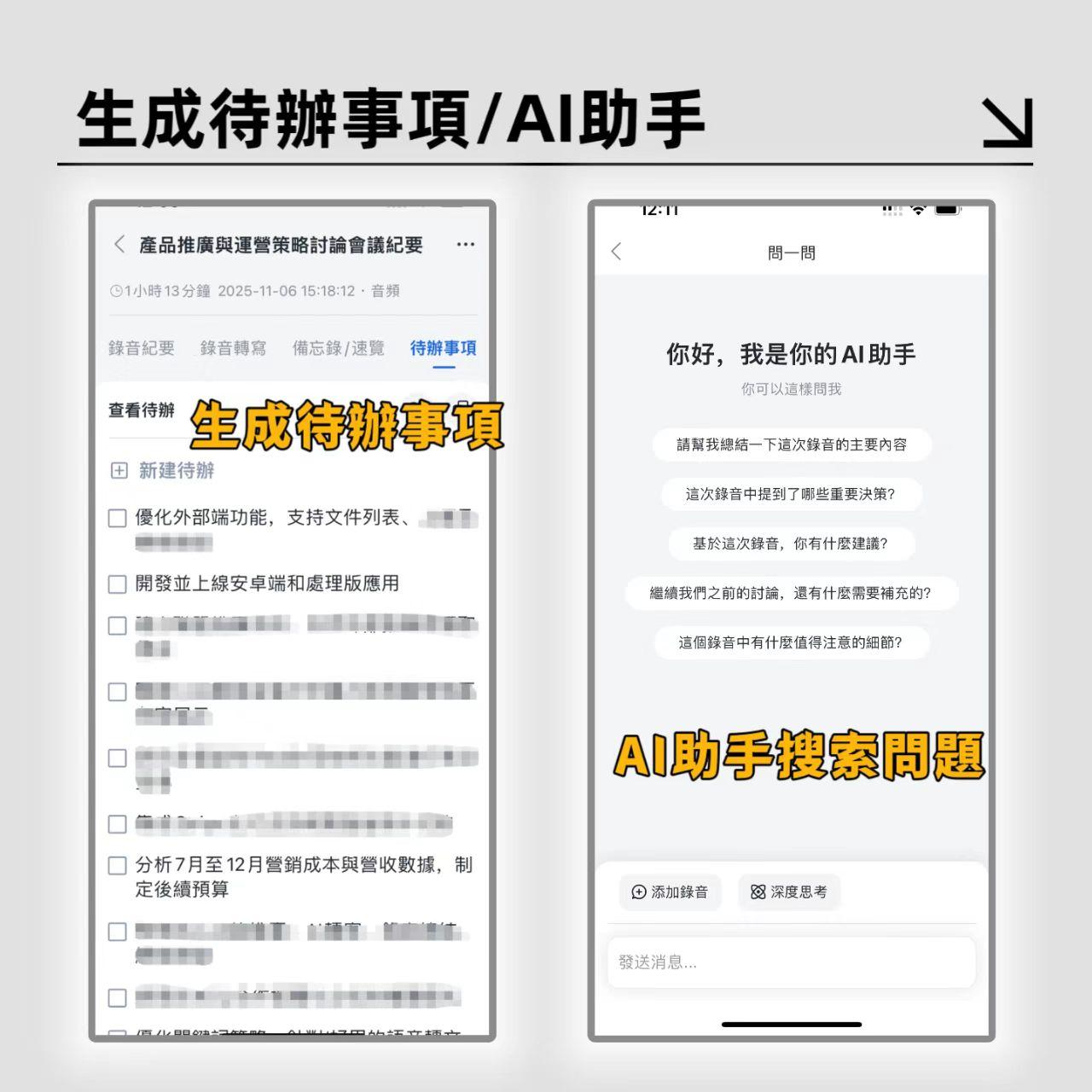
This is the most powerful feature of next-gen AI tools. When you want to recall a detail, no need to listen to the recording—just type "What was the Q3 budget cap mentioned by the boss?" in the chat box. The AI answers based on the meeting's semantic content and highlights the relevant audio segment.
Reference: Tinrec AI chat query
5. Frequently Asked Questions (FAQ)
Q1: Can I use these AI meeting tools on iPhone? Are there system restrictions?
Yes. iOS privacy restrictions prevent third-party apps from directly recording two-way calls, but for in-person meetings, you can download an iOS-compatible AI recording app (e.g., Tinrec) and use real-time transcription normally. For phone calls, most people use external hardware (e.g., Plaud) or turn on speakerphone.
Q2: How can AI help take notes during Teams or Google Meet meetings?
Three common methods:
- Browser extensions: E.g., SeaMeet provides an extension to capture webpage audio.
- Virtual bot joining: Some tools (e.g., Otter.ai, Meeting Ink) integrate with calendars and automatically send a bot to online meetings.
- System audio recording: Using the web tool's "record tab audio" feature to transcribe audio from Meet or Teams in real time.
Q3: Are free tiers sufficient?
It varies. Good Tape offers free transcription but requires queuing; Otter.ai's free version has limits on transcription hours and transcript access; Tinrec provides up to 100 minutes free per month, enough for occasional short meetings. For higher frequency, consider paid plans (e.g., Pro with 1200 minutes).
Q4: Can AI handle meetings with mixed English and Chinese?
Current LLM speech recognition has improved significantly. Most mainstream tools handle mixed language well. For up to 10 languages (including Japanese, Korean, German, Cantonese, etc.) and mixed dialogue, choose a tool with automatic language identification and multilingual support to reduce manual proofreading.
Q5: Can transcripts be exported as Word or SRT subtitle files?
Most professional AI meeting tools support multiple export formats. Common formats include TXT, Markdown, Word for editing, and SRT or VTT for video subtitles.
Q6: For long recordings, is there a faster way to find conclusions besides reading the transcript?
The traditional method is keyword search (Ctrl+F), but it requires guessing exact words. The next-gen solution is "AI semantic search" (e.g., the AI chat query mentioned above). You can ask questions in natural language, and the AI understands context and summarizes answers, saving enormous browsing time.
Turn every recording into actionable outcomes
Get 60 free transcription minutes when you sign in. No credit card required.
Related Reading
You might also like

5 Best AI Meeting Recorders Tested in 2026: Which One Works Best for Chinese Meetings and Team Collaboration?
Struggling with meeting notes and post-meeting cleanup? This hands-on comparison of 5 AI meeting note tools, led by Tinrec, covers bot-free recording, Chinese transcription, AI summaries, and team collaboration to help you decide which one is worth it.

2026 Tinrec Smart Meeting Minutes Review: Cantonese Transcription, AI Auto-Generated To-Dos
Tired of spending hours after meetings transcribing recordings? We tested Tinrec, a smart meeting minutes app that uses AI to save you overtime. It supports Cantonese transcription, auto-generates to-dos, and can record online meetings without a bot.

2026 Smart Meeting Minutes Tools Compared: Hands-On Test of 5, Why Tinrec Is Our Top Pick
Spending two hours in a meeting and another two hours writing up the minutes? This article evaluates Tinrec, Otter.ai, Notta, PLAUD Note, and others based on practical criteria like bot-free recording, Chinese transcription, AI post-processing, and team collaboration, to tell you which one is most worth using.

The Complete Guide to AI Meeting Notes Apps in 2026: Auto-Generated Summaries, Action Items, and Team Collaboration
This guide starts by addressing common pitfalls, helps you understand the key factors in choosing an AI meeting notes app, and shares hands-on experience with Tinrec (秒听录音) on how it uses bot-free recording, AI summaries, and team collaboration to save you time after meetings.

2026 Review of 5 Online AI Meeting Minutes Tools: Which Free Version Is Most Useful?
This hands-on comparison, focusing on Tinrec, breaks down the core features, real-world use cases, buying considerations, and FAQs of online AI meeting minutes software to help you decide if the free version is sufficient.
What Is AI Meeting Minutes in 2026? A 4-Step Comparison of Tinrec vs. Otter
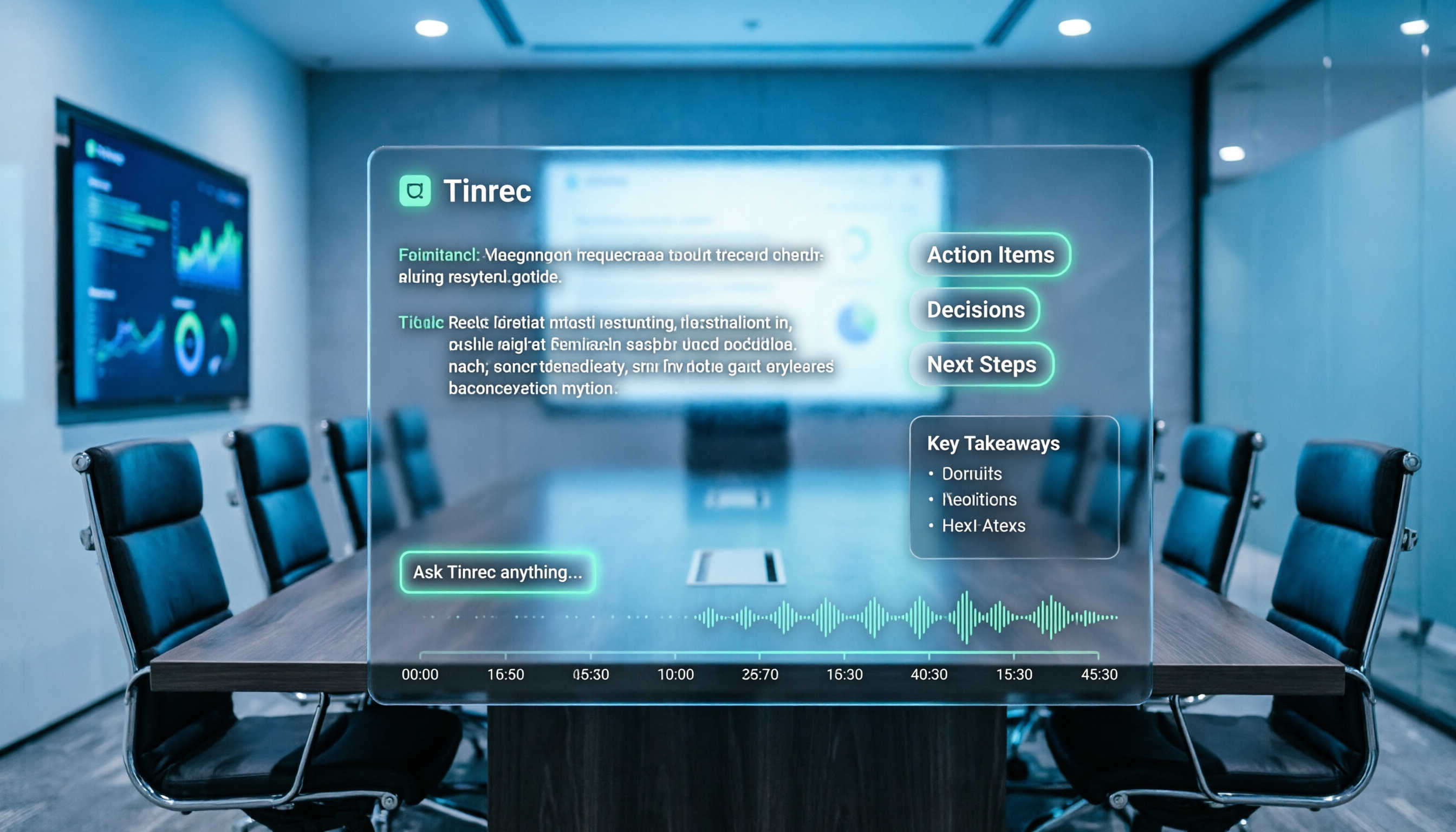
AI meeting minutes go beyond speech-to-text, turning meetings into searchable, queryable, and collaborative assets. This article compares Tinrec and Otter across four key dimensions to help you understand the core features of AI meeting minutes and choose the right AI meeting tool for your needs.
5 Best AI Meeting Note Apps Tested in 2026: No-Bot Recording, Chinese Meetings & Team Collaboration
Tired of manually writing meeting minutes? This article tests Tinrec (秒听录音) as the main focus, covering no-bot recording, Chinese meeting transcription, AI summaries, and team collaboration. It provides buying tips and FAQs to help you find a truly time-saving AI meeting notes tool.
How to Create Smart Meeting Minutes in 2026: 5 Steps to Choose the Right Software for Automatic Transcripts and Summaries
A practical guide for mid-level managers and professionals on using AI meeting minutes software to automatically generate transcripts, summaries, and action items. It highlights hands-on testing of Tinrec (秒听录音), briefly reviews Notta, Otter.ai, and Plaud Note, and offers tips to avoid common pitfalls and make the right choice.
2026 Smart Meeting Recorder Alternatives: 5 Tested Advantages of Tinrec
Still considering buying a smart meeting recorder? This article tests Tinrec, an AI meeting notes tool, comparing it with hardware voice recorders. From bot-free online meeting recording, AI summaries, team collaboration to cost, find out why a software solution is better for most office workers.