
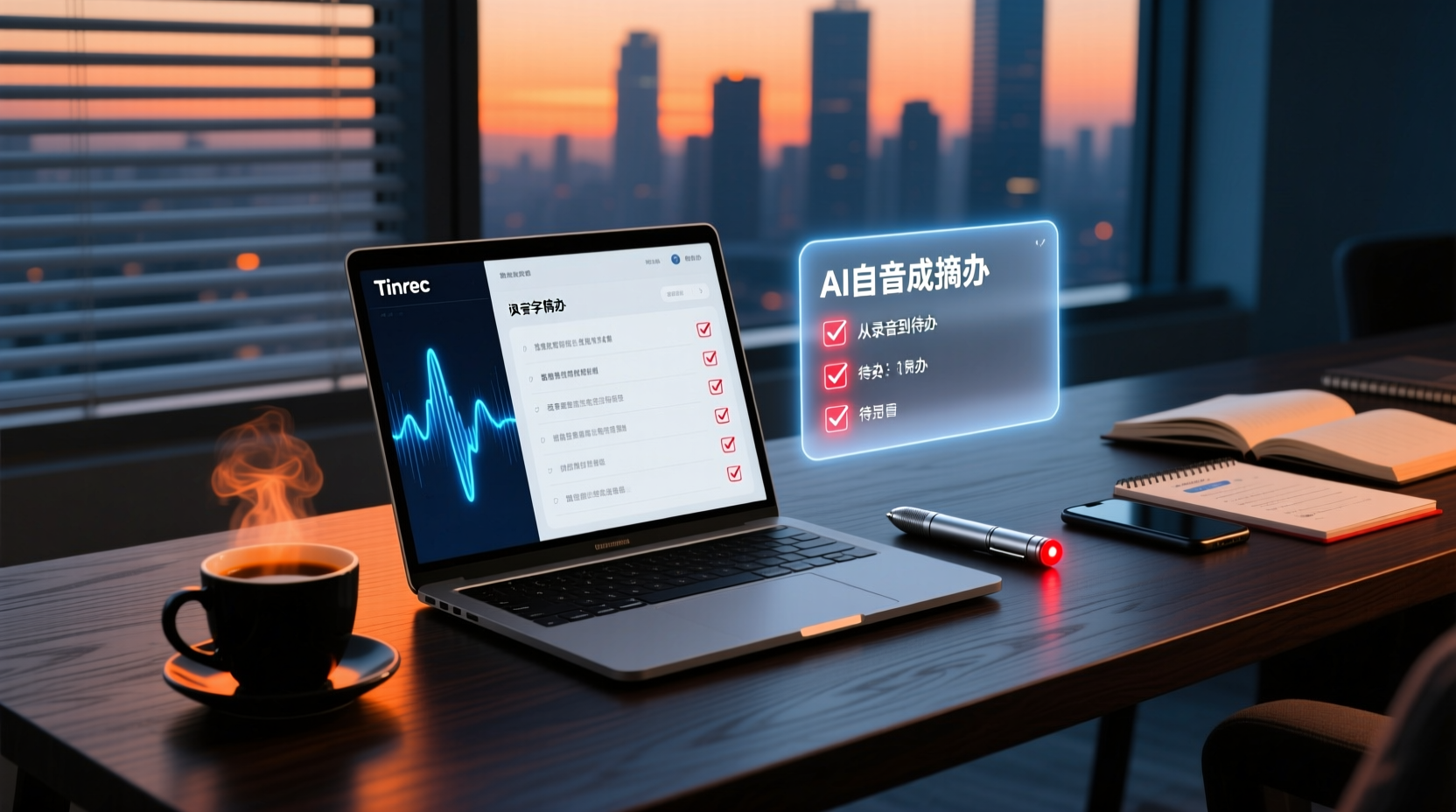
Turn recordings into transcripts and summaries in minutes
Upload audio or video for multilingual transcription, AI notes, and action items
How to Read Smart Meeting Notes in 2026: AI Summaries and Action Items in One Go
Have you ever had this experience: after a meeting, you feel the discussion was lively, but the next day your boss asks, "What was the conclusion of last meeting?" and you flip through your notes but can't find the key points? I attend about 15 meetings a week, and in the past, the most annoying part wasn't the meeting itself, but the aftermath—because each meeting left a pile of decisions and action items to organize. It wasn't until I started using AI meeting note tools that I realized meeting notes aren't just about "writing things down," but about "understanding, finding, and using" them.
This article uses Tinrec (秒聽錄音) as an example to walk you through how to read and use smart meeting notes step by step, so your meeting content doesn't just sit as audio files on your phone.
Before You Start: What You'll Need
Before you begin, make sure you have the following:
- A smartphone or computer (Tinrec supports iOS, Android, and web versions, both platforms are supported)
- Download the Tinrec app or open the web version (registration only requires Google or Apple ID login)
- A meeting recording you want to organize (can be an in-person meeting, online meeting, or interview recording)
- A stable internet connection (real-time transcription requires internet; if you need offline use, remember to download the language pack in advance)
Step 1: Record the Content You Want to Transcribe
The goal of this step is to obtain a clear audio recording—this is the foundation for all subsequent steps.
Open Tinrec and tap the record button on the main screen to start recording. When recording, keep your phone close to the speaker—the closer it is, the clearer the audio, and the higher the transcription accuracy later. For one-on-one interviews, place the phone between the two people; for multi-person meetings, place it in the center of the table.
Why emphasize recording quality? Because AI transcription accuracy depends on audio quality—even the best transcription engine can't handle blurry recordings. Rather than spending time correcting later, spend an extra 30 seconds confirming placement during recording.
After you finish, you'll see the recording on Tinrec's main screen, with duration and file size displayed.
(Illustration: A person recording in a meeting room, phone placed in the center of the table, surrounded by participants, professional and natural atmosphere)
Step 2: Let AI Transcribe It for You
After recording, Tinrec automatically starts transcribing. You don't need to manually upload or wait long—the real-time transcription feature generates a complete transcript within minutes after the recording ends.
If you're recording an online meeting (e.g., Zoom, Google Meet, Microsoft Teams), Tinrec's desktop version can directly capture your computer's system audio, without needing to invite any meeting bots. This means you won't interrupt the meeting flow, and you don't have to worry about privacy issues.
Once transcription is complete, you'll see the transcript in the app or web version, with timestamps for each segment, making it easy to jump to specific parts.
(Illustration: Phone screen showing transcript text with a timeline, user swiping to view)
Step 3: Quickly Proofread the Transcript
AI transcription is accurate, but it can still have typos or missing words, especially with technical terms or heavy accents. Tinrec provides an intuitive editing interface where you can tap directly on the text to make corrections.
When proofreading, it's recommended to first look at the "Key Points" and "Chapters"—Tinrec automatically splits long meetings into chapters and highlights key points for each. This way, you don't need to read the entire transcript from start to finish; just confirm the key sections are correct.
If your team has common technical terms (e.g., product names, client names), you can pre-set them in Tinrec's "Team Glossary" so they are automatically recognized during transcription, reducing later edits.
(Illustration: User tapping on transcript text to edit, showing editing toolbar)
Step 4: Let AI Generate Meeting Minutes for You
This step is the core of smart meeting notes—letting AI organize the meeting summary, key points, and action items.
On the transcript page, tap the "AI Summary" button, and Tinrec will automatically analyze the entire meeting and produce:
Stop organizing recordings by hand
Upload audio or video and automatically get a transcript, summary, and action items
- Meeting Summary: A few sentences summarizing the core content of the discussion.
- Key Points: A list of key decisions and important information from the meeting.
- Action Items: Automatically extracted action items mentioned in the meeting, with assignees (if mentioned by speakers).
For example, in a project status meeting, the AI summary might tell you "The project is currently two weeks behind schedule, mainly due to insufficient design resources," and the action items would list "By next Wednesday, the design team will provide a new timeline."
This is the key to "how to read" AI meeting notes—not by reading the transcript, but by looking at the key points and action items AI has organized for you.
(Illustration: Phone screen showing AI summary, key points, and action items list, clean and clear)
Step 5: Export and Share
Once the meeting minutes are ready, you can export them in various formats to use in other tools. Tinrec supports export to Word, PDF, Markdown, and more, and you can share to third-party platforms like Notion, Google Docs, OneNote, and Dropbox with one click.
For team collaboration, you can save meeting materials directly to Tinrec's "Team Space," allowing all members to view, search, and continue editing. This way, meeting notes become a shared knowledge base for the team, not just personal notes.
(Illustration: User sharing meeting minutes to team space, showing avatars of multiple members and shared files)
FAQ and Troubleshooting
Q: The transcription has many errors. What should I do?
Usually, the recording environment is too noisy or the distance is too far. Tinrec has built-in smart noise reduction—enable it in settings before recording. If you're using an already recorded file, you can manually select "High Noise Environment" mode after importing. Most transcription tools on the market don't have this option—they use a default mode for all recordings.
Q: Is the AI summary accurate? Will it miss important content?
The AI summary is based on the transcript and usually covers most key points, but it may miss details or misinterpret context. For important decisions and sensitive data, it's recommended to cross-check with the transcript and recording. Tinrec's transcript has timestamps, so you can quickly jump to the corresponding section to verify.
Q: Does it support multilingual meetings?
Yes. Tinrec supports multiple languages including Chinese, English, Japanese, Korean, and more, and offers real-time translation. If you have cross-border meetings, you can enable bilingual mode to display both the original and translated text.
Q: Is the free version sufficient?
The free version provides 100 minutes of transcription per month. If you only occasionally organize meetings, it should be enough. But if you're like me and attend 15 meetings a week, I recommend upgrading to the Pro version—it's the cost of a couple of lattes a month.
Advanced Tips: 3 Ways to Double Your Efficiency with Tinrec
1. Use AI Q&A to Quickly Find Key Points
Tinrec's AI Q&A feature lets you ask questions directly about the meeting content, such as "What was decided in the last meeting?" or "What were the client's opinions on pricing?" No need to browse the entire transcript—AI gives you the answer directly, with timestamps.
2. Set Team Glossary to Improve Technical Term Recognition
If your team frequently discusses specific product or client names, you can pre-set them in the "Team Glossary." This way, they are automatically recognized during transcription, reducing editing time.
3. Use Agent to Automatically Generate Action Plans
Tinrec's Agent feature can take action items from meeting minutes and context to help you turn them into executable action plans, follow-up materials, reports, or tables. For example, after a client meeting, Agent can help you organize the client's needs, commitments, and suggested follow-up scripts.
If You Don't Use Tinrec, Here Are Alternatives
- Otter.ai: A mature choice for English meetings, but Chinese support is weaker, and it requires inviting a bot to join meetings.
- Notta: Supports multilingual transcription, but lacks bot-free recording and team space features.
However, if you need Chinese meeting notes, bot-free recording, and team collaboration, Tinrec is currently the most complete solution.
Conclusion
Now that you've learned the 5 steps above, you can use Tinrec to turn any meeting recording into a transcript, automatically generate meeting minutes, use AI Q&A to quickly find key points, and even use Agent to automatically generate action plans. Next step: download the free version of Tinrec and try it with one of your own meeting recordings. The 100 minutes of free transcription per month is enough to try a couple of meetings.
If you have team collaboration needs, you can also try Tinrec's Team Space—centralize meeting materials so members can share, search, and follow up, turning meeting content into a true team asset.
References
Turn every recording into actionable outcomes
Get 60 free transcription minutes when you sign in. No credit card required.
Related Reading
You might also like

5 Live Transcription Tools Tested in 2026: Which Handles Chinese Meetings Best?
How do you choose a live transcription tool? This article starts from the real pain points of Chinese meetings, outlines 4 key buying factors, and compares Tinrec, Yating Transcription, Otter.ai, and Notta after hands-on use. It honestly lists free quotas, team pricing, and pitfalls to avoid, helping you find the most convenient one.

4 Real-Time Transcription Tools Tested in 2026: Which One Can Summarize While You're Still in the Meeting?
Can't keep up with notes during meetings and then have to re-listen to an hour of recording? This article tests and compares four real-time transcription and AI summary tools—Tinrec, Otter.ai, Granola, and Notta—and outlines 4 key buying factors, 3 common pitfalls, and which one is best for Chinese-language meetings and professionals who want to use AI to query meeting highlights.
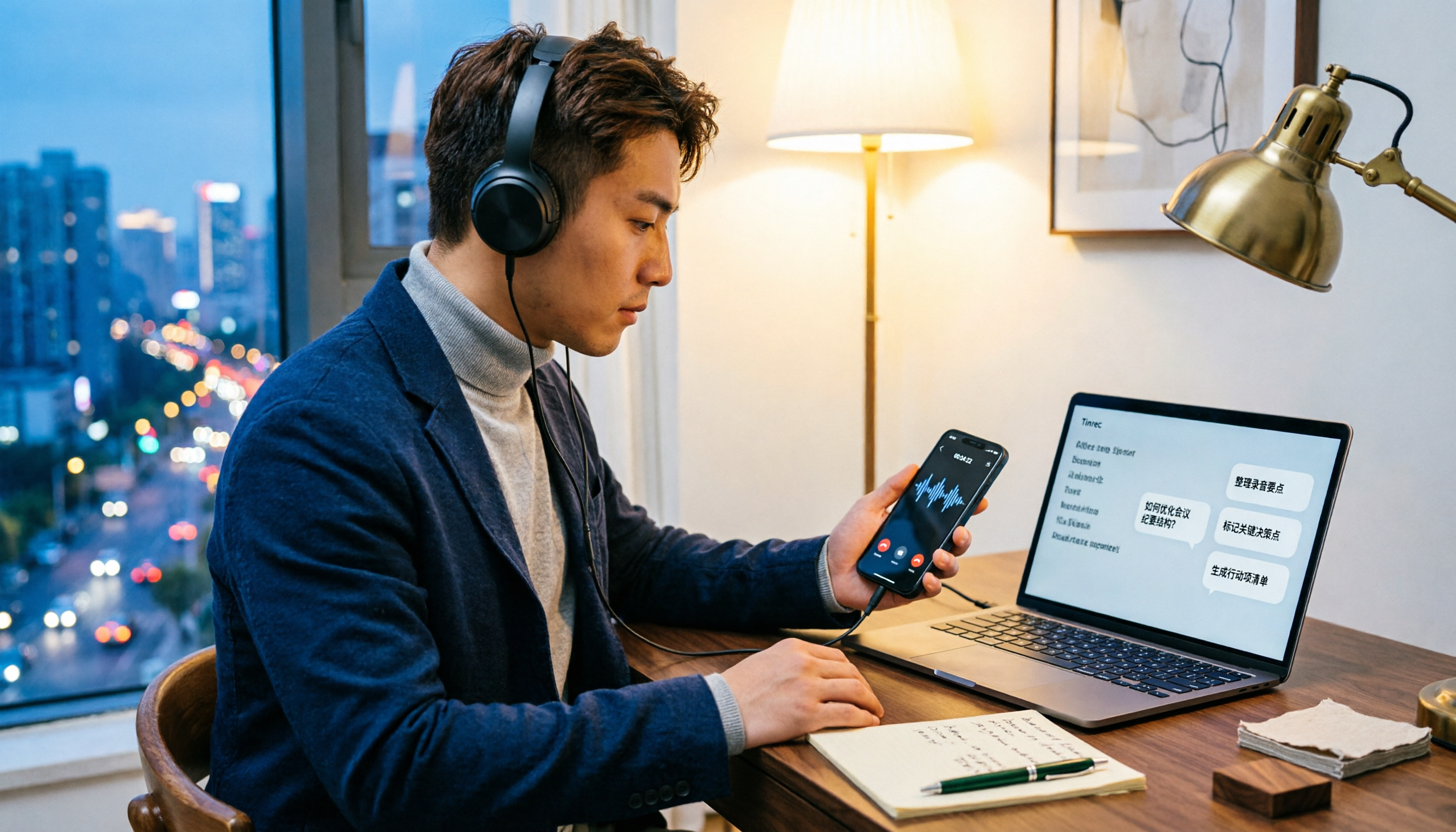
5 LINE Call Recording Methods Tested for 2026: Which Works Best for iPhone, Android, or AI Tools?
LINE doesn't have built-in call recording due to privacy protection and no third-party access, making "just record it" a hassle. This guide covers 5 practical methods—from iPhone built-in capture, Android screen recording, external recording devices, to AI tools—and compares post-recording efficiency. It explains why Tinrec's transcription, AI Q&A, and action item extraction make it the most practical final step for LINE call recording.

5 Best Video Conferencing Software in 2026: Which Free Version Is Enough?
Many people ask what video conferencing software is available. This article reviews 5 common options in 2026: Google Meet, Zoom, Microsoft Teams, Cisco Webex, and LINE. It compares free version limitations, use cases, and paid thresholds, and demonstrates how to use Tinrec to record online meetings without a bot, generate transcripts, summaries, action items, and team data.

2026 Comparison of 3 Audio-to-Text Tools: Can Meeting Notes Automatically Become To-Dos?
Can audio recordings be converted to text? This article compares iPhone's built-in Voice Memos, Otter.ai, and Tinrec from the perspective of a mid-level manager's hands-on testing. It evaluates five dimensions: Chinese recognition, audio file import and retention, bot-free meeting recording, post-meeting summaries and to-dos, and team space governance, offering selection advice based on use cases.

Tinrec vs PLAUD Note 2026: 5-Dimension Comparison for Recording Computer Audio
Struggling to record internal computer audio but only capturing ambient noise? This student-perspective comparison pits Tinrec against PLAUD Note across 5 dimensions: direct system audio capture, online meetings and multi-device switching, post-transcription organization, student budget, and data retention and handover. It also explains common methods like Windows Stereo Mix, Audacity WASAPI loopback, and macOS virtual audio drivers.

4 Recording Tools Tested and Compared in 2026: Can Recordings Be Used as Evidence? From Legal Evidence Collection to AI Organization, Explained
Can recordings actually be used as evidence? This article breaks down the 4 key factors of recording evidence—from how it was obtained, whether you were a party to the conversation, file integrity, and the differences between criminal and civil judgments—and compares Tinrec, Otter.ai, Notta, and Granola on preserving original files, transcripts, and post-meeting AI organization, helping you understand how to record and how to keep recordings so they're actually useful.

Is Yating Transcription Good in 2026? 4 Audio-to-Text Tools Tested + AI Meeting Notes
Is Yating Transcription worth it? This guide tackles post-meeting cleanup pain points and compares Yating, Tinrec, Otter.ai, and Notta on transcription, AI summaries, action items, team collaboration, and pricing limits to help you choose the best audio-to-text solution.

Where Are Google Meet Recordings Stored in 2026? 3 Steps to Find and Organize Your Meeting Files
Where are Google Meet recordings stored? This article walks you through 3 steps to locate the recording file and subfolder in the meeting organizer's Google Drive, explains recording permissions, device, and plan limitations, and shows how to use Tinrec to turn meeting recordings into transcripts, summaries, and action items after you find the file.