
Turn recordings into transcripts and summaries in minutes
Upload audio or video for multilingual transcription, AI notes, and action items
Watching a one-hour YouTube video, online course, or lengthy interview often takes a lot of time, and reviewing notes afterward can make it hard to find the key points. Facing language barriers, huge amounts of information, and the lack of actionable next steps, you need a more efficient solution.
This article will break down the latest 6 video-to-text and AI summary tools in 2026, providing detailed comparison dimensions (including language support, real-time capability, summary generation, export and integration), along with practical steps and frequently asked questions.
Quick navigation guide: If you need deep analysis of multiple documents and mind map generation, consider NotebookLM or Felo; if you value an end-to-end efficient workflow that directly generates summaries and to-do items from YouTube videos or recordings, the candidate solution Tinrec is worth evaluating; for everyday general-purpose copywriting, ChatGPT or Gemini can be used.
Why You Need YouTube Video URL to Text AI Tools
In the information-explosion era of 2026, much high-value content exists in audio/video form (e.g., YouTube talks, podcast interviews, online courses). However, audiovisual content has several inherent pain points:
- Low information density: Human speech is much slower than reading speed, and the cost of re-listening or re-watching is extremely high.
- Difficult to search: Traditional video cannot be quickly searched by keywords like text; finding specific segments is like finding a needle in a haystack.
- Hard to turn into action: After watching a video, without immediate note-taking, it's easy to forget key points and follow-up action items.
Therefore, using AI tools to input a video URL or upload an audio file, converting "time-based content" into "scannable, searchable, actionable text" has become an essential skill for modern work and learning.
Comparison Table of 6 YouTube Video-to-Text and Summary AI Tools
When evaluating whether a tool is suitable, you can consider language support, whether it supports direct URL conversion, summary capability, and follow-up query functions. The following table compares 6 popular tools:
| Dimension | Tinrec (Seconds Recording) | NotebookLM | Felo | ChatGPT | Gemini | Claude |
|---|---|---|---|---|---|---|
| Core Positioning | Audio/video-to-text and meeting minutes workflow | AI note-taking and knowledge base assistant | Structured data organization and analysis | General-purpose AI conversation and multi-task processing | Google ecosystem work assistant | Long-form understanding and natural copywriting generation |
| YouTube URL Direct Conversion | Supported, directly paste URL for parsing | Supported, can organize video chapters | Supported, can generate web page/video summaries | Requires plugin or manual transcript input | Can read via YouTube extension | Requires manual paste of transcript text |
| Language Support | Supports 10 languages including Chinese, English, Japanese, Taiwanese, Cantonese | Supports multiple languages | Supports multiple languages | Supports multiple languages | Supports multiple languages | Supports multiple languages, excels in English and Japanese |
| Summary & Action Items | Automatically generates meeting minutes, conclusions, to-do items | Automatically generates note summaries and concept organization | Converts key points into tables or mind maps | Requires custom prompts | Organizes based on prompts, concise style | Excellent at long-form summaries, stays on topic |
| AI Conversation Query | Supported, can deep-dive into speech text | Supported, queries uploaded sources | Supported, fast retrieval of related knowledge | Supported, as daily conversation | Supported, integrates with Workspace | Supported, natural conversation experience |
| Export & Integration | Multi-format file export | Saved to Google account | Supports export or save to Notion | Copy text or export conversation | Deep integration with Google Docs | Copy text |
| Price & Free Tier | Free version: 100 minutes/month; Basic: $4.9/month (600 minutes) | Currently free | Free version with basic usage, upgrade available | Free version available, advanced requires Plus subscription | Free version available, advanced requires Advanced subscription | Free version available, advanced requires Pro subscription |
In-Depth Reviews and Use Cases for Key AI Tools
NotebookLM: Great for Knowledge Organization and Visual Notes
NotebookLM's biggest feature is "understanding your content." Simply upload a document or paste a YouTube video link, and it grasps the context, automatically generating video summaries, organizing chapters, and even visualizing complex information into mind maps. For students and researchers who need to organize large amounts of class notes and research literature, it can significantly save time on summarization.
Stop organizing recordings by hand
Upload audio or video and automatically get a transcript, summary, and action items
Felo: A Powerful Tool for Tables and Structured Analysis
Felo excels at reorganizing messy data. When you provide a web link or document, it can quickly extract important information and condense it into easy-to-read summaries, tables, or mind maps. If your work requires comparing large amounts of data or creating logically structured presentations, Felo is a great tool for structured thinking.
Tinrec: Focused on Complete Action Workflow for Recordings and Videos
Compared to general-purpose AI, Tinrec is more focused on solving the "how to use after speech-to-text" problem. It supports direct parsing of YouTube or podcast URLs, and can handle real-time recording-to-text for physical meetings. Besides providing accurate transcripts, it automatically generates decision summaries and to-do action items, and includes speaker identification. Suitable for office workers and content creators who frequently need to record remote meetings, online courses, and cross-language interviews.
ChatGPT / Gemini / Claude: Powerful General-Purpose Text Processing
These three mainstream AI tools each have their strengths in text processing. ChatGPT is versatile and adaptable; Gemini seamlessly integrates with Google Docs for subsequent formatting; Claude has an extremely natural human tone, ideal for final polishing. However, when processing YouTube videos, they usually require plugins or a transcript obtained from other tools first, then fed in for rewriting.
Practical Tutorial: 4 Steps to Transform Videos and Recordings into High-Value Notes
How to put these tools into daily learning and work? Let's take Tinrec, which focuses on audio and video parsing, as an example to demonstrate 4 common scenarios with specific steps:
1. Online Video Link to Text (YouTube / Podcast)
When watching long foreign-language videos or talks, you don't need to take notes manually the whole time.
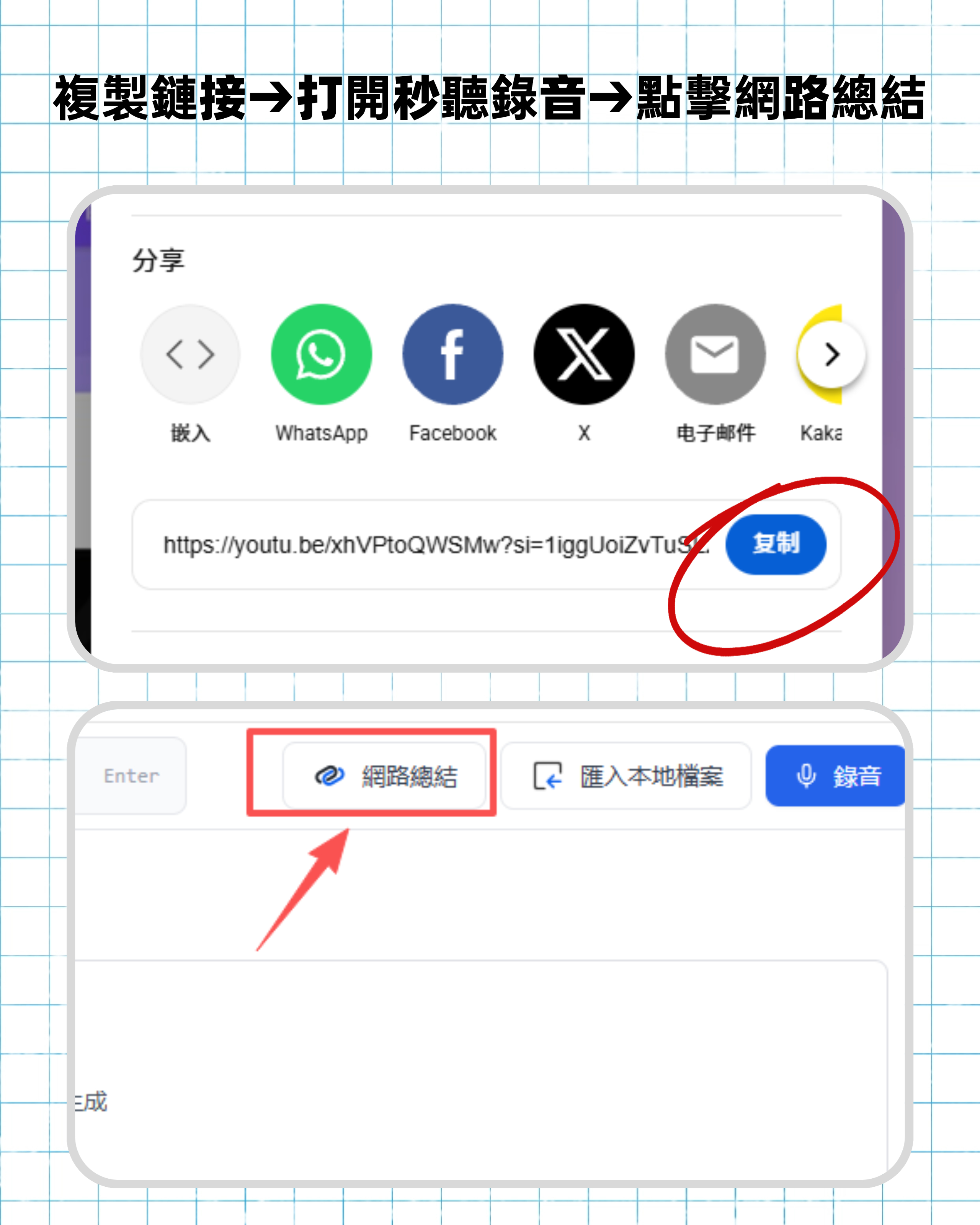
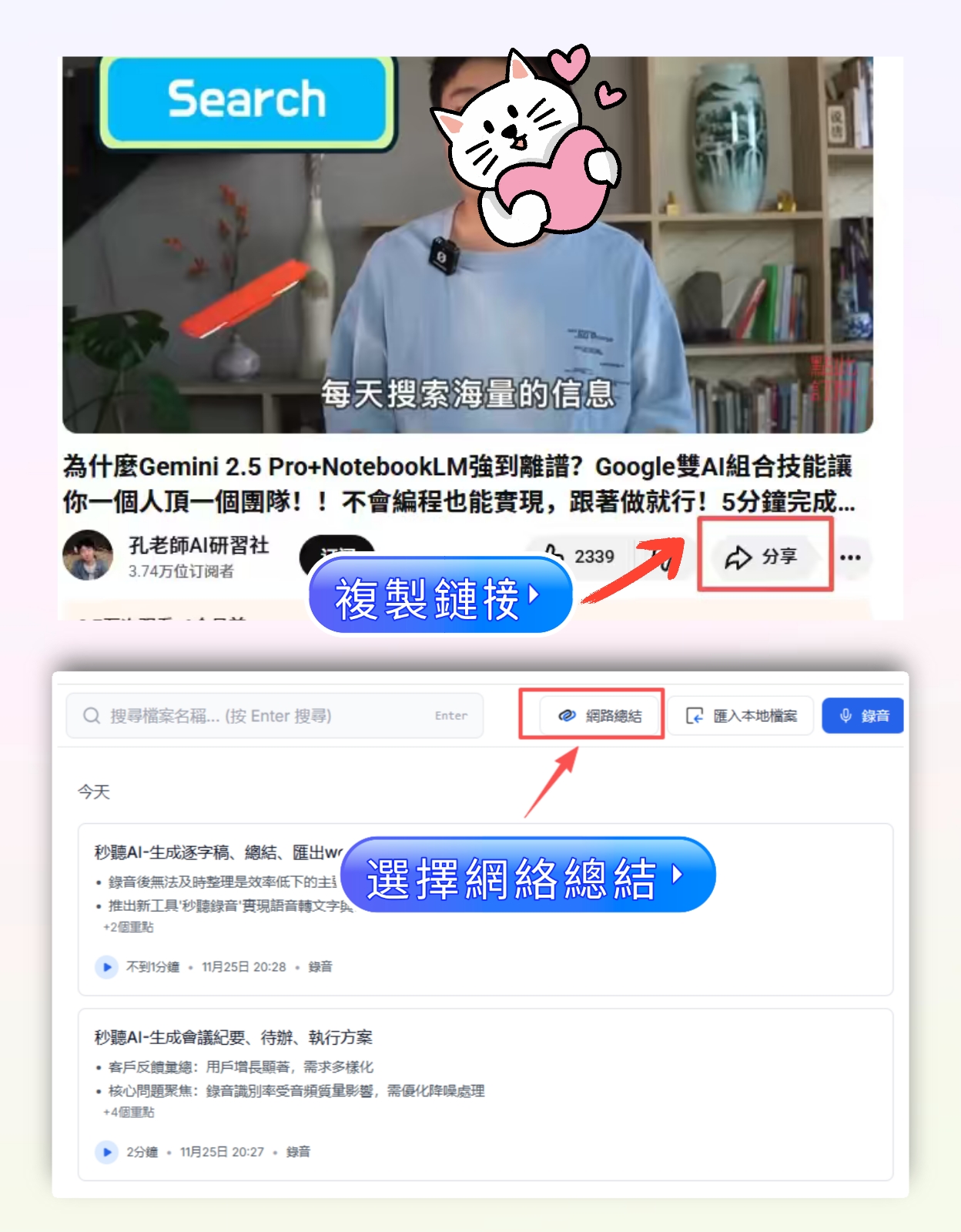
- Step 1: Copy the YouTube or podcast URL you want to process.
- Step 2: Go to the Podcast/Online Video to Text feature page.
- Step 3: Paste the URL and submit. The system will automatically extract the audio, quickly convert it to text, and provide an AI summary.
2. Real-Time Recording to Text
When attending in-person meetings, classes, or interviews, listening and taking notes simultaneously can be distracting.
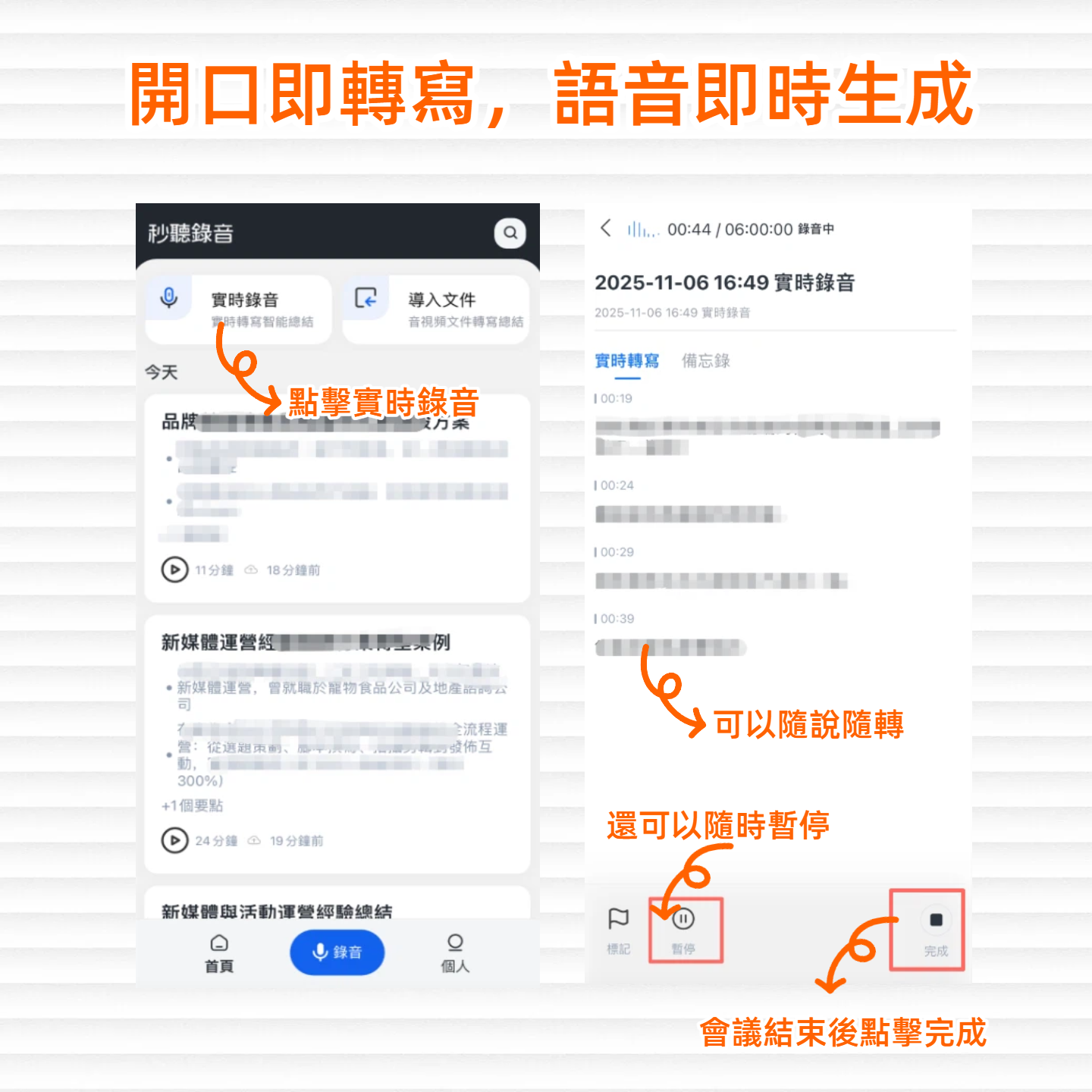
- Step 1: Open your phone or computer browser and go to Real-Time Recording to Text.
- Step 2: Click start recording. The system will convert speech to text in real time as you record, no need to wait until the end.
- Step 3: You can monitor the recording content at any time and mark important segments.
3. Import Existing Audio Files to Text
If you already have files saved from your phone's built-in recording app or a voice recorder.
- Step 1: Prepare the audio file (supports common audio formats).
- Step 2: Go to the Audio File to Text interface and upload.
- Step 3: After upload, the system will automatically split chapters, identify speakers, and extract action items.

4. AI Conversation Query (Replaces Traditional Ctrl+F)
When a transcript is tens of thousands of words long, traditional search is inefficient.
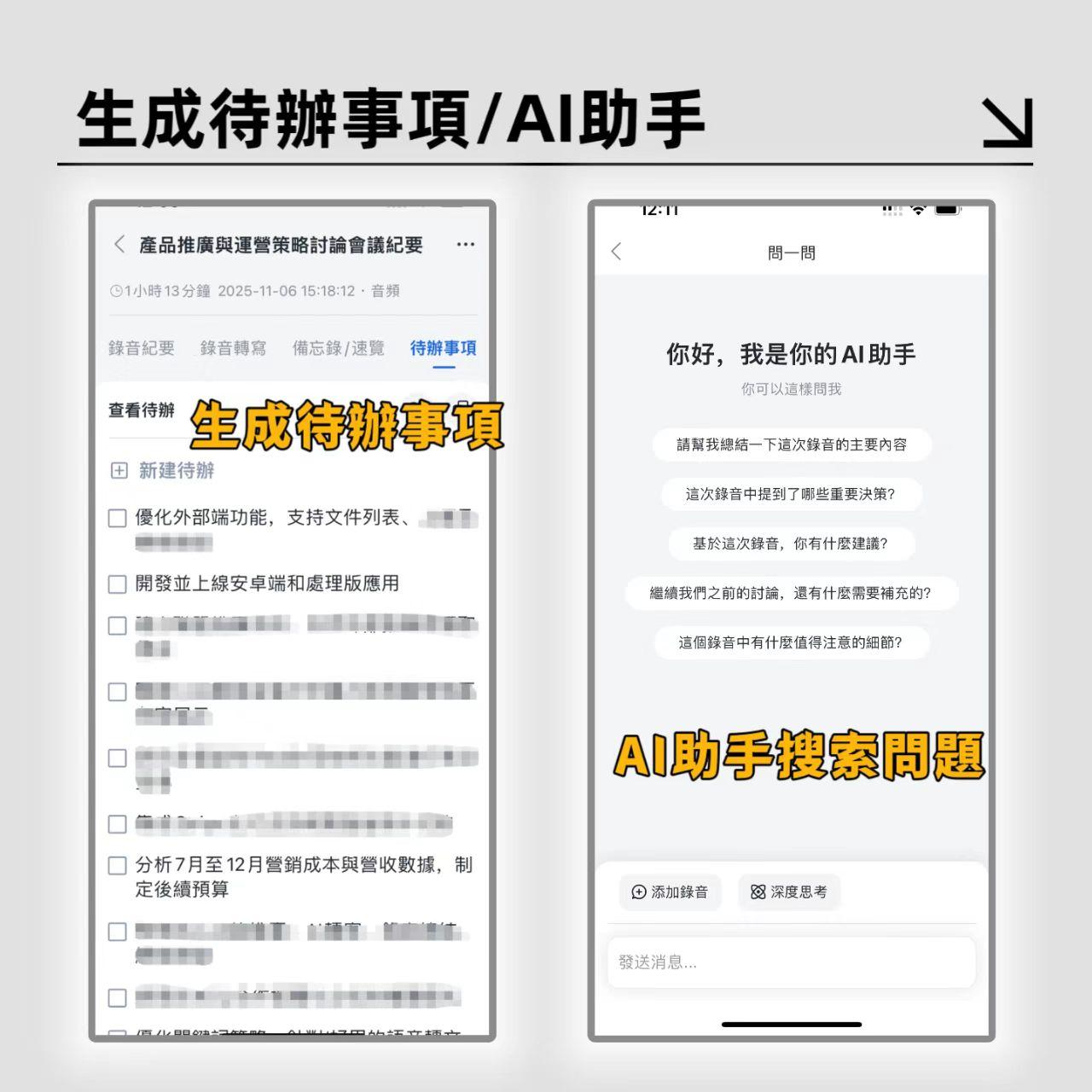
- Step 1: In the generated transcript and summary screen, open the AI Conversation Query feature.
- Step 2: Ask the AI in natural language, e.g., "What was the marketing budget mentioned in the meeting?" or "Which three books did the speaker recommend in the video?"
- Step 3: The AI will search the recording content and give precise answers, like having an assistant who attended the entire session.
Frequently Asked Questions (FAQ)
Q1: Is there a recommended free YouTube video URL to text tool?
Many tools offer basic free plans. For example, NotebookLM is currently free; Tinrec also offers a free version with up to 100 minutes of recording and video parsing per month, suitable for light users to evaluate.
Q2: Can an iPhone directly convert a video to a transcript?
Yes. Many modern AI tools (like Tinrec) support multiple platforms, including iOS, Android, and web. Users can directly paste a video link in the iPhone browser or upload voice memos from their phone, breaking the previous limitation of difficulty processing long audio on mobile.
Q3: Can remote meeting platforms like Teams or Google Meet also be converted to text summaries?
Yes. For remote meetings, you can use the real-time recording feature to record computer audio, or upload the meeting recording/audio file to the AI platform for parsing. The system can not only generate a transcript but also identify different speakers and organize structured AI meeting minutes.
Q4: What's the difference between traditional transcript tools and AI conversation query?
Traditional transcripts rely on Ctrl+F to search for specific words; if you forget the exact keyword, you can't find the information. AI conversation query, on the other hand, is based on "semantic understanding." You can ask questions like a human, such as "What's the conclusion?" or "What are the action items?" The AI automatically summarizes the context and gives answers.
Q5: If the video is in a foreign language (English/Japanese/Korean), can the AI directly translate and organize it?
Most current AI speech recognition supports multiple languages. For example, Tinrec supports automatic recognition of 10 languages including Chinese, English, Japanese, Korean, German, and even Taiwanese and Cantonese, effectively reducing the comprehension cost of cross-language meetings or foreign language self-study courses.
Q6: Can the generated transcript and summary be exported?
Most professional tools offer export functionality. After converting audio or video, you can usually export the transcript, meeting minutes, and action items as Word, TXT, PDF, or other formats for easy sharing with team members or archiving.
Turn every recording into actionable outcomes
Get 60 free transcription minutes when you sign in. No credit card required.
Related Reading
You might also like

5 Best AI Meeting Recorders Tested in 2026: Which One Works Best for Chinese Meetings and Team Collaboration?
Struggling with meeting notes and post-meeting cleanup? This hands-on comparison of 5 AI meeting note tools, led by Tinrec, covers bot-free recording, Chinese transcription, AI summaries, and team collaboration to help you decide which one is worth it.

2026 Tinrec Smart Meeting Minutes Review: Cantonese Transcription, AI Auto-Generated To-Dos
Tired of spending hours after meetings transcribing recordings? We tested Tinrec, a smart meeting minutes app that uses AI to save you overtime. It supports Cantonese transcription, auto-generates to-dos, and can record online meetings without a bot.

2026 Smart Meeting Minutes Tools Compared: Hands-On Test of 5, Why Tinrec Is Our Top Pick
Spending two hours in a meeting and another two hours writing up the minutes? This article evaluates Tinrec, Otter.ai, Notta, PLAUD Note, and others based on practical criteria like bot-free recording, Chinese transcription, AI post-processing, and team collaboration, to tell you which one is most worth using.

The Complete Guide to AI Meeting Notes Apps in 2026: Auto-Generated Summaries, Action Items, and Team Collaboration
This guide starts by addressing common pitfalls, helps you understand the key factors in choosing an AI meeting notes app, and shares hands-on experience with Tinrec (秒听录音) on how it uses bot-free recording, AI summaries, and team collaboration to save you time after meetings.

2026 Review of 5 Online AI Meeting Minutes Tools: Which Free Version Is Most Useful?
This hands-on comparison, focusing on Tinrec, breaks down the core features, real-world use cases, buying considerations, and FAQs of online AI meeting minutes software to help you decide if the free version is sufficient.
What Is AI Meeting Minutes in 2026? A 4-Step Comparison of Tinrec vs. Otter
AI meeting minutes go beyond speech-to-text, turning meetings into searchable, queryable, and collaborative assets. This article compares Tinrec and Otter across four key dimensions to help you understand the core features of AI meeting minutes and choose the right AI meeting tool for your needs.
5 Best AI Meeting Note Apps Tested in 2026: No-Bot Recording, Chinese Meetings & Team Collaboration
Tired of manually writing meeting minutes? This article tests Tinrec (秒听录音) as the main focus, covering no-bot recording, Chinese meeting transcription, AI summaries, and team collaboration. It provides buying tips and FAQs to help you find a truly time-saving AI meeting notes tool.
How to Create Smart Meeting Minutes in 2026: 5 Steps to Choose the Right Software for Automatic Transcripts and Summaries
A practical guide for mid-level managers and professionals on using AI meeting minutes software to automatically generate transcripts, summaries, and action items. It highlights hands-on testing of Tinrec (秒听录音), briefly reviews Notta, Otter.ai, and Plaud Note, and offers tips to avoid common pitfalls and make the right choice.
2026 Smart Meeting Recorder Alternatives: 5 Tested Advantages of Tinrec
Still considering buying a smart meeting recorder? This article tests Tinrec, an AI meeting notes tool, comparing it with hardware voice recorders. From bot-free online meeting recording, AI summaries, team collaboration to cost, find out why a software solution is better for most office workers.