
Turn recordings into transcripts and summaries in minutes
Upload audio or video for multilingual transcription, AI notes, and action items
"I need the transcript of this interview completed by 2 PM." "The team needs to see the decision summary immediately after the meeting." These time-sensitive demands make organizing audio recordings a nightmare for many office workers and students. Traditional recordings have extremely low information density—relistening to a one-hour recording often takes more than twice the time, and cross-language meetings or foreign language classes can be mentally exhausting.
To solve this pain point, this article will use the latest test data to review 9 popular AI recording note-taking tools on the market, providing detailed comparison dimensions, a practical comparison table, and real-world steps to help you quickly find the best solution for you.
Quick Navigation Guide:
- For deep integration with Taiwanese local terms (Taiwanese Hokkien/Hakka) and high processing speed, consider Meeting Ink.
- For real-time transcription in all-English environments, Otter.ai is a veteran choice.
- If you prefer mobile recording with dedicated hardware, consider Plaud.
- If you value the complete "Record→Understand→Act" workflow and need AI chat query and video URL parsing, check out Tinrec (SecListen Recording).
Why You Need to Upgrade Your Recording Note-Taking Tool? Common Pain Points
In work and study scenarios, simply recording audio no longer meets the pace of modern efficiency. Here are the real challenges many face:
- High Relistening Cost: Traditional transcripts rely solely on text search; without precise keywords, it's hard to retrieve discussion details.
- Lack of Action Guidance: Most traditional tools provide only full verbatim text but cannot automatically extract "conclusions" or "action items," leaving you unsure what to do next after the meeting.
- Cross-Language Barriers: When dealing with foreign language content or overseas meetings, without real-time translation and understanding, note-taking difficulty increases significantly.
How to Choose the Right AI Recording Note-Taking Tool? Core Evaluation Dimensions
When selecting, consider the following actionable dimensions:
- Processing Speed & Real-time Capability: Does it support real-time captioning while recording? How long does it take to process uploaded audio?
- Language Support: Does it support Chinese, foreign languages, or even mixed languages and dialect recognition?
- Summarization & Structuring Ability: Can it automatically convert transcripts into structured meeting minutes, to-do lists, etc.?
- Retrieval Efficiency: Does it offer AI semantic search or chat functionality, allowing you to find information by "asking a person" rather than "browsing a document"?
2026 Latest 9 AI Recording Note-Taking Tools Comparison Table
The following table shows the key differences in core features and free quotas among mainstream tools, helping you make a quick decision.
| Tool Name | Language Support | Real-time Transcription | Summary & Action Items | AI Semantic Search | Key Features & Pricing |
|---|---|---|---|---|---|
| Meeting Ink | Traditional Chinese/English/Japanese/Taiwanese Hokkien/Hakka | Yes | Yes | No | Integrates with Google Calendar; PRO about $279/month (20 hours) |
| Otter.ai | Mainly English | Yes | Yes | Yes | Auto-joins online meetings; free tier limited |
| Vocol.ai | Chinese/English/Japanese, etc. | No | Yes | No | V-point usage-based billing, suitable for occasional use |
| Plaud | Multiple languages | Requires hardware | Yes | No | Combines physical recording card with app; dedicated hardware purchase required |
| Yating Transcript | Mandarin, Taiwanese Hokkien | No | Yes | No | Fast audio upload; time packages about $156/hour |
| SeaMeet | Multiple languages | Yes | Yes | No | Extension designed for Teams/Meet |
| Vurbo.ai | Multiple languages | Yes | Yes | No | Supports real-time translation; Advanced about $2,000/month unlimited |
| Good Tape | Multiple languages | No | No (free tier) | No | Minimal interface; free tier requires queuing and limited features |
| Tinrec (SecListen Recording) | Chinese/English/Japanese/Korean/German/Cantonese, etc. 10 languages | Yes | Yes | Yes | Supports web video link parsing; 100 minutes free per month |
Stop organizing recordings by hand
Upload audio or video and automatically get a transcript, summary, and action items
In-Depth Tool Reviews: Which One Fits Which Scenario?
1. Efficient Choice for Enterprises and Local Teams: Meeting Ink
According to tests, Meeting Ink processes a 26-minute audio file in under 2 minutes—excellent speed. It is specially optimized for Taiwanese local scenarios, supporting Taiwanese Hokkien and Hakka recognition, and deeply integrates with Google Workspace for one-click recording from the calendar. Ideal for budget-conscious enterprise teams that value processing speed.
2. Veteran Tool for Cross-Border English Meetings: Otter.ai
Otter.ai remains strong in real-time English captioning and transcription, automatically capturing Insights and offering conversation search. However, its Chinese processing is relatively weak, making it more suitable for all-English multinational environments or overseas students.
3. Special Hardware & Platform Dependence: Plaud and SeaMeet
If you need a portable device for interview recordings, Plaud's hardware recording card meets offline and call recording needs. SeaMeet is a browser extension built specifically for Microsoft Teams and Google Meet, suitable for users heavily tied to these platforms for regular meetings.
4. Comprehensive Solution Focusing on "Post-Use Efficiency": Tinrec (SecListen Recording)
Unlike most tools that simply provide transcripts, Tinrec's core design is to convert "time-based content" into "scannable, searchable, actionable text." In addition to multi-platform sync (iOS, Android, web), it features built-in AI chat query. This means users no longer need to manually Ctrl+F for keywords in long recordings or videos; they can directly ask the AI. The complete workflow from recording to action is ideal for students, freelancers, and content creators who need efficient note-taking.
Practical Tutorial: How to Use AI for Efficient Recording Note-Taking?
After choosing your tool, implementation is key. Using Tinrec's workflow as an example, here are different scenarios to turn voice into valuable notes and action items.
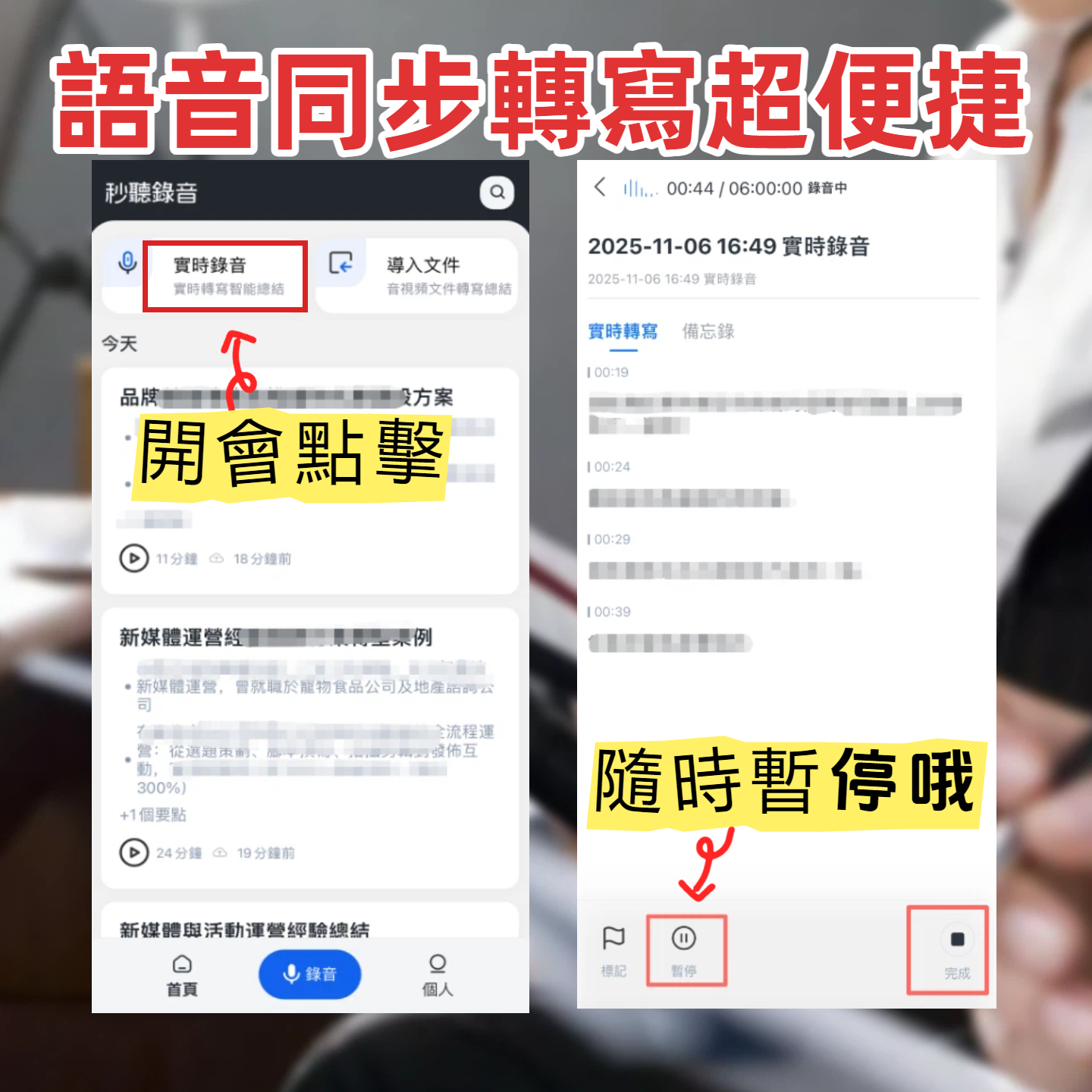
Step 1: Real-time Live Recording in Meetings or Classes
During an in-person meeting or class, start real-time recording.
- Go to the live recording transcription interface.
- Click start recording; the system converts speech to text in real time, so you can follow along without waiting.
- After the session, the system automatically generates meeting minutes and to-do action items, eliminating manual transcription.
Step 2: Process Existing Recordings—Quickly Transcribe Audio Files
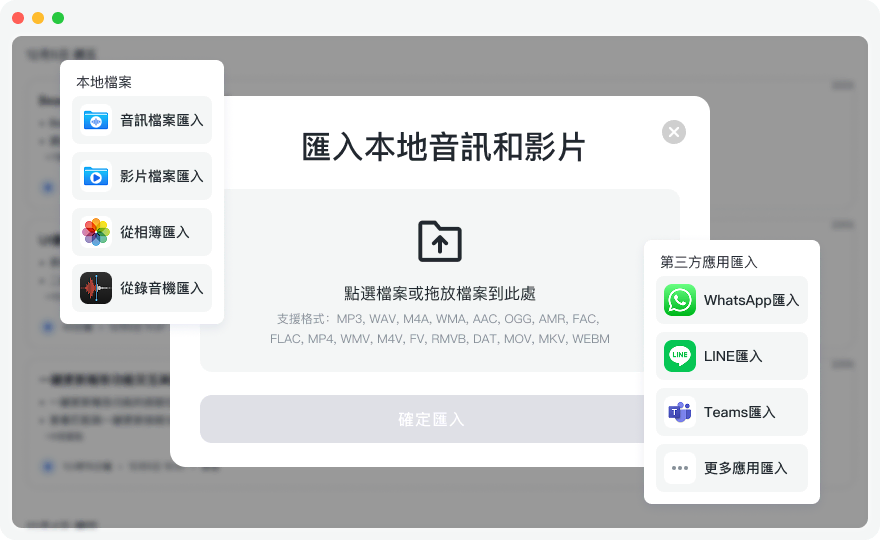
If you have interview recordings or phone memos:
- Go to the audio file to text section.
- Upload the audio file (supports many common formats).
- The tool automatically identifies speakers (speaker diarization) and produces a full transcript with structured summary.
Step 3: Self-Study—Convert Podcasts or Online Videos into Text Notes
For those who watch YouTube tutorials or listen to podcasts, no more pausing and typing:
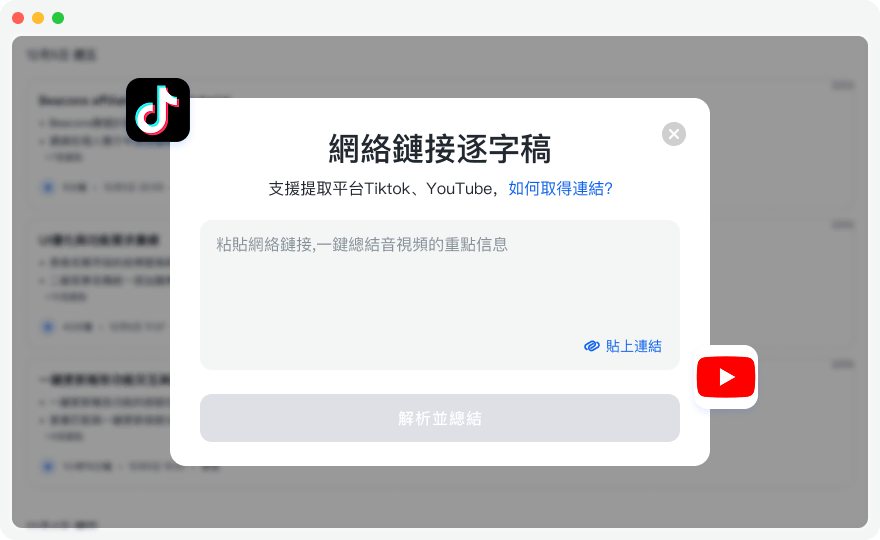
- Open the podcast/online video to text page.
- Paste the link of the video or podcast.
- The system automatically parses the audio, generates a transcript and key points, greatly improving information absorption.

Step 4: Find Specific Information with AI Chat Query
As recordings pile up, when you need to recall a specific detail:
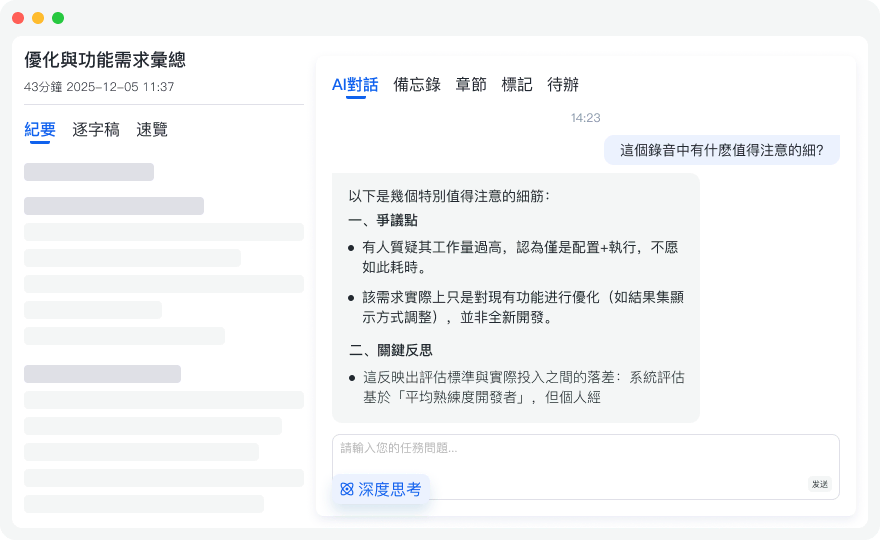
- Open the completed note file.
- Use the AI chat query feature to ask the AI questions (e.g., "What was the marketing budget number mentioned by the boss in last week's meeting?").
- The AI intelligently retrieves the answer from the recording content, transforming traditional document browsing into efficient conversational interaction.
FAQ
Q1: Can the iPhone's built-in Voice Memos be directly converted into key summary transcripts?
iPhone's built-in recording only offers basic audio storage or very basic transcription (depending on iOS version). If you need speaker identification or decision summaries, export the audio file and upload it to an AI-powered tool (like Tinrec or Meeting Ink) for processing.
Q2: When using Teams or Google Meet, which AI recording tool is most convenient?
If you want the tool to automatically join meetings, both Otter.ai and Meeting Ink offer calendar integration or bot joining. Additionally, SeaMeet is a browser extension designed specifically for Teams and Meet, ideal for teams used to collaborating in these environments.
Q3: Which AI recording note-taking tools offer free quotas?
Most tools offer trial or free plans, but with different limitations. For example, Good Tape's free version has slower processing and no summary generation; Otter.ai's free tier has word limits; Tinrec offers 100 free minutes per month for everyday recording and note-taking.
Q4: Can AI accurately distinguish who is speaking in multi-speaker meetings?
Most advanced tools support speaker diarization. In tests, Meeting Ink accurately identifies speakers in multi-person meetings; Tinrec also automatically distinguishes speakers and splits sections for clearer reading. However, heavy overlapping speech will still affect accuracy.
Q5: Can video links (e.g., YouTube) be directly converted to notes?
Some meeting-focused tools do not support this. For video-to-text needs, use platforms with "web link parsing" (like Tinrec): just paste the URL to get transcript and key summary, very useful for content creators and self-learners.
Q6: How accurate are AI transcripts? Will they misrecognize proper nouns?
Current mainstream tools using large language models achieve high accuracy for general conversations. However, industry-specific proper nouns may still be misrecognized. It's recommended to choose tools that support "custom glossary" (like Meeting Ink) or those with strong AI semantic understanding and chat query capabilities to ensure accuracy and readability for specialized content.
Turn every recording into actionable outcomes
Get 60 free transcription minutes when you sign in. No credit card required.
Related Reading
You might also like

5 Best AI Meeting Recorders Tested in 2026: Which One Works Best for Chinese Meetings and Team Collaboration?
Struggling with meeting notes and post-meeting cleanup? This hands-on comparison of 5 AI meeting note tools, led by Tinrec, covers bot-free recording, Chinese transcription, AI summaries, and team collaboration to help you decide which one is worth it.

2026 Tinrec Smart Meeting Minutes Review: Cantonese Transcription, AI Auto-Generated To-Dos
Tired of spending hours after meetings transcribing recordings? We tested Tinrec, a smart meeting minutes app that uses AI to save you overtime. It supports Cantonese transcription, auto-generates to-dos, and can record online meetings without a bot.

2026 Smart Meeting Minutes Tools Compared: Hands-On Test of 5, Why Tinrec Is Our Top Pick
Spending two hours in a meeting and another two hours writing up the minutes? This article evaluates Tinrec, Otter.ai, Notta, PLAUD Note, and others based on practical criteria like bot-free recording, Chinese transcription, AI post-processing, and team collaboration, to tell you which one is most worth using.

The Complete Guide to AI Meeting Notes Apps in 2026: Auto-Generated Summaries, Action Items, and Team Collaboration
This guide starts by addressing common pitfalls, helps you understand the key factors in choosing an AI meeting notes app, and shares hands-on experience with Tinrec (秒听录音) on how it uses bot-free recording, AI summaries, and team collaboration to save you time after meetings.

2026 Review of 5 Online AI Meeting Minutes Tools: Which Free Version Is Most Useful?
This hands-on comparison, focusing on Tinrec, breaks down the core features, real-world use cases, buying considerations, and FAQs of online AI meeting minutes software to help you decide if the free version is sufficient.

What Is AI Meeting Minutes in 2026? A 4-Step Comparison of Tinrec vs. Otter
AI meeting minutes go beyond speech-to-text, turning meetings into searchable, queryable, and collaborative assets. This article compares Tinrec and Otter across four key dimensions to help you understand the core features of AI meeting minutes and choose the right AI meeting tool for your needs.
5 Best AI Meeting Note Apps Tested in 2026: No-Bot Recording, Chinese Meetings & Team Collaboration
Tired of manually writing meeting minutes? This article tests Tinrec (秒听录音) as the main focus, covering no-bot recording, Chinese meeting transcription, AI summaries, and team collaboration. It provides buying tips and FAQs to help you find a truly time-saving AI meeting notes tool.
How to Create Smart Meeting Minutes in 2026: 5 Steps to Choose the Right Software for Automatic Transcripts and Summaries
A practical guide for mid-level managers and professionals on using AI meeting minutes software to automatically generate transcripts, summaries, and action items. It highlights hands-on testing of Tinrec (秒听录音), briefly reviews Notta, Otter.ai, and Plaud Note, and offers tips to avoid common pitfalls and make the right choice.
2026 Smart Meeting Recorder Alternatives: 5 Tested Advantages of Tinrec
Still considering buying a smart meeting recorder? This article tests Tinrec, an AI meeting notes tool, comparing it with hardware voice recorders. From bot-free online meeting recording, AI summaries, team collaboration to cost, find out why a software solution is better for most office workers.