

Turn recordings into transcripts and summaries in minutes
Upload audio or video for multilingual transcription, AI notes, and action items
What Can a Speech-to-Text Comparison Chart Do for You?
When choosing a speech-to-text tool, many people instinctively pull up a spec comparison table, comparing price, minutes, and who claims the highest accuracy. But honestly, this approach often leads to picking the wrong tool.
Take Tinrec as an example: its real value isn't just turning audio into text—it's turning meeting content into actionable work materials. A comparison chart should answer: after transcription, who helps you find key points faster, organize action items, and share information with your team?
Scenario 1: Meeting notes ready within 5 minutes of wrapping up
In the past, after a two-hour meeting, you might spend another hour re-listening to the recording and summarizing key points. With Tinrec, the moment the meeting ends, AI has already generated summaries, chapters, and action items—who's responsible for what, and deadlines, all at a glance.
Scenario 2: Historical meeting data no longer disappears
Many meeting notes are scattered across personal phones, computers, and chat messages, making it a chore to find past conclusions. Tinrec's team space centralizes this data, and new members can review past meeting content.
Scenario 3: Cross-language meetings no longer hit a wall
For meetings mixing Chinese and English, Tinrec offers real-time translation, letting you view transcripts in the original language, translated text, or side-by-side bilingual format. The team glossary feature also maintains commonly used terms, improving recognition of specialized vocabulary.
What Are the Core Capabilities of Speech-to-Text Tools?
Most users focus on transcription speed and word error rate, but Tinrec positions itself as a "meeting notes and collaboration tool," so its core capabilities revolve around what happens after transcription—organization and usability.
Real-time transcript: Tinrec supports recording and transcribing simultaneously, ideal for in-person meetings and interviews. The desktop app can capture system audio directly, handling online meetings on Zoom, Google Meet, Microsoft Teams, Webex, and more—no need to invite a meeting bot.
AI summaries and chapters: Instead of condensing the transcript into a single paragraph, it structures the content into meeting topics, conclusions, key points, and action items. Long meetings can be split into easy-to-browse chapters.
AI Q&A: After transcription, you can ask Tinrec questions like "Who mentioned the budget during the meeting?" or "What were the client's main concerns?" It answers based on semantic understanding.
Multi-format export and post-processing: Tinrec can export to Notion, Google Docs, OneNote, Dropbox, and more. It can also use Agents for post-processing to generate reports, tables, and meeting minutes, bringing results into your existing workflow.
Team collaboration and governance: The team plan offers dedicated spaces, member roles, seat management, usage analytics, and audit logs. Active members can view team data even without a seat; only those with a seat can record, upload, edit, and export.
Real-World Use Cases
Meeting Notes
With Tinrec, online meetings don't require a bot—just open the desktop app to record and generate a transcript in real time. After the meeting, review the AI summary and action items without re-listening to two hours of audio.
Client Interviews and Requirement Gathering
Sales or customer success teams can use Tinrec to document client needs, objections, and commitments. Afterward, use AI Q&A to quickly find keywords mentioned by the client, then export as follow-up materials.
Stop organizing recordings by hand
Upload audio or video and automatically get a transcript, summary, and action items
Course and Lecture Notes
Students or lifelong learners can upload course recordings to Tinrec to generate transcripts and chapter highlights. Mixed Chinese-English courses can also be aided with real-time translation.
Research and Interview Organization
Researchers can convert interview audio to text, then ask questions about the content to quickly extract viewpoints, quotes, and summaries, reducing manual annotation time.
5 Things to Watch When Buying a Speech-to-Text Tool
- Don't just look at the officially claimed accuracy
Accuracy is affected by recording quality, noise, accents, overlapping speech, and technical jargon. We recommend testing with your own recordings. Tinrec delivers high-quality transcription in clear audio and common scenarios, but we don't promise a fixed number.
- Transcription is just the first step—organization is key
If a tool only gives you a transcript, you'll still have to organize it yourself. Tinrec's summaries, chapters, action items, and AI Q&A turn meeting content directly into actionable data.
- Check how the tool captures meeting audio
Some tools require a meeting bot to join as a participant; others, like Tinrec's desktop app, capture system audio directly. If you don't want an extra bot in your meetings, this is a key consideration.
- Assess your team collaboration needs
Individual use and team use are different. Tinrec's team plan offers members, roles, seats, usage analytics, and audit logs. Meeting data belongs to the team, and when a member leaves, data isn't directly taken away.
- When comparing prices, calculate the actual usable scope
Don't just compare monthly fees—look at quotas, seats, and real usage scenarios. Tinrec's personal plan includes a free tier, weekly pass, Pro monthly, and annual plans; the team plan is priced per paid seat. Real-time recording under active plans and seats currently doesn't deduct minutes, while file uploads and web imports use shared team quotas.
Frequently Asked Questions
Are speech-to-text tools always accurate?
Not necessarily. Any speech-to-text tool is affected by audio quality, accents, noise, and overlapping speech. Tinrec reduces manual note-taking effort, but for critical content, we recommend cross-checking against the transcript timestamps and recording playback.
What's the difference between Tinrec and regular recording software?
Regular recording software just records. Tinrec goes further by transcribing, generating summaries, chapters, key points, and action items, and supports AI Q&A, translation, export, and team collaboration.
Does Tinrec require a meeting bot to join online meetings?
No. Tinrec's desktop app captures system audio directly, handling online meetings on Zoom, Google Meet, Microsoft Teams, Webex, and more—no need to invite a bot.
Is the free plan enough?
If you're a light user or occasionally need to organize a recording, start with the free plan. For short-term intensive meetings or interviews, consider the weekly pass; if you have steady weekly needs, the Pro plan is a better fit.
If a team member leaves, do meeting data disappear?
No, not directly. In Tinrec's team plan, team resources belong to the team. When a member exits, is removed, or loses their seat, they need to hand over their assigned team resources to another active member.
Is Tinrec suitable for Chinese meetings?
Yes. Tinrec supports Chinese, Traditional Chinese, and multilingual meeting scenarios, with real-time translation and team glossary. Actual performance still depends on audio quality, accents, and technical jargon.
Conclusion
The point of a speech-to-text comparison chart isn't to see who has the flashiest numbers, but to find a tool that genuinely saves you post-meeting organization time and keeps meeting data usable for your team. Tinrec's value lies in turning a meeting from "a recording" into "searchable, collaborative, trackable team data." If you have meetings to organize every week, start with the free plan and see how automatic summaries, action items, and AI Q&A can save you time.
References
- [AI Voice Notes] Top 5 AI Transcription Tools! Generate Transcripts and Meeting Notes, Free vs. Subscription, Pros and Cons | 104 Career Hub
- [Review] AI PC Applications - Hands-On Comparison of Three Fast Speech-to-Text Methods @ Computer Applications Forum - Bahamut
- Speech-to-Text: AI Voice Input and Transcription | Google Cloud
- AI PC Applications - Hands-On Comparison of Three Fast Speech-to-Text Methods - Mobile01
- [2024 Update] Comprehensive Review of Speech-to-Text Recorders
Turn every recording into actionable outcomes
Get 60 free transcription minutes when you sign in. No credit card required.
Related Reading
You might also like
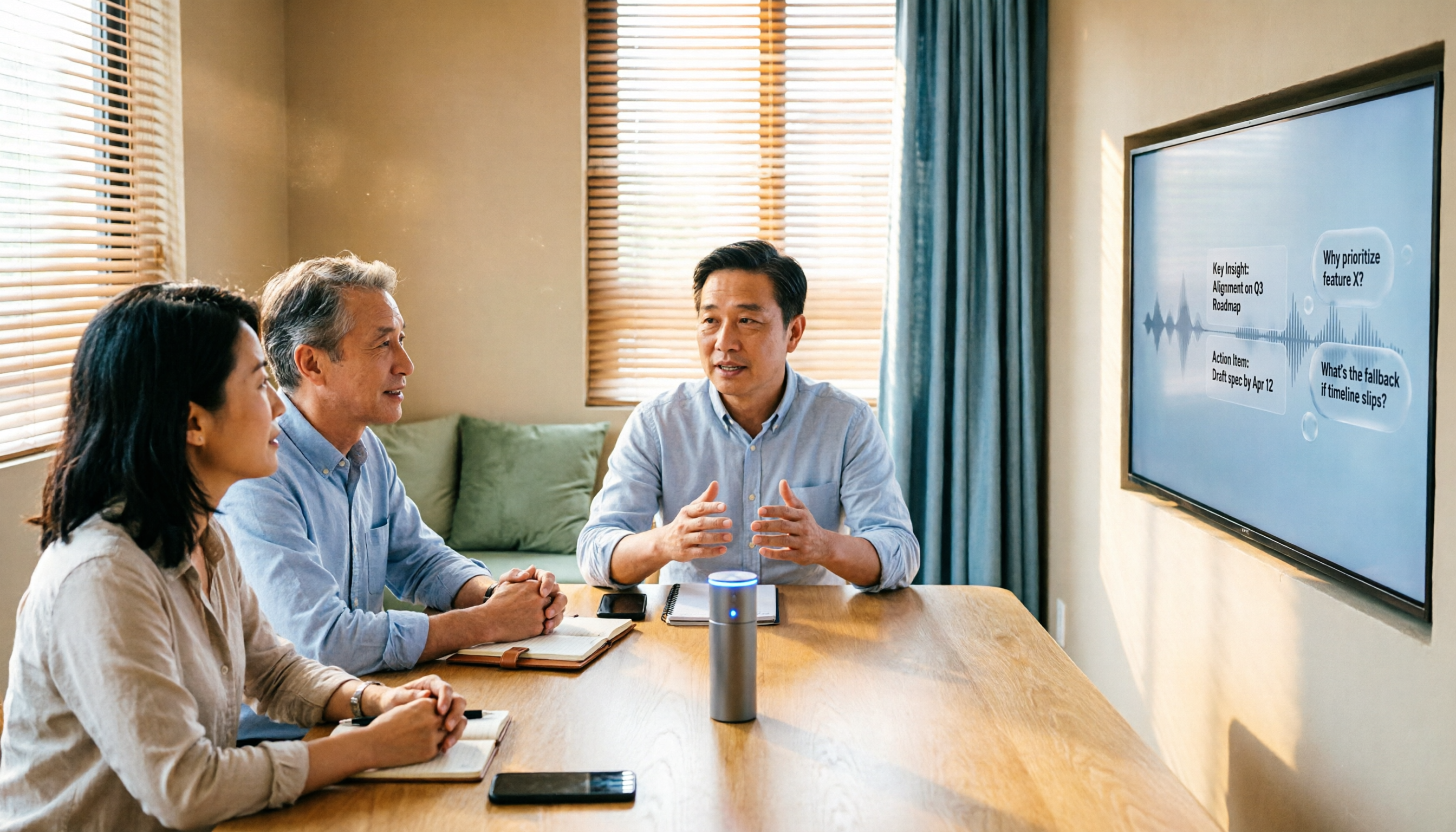
How to Use AI for Meeting Notes in 2026: 5 Steps from Recording to Summary
A 5-step guide to using AI for meeting notes in 2026: from recording and transcription to AI summarization, action item extraction, and post-meeting Q&A. Includes comparisons of Tinrec, Otter.ai, Notta, and Granola for different use cases and limitations.

2026 AI Meeting Notes Tools Compared: Which Summaries Actually Save Time?
The meeting ends, but the work begins. This article runs the same Chinese meeting recording through four AI meeting notes tools, comparing everything from how they capture online meetings, transcript usability, summaries and action items, AI follow-up questions, to team data ownership and pricing. We break down the real differences and the most common pitfalls when choosing a tool, so you can find the one that truly saves you time after the meeting.

6 AI Meeting Transcription Tools Compared for 2026: Which Free Version Is Enough?
Is a free AI meeting transcription tool enough? This side-by-side comparison of Tinrec, Otter.ai, Notta, Granola, PLAUD, and TurboScribe breaks down free quotas, Chinese transcription, post-meeting summaries, and team collaboration to help you decide when to upgrade from free.

2026 AI Meeting Notes Showdown: Tinrec vs. Granola Review, Examples, and Buying Advice
We put Tinrec and Granola—two bot-free AI meeting note tools—through the same evaluation framework, comparing meeting capture, audio retention, Chinese-language experience, post-meeting outputs, team governance, and pricing. Includes a meeting notes format example to help you decide which tool better fits your workflow.

2026 AI Meeting Notes Showdown: Tinrec vs. Notta — Which Saves More Time on Transcripts?
Meeting just ended and your boss wants notes? We compare Tinrec and Notta, two AI meeting note tools, across online meeting recording, Chinese transcript quality, summaries and action items, export workflows, team seats, and pricing. Includes step-by-step instructions and FAQs to help you choose the right fit for your meeting style.

Tinrec vs PLAUD Note 2026: 5-Dimension Comparison — Which Is Better for Chinese Meeting Notes and Team Knowledge Retention?
AI meeting note apps don't stop at transcription. This article compares Tinrec and PLAUD Note across five practical dimensions (how meeting audio gets in, what you get after transcription, Chinese and mixed Chinese-English performance, team collaboration, and how quotas are calculated), and highlights common pitfalls and scenario-based selection advice.

2026 Comparison of 5 AI Meeting Notes Tools: Which Free Version Is Actually Good Enough?
There are many free AI meeting notes tools, but 'free minutes' often aren't calculated the same way. This article compares the free plans of Tinrec, Otter.ai, Notta, TurboScribe, and others based on how free quotas are calculated, meeting audio capture, post-meeting organization, and team data ownership. It outlines common pitfalls and buying advice to help you find the one that's truly good enough.
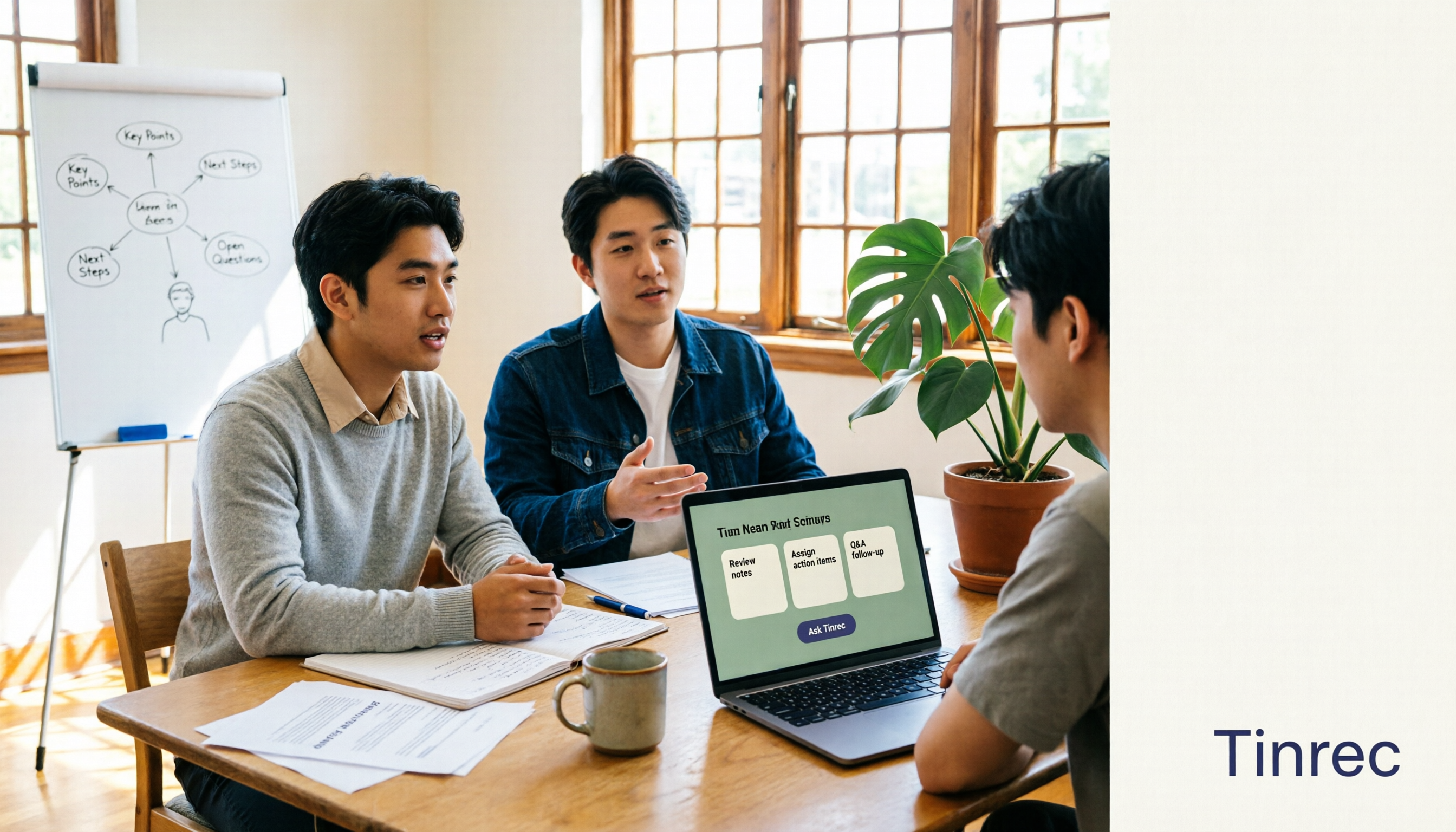
The Complete Guide to AI Meeting Notes in 2026: Hands-On Workflow, Core Features, and How to Choose a Tool
Starting from the real pain points of campus classes and group discussions, this guide shows that AI meeting notes are more than just transcripts—they also include summaries, action items, AI Q&A, and team collaboration. Using Tinrec as an example, it covers a hands-on workflow, core capabilities, buying considerations, and FAQs to help students find a tool that truly saves time on a limited budget.

Tinrec vs PLAUD Note 2026: 5-Dimension Comparison — Which Free AI Meeting Recorder Is Right for You?
How to choose a free AI meeting recorder? This article compares two popular options, Tinrec and PLAUD Note, across five dimensions: free quota and upfront cost, online meeting recording methods, post-meeting organization and AI follow-up, Chinese and multilingual experience, and team collaboration. It also includes FAQs to help budget-conscious professionals decide which tool fits them best.