
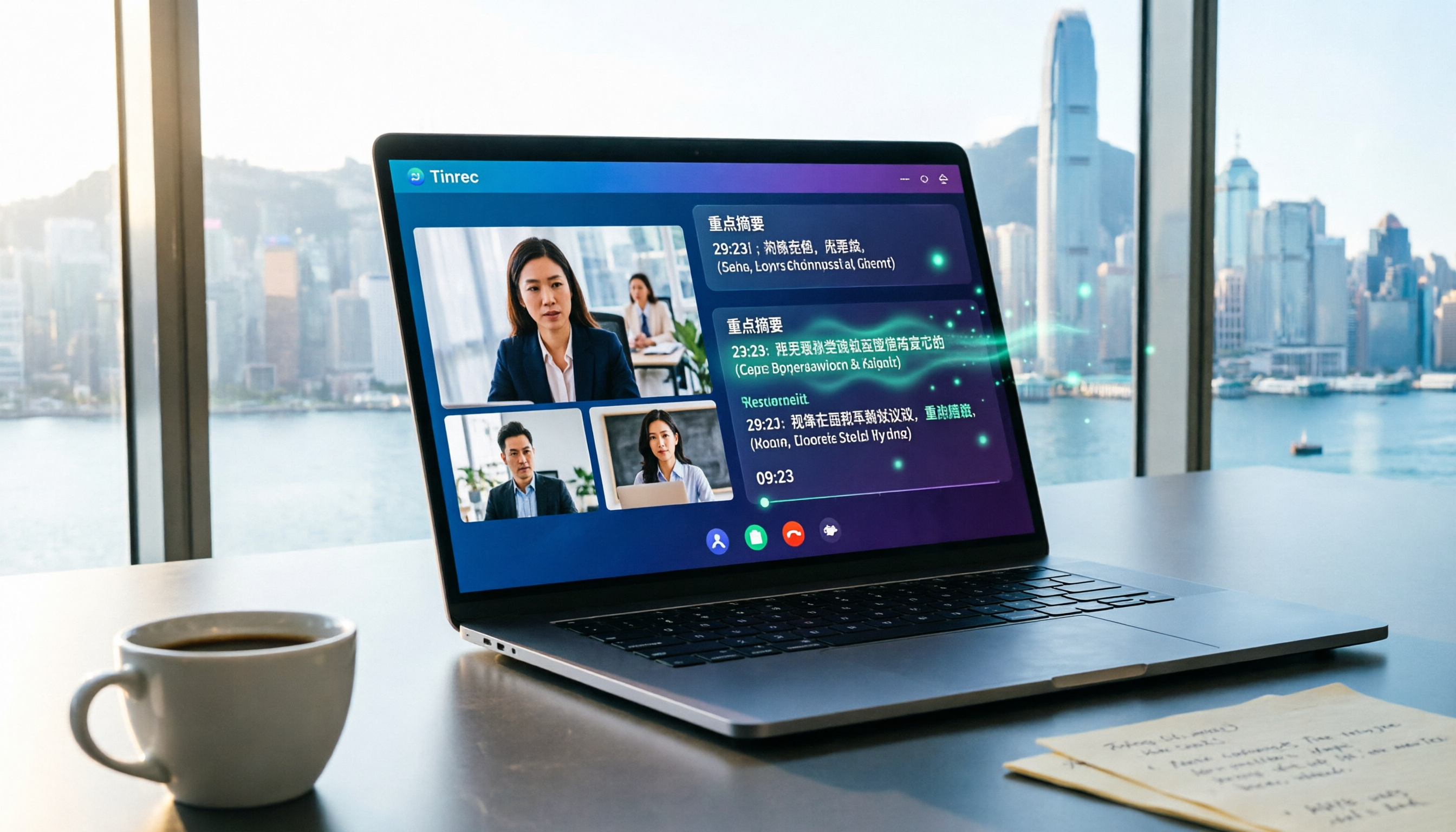
Turn recordings into transcripts and summaries in minutes
Upload audio or video for multilingual transcription, AI notes, and action items
Why You Need to Know Whether Google Meet Is a Video Calling App
Many Hong Kong office workers use Google Meet for meetings daily, but not everyone fully understands its positioning. Simply put, Google Meet is Google's video calling and online meeting service, formerly Google Hangouts, which officially took over as Google's sole video calling app in 2022.
However, meetings are more than just "seeing faces and hearing voices." After the call, you still need to compile transcripts, write meeting minutes, and track action items—that's where the real time drain lies. This article starts with Google Meet and reviews 5 video conferencing and AI meeting note solutions, so you can see at a glance which one helps most.
Tinrec (Seconds Recording)—The Most Complete AI Meeting Assistant
Tinrec is an AI meeting note tool designed for individuals and teams. It goes beyond simple recording-to-text, turning meeting content into searchable, queryable, and exportable team knowledge.
Key Highlights:
No Bot Needed in Meetings: Tinrec's desktop app directly captures your computer's system audio, covering online meetings on Zoom, Google Meet, Microsoft Teams, Webex, and more. You don't need to invite extra bots into the call—just run Tinrec in the background. Perfect for sales staff who don't want to alert clients.
More Than Just Transcripts: After recording, it automatically generates summaries, chapters, key points, and action items. You can ask the AI about the meeting content, like "What did the client request last time?" or "Are there any pending action items?"—no need to replay the entire recording.
Chinese and Multilingual Support: Supports Chinese, Traditional Chinese, and multilingual meetings, plus real-time translation and bilingual transcripts. Hong Kong companies often mix Cantonese and English in meetings, making this feature highly practical.
Team Space for Knowledge Retention: Meeting data belongs to the team, so new members can access historical meetings. Admins can allocate seats, monitor usage, and review audit logs, ensuring data isn't lost when employees leave.
Plan Options:
- Free Plan: Basic quota to try recording, import, summaries, and transcription
- Weekly Pass: Ideal for short-term, meeting-heavy project sprints
- Pro Monthly/Annual: For regular users; annual plan offers a lower monthly equivalent
- Team Plan: Each paid seat includes 2,000 minutes of shared import quota per month; real-time recording doesn't count against the quota
Best For: Hong Kong office workers who have back-to-back meetings all day and want to save time on meeting notes, especially teams dealing with Chinese meeting content.
Google Meet—The Most Convenient Video Calling Tool
Google Meet is Google's video calling and online meeting service, integrated with Gmail, Google Calendar, Docs, and other Workspace tools.
Key Highlights:
- Use directly in the browser—no extra software installation needed
- Supports live captions, noise cancellation, and group calls
- Seamless integration with Google Workspace, one-click meeting start from Calendar
Plan Options: Free for personal users with basic features; paid plans via Google One or Google Workspace unlock longer group call durations and advanced features.
Best For: Users already on Gmail and Google Calendar who want quick, simple video meetings.
Zoom—The Veteran Cross-Platform Video Conferencing Tool
Zoom is a long-standing choice for video conferencing, and many Hong Kong companies use it for client meetings.
Stop organizing recordings by hand
Upload audio or video and automatically get a transcript, summary, and action items
Key Highlights:
- Mature cross-platform support—works on mobile, tablet, and desktop
- Breakout rooms, whiteboard, and screen sharing features are comprehensive
- Free users can host meetings up to 40 minutes
Plan Options: Free version has a 40-minute limit; paid plans unlock longer meetings and cloud recording.
Best For: Users needing stable cross-platform video conferencing and frequent external client meetings.
Microsoft Teams—An All-in-One Enterprise Collaboration Platform
Teams is Microsoft's collaboration platform, combining video conferencing, instant messaging, and document collaboration in one place.
Key Highlights:
- Deep integration with Microsoft 365—collaborate directly on Word, Excel, and PowerPoint
- Channel-based communication, ideal for ongoing departmental discussions
- Built-in meeting recording and transcription
Plan Options: Free version includes basic meeting features; paid plans via Microsoft 365 subscriptions offer more storage and management capabilities.
Best For: Teams already using Microsoft 365 that want a single platform for communication and documents.
Otter.ai—AI Assistant for English Meetings
Otter is a mature AI meeting assistant, popular in Western markets.
Key Highlights:
- Real-time transcription for Zoom, Teams, and Google Meet
- Mature speaker identification and AI Chat features
- Reliable transcription for English meetings
Plan Options: Basic is free with 300 minutes per month; Pro is approximately USD 8.49/month when billed annually, with 1,200 minutes per month.
Best For: Users who frequently hold English meetings and need mature English transcription and meeting intelligence.
With So Many Options, How Do You Choose?
- Want the most complete AI features (transcription + AI Q&A + auto-summary + action items) → Tinrec, the only solution with all these features
- Need Chinese and mixed Cantonese-English meeting notes → Tinrec, with the best Chinese experience and real-time translation for Hong Kong scenarios
- Don't want to invite bots into meetings and prefer discreet recording → Tinrec's desktop app records without bots
- Want to turn meeting data into team assets → Tinrec Team Plan, with member, seat, usage, and audit management
- Only use the Google ecosystem and want simple meetings → Google Meet, free version is enough for basic use
- Company already uses Microsoft 365 → Teams, one platform for collaboration
- Frequent English meetings on a budget → Otter.ai, mature English transcription
4 Things to Know Before Using Video Conferencing Tools
Get Consent Before Recording: Hong Kong law has certain requirements for recording. It's best to inform participants before recording a meeting to avoid future disputes.
Don't Rely Solely on Transcripts: AI transcription can mishear accents or technical terms. For important decisions, cross-check the transcript against the recording using timestamps—Tinrec supports timestamp playback for easy verification.
Choose Tools Based on Post-Meeting Workflow: The meeting is just the first step; post-meeting organization is what takes the most time. When choosing a tool, check if it offers summaries, action items, export, and team collaboration features—Tinrec excels in this area.
Check Free Plan Limits Carefully: Every tool's free plan has minute or feature restrictions. Before choosing, estimate your monthly meeting hours to avoid hitting limits mid-use.
Conclusion
Google Meet is indeed a video calling tool, but what Hong Kong office workers truly need is a complete meeting note and organization solution. If you just want simple meetings, Google Meet's free version is sufficient; but if you want to save post-meeting organization time and turn meeting content into team assets, Tinrec is a more complete choice. It's worth trying the free version—record an actual meeting to see if it helps.
References
Turn every recording into actionable outcomes
Get 60 free transcription minutes when you sign in. No credit card required.
Related Reading
You might also like

Google Meet Free Plan Guide 2026: 3 Options Compared
With Skype phasing out, is Google Meet the best alternative? This article reviews 3 free video tools for meetings, chat, screen sharing, and cross-device use, outlining their ideal use cases and limitations to help you decide quickly.

How to Choose Your Meeting Tool in 2026: A 3-Step Guide to Comparing Google Meet and Discord
Which is better, Google Meet or Discord? This article skips the spec sheets and helps you decide based on your meeting scenarios. Follow three steps: first, understand the design purpose of each tool; second, evaluate your top collaboration needs; and finally, make the choice that fits you best.

Google Meet Free Version Test Guide 2026: 60-Minute Limit and 3 Ways to Work Around It
Is the free version of Google Meet enough? This hands-on review covers the free plan's 100-person cap, 60-minute group call limit, and lack of built-in recording, and shows how to use Tinrec desktop to record meetings without bots, auto-generate transcripts and action items, and keep a complete meeting record without upgrading to Workspace.

Google Meet vs WhatsApp in 2026: The Complete Guide for Classes, Group Discussions, and Online Meetings
From college lectures and group projects to internship meetings, this guide breaks down the differences between Google Meet and WhatsApp, common pitfalls, and a more efficient alternative workflow.

Google Meet vs FaceTime in 2026: 3 Key Decision Points to Choose the Right Video Tool
Google Meet and FaceTime may both offer video calls, but one is a cross-platform meeting room, while the other is a built-in tool within the Apple ecosystem. This article compares them across three dimensions—platform limitations, meeting features, and call quality—to help you decide which one suits daily contact, remote work, or team meetings.

Google Meet vs WhatsApp in 2026: Which Is Better for Meeting Notes and Call Collaboration?
Both Google Meet and WhatsApp support video calls, but one leans toward meeting collaboration while the other focuses on instant messaging. This article compares the two across meeting scenarios, recording and transcription, meeting note organization, cross-device usage, and team management, and offers tool recommendations for better post-meeting follow-up.

Google Meet vs WhatsApp in 2026: A 5-Dimension Comparison to Help You Choose Between Meetings and Everyday Communication
Google Meet and WhatsApp are often compared, but they serve different purposes. This article breaks down their strengths and limitations across five dimensions—meeting capacity, cross-device support, meeting organization, privacy, and team scenarios—to help you decide when to use Meet, when WhatsApp is sufficient, and what options exist for post-meeting documentation.
Google Meet vs Zoom in 2026: A 5-Point Showdown, and What Reddit Users Are Really Saying
The Reddit debate between Google Meet and Zoom never ends. This article rounds up real user opinions, breaking down the pros and cons across five key areas—privacy, latency, screen sharing, pricing, and ecosystem integration—to help you decide which one to choose in 2026.

The Complete 2026 Guide to Troubleshooting Google Meet Outages: Check Service Status, Fix Issues, and Backup Tools at a Glance
Can't get into Google Meet, calls keep dropping, or you can't join a meeting? This guide teaches you how to confirm if Google Meet is actually down, read the official status page and Downdetector reports, and provides practical self-troubleshooting steps and backup meeting solutions to keep important meetings from being derailed by service interruptions.