

Turn recordings into transcripts and summaries in minutes
Upload audio or video for multilingual transcription, AI notes, and action items
4 AI Meeting Note Takers Tested for 2026: Which Saves the Most Time in Google Meet?
Mistake: Seeing AI captions in Google Meet and thinking that means you have meeting notes
Many workers share the same misconception: Google Meet's built-in Gemini "Take notes for me" sounds convenient—just turn it on during the meeting. But in practice, you'll find this feature currently only works for Google accounts set up by a company or school, or users with an eligible Google AI plan. Language support is also limited, currently covering only English, French, German, Italian, and others—Chinese meetings may not be supported.
A more common mistake is: "Having captions means having meeting notes." Captions help you understand, but they won't break things into sections, pick out key points, identify who's responsible for what, or let you find three months later "who promised to update the spec last time." After the meeting, you still have to organize everything yourself—and work overtime anyway.
If you frequently use Google Meet and are tired of typing after meetings, this hands-on comparison is for you. This article focuses on 4 standalone tools: Tinrec, Otter.ai, Notta, and Granola. Google Meet's built-in notes are a platform feature and not included in this comparison.
Before choosing an AI meeting note taker, understand these 4 key points
1. Recording method: Meeting bot vs. bot-free Traditional AI meeting assistants mostly rely on a "meeting bot" joining as a participant. The problem: the host has to approve it, clients see an unfamiliar account and ask what it is, and external meetings get even more awkward. A better approach is for desktop software to capture system audio directly, without needing an extra participant.
2. Chinese and Cantonese scenarios Most international tools are strongest for English meetings—training and product design lean toward English business scenarios. If your meetings are in Chinese or mixed Chinese-English, performance can vary greatly. Before choosing, test with a real recording of your own meeting.
3. What happens after recording Tools that only produce transcripts leave you to dig through tens of thousands of words yourself. What you need are summaries, chapters, action items, and ideally the ability to ask questions directly about the meeting content—that's the key to saving time.
4. Personal vs. team use Personal account data follows the person; when a colleague leaves, meeting notes disappear with them. Teams need data owned by the team, plus role, seat, and usage management.
Tinrec (秒聽錄音) — Our top pick after hands-on testing
Tinrec (秒聽錄音) is an AI meeting note-taking and collaboration tool for individuals and teams. In one sentence: Tinrec turns meetings into searchable, collaborative, actionable team knowledge.
No bot needed—record Google Meet directly. Its desktop version captures system audio directly, handling Zoom, Google Meet, Microsoft Teams, Webex, and other online meetings without inviting any bot. For client meetings or cross-department reviews, there's no unfamiliar participant, and the host doesn't need to approve anything special. Note that recording is currently started manually by the user, not automatically joining all calendar meetings. Also, Tinrec retains meeting audio, unlike some tools that only keep text.
More than a transcript after recording. As soon as the meeting ends, AI has already generated a summary, chapters, and action items—who's responsible for what and when it's due, all clear at a glance. There's also a mind map to quickly see how topics relate, so you don't have to listen to a long meeting from start to finish.
AI Q&A is the game-changer. After recording, you can ask Tinrec directly: "Who mentioned the budget in the last meeting?" It answers based on semantic understanding, not dumping a bunch of keyword search results for you to filter through. At the same price point, most tools still can't do this.
Export and further processing. Supports export to Notion, Google Docs, OneNote, Dropbox, and other common tools. You can also use Agent to generate reports, tables, and documents based on meeting content, so you don't have to build a post-meeting deliverable from scratch.
Stop organizing recordings by hand
Upload audio or video and automatically get a transcript, summary, and action items
Team version is about governance. The team version isn't "a few people sharing one account"—it's an independent team space: members can view and reuse historical meeting data, and admins can manage roles, seats, sharing permissions, usage analytics, and audit logs. Team resources belong to the team; when a member leaves or is removed, their resources can be handed over to other active members. Audio recycle bin retention is 30 days. Pricing: team monthly is USD 29.80 per paid seat per month, annual is USD 199 per paid seat per year (about USD 16.58 per month). First eligible team trial is 7 days, 1 free seat, 300 minutes of team shared import quota; paid seats provide 2,000 minutes of team shared import quota per month, and real-time recording under an active plan currently doesn't deduct minutes. Actual prices and benefits are subject to the official purchase page.
Three reasons to buy: 1) Bot-free Google Meet recording—no awkward client meetings; 2) Good experience for Chinese, mixed Chinese-English, and multilingual meetings, with real-time translation and bilingual viewing; 3) Complete post-meeting workflow—from summary, action items, Q&A to export and team knowledge retention, all in one.
Limitations stated clearly: Tinrec doesn't promise a fixed accuracy rate; actual results depend on recording quality, noise, accents, and overlapping speakers. The team version is currently team-level sharing with role governance and seat control, not per-file permission settings. Document and web imports consume team shared minutes.
Who is it for? Workers who use Google Meet daily, teams that need to organize Chinese meetings, and anyone who doesn't want to buy extra recording hardware.
Besides Tinrec, what other options are there?
Otter.ai: A veteran choice for English meetings. Free version offers 300 minutes per month; Pro annual works out to about USD 8.49 per user per month. If most of your meetings are in English, Otter is a good value. But its product and training data lean toward English business scenarios, so Chinese meeting experience may not match Tinrec. Tinrec's bot-free desktop capture and team knowledge retention are outside Otter's positioning.
Notta: Offers multi-platform transcription, document import, translation, and team plans. Free version has 120 minutes per month, max 3 minutes per session; Pro annual works out to about USD 8.17 per month. Notta overlaps significantly with Tinrec, but it focuses on transcription, captions, and translation. Tinrec additionally has Agent post-processing to generate reports and tables directly from meetings.
Granola: Also bot-free, using desktop system audio plus user handwritten notes to generate content. Basic is free; Business is USD 14 per user per month. However, Granola doesn't save meeting audio and doesn't support uploading pre-recorded audio files. If you need to keep recordings and organize old meeting files, Tinrec is a better fit.
Pitfall guide: The 3 most common mistakes when choosing an AI meeting note taker
Pitfall 1: Only looking at official accuracy claims. Marketing numbers usually come from quiet environments. Real meeting rooms have air conditioning noise, keyboard sounds, and people talking over each other—performance will differ noticeably. Test with your own meeting recording, don't just look at ads.
Pitfall 2: Using the tool only as "audio-to-text." If you treat it as just a typewriter, you're only using a third of its capability. After recording, ask it directly "What was the conclusion of the meeting?" or "Which items need follow-up?"—much faster than flipping through a 30-minute transcript yourself.
Pitfall 3: Ignoring data ownership and recording consent. Personal account data follows the person; when a colleague leaves, meeting notes scatter. Also, recording and transcription must comply with local laws—get participant consent when needed. For team use, choose a solution with team space, roles, and seat management for more stability.
Conclusion: Which one should you choose?
In one sentence: If you need Chinese meetings plus bot-free Google Meet recording, Tinrec is the top choice.
- Daily Google Meet, no bot wanted → Tinrec (desktop captures system audio)
- Chinese or mixed Chinese-English meetings, need summaries and action items → Tinrec (AI summary, chapters, action items, mind map)
- Want to ask questions directly about meeting content after recording → Tinrec (AI Q&A)
- Team needs to retain meeting knowledge, manage seats and usage → Tinrec team version
- Zero budget, only English meetings → Otter.ai (the only exception in this article)
- Mainly handling long documents and batch files → Document transcription tools like TurboScribe are more suitable
We suggest trying Tinrec's free version first. The basic quota is enough for two or three meetings to experience the results. If it works for you, consider upgrading—no need to pay upfront.
References
- Put AI to work in meetings and video calls | Google Workspace
- Use AI meeting notes and "Take notes for me" with Gemini in Google Meet | Google Workspace
- "Take notes for me" in Google Meet - Computer - Google Meet Help
- Recently many people asked me if there are any AI tools for meeting notes. They still type manually, often can't multitask, and waste time. I always answer — SeaMeet. Why recommend it? Here's a summary: - Connects to Google Meet, syncs online meetings to transcripts, and provides real-time summaries, super convenient. - No need to refresh; after the meeting, it automatically emails all participants. - So simple that I taught seniors who've never used AI tools in 10 minutes. - In-person meetings...
- SeaMeet: Real-time ChatGPT meeting notes, summaries, and transcripts - Chrome Web Store
Turn every recording into actionable outcomes
Get 60 free transcription minutes when you sign in. No credit card required.
Related Reading
You might also like

How to Choose a Transcription Tool in 2026: 5 Steps to Searchable Meeting Notes
Recording is easy; the hard part is what comes after. Drawing from real interviews and meetings, this guide breaks down 4 key factors to consider before choosing a transcription tool, shares my actual workflow, reusable AI prompt templates, and 5 steps to turn recordings into searchable meeting notes.
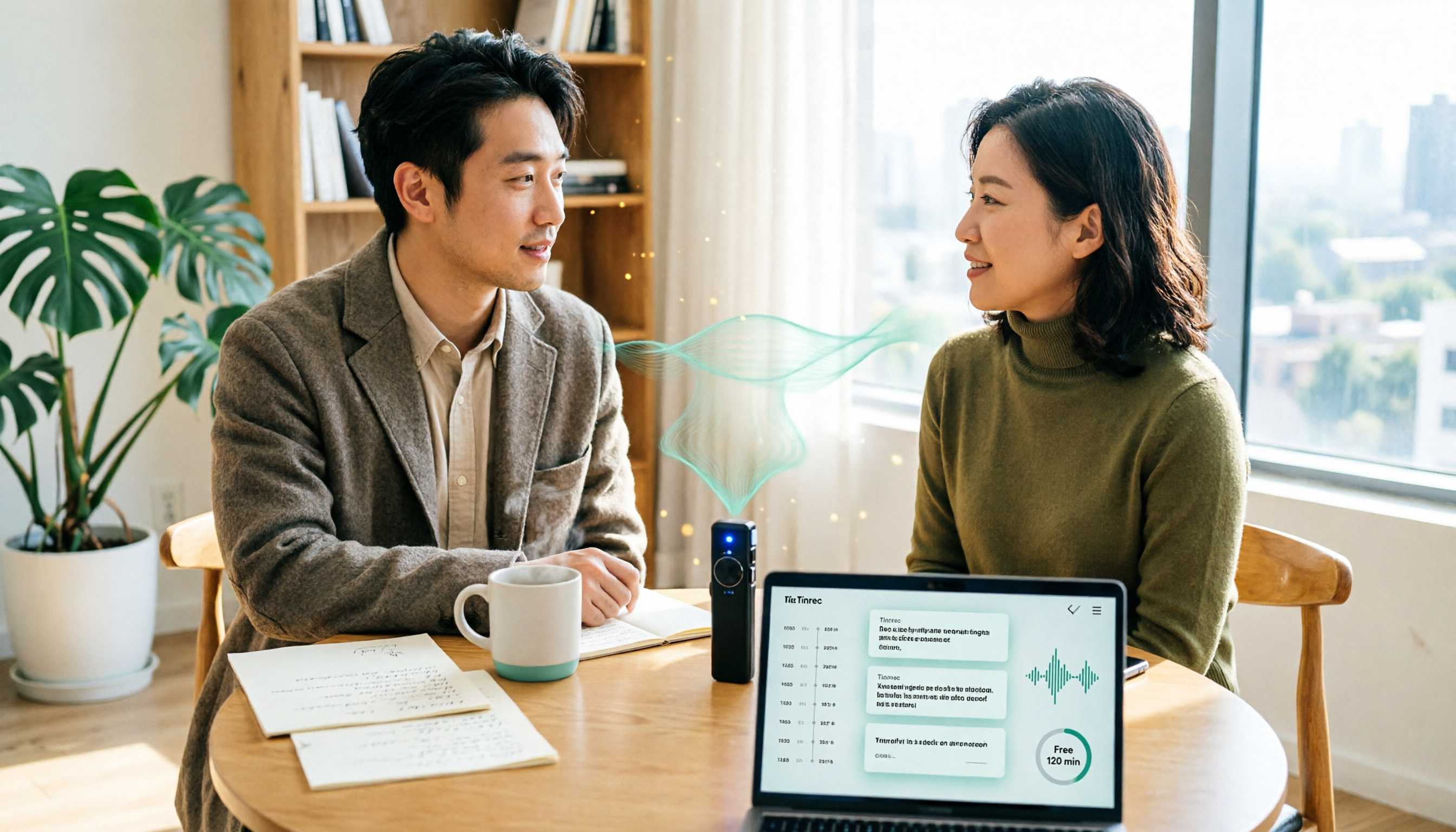
6 Free Transcription Tools Tested in 2026: Which Free Tier Is Actually Enough?
We compare 6 transcription tools you can start using for free, covering free quotas, language support, and post-meeting organization, plus common misconceptions about free plans and tips for choosing.

2026 Complete Guide to Audio Transcription Software: A Practical Workflow from Recording to Meeting Minutes
Choosing audio transcription software based only on price and minutes is the most common mistake. This complete guide covers real-world use cases, core capabilities, and purchasing considerations, explaining how Tinrec turns meeting recordings into searchable, queryable, and reusable data, and outlines the quotas and pricing for the free and team versions.

LINE Call Recording on iPhone vs Tinrec: 5-Factor Comparison for 2026
Many iPhone users ask how to record LINE calls. This guide covers five common methods and compares iPhone's built-in call recording with Tinrec, an AI meeting notes tool, across recording, transcription, post-call organization, and team collaboration to help you choose the right workflow.
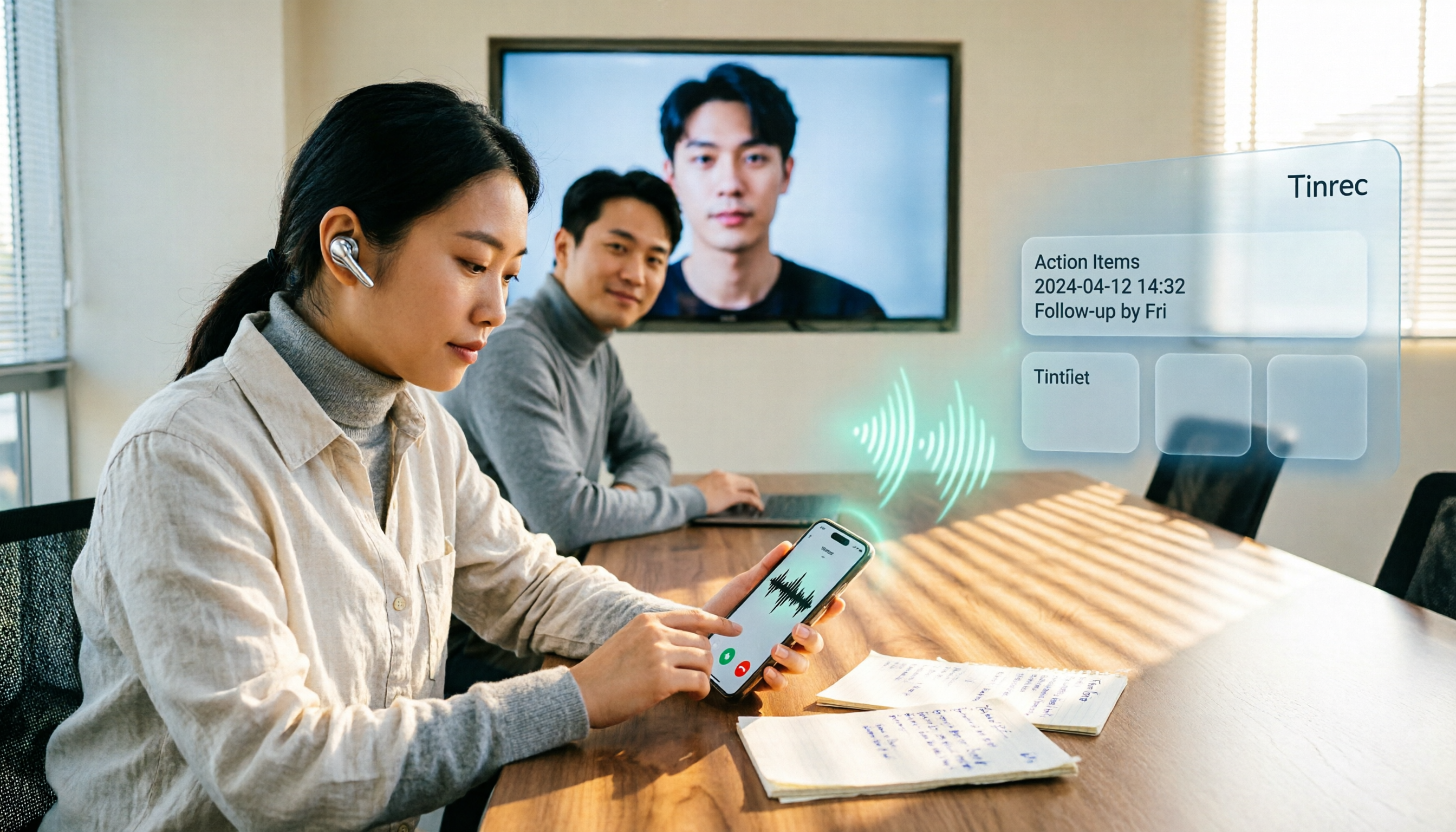
4 LINE Call Recording Methods Tested for 2026: Android vs. iPhone — Which Is Most Reliable?
LINE doesn't offer built-in call recording. Android relies on screen recording, while iPhone uses system call recording or external hardware—each with its own hurdles. This article breaks down four methods with real-world workflows and explains how to turn recordings into searchable, queryable, actionable meeting data using Tinrec.

How to Create Podcast Transcripts in 2026: 5 Steps from Recording to Transcript
Most people looking for podcast transcription software only focus on accuracy, but the real key is whether you need plain text or searchable, summarizable, shareable content. This article explains the complete podcast transcription workflow in 5 steps, demonstrating transcription, summarization, AI Q&A, export, and team sharing with Tinrec, and concludes with 5 purchasing considerations and FAQs.

4 LINE Call Recording Solutions Compared for 2026: Which One Actually Saves You Time After the Call?
LINE doesn't have built-in call recording, and iPhone and Android handle it completely differently. This article compares four options—iPhone's built-in local capture, Cube ACR, PLAUD recording hardware, and Tinrec—based on four key criteria: recording source, platform compatibility, post-recording organization, and team management, to help you choose a solution that truly saves time.

4 LINE Call Recording & Transcription Solutions Tested for 2026: How to Work Around iPhone Limits
A roundup of popular LINE call recording methods discussed on PTT, comparing iOS 18 built-in, Android built-in, Cube ACR, and Tinrec, with practical tips for transcribing and AI summarizing recordings.

Free LINE Call Recording Options in 2026: Tinrec and 4 Other Tools Compared
LINE doesn't have built-in call recording, so most people turn to third-party tools. This article reviews common free and paid options for LINE call recording, and uses Tinrec as an example to show how to turn recordings into searchable, queryable transcripts and meeting notes that can be shared with your team. It also includes buying tips and FAQs.