
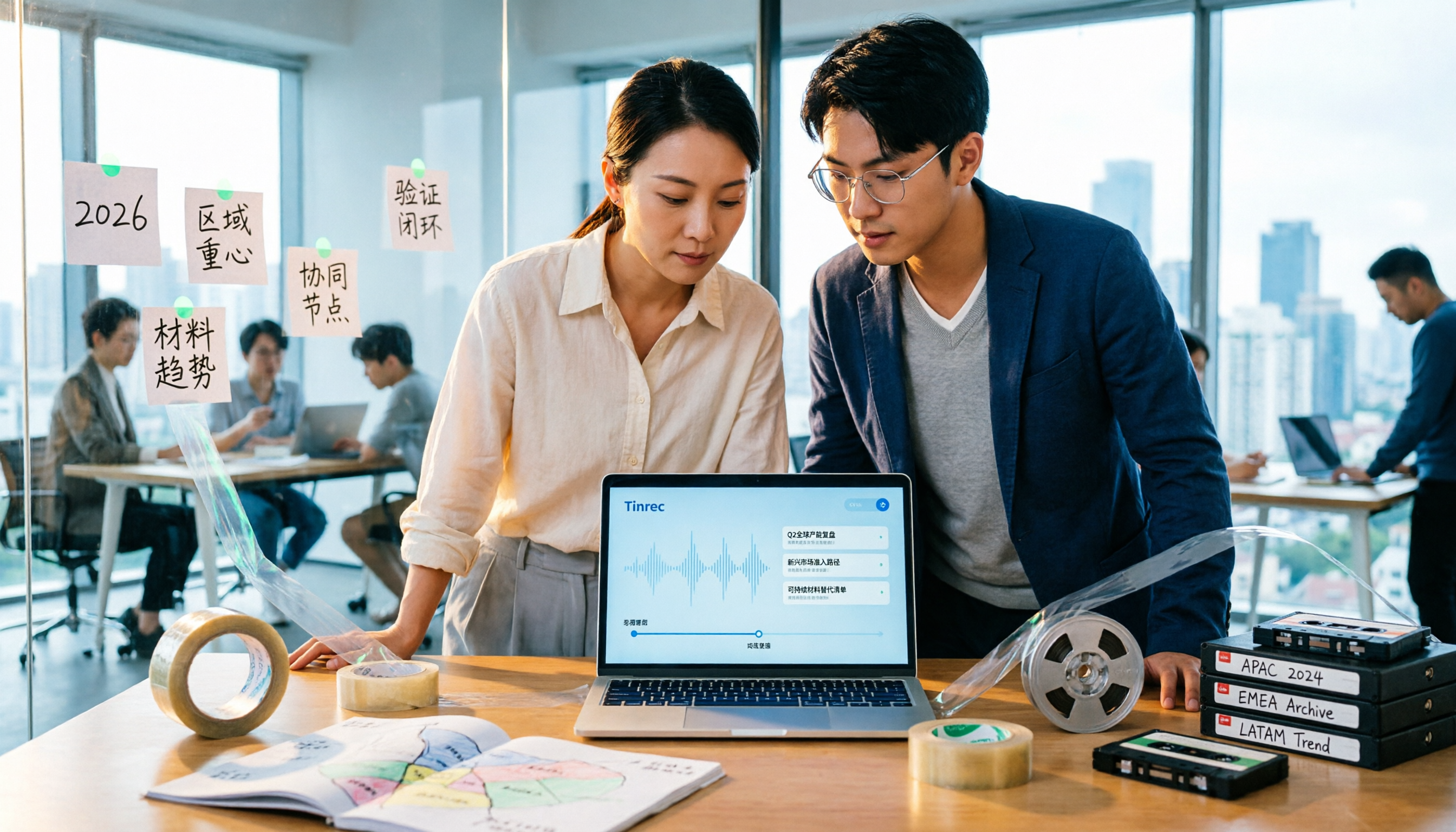
Turn recordings into transcripts and summaries in minutes
Upload audio or video for multilingual transcription, AI notes, and action items
2026 Tape Market Outlook: 5 Steps to Understand Global Tape Industry Trends
First, Confirm: Which Question Are You Trying to Answer?
If you're evaluating tape suppliers for 2026, preparing to switch your production line to a new batch of box sealing tape, or simply trying to explain clearly in a meeting whether "the tape market is doing well this year," you've probably already been bombarded by three sets of numbers: some say the overall tape market is $90.7 billion, others say the adhesive tape market is $92.15 billion, and still others say data archival tape shipments surged 57% in the first quarter.
All three numbers are correct, but they answer completely different questions. Mixing up the definitions is more dangerous than not reading the reports at all.
This article isn't going to pile on another market report. What we're going to do is break down the 2026 tape market into 5 assessment steps, so that at your next procurement meeting, you can explain in three minutes what the market looks like, where the opportunities are, and where the risks are hidden.
Before Understanding the 2026 Tape Market, Grasp These 5 Key Points
1. First confirm the scope: which "tape market" are you looking at?
Even though they're all called the tape market, different research firms have very different statistical scopes. Future Market Insights' overall tape market is about $90.7 billion in 2026; MarketsandMarkets' adhesive tape market is about $92.15 billion in 2026. The numbers are close but the definitions differ, so when citing them, always clearly state the source and scope, otherwise you'll easily be stumped in a meeting.
2. Next, look at regional focus: Asia-Pacific is already more than half the market
Taking the adhesive tape market as an example, Asia-Pacific already accounted for 51.9% of the market share in 2025 (by value). This means that supply chains, cost structures, and lead time risks are heavily concentrated in a single region. For procurement, this is both bargaining power and concentration risk.
3. Look at the application structure: the largest volume segment isn't necessarily the most profitable one
Packaging and sealing applications account for 41.0% of overall tape demand in 2026; if we focus on industrial tape, packaging tape alone accounts for 32.6%. This segment is characterized by "repeat purchases"—manufacturing, warehousing, retail shipping, and export logistics all use it, and it works with both manual and automated application equipment, so volume is stable. But conversely, it's also the most standardized and easiest to price-compare.
4. Look at material trends: polypropylene is the mainstay, paper-based substrates and silicone are growing
Polypropylene is estimated to account for 29.8% of the market share in 2026; silicone resin is the fastest-growing subsegment from 2026 to 2031, with a CAGR of 5.22%. Meanwhile, extended producer responsibility (EPR) requirements in Europe and some North American markets are pushing packaging buyers to re-examine tape materials, creating entry opportunities for paper-based substrates, water-based adhesives, thinner films, and bio-based adhesive formulations.
5. Look at long-term drivers: e-commerce, automation, and regulation
Data released by the U.S. Census Bureau in May 2026 shows that first-quarter e-commerce sales reached $326.7 billion, up 9.8% year-over-year, accounting for 16.9% of total retail—this directly supports steady consumption of box sealing and shipping tape. The spread of automated application equipment and tightening packaging regulations in various countries are the variables to watch most closely in the coming years.
Four Tape Sub-Markets in 2026, Numbers at a Glance
Overall Tape Market (FMI scope) About $90.7 billion in 2026, reaching $147.7 billion by 2036, with a CAGR of 5.0%; the 2025 base was $86.4 billion, and the absolute dollar opportunity from 2026 to 2036 is about $57 billion. Construction and building accounts for 24.0% of end-use demand, the second-largest outlet after packaging.
Adhesive Tape Market (MarketsandMarkets scope) About $92.15 billion in 2026, about $117.47 billion by 2031, with a CAGR of 4.97%, driven mainly by automotive, packaging, electronics, and construction. Silicone resin is the fastest-growing material subsegment.
Industrial Tape and Box Sealing Demand In addition to packaging tape accounting for 32.6% and polypropylene 29.8%, India's expansion in electronics, automotive, food processing, construction, consumer goods, and parcel delivery is making it an increasingly important market. In July 2025, 3M also launched Scotch Performance Paper Box Sealing Tape 570 for automated application and recycling-oriented carton sealing.
Paper Tape Market About $6.3 billion in 2026, about $9.6 billion by 2036, with a CAGR of 4.0%, and an incremental opportunity of about $3.3 billion over the decade. Product types include masking tape, packaging tape, consumer and stationery tape, and pressure-sensitive tape; applications range from masking, sealing, bundling, fixing, to labeling and splicing.
Same Name, Different Thing: Data Archival Tape (LTO) This segment has nothing to do with tape itself, but it's also called tape. Shipment capacity fell 9% year-over-year in 2025, but rose 57% year-over-year in the first quarter of 2026; in 2024 it hit a historical peak of 176.5 EB (up 15.4% year-over-year). If your keyword is "tape market," remember to first confirm whether the other party is talking about box sealing tape or data archival tape.
Beyond Physical Tape, What Else Are Enterprises "Bonding" in 2026?—Tinrec
The markets above share a common logic: fixing things in place, sealing them up, preserving them. In business operations, there's another category of things that also needs to be packaged and archived: meeting content that disperses as soon as each meeting ends.
Stop organizing recordings by hand
Upload audio or video and automatically get a transcript, summary, and action items
Tinrec is an AI meeting notes and collaboration tool for individuals and teams, covering iOS, Android, desktop, and web. What it handles isn't "recording the sound," but turning meetings into searchable, collaborative, actionable data.
First scenario: Record online meetings without a meeting bot. Tinrec's desktop version directly captures your computer's system audio, handling meeting content played on your computer from platforms like Zoom, Google Meet, Microsoft Teams, and Webex, without pulling an extra bot into the meeting as a participant. For external client meetings, this removes the awkwardness of "an extra unfamiliar account in the meeting room." Note that this doesn't mean it automatically joins all meetings on your calendar—users still need to initiate recording themselves.
Second scenario: After recording, the work begins. When the meeting ends, the transcript is already generated in sync, and AI then generates summaries, chapters, key points, and action items; long meetings are broken into browsable segments, and cross-language meetings can be viewed in original text, translation, or bilingual format. If you only treat this type of tool as a transcript generator, you're only using part of its capabilities.
Third scenario: Ask the meeting directly instead of scrolling through the transcript. After recording, you can directly ask Tinrec: "Who mentioned the budget in the last meeting?" It will give an answer based on semantics, rather than throwing a string of keyword search results at you. This is the most obvious gap between it and pure transcription tools. As meeting data accumulates, you can further generate reports, tables, and documents, or export to Notion, Google Docs, OneNote, or Dropbox for further processing.
The team version turns a personal tool into a team asset. The team version isn't "multiple people sharing one account," but an independent team space: meeting data belongs to the team, members are invited via a join link, and administrators can set owners, admins, and regular members, and assign, reclaim, or transfer seats. In terms of plans, eligible new teams can try it for 7 days, including 1 free seat and 300 minutes of team shared import quota; the team monthly plan is USD 29.80 per paid seat per month, and the annual plan is USD 199 per paid seat per year (about USD 16.58 per month), with each paid seat providing 2,000 minutes of team shared import quota per month. Under an active team plan and active seats, real-time recording currently does not deduct minutes; file and web imports consume the team shared quota and do not use members' personal quotas.
**Limitations should also be clearly stated.** Roles and seats are two concepts: members without a seat can still view, play, and read team data, but they need a seat to record, upload, edit, and export. Currently, the team version is mainly team-level sharing, not a file-level granular permission system. In addition, transcription quality is affected by recording quality, noise, accents, overlapping speakers, and technical terminology, and is not suitable for promising a fixed accuracy rate externally. For important content, it's still recommended to compare transcript timestamps with recording playback.
**Who is it for?** Teams that frequently need Chinese or mixed Chinese-English meeting notes, prefer not to add meeting bots, and want to turn meeting content into a searchable team asset will feel the difference most directly.
Besides Tinrec, What Other Options Are There?
Otter.ai A mature English AI meeting assistant, with a Basic free plan of 300 minutes per month, and Pro at about USD 8.49 per user per month on an annual basis. It has a strong mindshare for English business meetings. If you're dealing with Chinese or mixed Chinese-English meetings and need governance capabilities like team hotwords and an audio recycle bin, Tinrec is a better fit.
Granola A bot-free AI meeting notes tool, with Basic free and Business at USD 14 per user per month, focusing on "user notes + AI enhancement." Its limitations are clear: it doesn't save meeting audio and doesn't support uploading pre-recorded audio files. When you need to keep recordings or organize historical meeting files, this is where Tinrec clearly wins.
PLAUD Note / NotePin Representatives of AI recording hardware, with NotePin at USD 159 and Note Pro at USD 189, plus membership fees (Pro at USD 99.99 per year). The value of hardware for on-the-go recording doesn't need to be denied, but you have to buy the device first. Tinrec requires no extra hardware, works on desktop, web, and mobile, and can directly handle online meetings.
Pitfall Guide: The 4 Most Common Mistakes When Looking at Markets and Choosing Tools
Pitfall 1: Mixing numbers from different scopes. $90.7 billion and $92.15 billion aren't a matter of who's right or wrong, but of different statistical scopes. When citing, stating the source and definition is more important than remembering the number.
Pitfall 2: Treating market size as your own opportunity size. A big market doesn't mean you can enter it. Packaging and sealing account for 41.0% of demand, the largest volume, but also the most standardized and most price-competitive. It depends on whether you're targeting materials, applications, or new demand driven by regulation.
Pitfall 3: Ignoring the material and regulatory line. EPR requirements are changing the logic by which packaging buyers choose tape, and that's how opportunities for paper-based substrates, water-based adhesives, and bio-based formulations are growing. Looking only at price will make you miss this round of material switching.
Pitfall 4: Comparing only transcription minutes when choosing a meeting tool. Minutes are just the entry ticket. What really determines long-term cost is post-meeting processing and data ownership: whether meeting notes can be queried, whether they can be exported to existing workflows, and whether data disappears when members leave. Tinrec's value mainly lies in the latter half, not just the first half.
Summary: In 2026, Which Market Should You Actually Look At?
- To see overall size and ten-year trends → FMI's overall tape market (about $90.7 billion in 2026, about $147.7 billion in 2036)
- To see adhesive tape and regional focus → MarketsandMarkets scope (Asia-Pacific 51.9% in 2025)
- To capture box sealing and e-commerce linkage → packaging tape within industrial tape (32.6% in 2026)
- To find entry points for eco-friendly materials → paper tape market, plus EPR-driven formulation changes
- To turn meeting content into team data → Tinrec (bot-free recording, AI Q&A, team space and seat management)
If you're evaluating the last item, Tinrec has a free version you can start with, and teams also get a 7-day trial, 1 free seat, and 300 minutes of shared import quota. Try a real meeting of your own with a transcript and an AI Q&A first, then decide whether to go further—that will be more accurate than reading any market report.
References
- Adhesive Tapes Market Report 2026-2031 377 Pages & 427 Tables
- Industrial Tape Market Size and YoY Growth Rate, 2026-2033
- Paper Tapes Market Insights & Growth 2026–2036
- Tape capacity shipments fell in 2025 but 2026 could be a boom year for tape
- Tapes Market to Reach USD 147.7 Billion by 2036 at 5.0% CAGR as Automation, E-commerce & Bonding Drive Demand - Newstrail
Turn every recording into actionable outcomes
Get 60 free transcription minutes when you sign in. No credit card required.
Related Reading
You might also like

Taigi Keyboard vs. MOE Taiwanese Hokkien Input Method: A 5-Dimension Comparison for Computer Users in 2026
Want to type Taiwanese Hokkien on your computer but not sure which input method to choose? This article compares Taigi Keyboard and the MOE Taiwanese Hokkien Input Method across five dimensions: installation ease, dictionary completeness, cross-platform support, typing fluency, and licensing. It also includes a bonus look at the FHL Taiwanese and Hakka Input Method to help you find the most suitable Taiwanese Hokkien input solution.

How to Install Taiwanese Hokkien Input Methods on PC (2026): MOE & FHL Editions
Want to type Taiwanese Hokkien on your computer but not sure which input method to install? This guide addresses common misconceptions, provides step-by-step installation instructions for the Ministry of Education (MOE) Taiwanese Hokkien input method for PC, covers supported platforms and dictionary features, and compares it with the FHL Taiwanese Hokkien & Hakka input method. Learn how to choose, install, and activate the right Taiwanese Hokkien input method for your computer.

5 Cantonese Speech-to-Text Tools Tested and Compared in 2026: Which Saves the Most Time Transcribing Cantonese Audio?
Turning Cantonese recordings into text—the biggest pitfall isn't a weak tool, it's ending up with a pile of unusable transcripts. This article starts with common misconceptions, then covers practical usage, core capabilities, use cases, and 5 key buying considerations for Cantonese speech-to-text. It also uses Tinrec to demonstrate the full workflow from recording to action items.

Best Cantonese Voice Input for Apple in 2026: 4 Methods Tested, Tinrec Wins for Long Meetings
Apple's built-in Cantonese voice input works for short phrases, but struggles with long meetings and multiple speakers. This article tests 4 common approaches and explains how Tinrec handles Cantonese meeting transcripts, AI summaries, action items, and team knowledge retention.

3 Free Google Speech-to-Text Options Tested: Is Free Really Enough?
Is Google speech-to-text free? We tested three free options—Google Docs voice typing, Google AI Studio (Gemini), and pyTranscriber—and break down their limitations and best use cases. We also explain why Tinrec is a more time-saving choice when you need Chinese meeting transcripts, post-meeting summaries, and action items.

2026 Comparison of 2 Cantonese Meeting Transcription Tools: Tinrec vs Otter.ai — Which Should You Choose?
Cantonese meeting transcription often struggles with recognition gaps and post-meeting organization. This article starts with two common misconceptions and compares Tinrec and Otter.ai in real tests across Chinese and Cantonese meetings, meeting capture methods, post-meeting organization, plan flexibility, and team data retention. It also summarizes 5 key points to consider when choosing a tool and answers common questions.

2026 Voice-to-Text Tools Compared: AI Cantonese Transcription and Meeting Notes
Turning Cantonese or mixed-language meeting recordings into usable transcripts is challenging, and tools vary widely in output quality. This article compares Tinrec, Otter.ai, Notta, and Granola across five key aspects: Cantonese model support, accuracy evaluation, post-meeting output, recording retention, and team authorization. It also highlights four common pitfalls to help you choose the right tool.

4 Speech-to-Text Tools Tested: Which Free Cantonese Option Is Good Enough?
Starting from real mid-level manager meeting scenarios, we tested 4 speech-to-text tools on Cantonese and mixed Chinese-English meetings, comparing the real limits of free tiers, post-meeting AI organization, and team collaboration design to help you decide which one is good enough.

4 Speech-to-Text Tools Tested and Compared in 2026: Is Google AI Studio's Free Version Really Enough?
Google AI Studio's speech-to-text is free and quick to start, but it has audio length and quota limits, and you still have to copy and proofread the transcript yourself. This article starts with common misconceptions, tests and compares 4 tools, explains the real boundaries of free plans, and shows how Tinrec fills in the post-meeting organization gap with bot-free recording, AI Q&A, and team spaces.