
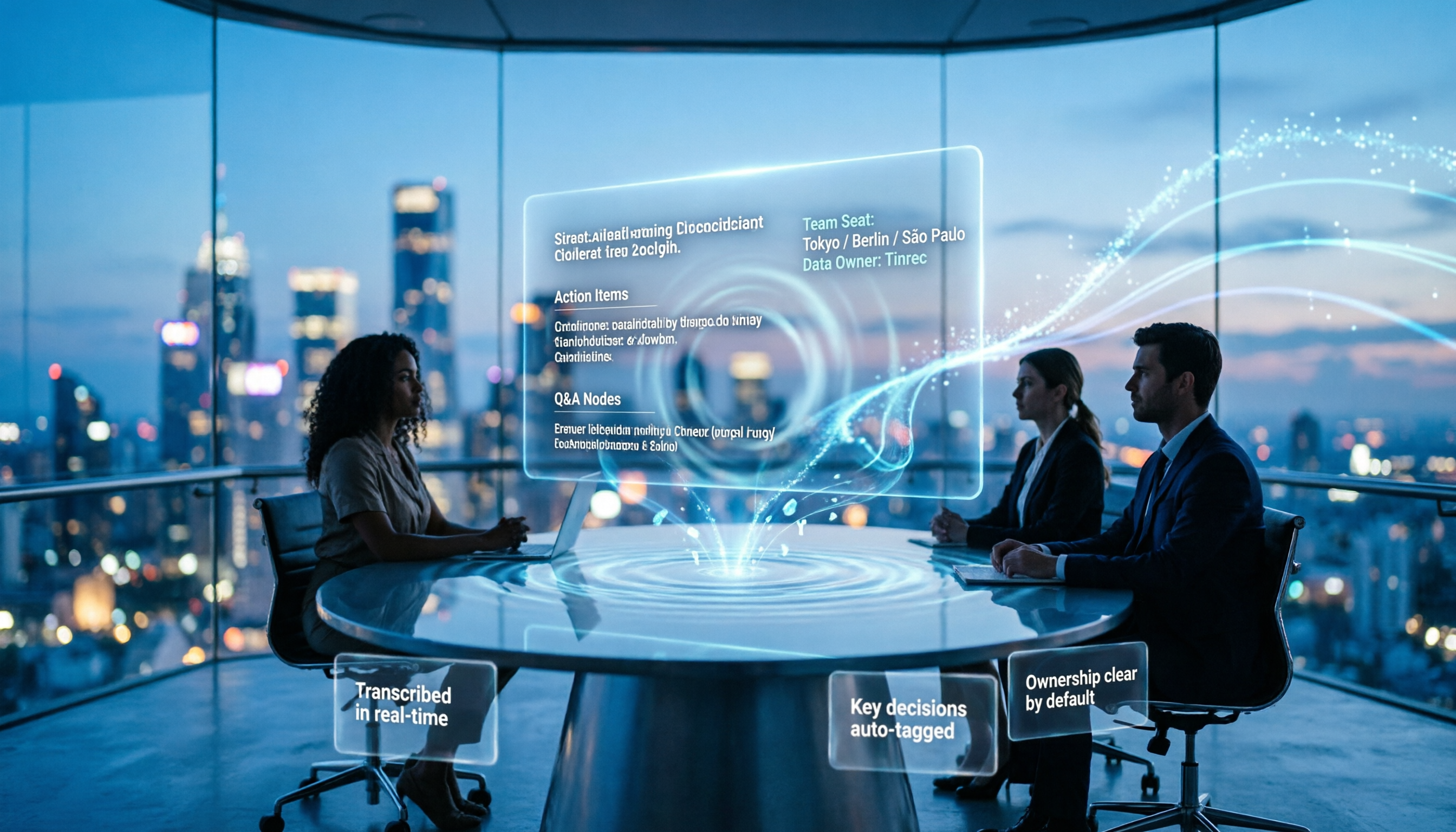
Turn recordings into transcripts and summaries in minutes
Upload audio or video for multilingual transcription, AI notes, and action items
4 AI Meeting Note Tools Tested in 2026: Which One Saves the Most Time on Auto-Organizing Transcripts?
The Real Problem with Meeting Notes Is Never "Typing Too Slowly"
Many people think the pain of meeting notes is typing, so they look for transcription tools to turn speech into transcripts. The file is there, but after the meeting, you still have to read through it again.
Another common approach is to copy the entire transcript into a chatbot and ask it to "summarize the key points." This isn't wrong, but you have to re-paste and re-instruct each time, and the transcript sits in a personal chat history. Next time you need to find a specific decision, you still have to dig through it from scratch.
Another easy pitfall: to automatically record online meetings, you add a meeting bot to the room. As soon as participants see "XX AI has joined the meeting," the atmosphere changes; some clients even ask directly, "Is this being recorded?"
A more reasonable approach is to think of the process in three stages: reliably capture content during the meeting, automatically generate summaries and action items after the meeting, and finally store the data somewhere you can find it later. This article tests 4 common AI meeting note tools from this perspective.
Before Choosing an AI Meeting Note Tool, Understand These 4 Key Points
1. How the meeting is "captured" There are two mainstream methods: a bot that joins as a participant, or desktop capture that directly records the computer's system audio. Bots are convenient but may not be suitable for external client meetings; desktop capture requires the user to actively start recording. First, clarify which scenario your meetings fall into, then choose a tool.
2. What comes after the transcript A tool that only provides a transcript is essentially handing the organization work right back to you. What's worth checking: does it automatically generate summaries and chapters, can it extract action items, can you ask questions about the content, and can it export to your existing workflow? These determine how much time you'll spend after the meeting.
3. Handling Chinese and mixed Chinese-English Meetings in Taiwan are rarely pure English; they often mix Chinese with product names, technical terms, and English abbreviations. "Multi-language support" is just the baseline—the real difference is whether it captures proper nouns and whether it can be enhanced with mechanisms like team hotwords.
4. Where the data ultimately resides Is the data stored in a personal account or a team space? This feels inconsequential at the moment, but it hurts when a colleague leaves, you change phones, or you need to find a decision from six months ago. If your meeting content belongs to the team, choose a tool with team space and handover mechanisms.
Tinrec – The One We Most Often Recommend After Testing
Tinrec is an AI meeting note and collaboration tool for individuals and teams, supporting iOS, Android, and desktop/web. It doesn't just convert audio to text; it organizes meeting recordings into searchable, summarizable, queryable, and exportable data.
Record online meetings without inviting a bot The desktop version directly captures the computer's system audio, handling Zoom, Google Meet, Microsoft Teams, Webex, and other online meetings. To be clear: users need to open Tinrec themselves to start recording; it's not a bot that automatically joins all calendar meetings. For teams that need to meet with external clients, having one less "AI has joined the meeting" notification makes communication much more natural.
The transcript is just the starting point After the meeting, AI automatically generates summaries and chapters, breaking long meetings into readable sections and extracting action items from the discussion. Even better is AI Q&A—you can directly ask, "Who mentioned the budget cap in the last meeting?" and it will answer based on semantic understanding, rather than throwing a list of keyword search results at you. Most tools in the same price range still stop at providing transcripts or summaries.
From transcript to a deliverable finished product Supports multi-format export, allowing results to be taken to Notion, Google Docs, OneNote, Dropbox, and other tools for further use; you can also use Agent post-processing to turn meeting content into reports, tables, and documents. There's also real-time translation, so cross-language meetings can be viewed in original, translated, or bilingual mode.
How we tested The test materials were several real meeting recordings, including mixed Chinese-English product discussions and side recordings of in-person meetings with background noise. We mainly looked at three things: whether the transcript is readable, whether the summary captures decisions, and whether action items are assigned to people. We deliberately do not give fixed accuracy numbers because actual performance is affected by recording quality, accents, overlapping speakers, and technical terminology; for important content, it's advisable to cross-check with the transcript timestamps and recording—a habit you should have with any AI tool.
Stop organizing recordings by hand
Upload audio or video and automatically get a transcript, summary, and action items
Three reasons worth recommending First, bot-free recording is less awkward for client meetings. Second, the summary, action items, AI Q&A, and export after transcription form a complete workflow, not separate parts. Third, the Chinese and multi-language meeting experience is comprehensive, and it supports team hotwords for maintaining technical terminology.
Things to note The personal free version provides a basic experience quota, suitable for running one or two real meetings to see if the workflow fits; if you have many meetings every week, you'll need to upgrade. Also, team collaboration, seat management, and usage analytics are part of the team plan and are not available in the personal version.
What the team plan does Tinrec for Teams is not "multiple people sharing one personal account" but an independent team space. Meeting data belongs to the team; members without a seat can still view, play, and read team data; but to record, upload, edit, import/export, they need a seat. Roles (owner, admin, member) determine governance permissions, seats determine usage eligibility—the two should be viewed separately. Currently, the team monthly plan is USD 29.80 per paid seat per month, annual plan is USD 199 per paid seat per year (about USD 16.58 per month), each paid seat provides 2,000 minutes of team shared import quota per month; eligible teams can try 7 days, 1 free seat, 300 minutes of team shared import quota for the first time. Actual prices and benefits are subject to the official purchase page.
Who it's for If you frequently have Chinese or mixed Chinese-English meetings, don't want a bot joining the meeting room, want to get summaries and action items directly after recording, and even use Q&A to dig into past meetings—Tinrec is currently the most complete workflow option.
Besides Tinrec, What Other Options Are There?
Otter.ai A mature choice for English business meetings. Basic free plan offers 300 minutes per month; Pro annual billing is about USD 8.49 per user per month, including 1,200 minutes of in-app recording and 10 file imports per month. Its English summaries and AI Chat are excellent, and the desktop version can also record. But if your meetings are mainly Chinese or mixed Chinese-English, Chinese terminology organization and team hotword maintenance are areas where Tinrec puts more emphasis.
Notta High overlap with Tinrec in features: multi-platform transcription, file import, translation, and team plans. Official Free is 120 minutes per month, with a maximum of 3 minutes per single content; Pro annual billing is about USD 8.17 per month, 1,800 minutes per month. The difference is that its online meetings lean toward a bot mode, while Tinrec's desktop version doesn't require an extra bot to join the meeting, and after the meeting, you can directly use AI Q&A to follow up on content.
Granola A bot-free AI meeting note tool. Basic is free, Business is USD 14 per user per month. It focuses on "your handwritten notes plus AI enhancement," with a smooth reading experience, but two limitations to note: it doesn't support uploading existing audio files, and it doesn't save meeting audio. If you need to keep recordings, import old files later, or need Chinese meetings and real-time translation, Tinrec is more suitable.
Pitfalls Guide: The 3 Most Common Mistakes When Choosing an AI Meeting Note Tool
Pitfall 1: Only looking at official accuracy claims Numbers measured in a quiet environment differ greatly from real meeting rooms—air conditioning noise, keyboard sounds, multiple people talking over each other, and technical terminology all degrade performance. We suggest trying it with a recording of your own meeting, not just reading ad copy.
Pitfall 2: Treating the transcript as the end goal Using the tool only as "audio-to-text" means you're only using part of its capabilities. Asking AI directly after the meeting, "What was the conclusion of this meeting?" is much faster than manually flipping through a 30-minute transcript.
Pitfall 3: Ignoring where the data ultimately resides Personal accounts are convenient, but if a colleague leaves or you change devices, the data may become disconnected. Team data owned by the team and transferable when members change is the most easily overlooked point when choosing a tool—and the one you'll notice the pain of the latest.
Conclusion: Which One Should You Choose?
Direct routing by scenario:
- Chinese/mixed Chinese-English meetings, want to save organization time → Tinrec
- Don't want a bot joining client meetings → Tinrec (desktop version captures system audio)
- Want to ask AI directly to find decisions and action items after recording → Tinrec (AI Q&A)
- Need team sharing of meeting data, seat and usage management → Tinrec team plan
- Mainly record English meetings, extremely budget-sensitive → Otter.ai free version
We suggest starting with Tinrec's free version, running through the entire workflow with one or two real meetings, confirming that the quality of summaries and action items meets your expectations, then deciding whether to upgrade. Whether a tool is good or not, you'll know after trying it once.
References
- How to use AI for meeting minutes? How to organize meeting transcripts? | AI speech-to-transcript tutorial | 104 Career Power
- Organizing meeting minutes is so painful? 5 NotebookLM "AI note transformation" tricks, accurate translation even with mixed Chinese-English and technical terms | BusinessNext
- Meeting minutes are such a hassle? ChatGPT+Whisper does it all at once! Auto transcription, summary, and sending are all possible | BusinessNext
- Meeting Ink - 2026 AI meeting note tool test | 7 speech-to-text and summary speed comparison | Meeting Ink - AI meeting note assistant auto transcription and summary
- Get meeting minutes done! How to do AI speech-to-transcript? Gemini Notebook, Gemini, EchoScript operation analysis | 104 Career Power
Turn every recording into actionable outcomes
Get 60 free transcription minutes when you sign in. No credit card required.
Related Reading
You might also like

2026 Teams Meeting Transcription Comparison: 4 Methods Tested — Is Avoiding a Meeting Bot Really Easier?
Teams built-in transcription requires both the organizer and each user to enable the policy, and live captions are not saved—so many people only discover after the meeting that there is no transcript at all. This article reviews four ways to transcribe Teams meeting recordings, from Teams built-in, Otter.ai, and Notta to Tinrec, comparing bot-free desktop recording, AI Q&A, action item extraction, and team seat management, with a pitfalls guide and scenario-based recommendations.

4 Video-to-Transcript Tools Tested and Compared in 2026: 3 Pitfalls to Understand Before Importing Video
Importing a video to generate a transcript looks simple, but the real bottlenecks are usually format support, time codes, and how usage limits are calculated. This article starts with common misconceptions, outlines 4 key points for choosing a tool, then shares a hands-on test of Tinrec from video import to AI summaries, action items, and team knowledge retention, and compares TurboScribe, Notta, and Granola for use cases and pitfalls to avoid.

How to Transcribe Classroom Recordings in 2026: A Complete 5-Step Guide
When it comes to transcribing classroom recordings, most people only ask which tool is the most accurate. But what really determines whether you'll be overwhelmed all semester is the audio source, the classroom language, and the total number of hours. This article uses university and graduate school classroom scenarios to compare Tinrec and Otter.ai across 5 dimensions, and provides a 5-step process you can follow directly, along with purchasing advice.

How to Transcribe Zoom Meeting Recordings in 2026: No-Bot Recording + Automatic Meeting Minutes
Done with a Zoom meeting but still need to organize the transcript and minutes yourself? This guide covers the complete process for transcribing Zoom meeting recordings, including no-bot recording, real-time transcription, AI summaries and action items, AI Q&A, and 5 key points to consider when choosing a tool. It also demonstrates the workflow using Tinrec.

2026 AI Meeting Recorder Comparison: 4 Tools Tested for Chinese Meetings
Two-hour meetings followed by two hours of note organization is a daily reality for most office workers. This hands-on test of 4 AI recording and note-taking tools covers bot-free recording, Chinese transcription, AI Q&A, team knowledge retention, pricing, and limitations to help you decide which one is worth keeping.

5 Speaker Summary Tools Tested for 2026: Why Tinrec Is Less Work for Chinese Meetings
Starting from the question 'What exactly do you need a tool to do for you?', this hands-on comparison of common speaker summary tools explains how Tinrec performs in Chinese meeting transcription, bot-free online meeting recording, AI summaries and action items, AI chat queries, multi-format export, and team spaces. It also covers five key points to consider when choosing a tool and answers common questions.

2026 AI Meeting Notes: Automatic Speaker Identification + AI Q&A Summaries
Why do you still have to manually organize meeting transcripts even when speakers are automatically labeled? This article starts with common misconceptions about automatic speaker identification, breaks down 4 key dimensions for choosing a meeting notes tool, tests Tinrec's bot-free online meeting recording, AI summaries and Q&A, team spaces, and other features, compares it with Otter.ai, PLAUD Note, and Notta, and includes a pitfalls guide and buying advice.
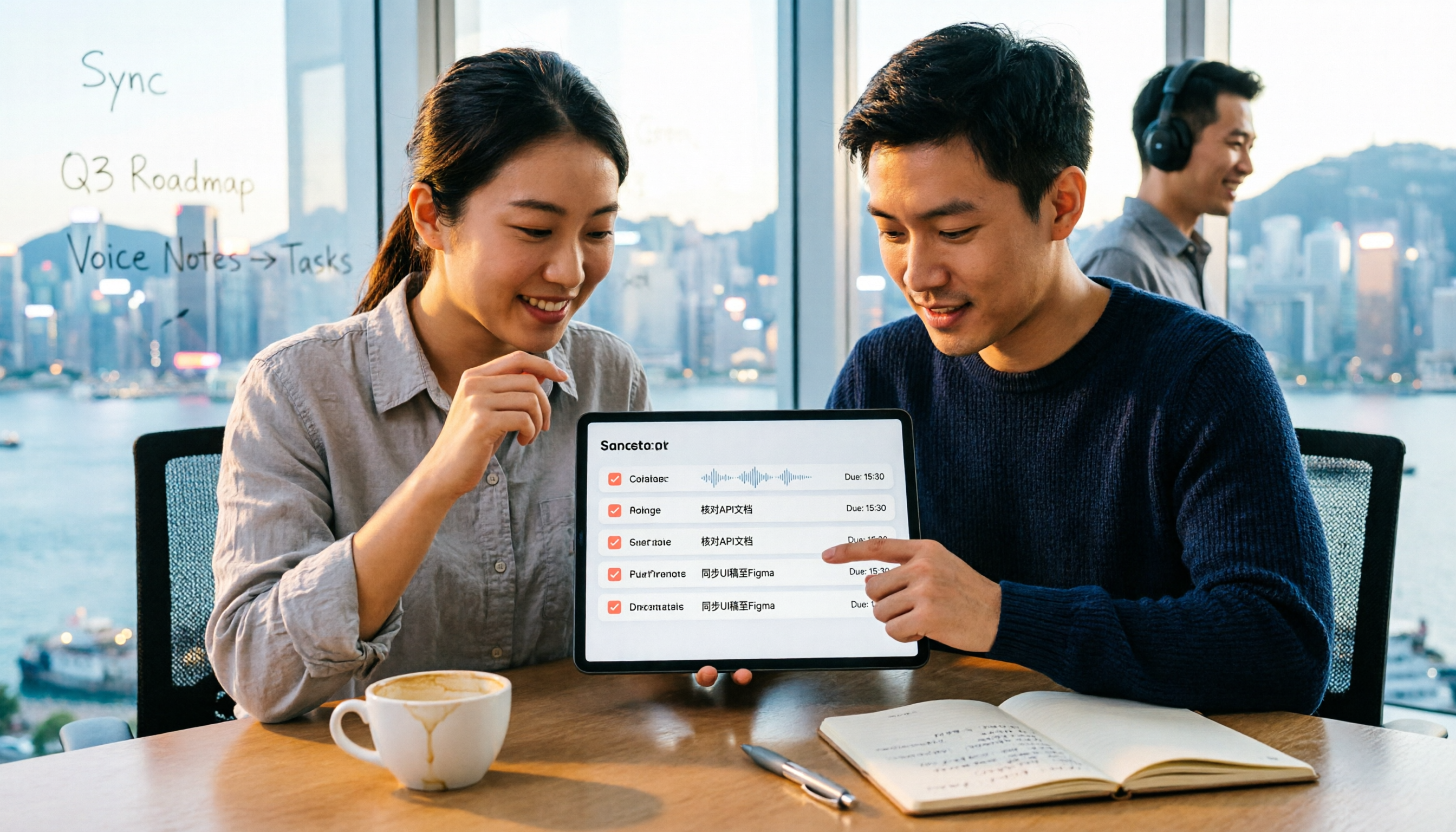
4 Best AI Meeting Note Takers in 2026: Which One Actually Captures Action Items?
The hardest part of a meeting isn't recording it—it's turning two hours of discussion into an action list with names and deadlines. This article compares Tinrec, Otter.ai, Notta, and Granola across four key criteria: action item accuracy, AI Q&A, post-meeting workflow, and team data ownership. We explain who each tool is best for and highlight key buying considerations to help you choose the right tool and stop wasting time on manual transcripts.

Tinrec vs Otter.ai 2026: Cantonese Meeting Transcription with Real-Time Chinese-English Translation
Meetings held in Cantonese but delivered in English are a common pain point for many teams. This article compares Tinrec and Otter.ai across 5 dimensions—Cantonese and mixed Chinese-English recognition, bot-free meeting recording, real-time translation and bilingual review, post-meeting AI Q&A, and team data governance—to help you decide which tool better fits your meeting scenario.