
Turn recordings into transcripts and summaries in minutes
Upload audio or video for multilingual transcription, AI notes, and action items
4 Audio-to-Text Summary Tools Tested and Compared in 2026: Which AI Summary Actually Saves Time?
Have you noticed that many people end up busier after using audio-to-text tools?
The three most common misconceptions I see are: First, thinking that "getting a transcript" equals "done organizing"—a two-hour meeting becomes 20,000 words, and you still have to read through it all. Second, only looking at free minutes and price, without checking whether the tool can help you pick out key points after transcription. Third, thinking you must buy an extra recording device to properly capture meetings.
The truly time-saving approach is to treat "transcription" and "summarization" as one task. Take Tinrec as an example: it's an AI meeting notes and collaboration tool for individuals and teams that turns meeting recordings into searchable, summarizable, queryable, exportable, and further processable data. It supports real-time recording, desktop-based bot-free online meeting transcription, audio and video file import, real-time translation, and can automatically generate summaries, chapters, to-dos, and mind maps. The free version offers a basic quota, suitable for office workers and students who want to try before deciding.
For this test, I used Tinrec as the demonstration tool; I only briefly compared other common tools by positioning, without naming them one by one, to avoid spending the entire article introducing others.
What Can Audio-to-Text Summarization Do for You?
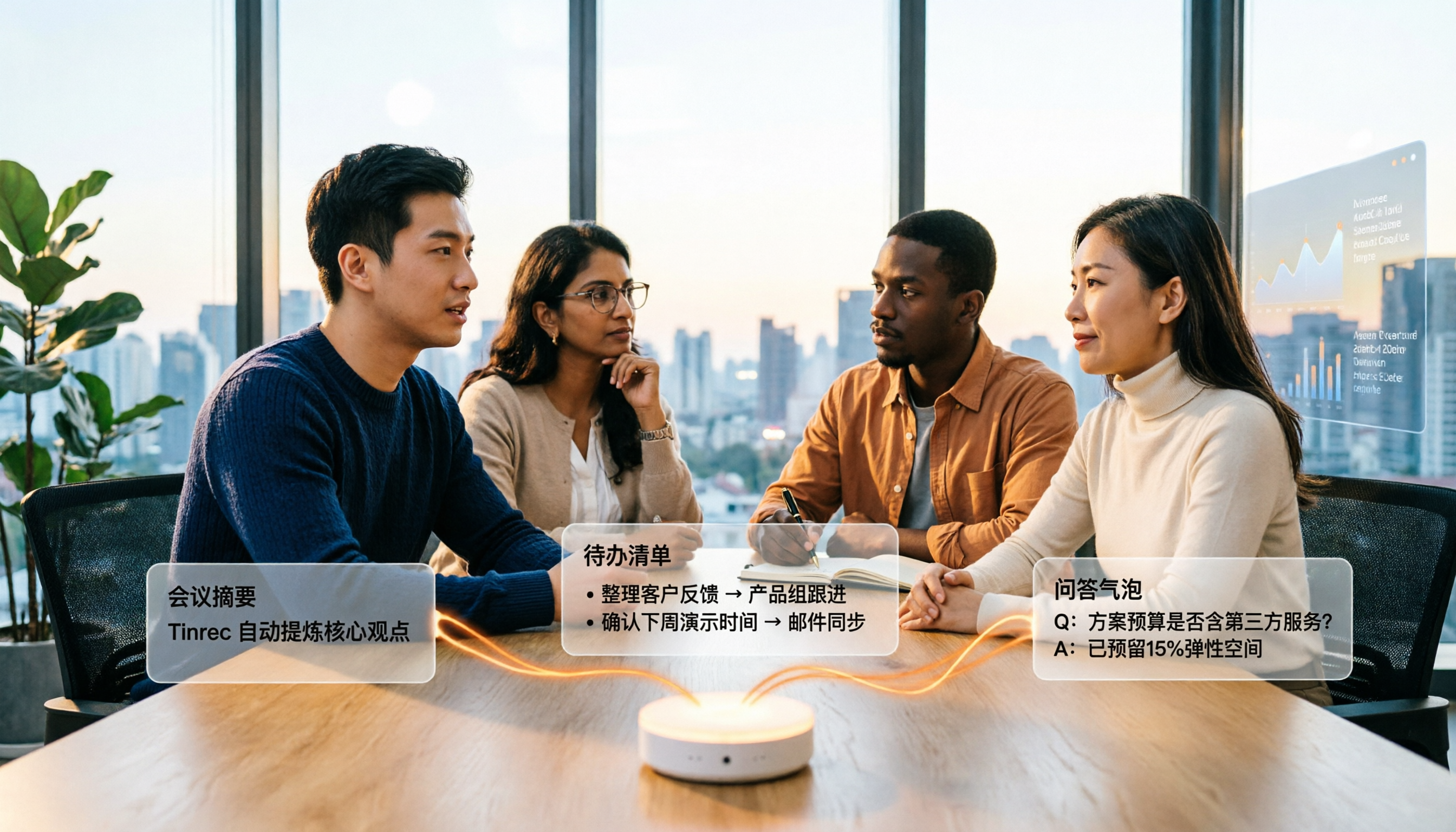
Scenario 1: Get usable meeting notes within five minutes after a meeting Previously, after a two-hour meeting, you might spend another hour organizing notes. With Tinrec, as the meeting ends, AI has already prepared summaries, chapters, and to-dos—who is responsible for what and what's next can be seen at a glance.
Scenario 2: Courses and lectures—no need to re-listen to two hours afterward Not being able to take notes during class is the most common pain point. Give the recording to Tinrec, and it will break long content into paragraphs and chapters. You can jump directly to the section you need to review without dragging the timeline back and forth.
Scenario 3: Interviews and client communication—key points don't rely on memory The worst part of interviews is not remembering what the other person said afterward. Tinrec keeps the full transcript and lets you ask questions about the content, such as "What concerns did the client mention?"—finding answers directly from the semantics.
Scenario 4: Historical recordings stuck on your hard drive Those recordings from a year ago are usually never listened to again. Tinrec supports uploading existing audio and video files for transcription, turning them into searchable text data—that's what truly preserves them.
What Are the Core Capabilities of Audio-to-Text Summarization?
Real-time transcription: transcribe while recording, not after. During a meeting, you can follow along with the text to confirm no key points are missed, rather than discovering after the meeting that a crucial segment wasn't recorded. Tinrec's real-time recording-to-text is suitable for in-person meetings, interviews, and on-site notes.
Bot-free online meeting recording: desktop version captures system audio directly. Note that Tinrec does not operate by having a "meeting bot join the meeting." The desktop version captures computer system audio to handle online meetings on Zoom, Google Meet, Microsoft Teams, Webex, etc., without needing an extra bot as a participant or official platform partnership.
AI summaries and chapters: break long meetings into understandable structure. It doesn't just condense the transcript into a paragraph; it organizes topics, discussion points, and conclusions, letting you see the big picture first before deciding whether to dive into details.
To-do extraction: turn discussions into actionable next steps. Project meetings and client meetings need this most. Tinrec extracts action items from conversations, reducing the situation where "the meeting ended but no one knows what to do."
AI chat query: keep asking questions after transcription. You can directly ask "Who mentioned the budget in the meeting?" or "What was the client's feedback?" and it will answer based on the content—especially convenient for those who need to revisit old meetings.
Real-time translation, multi-format export, and further processing. Cross-language meetings can show original text, translation, or bilingual content; organized results can be exported to Notion, Google Docs, OneNote, Dropbox, etc., and further generate reports, tables, and meeting minutes.
Real-World Use Cases
Meeting notes Weekly meetings, review meetings, and cross-department meetings are most prone to the "forget after meeting" problem. After recording with Tinrec, transcripts, summaries, and to-dos are generated together. When managers need to review decision context, they can search keywords to find the discussion at that time.
Stop organizing recordings by hand
Upload audio or video and automatically get a transcript, summary, and action items
Classroom and learning In a two-hour class, key points usually take only twenty minutes. Tinrec's chapters and summaries help you quickly locate them, so you don't need to re-listen to the entire session when reviewing.
Interviews and research When you need to quote interviewees' exact words, transcripts are far more reliable than memory. With AI Q&A, you can quickly find paragraphs related to specific topics, greatly improving material organization efficiency.
Content creation and post-meeting deliverables Turning interviews or meeting content into articles, reports, or video scripts is a daily task for many self-media and marketing professionals. Tinrec's Agent post-processing can generate documents and tables based on meeting content, saving the work of retyping.
5 Things to Note When Choosing an Audio-to-Text Summary Tool
1. How does it capture online meetings? First clarify whether a bot is needed. Some tools rely on a bot joining the meeting, while others capture system audio. Tinrec belongs to the latter—users actively start desktop recording, and it does not automatically join all your calendar meetings. Understand this clearly before choosing.
2. What it can do after transcription is more important than accuracy. Transcripts are just raw material. Tinrec puts summaries, chapters, to-dos, AI Q&A, and export in the same workflow—that's where real time savings come from.
3. Actual performance with Chinese and mixed Chinese-English. Meetings in Taiwan often mix Chinese and English. When choosing a tool, test with your own recordings. Tinrec covers Chinese, Traditional Chinese, and multilingual meeting scenarios, and supports team hotword management for technical terms; actual results are still affected by recording quality, noise, accents, and multiple people speaking simultaneously.
4. Whether audio files are retained and whether old files can be imported. Some tools only keep text and not audio, leaving no way to verify afterward. Tinrec retains audio, supports uploading existing audio and video files, and provides an audio recycle bin—accidentally deleted files may still be recoverable.
5. For team use, look at governance capabilities. If used by a department or project team, note whether data belongs to individuals or the team. Tinrec's team version is an independent team space with members and roles, seat allocation, shared benefits, usage analytics, audit logs, and audio recycle bin. When members leave, resources can be handed over to others, so data doesn't disappear with the individual.
How is pricing calculated? The personal version offers plans based on needs: for occasional recording organization, the free version's basic quota is enough; for short-term intensive meetings or interviews, consider a weekly pass; for stable weekly needs, the Pro monthly plan is more suitable; for long-term data retention, the Pro annual plan has a lower monthly equivalent.
The team version's first eligible trial is 7 days, 1 free seat, 300 minutes of team shared import quota; team monthly payment is USD 29.80 per paid seat per month, annual payment is USD 199 per paid seat per year (equivalent to about USD 16.58 per month), with each paid seat providing 2,000 minutes of team shared import quota per month. Real-time recording under an active team plan currently does not deduct by minutes; file and network imports use the team shared quota. Actual prices and benefits are subject to the official purchase page.
Frequently Asked Questions
Q1: How is audio-to-text summarization different from a plain transcript? A transcript is raw material; a summary is a directly usable result. After transcription, Tinrec generates summaries, chapters, and to-dos, and allows questions about the content—this is the biggest difference from pure transcription tools.
Q2: Is Tinrec's free version enough? The free version offers a basic quota, suitable for those who occasionally organize meetings, courses, or interviews to experience the entire workflow first. If you have stable weekly needs, consider the Pro plan.
Q3: Do I need to add a meeting bot to Zoom or Teams? No. Tinrec's desktop version directly captures computer system audio, without an extra participant or official platform authorization. Note that it requires you to actively start recording; it does not automatically join all meetings.
Q4: Is accuracy high? Can it completely replace manual note-taking? We do not recommend promising fixed numbers. Actual accuracy is affected by recording quality, noise, accents, overlapping speakers, and technical terms. A more practical approach is to let Tinrec save most of your typing and organizing time, and verify important content against the transcript and recording.
Q5: What's the difference between the team version and personal version? Can members without a seat see data? Personal version data belongs to the individual account; the team version has an independent space where data belongs to the team. Active members without a seat can still view, play, and read team data, but need a seat to record, upload, edit, and export.
Q6: Can deleted recordings be recovered? Team audio goes to the recycle bin and can be restored before permanent cleanup begins; the current retention period is 30 days, but to-dos are not covered by the recycle bin.
Conclusion
The real value of audio-to-text summarization is not saving you a few keystrokes, but letting you get a document that is understandable, searchable, and shareable right after a meeting, class, or interview.
If your current workflow is still "transcribe first, then figure out how to organize," the most time-consuming part in between can actually be handled by a tool. Tinrec's free version offers a basic quota, enough to run through several complete cycles of recording, transcription, summarization, and Q&A—try it once and you'll see the difference.
References
- Online AI voice, video, audio file auto-transcription - Free trial - cSubtitle
- No time limit! 3 free AI transcription tools, highly recommended! AI voice notes generate meeting minutes, presentations, mind maps | 104 Career Power
- Yating Transcription
- Tested 4 best "speech-to-text" online tools, free instant audio-to-transcript
- Speech-to-Text: AI voice input and transcription | Google Cloud
Turn every recording into actionable outcomes
Get 60 free transcription minutes when you sign in. No credit card required.
Related Reading
You might also like
8 Best Phone-to-Text Tools in 2026: Image OCR, Audio Transcription, and Meeting Notes Compared
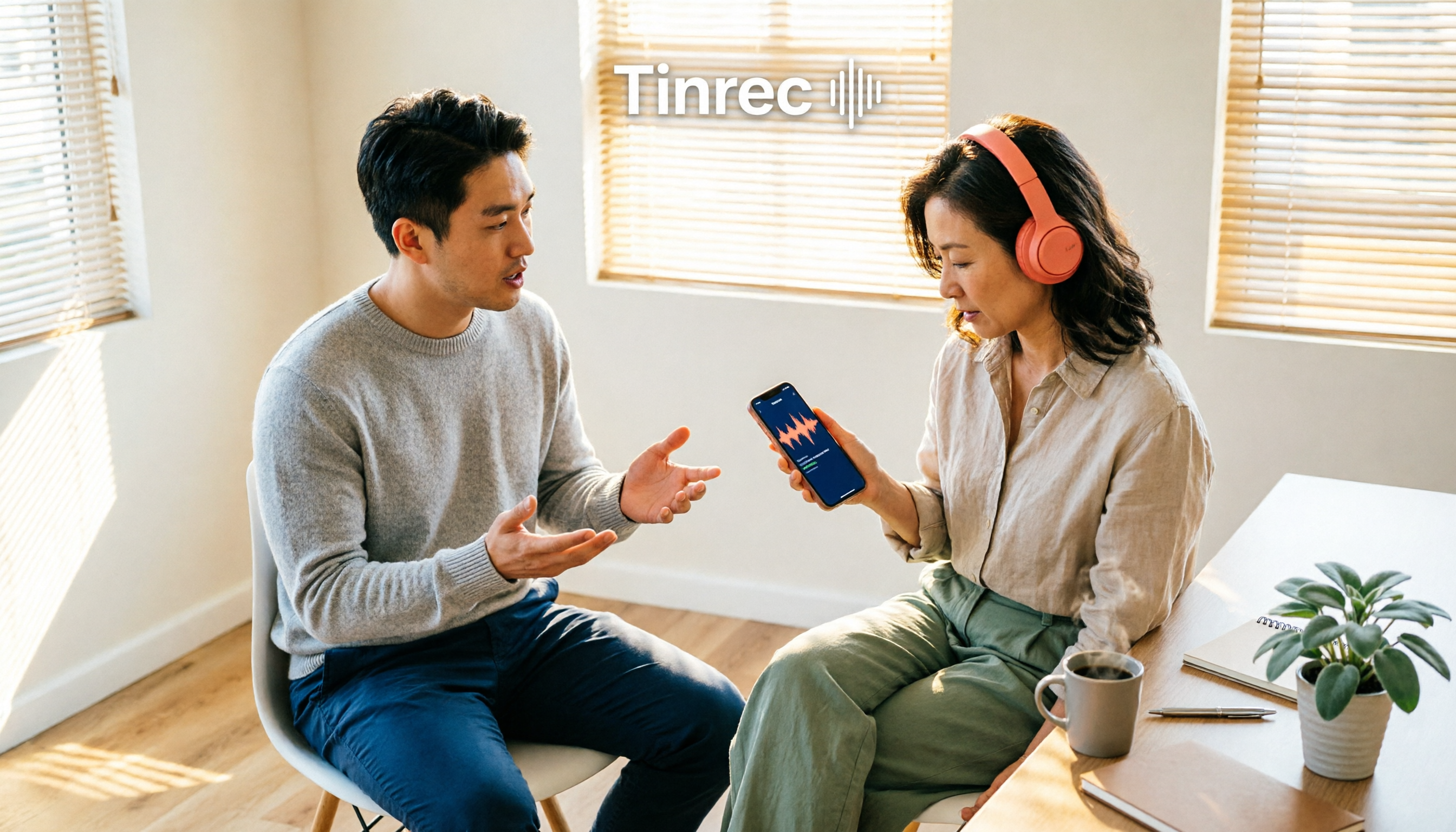
Phone-to-text tools fall into two distinct categories: image OCR and audio transcription. This guide compares 8 tools—including Google Lens, Google Keep, LINE, and Google Drive for free image-to-text OCR, plus Tinrec, Otter.ai, Notta, and Granola for meeting transcription. We cover 4 key selection criteria and 4 common mistakes to help you choose the right tool without wasting money.

4 iPhone Image-to-Text Methods Compared: Live Text vs Notes Scan vs Shortcuts—Which Saves the Most Time?
iPhone has built-in image-to-text features, but they're scattered across Photos, Notes, and Shortcuts—many people never use them. This guide walks through Live Text, Notes scan text, and Shortcuts workflows, covering device and OS requirements, real-world factors that affect accuracy, and a commonly overlooked scenario: when the source isn't an image but meeting recordings and videos, how to use Tinrec, its limitations, and how it differs from Otter.ai, Notta, and PLAUD.
Tinrec vs Otter.ai 2026: 5-Dimension Comparison for English Audio Transcription
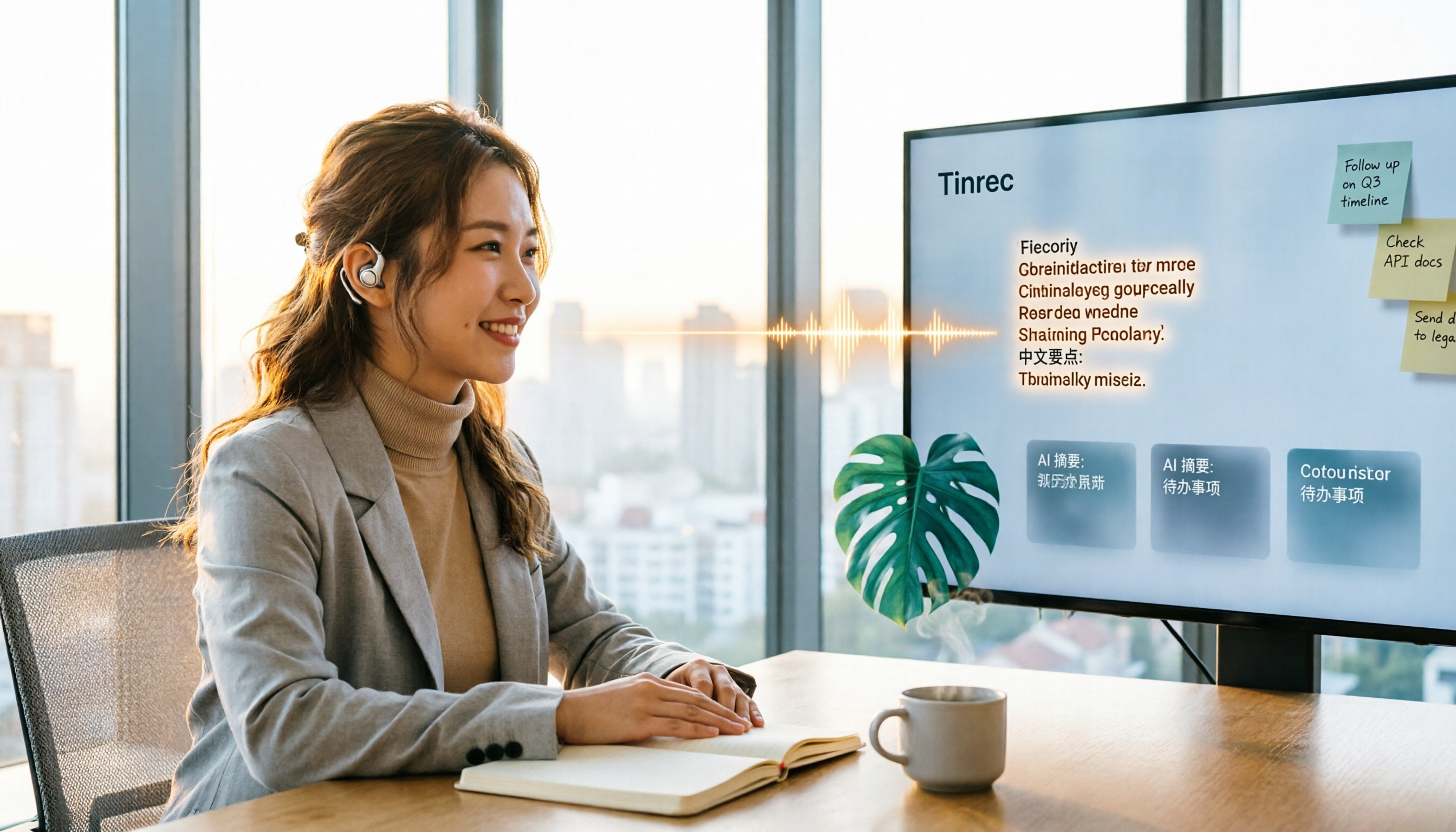
Which tool should you use for English audio transcription? This article compares Tinrec and Otter.ai across 5 dimensions, covering bot-free meeting recording, mixed Chinese-English recognition, AI summaries and action items, team knowledge retention, and pricing. It also includes practical use cases, buying considerations, and FAQs to help you find the right English transcription workflow.

2026 Office Recording to Text Guide: Tinrec Real-Time Transcription + AI Meeting Notes
Should you buy a voice recorder for meetings, or use an AI meeting notes tool? This guide examines office scenarios, explains why a standalone recorder only does half the job, and tests how Tinrec turns recordings into searchable, collaborative data with real-time transcription, AI summaries, action item extraction, and team spaces. It also covers 6 key buying factors and FAQs.
5 Meeting Transcription Apps Compared in 2026: Which AI Meeting Notes Actually Save Time?
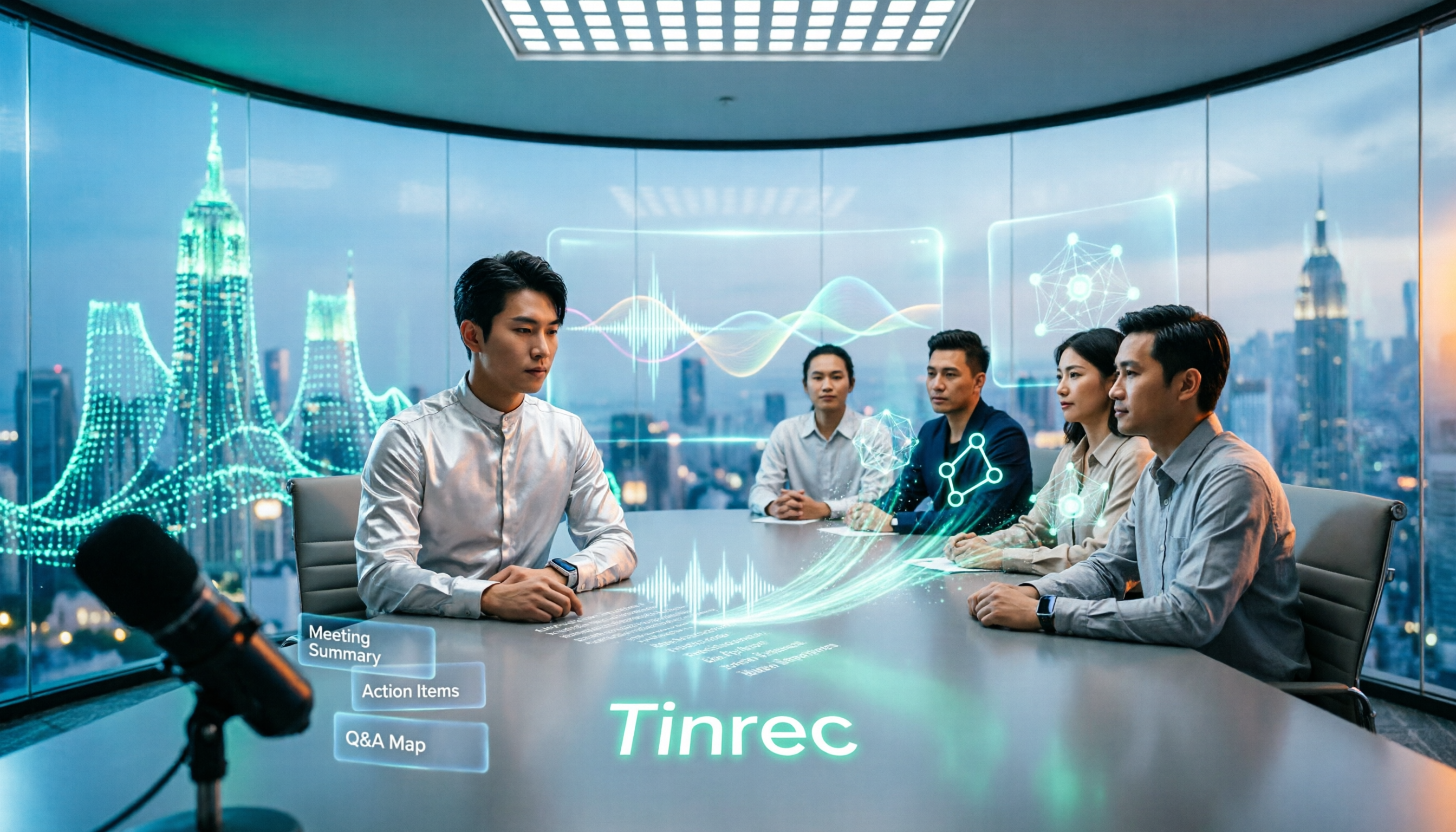
We compare five common approaches to meeting recording and transcription, explain where each one falls short, and use Tinrec to demonstrate a complete workflow from live recording and bot-free online meeting transcription to AI summaries, action item extraction, AI Q&A, and team knowledge retention. Includes buying tips and FAQs.

3 Link-to-Text Tools Tested and Compared in 2026: Which One Turns Link Content into a Transcript?
There are two needs for link-to-text: one is to display hyperlinks as readable text, and the other is to turn videos or meeting content behind links into transcripts. This article tests Tinrec, Notta, TurboScribe, and Link Transformer, covering buying considerations, hands-on performance, and pitfalls to help you choose the right tool for your situation.

4 Video Summarization Tools Tested in 2026: Which One Turns Long Videos into Usable Data?
Stored a bunch of videos but no time to rewatch them? This article compares 4 video summarization tools in practice, examining input sources, summarization methods, AI follow-up questions, and team collaboration, and shares hands-on experience, pricing, and limitations of Tinrec in meeting recordings and interview organization.

6 Best Speech-to-Text Tools in 2026: Which Saves More Time for Chinese Transcripts and AI Meeting Notes?
This article reviews 6 speech-to-text tools in 2026, including Tinrec, cSubtitle, Yating Transcription, Google Cloud Speech-to-Text, Notta, and TurboScribe. It compares Chinese transcription, AI meeting notes, team collaboration, and pricing. The article explains each tool's positioning, highlights, free and paid plans, and provides scenario-based recommendations to help professionals and teams find the right speech-to-text tool.

2026 Comparison of 2 Audio-to-Text Tools: Tinrec vs PLAUD Note – Which Is Better for Chinese Meetings?
The real fork in the road for turning recordings into text isn't which AI is strongest, but whether you're dealing with in-person audio or online meetings on your computer. This article compares Tinrec and PLAUD Note across 6 dimensions: acquisition threshold, online meeting recording method, post-transcription output, Chinese and bilingual review, historical file import, and team data retention. It ends with a ready-to-use starter checklist.