
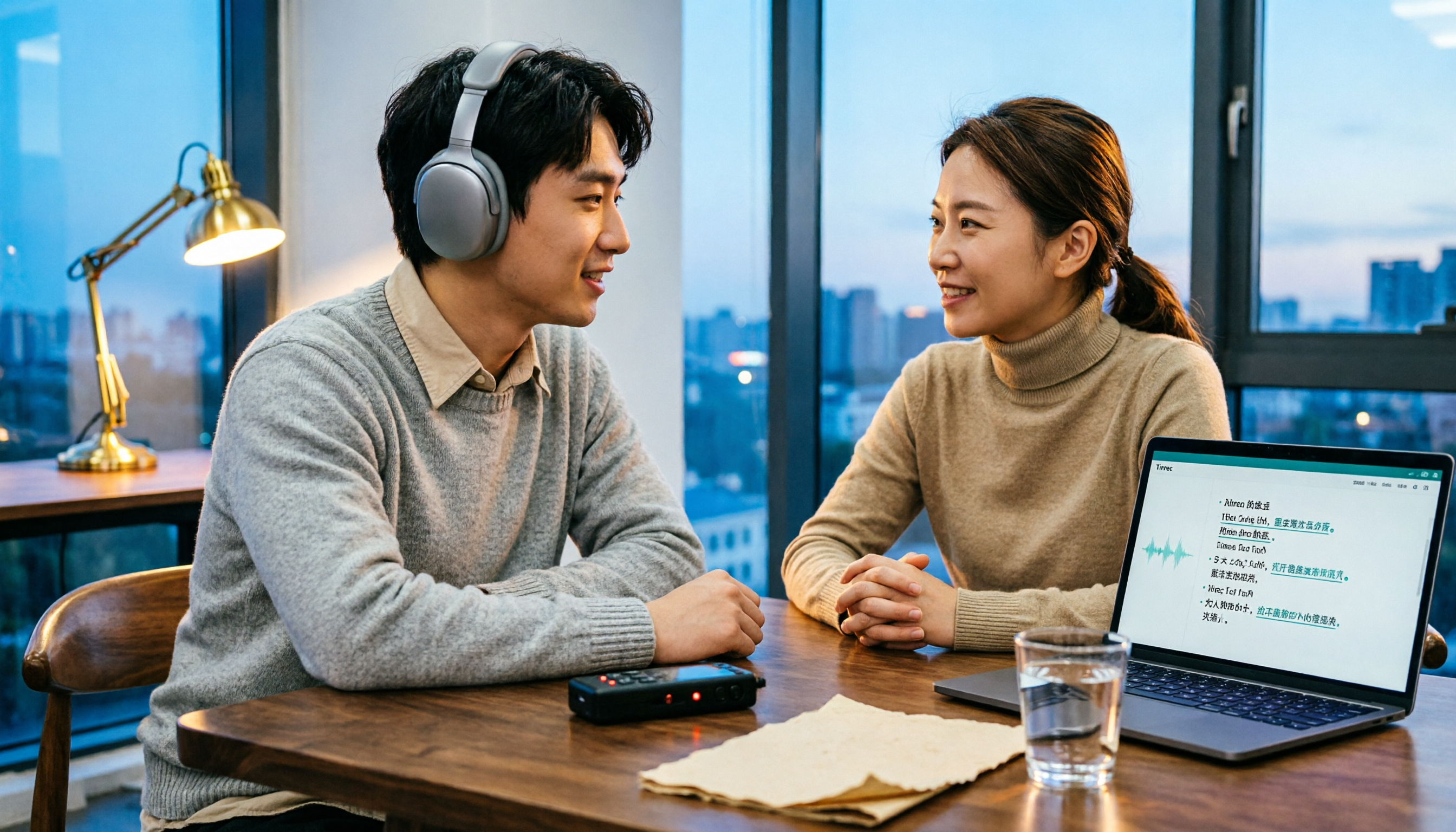
Turn recordings into transcripts and summaries in minutes
Upload audio or video for multilingual transcription, AI notes, and action items
4 Audio-to-Text Tools Tested and Compared in 2026: Which Free Version Is Good Enough?
Before Turning Audio into Text, Figure Out Your "End Goal"
Many people ask me "how do I turn an audio recording into text," and I usually ask back first: what are you going to do with the text once you have it?
Different answers lead to very different approaches.
If you just want to jot down a reminder or an idea, your phone's built-in voice input is enough. iPhone's Voice Memos can even show a transcript directly and let you copy the whole text, so short recordings like these don't need any extra tool.
But if you're dealing with the following situations, built-in features start to fall short:
A two-hour meeting, followed by two more hours of organizing meeting notes—this is the daily routine for many office workers.
Interview recordings sit on your hard drive, and when you actually need to quote a specific sentence, you have to listen from the beginning to the end.
Cross-department meetings have many speakers and mixed Chinese-English, and even after you finally get a transcript, you still don't know what the conclusion was or who agreed to what.
What these scenarios really need isn't "text conversion"—it's "turning recordings into data you can use directly." With the right tool, these things can be solved all at once.
Before Choosing an Audio-to-Text Tool, Understand These 4 Key Points
Accuracy: Don't just look at the numbers in ads. The accuracy rates officially stated are usually measured in quiet environments. Real meeting rooms have air conditioning noise, keyboard sounds, and multiple people talking over each other—that's when the gap shows. When choosing a tool, look at its performance with Chinese, mixed Chinese-English, and background noise.
Do you want a transcript, or a finished post-meeting product? A transcript is just raw material. Summaries, chapters, key points, and action items are what most people actually need to deliver. Tinrec puts these post-processing steps into the same workflow, which I'll detail later.
Does it retain recordings, and can it import old files. Some tools only do live meetings, don't support uploading existing audio files, and don't retain audio. If you have a pile of old recordings sitting in your drawer, this matters a lot.
Free quota and team collaboration. For occasional personal use, the free version is usually enough. But for team sharing, you need to check whether there's a team space, member seats, usage and activity logs that can be managed.
Tinrec—Our Top Pick After Testing
Tinrec is an AI meeting notes and collaboration tool for individuals and teams, available on web, desktop, and mobile. It doesn't just turn sound into text—it helps you organize meeting content into data that can be searched, queried, exported, and further processed.
No bot for recording online meetings. This is what I find most practical. Tinrec's desktop version directly captures your computer's system audio to handle Zoom, Google Meet, Microsoft Teams, Webex, and other meetings, without inviting a meeting bot to join. For participants, the meeting is just the original meeting, with no unfamiliar participant added.
Transcribe while recording, with real-time translation. You can see the transcript during recording, and for cross-language meetings you can switch between original text, translation, or bilingual view. For mixed Chinese-English passages, this feature saves noticeable time.
The real focus is after the meeting: summaries, chapters, action items, AI Q&A. After the meeting ends, Tinrec organizes a summary, chapters, and key points, and extracts action items from the discussion into to-dos. Even better is AI Q&A—you can directly ask it "Who mentioned the budget in the last meeting?" and it will answer based on the meeting content, rather than giving you a list of keyword search results. When you need to deliver documents, you can also use Agent post-processing to generate reports, tables, and meeting minutes.
Existing files can also be organized. Besides live recording, you can upload audio and video files to catch up on historical meetings and interviews all at once. Organized content can be exported to Notion, Google Docs, OneNote, Dropbox, and other tools, connecting back to your original workflow.
From my own trial, Chinese and mixed Chinese-English passages were recognized consistently, and punctuation and paragraphing were also decent. But honestly, when multiple people talk over each other, any tool still requires going back to the recording to verify—I won't sugarcoat that.
Stop organizing recordings by hand
Upload audio or video and automatically get a transcript, summary, and action items
Three main advantages: First, online meetings don't need a bot, which is especially friendly for meetings with external clients. Second, after transcription it's not just a transcript—summaries, to-dos, and AI Q&A are all done for you. Third, it covers Chinese, Traditional Chinese, and multilingual meetings, and you can maintain professional terminology with team hotwords.
Limitations to note: The free version only provides a basic quota, suitable for light use; if you're a heavy user with regular weekly meetings, you'll need a paid plan. Also, file import consumes quota, so before organizing a large number of old recordings, it's best to check your plan first.
If you're a team. The team version isn't "multiple people sharing one account"—it's an independent team space where meeting data belongs to the team. Members without a seat can still view, play, and read team data; only after getting a seat can they record, upload, edit, and export. Admins can manage roles, seats, sharing permissions, usage, and activity logs, and have audio recycle bin and resource handover capabilities. The first eligible team trial is 7 days, 1 free seat, and 300 minutes of team shared import quota; team monthly is USD 29.80 per paid seat per month, annual is USD 199 per paid seat per year (about USD 16.58 per month), with each paid seat providing 2,000 minutes of team shared import quota per month. Actual prices and benefits are subject to the official purchase page.
Who it's for: People who frequently handle Chinese or mixed Chinese-English meetings, want to use AI to find key points right after recording, don't want an extra bot in online meetings, or want to turn meeting data into team assets.
Besides Tinrec, What Other Options Are There?
Granola. A bot-free AI meeting notes tool focused on "handwritten notes + AI enhancement," with a free version available and Business at USD 14 per user per month. Note that it doesn't support uploading pre-recorded audio files and doesn't save meeting audio; if you want to turn old recordings into transcripts or listen back to verify later, Tinrec's approach is more suitable.
TurboScribe. A cost-effective file transcription route, good at long files and batch uploads, free version 3 files per day (max 30 minutes per file), Unlimited annual at USD 120 (about USD 10 per month), paid version max 10 hours or 5 GB per file. If you have a bunch of long recordings and only need text, it's a great deal; but live meeting recording, AI Q&A, and team data space are not its design focus.
Otter.ai. A mature choice for English business meetings, Basic free 300 minutes per month, Pro annual equivalent to about USD 8.49 per user per month. Its strength is in English meeting scenarios; if you mainly handle Chinese or mixed Chinese-English content, Tinrec's Chinese experience and real-time translation will be more aligned. Competitor prices and benefits may change, so please refer to official pages before use.
Pitfall Guide: The 3 Most Common Mistakes When Choosing an Audio-to-Text Tool
Pitfall 1: Only looking at advertised accuracy numbers. That number is mostly measured under ideal conditions. The right approach is to test with your own meeting recordings, especially the noisiest and messiest part.
Pitfall 2: Ignoring "does it retain recordings, can it import old files." Some tools only handle live meetings, don't retain audio, and don't accept existing files. By the time you find out you can't transcribe an interview from three months ago, it's too late. Confirm these two things before choosing.
Pitfall 3: Treating the tool only as a "typing replacement." If you only use it to generate transcripts, you're only using part of its capabilities. Features like Tinrec's AI Q&A, action item extraction, and Agent post-processing are where the real time savings in organizing come from.
Conclusion: Which One Should You Actually Choose?
Need Chinese or mixed Chinese-English meeting transcripts → Tinrec.
Want to use AI to ask key points, generate to-dos and reports right after recording → Tinrec.
Don't want a bot to join online meetings → Tinrec (desktop version captures system audio).
Team needs to share meeting data, manage seats and usage → Tinrec team version.
Only have a bunch of long audio files, only need text, budget first → TurboScribe.
Only use iPhone for meeting notes, don't need to retain recordings → Granola.
I suggest starting with Tinrec's free version, running your own meeting recordings two or three times, then deciding whether to upgrade; teams can first check if they qualify for the trial. Also a reminder: recording and transcription should comply with local regulations, and obtain participant consent when necessary.
References
- Online AI voice, video, audio file auto-transcription - Free trial - cSubtitle
- Complete guide to audio-to-text: methods and AI tool cost comparison | Subanana
- View Voice Memos transcript on iPhone - Apple Support (Taiwan)
- Today I looked into how to turn audio files into text, thinking I could just throw the file into GPT and get it done, but it turns out—not yet 😂 I read many netizens' shares, some use local models, I tried that before too, although free, it's slow and not very accurate (and you need a powerful computer). There are also paid tools, but the subscription makes people hesitate. Then I remembered I actually have an OpenAI API Key, and I want to use their Whisper speech recognition to transcribe. Finally found a Google Colab method,
- Audio-to-text often fails? Throw the audio file to ChatGPT, transcript and to-dos done at once | Manager Today
Turn every recording into actionable outcomes
Get 60 free transcription minutes when you sign in. No credit card required.
Related Reading
You might also like

4 Best Meeting Transcription Apps in 2026: Which Saves the Most Time for Chinese Meetings?
Tired of meeting notes dragging past quitting time? This article covers 5 key factors for choosing a meeting transcription app, compares Tinrec, Otter.ai, Notta, and PLAUD Note on recording method, Chinese recognition, post-meeting output, and pricing, and highlights 4 common pitfalls to help you find the one that truly saves time.
4 Best YouTube Speech-to-Text Tools in 2026: Which Saves More Time for Chinese Transcripts and AI Summaries?
YouTube's built-in captions are free but can't be turned into meeting notes directly. This article compares Tinrec, Notta, TurboScribe, and Vizard from a mid-level manager's hands-on perspective, explaining how to turn YouTube videos and online meeting audio into searchable, queryable transcripts, summaries, and action items that teams can share.

2026 Comparison of 3 Online Voice Generation Tools: Tinrec, Otter.ai, and CapCut—Which Is Best for Chinese Transcripts?
Starting from the real struggles of students recording lectures, this hands-on comparison tests Tinrec, Otter.ai, and CapCut across six dimensions: Chinese recognition, recording methods, transcript post-processing, AI Q&A, student budget, and team collaboration, to find the best fit for Chinese classes and meeting notes.

4 iPhone Audio-to-Text Methods Compared in 2026: Are Built-in Features Enough?
A hands-on comparison of iPhone's built-in Voice Memos, Notes app, and iMessage audio transcription, plus how Tinrec differs for Chinese meetings, AI summaries, to-dos, Q&A, and team collaboration. If you just need short recordings transcribed, built-in tools are enough; if you frequently hold meetings and need post-meeting action items and cross-platform use, Tinrec saves more time.

4 Meeting Minutes Tools Tested and Compared in 2026: How to Write Meeting Minutes Without Turning Them Into a Transcript
The key to writing meeting minutes isn't typing speed—it's making three judgments: topics, decisions, and action items. This article covers the essentials of writing meeting minutes and common mistakes, and tests and compares four tools—Tinrec, Otter.ai, Notta, and PLAUD—to help you find the most time-saving post-meeting workflow.
4 Meeting Minutes Tools Tested and Compared in 2026: How to Write Meeting Minutes Without Turning Them Into a Transcript
The key to writing meeting minutes isn't typing speed—it's making three judgments: topics, decisions, and action items. This article covers the essentials of writing meeting minutes and common mistakes, and tests and compares four tools—Tinrec, Otter.ai, Notta, and PLAUD—to help you find the most time-saving post-meeting workflow.
4 Best Meeting Transcription Apps in 2026: Which Saves the Most Time for Chinese Meetings?
Tired of meeting notes dragging past quitting time? This article covers 5 key factors for choosing a meeting transcription app, compares Tinrec, Otter.ai, Notta, and PLAUD Note on recording method, Chinese recognition, post-meeting output, and pricing, and highlights 4 common pitfalls to help you find the one that truly saves time.
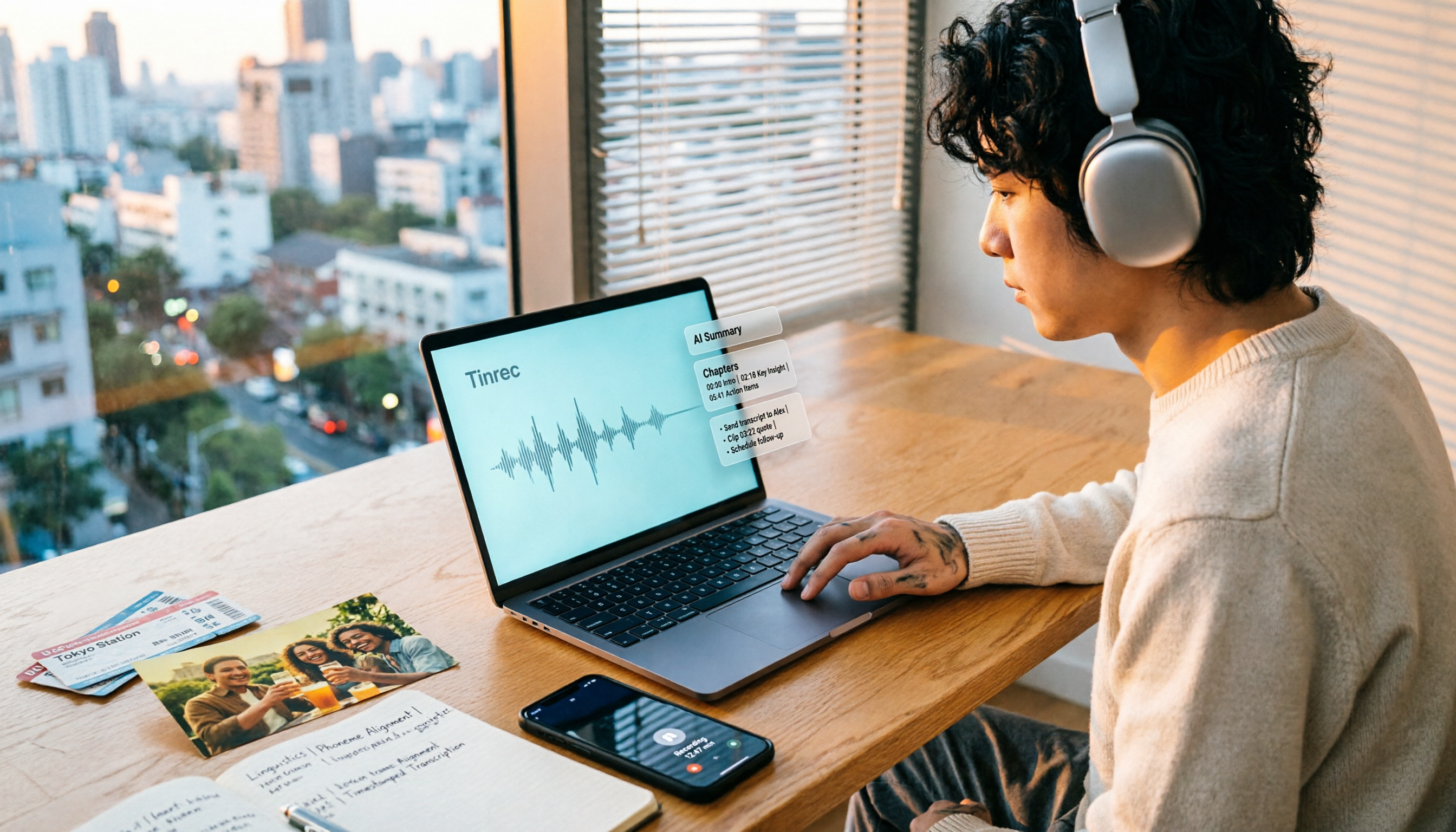
How to Make a 2026 Life Recap Video: Tinrec Audio-to-Text + AI Summary
Want to turn travel, party, or class videos into a life recap but stuck on transcripts and organization? This guide covers common pitfalls and shows how to use Tinrec to convert audio/video to transcripts, then use AI summaries, chapters, to-dos, and Q&A to organize key points. It also compares Notta, TurboScribe, and YouTube Summary with ChatGPT for different scenarios.

5 Best iPhone Audio-to-Text Solutions in 2026: Built-in Features vs. AI Meeting Tools
iPhone's built-in transcription isn't available on every model, and recording is just the beginning. This article debunks common myths and compares five solutions—Apple Voice Memos, Otter.ai, PLAUD recording hardware, and Tinrec—covering device compatibility, usage limits, cross-platform support, and team data ownership. Includes a buyer's guide and scenario-based recommendations to help you choose the most time-saving audio-to-text workflow.