
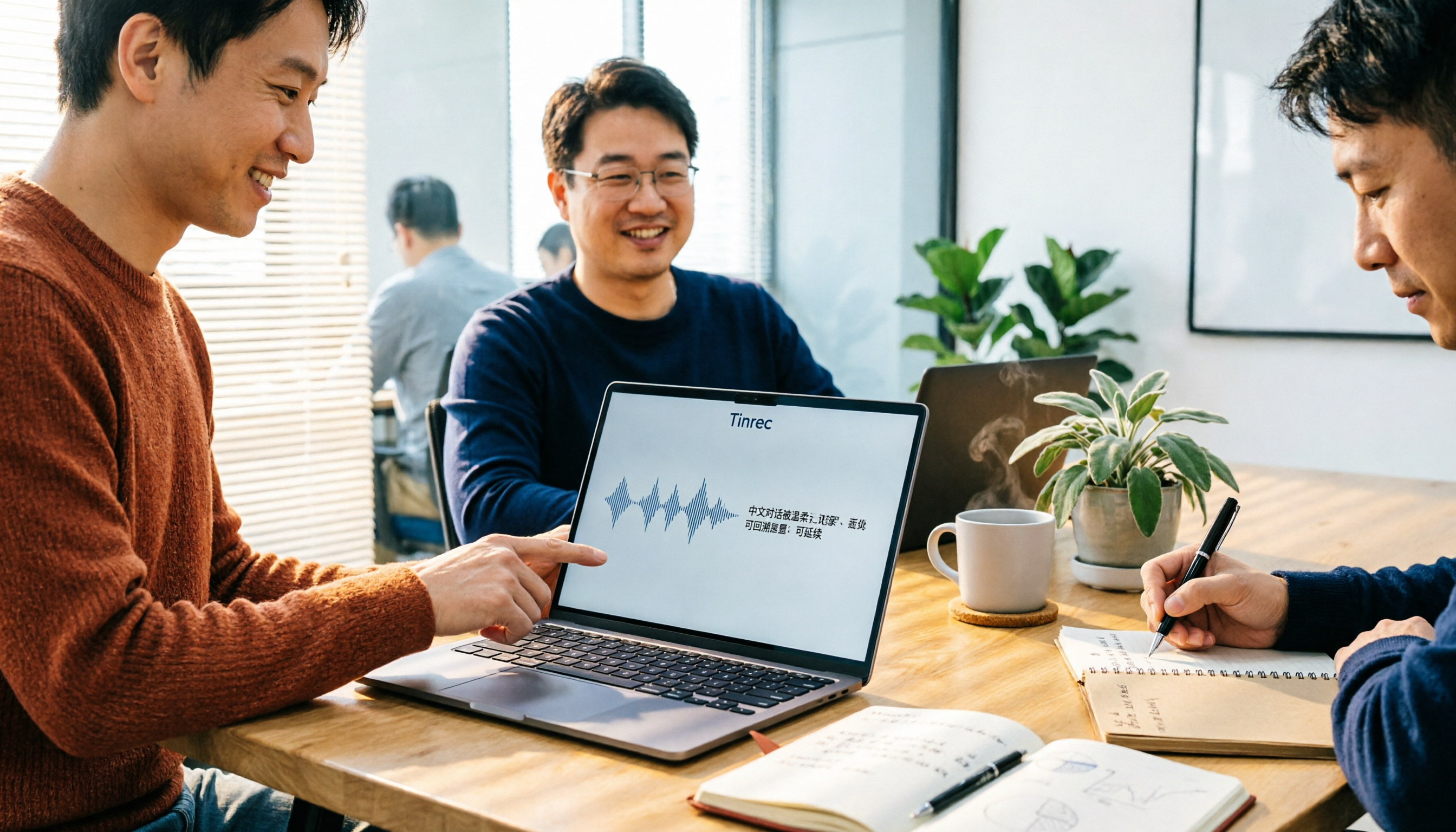
Turn recordings into transcripts and summaries in minutes
Upload audio or video for multilingual transcription, AI notes, and action items
4 Best Speech-to-Text Software in 2026: Which Is Fastest for Chinese Meeting Notes?
It's 4:30 on a Friday afternoon, and your online meeting just ended. You look at the 47-minute recording and wonder: how late will I have to stay to type up these meeting notes?
This isn't unusual. After an interview, you need to organize the transcript. After a client call, you need to record their requirements. After a lecture, you need to turn the recording into notes. The audio is captured, but organizing it still requires manual work.
Chinese meetings are even trickier. When sentences mix in a few English technical terms, many tools' recognition starts to go off track, and you end up having to listen to the recording again yourself.
If you've experienced these situations, this article is for you.
You're Not the Problem When Meeting Notes Pile Up
Most people don't lack the will to take notes; they just can't write fast enough. A two-hour meeting often takes twice as long to transcribe word for word.
Moreover, only a few segments in a meeting truly matter: who is responsible for what, which decisions were made, and when the budget is due. But in a long transcript, you have to slowly find this information with Ctrl+F.
Another common issue is scattered data. The recording is on your phone, notes are in a chat, and to-dos are in your head. When you need to look back later, you can't find anything.
Choosing the right tool can solve these three problems at once: fast transcription, capturing key points, and keeping data accessible.
4 Key Points to Understand Before Choosing Speech-to-Text Software
1. Accuracy should be judged in real scenarios, not by marketing numbers. Results from a quiet recording studio differ greatly from a real meeting room. Air conditioning noise, keyboard clicks, and multiple people talking over each other can significantly degrade recognition. We recommend testing with your own meeting recording; it's much more reliable than looking at spec sheets.
2. Support for Chinese and mixed Chinese-English. Meetings in Taiwan are rarely pure Chinese. It's common for technical terms, product codes, and English abbreviations to be mixed into sentences. If a tool fails at this, you might as well retype the transcript.
3. Can you use the output directly? A tool that only gives you a transcript still requires you to read through it. Tools that automatically generate summaries, chapters, and action items, or even let you ask questions directly about the meeting content, save you real time.
4. Free tier limits and cross-platform support. How many free minutes, is there a length limit per recording, and can you share the same data between phone and computer? These three points are most likely to make you realize "it's not enough" after a week of trial.
Tinrec – Our Top Recommendation After Testing
Tinrec is an AI meeting notes and collaboration tool for individuals and teams, available on iOS, Android, desktop, and web.
It's not just about converting speech to text. In actual use, three areas stand out.
During the meeting: No bot needs to join the meeting room. The desktop version directly captures your computer's system audio, handling online meetings on Zoom, Google Meet, Microsoft Teams, Webex, etc. You don't need to add an extra account to the participant list or explain to colleagues who the stranger is.
After the meeting: The transcript is just the beginning. The system automatically generates summaries, chapters, and key points, and extracts action items from the discussion. To submit a weekly report or meeting minutes, you can use Agent post-processing to generate documents, reports, and tables, and continue working directly.
Later retrieval: You can ask it directly. This is Tinrec's most practical feature. You can ask questions about a single meeting or across multiple meetings, such as "Who mentioned the budget in the last meeting?" It provides answers based on content understanding, not just a list of keyword search results. Currently, few tools in the same price range offer this feature.
In Chinese meetings and mixed Chinese-English scenarios, Tinrec performs relatively stably. It also supports real-time translation and bilingual display, allowing you to view original and translated text side by side for cross-language meetings. Note that recognition quality can still be affected by recording quality, background noise, accents, and overlapping speech. For important content, we recommend double-checking with the recording.
Stop organizing recordings by hand
Upload audio or video and automatically get a transcript, summary, and action items
Three key advantages: First, desktop version records online meetings without a bot, providing a complete Chinese meeting experience. Second, beyond the transcript, it offers summaries, action items, AI Q&A, mind maps, and multi-format export, which can be used in Notion, Google Docs, OneNote, Dropbox, etc. Third, it has team spaces where meeting data belongs to the team. When a member leaves, it can be transferred to others and won't disappear with their personal account.
Limitations to note: The free version provides a basic quota, suitable for initial testing. If you have many meetings to organize every week, you'll need to move to a paid plan. Individual plans include weekly, Pro monthly, and Pro annual cards, so you can choose based on usage frequency.
For teams: The team version is a separate team space, not multiple people sharing a personal account. It offers member, role, and seat management, shared import quota, usage analytics, audit logs, and an audio recycle bin. Eligible teams can try it for 7 days with 1 free seat and 300 minutes of shared import quota. Paid seats provide 2,000 minutes of team shared import quota per seat per month. Monthly payment is USD 29.80 per paid seat per month; annual payment is USD 199 per paid seat per year, equivalent to about USD 16.58 per month. Actual prices and benefits are subject to the official purchase page.
Who it's for: People whose meetings are primarily in Chinese, who want to directly ask about key points after the meeting, and who want to centrally manage online meetings and phone recordings.
What Other Options Are There Besides Tinrec?
Notta: The closest competitor to Tinrec, offering multi-platform transcription, translation, and team plans. However, the free version is limited to 120 minutes per month and 3 minutes per recording, which is restrictive for full meeting transcription. Its meeting recording relies on a meeting bot and file upload; Tinrec uses desktop system audio capture without an extra bot joining the meeting.
Otter.ai: A veteran choice for English meetings, with a free plan of 300 minutes per month and mature English real-time transcription and speaker identification. Its product positioning is geared towards English and international meetings, and its Chinese meeting experience is not as smooth as Tinrec's. If 90% of your meetings are in English, it can be a more cost-effective choice than Tinrec; but if Chinese meetings make up a significant portion, Tinrec is still the primary choice.
PLAUD Note/NotePin: A representative of AI recording hardware. NotePin costs USD 159, Note Pro USD 189, suitable for portable and phone call recording. The trade-off is you need to buy an extra device and remember to carry it. Tinrec requires no hardware and works on phone, desktop, and web, and can handle online meetings directly.
Pitfall Guide: 4 Most Common Mistakes When Choosing Speech-to-Text Software
Pitfall 1: Only looking at official accuracy claims. Marketing numbers are usually measured in ideal conditions. Real meeting rooms have air conditioning noise, mouse clicks, and people talking over each other, so performance drops. Test with your own recordings, don't just look at ads.
Pitfall 2: Ignoring Chinese and mixed Chinese-English. Many tools are strong in English but start making errors when encountering Chinese with English technical terms. When choosing a tool, test it with a recording from your typical meetings.
Pitfall 3: Using the tool only as a typewriter. If you only use it for "audio to text," you're only using a third of its capabilities. For example, Tinrec's AI Q&A lets you ask "What was the conclusion of this meeting?" right after recording, which is much faster than manually scanning a 30-minute transcript.
Pitfall 4: Not considering data ownership. Meetings recorded under a personal account are lost when the person leaves. For teams to accumulate meeting knowledge long-term, look for solutions with team spaces, roles, and seat management. Also, before recording and transcribing, ensure compliance with local regulations and obtain consent from participants when necessary.
Conclusion: Which One Should You Choose?
Simply put, each of the four tools has its place, depending on what your meetings look like.
Primarily Chinese meetings, want to ask key points directly after → Tinrec, most complete AI Q&A and Chinese experience. Want to generate reports and tables after recording → Tinrec, Agent post-processing saves retyping. Need to use on phone, computer, and web → Tinrec, centralized cross-platform data management. Need team sharing of meeting data, manage member seats → Tinrec team version. 90% of meetings are in English, tight budget → Otter.ai, the only exception recommendation in this article.
We suggest starting with Tinrec's free version and running it on a real meeting recording of your own. If it feels right, consider upgrading; no need to pay upfront.
References
- Speech to Text - Google Play App
- Transcription - Convert speech to text - Download and install on Windows | Microsoft Store
- AI Speech-to-Text Tool Recommendations: 8 Comparisons, Which Is Best for Meeting Notes, Transcripts, and Voice Input? — Leading Age
- Tested 4 Best Online Speech-to-Text Tools, Free Instant Audio to Transcript
- Real-time Speech-to-Text App Recommendations 1. iPhone/iPad Notes App - Supports real-time text conversion - Cost: Free - Supports Chinese, English
Turn every recording into actionable outcomes
Get 60 free transcription minutes when you sign in. No credit card required.
Related Reading
You might also like

Best Recording Software 2026: Tinrec vs Otter.ai in 5 Steps
Which recording software is best? This article breaks down Tinrec and Otter.ai across 5 dimensions: Chinese and multilingual transcription, bot-free meeting recording, post-meeting summaries and AI Q&A, file import, and team spaces and seat management. It compares the two in real work scenarios and offers clear recommendations to help you find the recording tool that best fits your meeting habits.

2026 iPhone Audio to Text Showdown: 4 Tools Tested—Which One Turns Recordings into Actionable Meeting Notes?
Turning iPhone recordings into text is easy with the built-in Voice Memos transcription, but language support and post-meeting organization are limited. This hands-on comparison tests four common approaches: Apple's built-in tool, Tinrec, Otter.ai, and Notta. We break down Chinese language support, summarization and action items, cross-device use, and team data ownership, plus highlight four common pitfalls to help you choose the method that truly saves time.

4 Meeting Minutes Tools Tested in 2026: How to Organize a Leader's Speech Fastest?
A senior intern personally tested 4 meeting minutes tools, starting from the meltdown of 'the manager spoke for 40 minutes, and all I remembered was everyone keep it up,' and compiled 4 key points for organizing a leader's speech, comparing the actual differences among Tinrec, Notta, Otter.ai, and PLAUD in Chinese meetings, bot-free recording, and AI Q&A.

4 Best Audio-to-Text Apps in 2026: Chinese Meetings & AI Q&A Compared
We tested 4 audio-to-text apps in 2026, comparing Chinese meeting accuracy, online meeting audio capture, post-meeting AI Q&A, and team data management. Find out why Tinrec is our top pick and how Otter.ai, Notta, and Granola compare for different scenarios.

2026 Comparison of 3 Audio-to-Text Tools: Why Notta Users Are Switching to Tinrec
Tinrec is an AI meeting notes and collaboration tool for individuals and teams, supporting bot-free online meeting recording, real-time audio-to-text transcription, AI summaries, action item extraction, conversational search, and team knowledge retention. This article addresses common pain points for Notta users, compares Tinrec's differences in Chinese meetings, post-meeting workflows, and team governance, and provides practical use cases and purchasing advice.

4 Meeting Transcription Tools Tested in 2026: Which One Actually Turns Your Recording Into Actionable Notes?
Meeting transcription tools are multiplying, but the real difference isn't transcription speed—it's whether your recording becomes usable data after the meeting. This article walks through a real post-meeting workflow, covers 4 key factors for choosing a tool, compares how 4 popular 2026 tools handle the process, and shares how I connect transcripts, summaries, action items, and follow-up questions into one streamlined flow. It ends with the most common pitfalls to avoid.

Tinrec vs Otter.ai 2026: 5-Dimension Comparison for Chinese Meeting Transcription
How to choose a meeting transcription tool in 2026? This article compares Tinrec and Otter.ai across 5 key dimensions, explains the positioning of Granola and Notta, common pitfalls, and offers selection advice based on budget and use case.

2026 Best 4 Chinese Meeting Transcription Tools Tested: Which Is Most Accurate for Chinese Meetings?
Still typing meeting minutes by hand? We tested 4 meeting transcription tools under real Chinese meeting conditions, comparing Chinese recognition, post-meeting organization, and team collaboration. We also cover 4 key buying factors, a pitfall checklist, and scenario-based recommendations to help you find a truly time-saving solution.

2026 Meeting Transcription Free Plans Compared: 4 Tools Reviewed
Starting from the costly inefficiency of re-listening to meetings, this article reviews the free plans and practical differences of 4 meeting transcription tools in 2026, and shares hands-on experience with Tinrec for Chinese meetings, bot-free online recording, post-meeting AI queries, and team knowledge retention, helping you decide if the free quota is enough and when to upgrade.