

Turn recordings into transcripts and summaries in minutes
Upload audio or video for multilingual transcription, AI notes, and action items
Tinrec vs WayinVideo 2026: 5-Dimension Comparison — How to Choose for Short Video Summaries and Team Knowledge Retention
Why Do You Need to Summarize Short Video Content?
Short videos are brief, but their information density is high. Scrolling through TikTok on your commute, watching Instagram Reels during lunch, catching up on YouTube Shorts before bed — before you know it, you've watched a dozen.
The problem is, watching doesn't mean remembering. Tutorials, unboxings, news, opinions — if you don't save a summary, you'll have to search for it again next time.
This article covers 6 ways to summarize short video content, from tools specialized in short video summaries to workflows using transcripts plus AI follow-up questions, and tells you how to choose.
Option 1 | Tinrec — Turn Audio and Video Content into Searchable, Queryable Data
Tinrec is an AI meeting notes and collaboration tool for individuals and teams. It doesn't just convert audio to text; it also organizes summaries, chapters, to-dos, and supports AI Q&A around the content.
For short video summaries, you can upload downloaded short video audio or video files to quickly get transcripts; some public video links can also be imported via web link. It supports Chinese, Traditional Chinese, and multilingual content, and you can view the original text, translation, or bilingual content.
Beyond transcripts, Tinrec generates AI summaries, chapters, and key points to help you grasp the structure of short videos. Even more useful is AI Q&A: you can directly ask "What are the three main points of this video?" "What does it say about the product price?" "Turn this passage into a social media post outline."
If you need to bring short video summaries into your daily workflow, Tinrec supports multiple export formats and can export to Notion, Google Docs, OneNote, Dropbox, and other tools. Agent post-processing can further generate reports, tables, and documents.
Pricing: The personal plan has a free version to try basic quotas; for short-term intensive organization, consider a weekly pass; for weekly needs, look at the Pro monthly plan; for long-term data retention, consider the Pro annual plan.
If you're a content team wanting to centrally share short video summaries, transcripts, and materials, Tinrec's team plan offers team spaces, member and seat management. Team monthly is USD 29.80 per paid seat per month, annual is USD 199 per paid seat per year; first eligible team trial is 7 days, 1 free seat, 300 minutes of team shared import quota, and paid seats provide 2,000 minutes of team shared import quota per month. Actual prices and benefits are subject to the official purchase page.
Who it's for: Content editors, marketers, researchers, and teams who want to organize short videos in Chinese, need transcripts plus AI Q&A, and want to turn summaries into a searchable material library.
Option 2 | WayinVideo — Specialized in Short Videos and Timestamped Summaries
WayinVideo is a free AI video summary tool that focuses on accuracy, speed, and timestamps. It can turn Instagram Reels, TikTok short videos, and YouTube videos into clearly structured summaries.
Its highlights include chapter highlights, mind maps, exportable transcripts, and output with timestamps and quotes. You can also use AI Chat to ask follow-up questions or use multilingual summaries and API.
If you often need to verify whether the AI is correct, timestamps are very convenient — you can jump directly back to the original clip.
Pricing: The source page lists it as a free AI video summary tool; actual quotas and paid plans are subject to the official website.
Who it's for: People who want to directly paste TikTok or Reels links and quickly get timestamped summaries and mind maps.
Option 3 | Monica YouTube Summary with GPT — YouTube Video Summaries
Monica's YouTube Summary with GPT is a web app that uses GPT to provide concise yet informative summaries of YouTube videos.
It can retrieve YouTube video transcripts in multiple languages and lets you choose the transcript language, even for videos without subtitles. For those who don't want to watch the entire video and just want to grasp the key points first, it saves a lot of time.
Pricing: The source page lists it as a free online video summary tool; paid plans and quotas are subject to the official website.
Who it's for: People who mainly watch YouTube and want quick summaries and transcripts.
Option 4 | ChatGPT + Transcript Tools (Whisper JAX, Glarity) — Build Your Own Summary Workflow
If you like to control the summary prompts yourself, you can first use a transcript tool to get the text, then hand it to ChatGPT for analysis.
Stop organizing recordings by hand
Upload audio or video and automatically get a transcript, summary, and action items
Extensions like YouTube Summary with ChatGPT can turn YouTube videos into transcripts, then use ChatGPT to summarize key points, translate into Traditional Chinese, and even customize 1 to 3 follow-up question buttons.
Whisper JAX is also a free tool mentioned in the source; just enter a YouTube video link to get a transcript. Remember to check "Return timestamps" to get time-ordered segments. Glarity can help translate outline content.
Pricing: ChatGPT has free and paid plans; Whisper JAX is listed as free in the source; actual details are subject to the official website.
Who it's for: People who want to customize summary formats and prompts, or need to translate foreign-language short videos into Chinese.
Option 5 | MemoAI — Video Summaries and Mind Maps Combined with ChatGPT
After combining with ChatGPT, MemoAI can not only summarize video content but also generate AI mind maps — structured bullet-point organization.
The source article mentions that this kind of bullet-point organization is easier to read than plain summaries. If you're used to absorbing content through outlines or mind maps, consider this type of tool.
Pricing: The source does not provide a clear price; subject to the official website.
Who it's for: People who like visual outlines, mind maps, and bullet-point organization.
Option 6 | Browser AI Summaries like MaxAI, Sider, Video Summarizer — Subtitle and Comment Assistance
These browser AI summary tools are good for quickly skimming videos. Sider cannot summarize videos without subtitles; Video Summarizer may also fail to retrieve subtitle data for videos with subtitles disabled.
An interesting approach from the source: MaxAI once used over 5,000 comments left by viewers to summarize what a video was about. If the video itself has incomplete subtitles but many comments, this can be an auxiliary clue.
If a video has no subtitles, you can first use speech recognition tools like Whisper JAX to generate a transcript, then hand it to AI like ChatGPT for analysis.
Pricing: The source does not provide a clear price; subject to the official website.
Who it's for: People who just want a quick idea of the content when the video has complete subtitles or many comments.
With So Many Options, How Should You Choose?
• Want to directly handle TikTok, Reels, YouTube Shorts, and need timestamped summaries and mind maps → WayinVideo.
• Only YouTube videos, want quick summaries → Monica YouTube Summary with GPT.
• Want to control summary prompts, translation, and follow-up questions → ChatGPT + Whisper JAX/Glarity.
• Like mind maps and bullet-point outlines → MemoAI.
• Video has complete subtitles or many comments → Browser tools like MaxAI, Sider.
• Want to handle Chinese short videos, downloaded audio/video files, and also need transcripts, summaries, AI Q&A, to-dos, and export → Tinrec.
• Need to turn summaries of multiple short videos into a searchable material library → Tinrec.
• Need to bring summaries to Notion, Google Docs, OneNote, Dropbox for further editing → Tinrec.
• Need team sharing of short video summaries, transcripts, and materials → Tinrec team plan.
• Need cross-language bilingual viewing and Chinese meeting, interview, course content organization → Tinrec.
• Zero budget, just want to try occasionally → Start with free plans of various tools or Tinrec free version.
4 Things to Know Before Using Short Video Summary Tools
First confirm whether the source is a link or a file. Some tools don't support videos without subtitles or with subtitles disabled. In such cases, you can first do speech recognition, then hand it to AI for analysis.
Verify AI summaries. AI may miss or misunderstand things. For important information, it's recommended to check timestamps, original transcripts, or the original video.
Chinese and technical terms affect results. Tinrec supports Chinese, Traditional Chinese, and multilingual content, and also provides team hot word management; actual results are affected by recording quality, accent, noise, and overlapping speech.
Team use requires attention to permissions and authorization. Tinrec team plan manages team governance and usage eligibility by roles and seats, not document-level private permissions; members without seats can view, play, and read team data but cannot upload, edit, or export. Short video materials also have copyright and consent issues; please comply with local laws when using them.
Prices and quotas are subject to the official website. Free plans usually have usage limits; before paying, please confirm on the official purchase page.
Conclusion
Summarizing short videos isn't hard; the hard part is choosing the right workflow. To directly summarize TikTok, Reels, and Shorts, WayinVideo is a good fit; for YouTube only, Monica or ChatGPT plus transcript tools work smoothly.
If you value Chinese content, transcripts, AI Q&A, to-do extraction, multi-format export, and even want to turn short video summaries into a team-searchable material library, Tinrec is worth trying.
You can start with the free version or a short-term plan, run through the short videos you often watch, and then decide whether to upgrade.
References
- Summarize YouTube with GPT: Free Online Video Summary Tool
- Free AI Video Summary Tool — Accurate, Fast, with Timestamps
- ChatGPT YouTube Summary Video Key Points Technique: From Video Transcript to Summary Method - Mr. Mad
- AI Summarize Videos: Quickly Summarize YouTube Video Key Points with AI - JJTECHSHOW
- Video Too Long to Watch? Essential Tools for Learning and Fandom! Quickly Summarize Long Videos and Translate Foreign Videos! - PanSci
Turn every recording into actionable outcomes
Get 60 free transcription minutes when you sign in. No credit card required.
Related Reading
You might also like

2026 AI Voice Recognition Tools Compared: Which Custom Vocabulary Works Best?
Spend two hours in a meeting only to find your product code missing from the transcript? The problem isn't audio quality—it's the lack of a custom vocabulary. This hands-on comparison of Tinrec, Otter.ai, Granola, and PLAUD Note covers vocabulary maintenance, post-meeting Q&A, online meeting recording, team quotas, and costs. We break down 5 key buying factors, 3 common pitfalls, and offer scenario-based recommendations.
4 Speech-to-Text Tools Tested in 2026: Free Tiers and Post-Meeting Cleanup Compared
We tested four speech-to-text approaches in 2026, covering free tiers, Chinese recognition, online meeting recording, and post-meeting organization for students taking class notes, working on group projects, and conducting graduation interviews. We also share how Tinrec handles real-time transcription, AI summaries, action item extraction, AI Q&A, and team spaces.
How to Use Speech-to-Text in 2025: 5-Step Free Tutorial
How do you choose and use free speech-to-text in 2025? This article walks through a complete 5-step process with Tinrec, from live recording and audio upload to generating transcripts, AI summaries, chapters, action item extraction, and exporting. It also covers 4 practical use cases, 5 buying considerations, and FAQs to help you turn meeting and lecture recordings into ready-to-use materials at zero cost.

2026 Speech-to-Text Tools Compared: Which Saves the Most Time for Chinese Meetings?
A mid-level manager overseeing a 10-person team and about 15 meetings per week shares hands-on experience. This article skips the fluff and starts from the key question: 'Do you need a verbatim transcript, or usable meeting data?' It breaks down the core capabilities of speech-to-text tools, real-world scenarios, and 5 key buying factors, and explains Tinrec's actual performance and limitations in bot-free recording, AI summary to-dos, and team seat governance.
2026 Video Summarizer Guide: Tinrec One-Click Transcript + AI Summary & Action Items
Videos pile up but you never finish them? This hands-on guide walks through a complete video summarizer workflow—from uploading videos and generating transcripts to automatic summaries and action items, plus the ability to ask questions about the content after recording. We test Tinrec as the primary tool and compare it with Notta, TurboScribe, and Otter.ai, including 4 key buying factors and 3 common pitfalls to help you choose the one that truly saves time.
How to Turn Text into Video in 2026: From Recording to AI Video Generation
The real bottleneck in text-to-video isn't the generation—it's the text you feed the AI. This guide starts with common mistakes, then shows how to use Tinrec to turn meeting, interview, and course recordings into structured transcripts, summaries, and script material for AI video generation. Includes real-world use cases, 5 factors to consider when choosing tools, and FAQs.
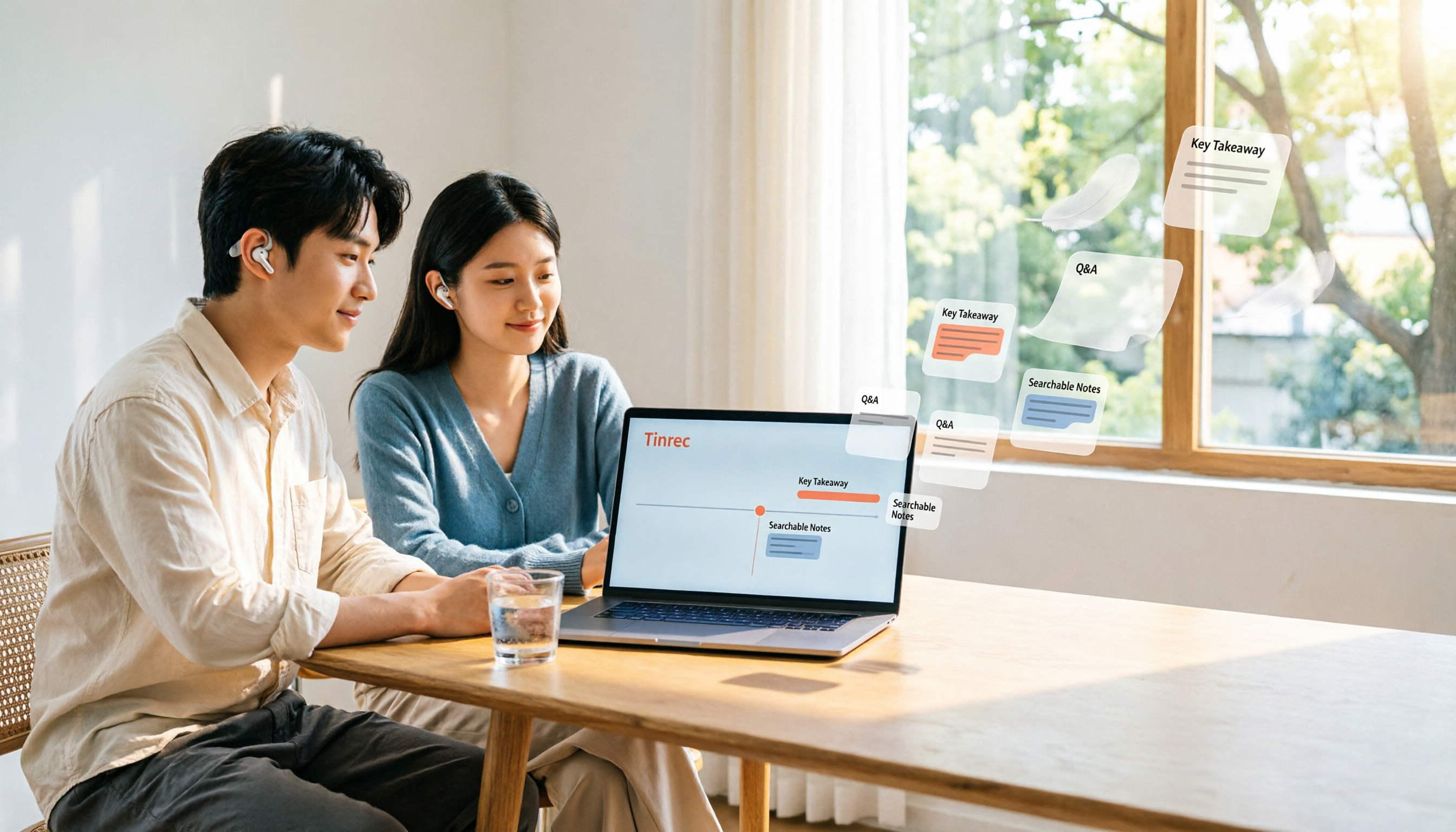
4 Video Note-Taking Tools Tested: Which One Turns a 2-Hour Video Into Searchable Notes?
You watch a two-hour course and only remember the opening. You've saved 80 meeting recordings and never opened them again. The problem isn't your focus—it's your tools. This article compares four automatic video note-taking apps, breaking down how Tinrec turns videos and meetings into searchable, queryable, exportable data, and who Notta, NoteGPT, and LunaNotes are best for. It also covers four key buying factors, three common pitfalls, and scenario-based recommendations.

2026 AI Meeting Notes Showdown: Tinrec vs Otter.ai for Chinese-Language Meetings
2026 comparison: Tinrec and Otter.ai differ in five key areas—meeting capture, Chinese-language meeting experience, post-meeting workflow, recording retention, and team governance. We break down free plans and paid pricing to help teams that mainly hold Chinese-language meetings decide which AI meeting notes tool to choose.

2026 Comparison of 2 Lecture Video Summarization Tools: Which Handles Chinese and Cantonese Lectures More Efficiently?
Should you buy hardware or use software for lecture video summarization? This article uses the same lecture video as a benchmark to compare Tinrec and PLAUD Note across five dimensions: import methods and hardware requirements, Chinese and Cantonese recognition, key point organization and AI follow-up, cross-platform and post-meeting export, and team sharing and data retention. It helps you decide which tool is better suited for organizing lecture content.