

Turn recordings into transcripts and summaries in minutes
Upload audio or video for multilingual transcription, AI notes, and action items
Why You Need Online Speech-to-Text Generation
Meeting recordings, interviews, course videos, voice memos—if this content only exists as audio, it's hard to search, cite, and organize. The old way was to transcribe by listening yourself; a 1-hour meeting could take 3 to 4 hours. Now, with online speech-to-text tools, you can get a transcript in minutes.
But here's the question: Is free enough? How accurate is Chinese recognition? Which one is suitable for meetings, and which for long documents? This article reviews 5 speech-to-text online generation solutions worth noting in 2026, and at the end tells you how to choose based on your needs.
Option 1 | Tinrec (Miao Ting Lu Yin) — The Most Complete AI Recording Assistant
Tinrec is an AI meeting notes and collaboration tool for individuals and teams. It doesn't just convert audio to text; it organizes meeting recordings into searchable, summarizable, queryable, and exportable data. If you need to handle Chinese meetings, online interviews, or team weekly meetings, I'd put it first.
Its core highlights include:
- Bot-free online meeting recording: The desktop version directly captures computer system audio, handling Zoom, Google Meet, Microsoft Teams, Webex, etc., without inviting a meeting bot to join.
- Post-transcription workflow: Automatically generates summaries, chapters, to-dos, and mind maps, and supports AI Q&A around meeting content. You can directly ask, "What budget constraints did the client mention this time?"—much faster than re-listening to the recording.
- Multi-format export and post-processing: Transcripts can be exported to Notion, Google Docs, OneNote, Dropbox, etc., and can also generate reports, tables, and meeting minutes.
- Team space: The team version provides independent spaces, meeting data belongs to the team, and includes members, roles, seats, usage analytics, and audit logs. When a member leaves, team resources can be handed over to other members and won't disappear with the individual account.
In terms of pricing, the personal version has a free version, weekly pass, Pro monthly, and Pro annual, suitable for choosing based on usage frequency; the team version offers a 7-day trial for first-time eligible users, 1 free seat, and 300 minutes of shared import quota. Subsequent monthly payment is USD 29.80 per paid seat per month, annual payment is USD 199 per paid seat per year (about USD 16.58 per month), and each paid seat provides 2,000 minutes of team shared import quota per month. Actual prices are subject to the official website.
Who it's for: Users who need Chinese meeting transcription, post-meeting organization, AI Q&A, and team data accumulation. If you only need to occasionally convert a recording to text, you can start with the free version.
Option 2 | MyEdit — Online Speech-to-Text AI Tool
MyEdit is an online speech-to-text tool that supports 9 languages including Traditional Chinese, English, Japanese, and Korean. After uploading an MP3 or recording file, you can export a plain text file (.txt) or subtitle file (.srt). It requires no software installation; just open the webpage and use it. It's suitable for those who need to quickly convert recordings into transcripts or YouTube subtitles.
MyEdit's free usage can complete basic transcription tasks. If you need extensive commercial output, the official recommendation is to upgrade to a paid subscription to unlock more monthly transcription hours. For detailed pricing, please refer to the official website. Note that it mainly processes uploaded files and lacks team collaboration space and meeting Q&A features.
Who it's for: Users who occasionally need online transcription, subtitle creation, and have a limited budget.
Option 3 | cSubtitle — Online Transcription Service Focused on Chinese
cSubtitle specializes in Chinese speech-to-text. No account is required to upload video or audio files. It supports formats like MP4, MOV, MP3, WAV, M4A, OGG, WMA, with a single file size limit of 4GB and duration up to 5 hours. It automatically adds punctuation, segments, and generates Word files with time codes and subtitle files (.sub, .vtt). It also has batch processing.
Stop organizing recordings by hand
Upload audio or video and automatically get a transcript, summary, and action items
cSubtitle focuses on Chinese Mandarin training and has a certain level of accuracy for Chinese content. It's suitable for meeting notes, interviews, courses, and documentation of audio/video materials. For free trial details and paid plans, it's recommended to check the official website directly.
Who it's for: Users who mainly work with Chinese content and need subtitle files or batch processing.
Option 4 | TurboScribe — Cost-Effective Long Document Transcription
TurboScribe is a cost-effective document transcription tool, focusing on long documents, batch uploads, subtitles, and translation. The free version allows 3 files per day, up to 30 minutes per file; the Unlimited plan is USD 120 per year (about USD 10 per month), with a maximum of 10 hours or 5GB per file, and up to 50 files per upload.
If you have many pre-recorded courses, podcasts, or interview audio files to process at once, TurboScribe's batch and long-file capabilities are more convenient than general meeting tools. However, it doesn't emphasize real-time meeting notes, AI Q&A, or team collaboration, making it more suitable as a productivity tool for file transcription.
Who it's for: Users who need to batch process long audio files, have a limited budget, and don't need team features.
Option 5 | Otter.ai — Mature AI Meeting Assistant
Otter.ai is a mature AI meeting assistant that supports Zoom, Microsoft Teams, and Google Meet, offering real-time transcription, speaker identification, AI Chat, and team management. The free Basic version offers 300 minutes per month; Pro annual is about USD 8.49 per user per month, with 1,200 minutes of in-app recording and 10 file imports per month; Business provides unlimited meeting recordings and more management capabilities.
Otter's experience in English business meetings is very complete, but if your meetings are mainly in Chinese and you need bot-free desktop recording and post-meeting Chinese summaries and to-do organization, Tinrec's localization will be more aligned with your needs.
Who it's for: Users who frequently participate in English meetings and need a mature meeting assistant.
With So Many Options, How Should You Choose?
I usually first look at your "meeting language" and "what you want to do after the meeting":
- Want the most complete AI features (transcription + AI chat query + automatic minutes + to-do extraction) → Tinrec, currently the only option in this list that covers all these capabilities.
- Need Chinese meetings, mixed Chinese-English content, and don't want to invite a meeting bot → Tinrec, desktop version directly captures system audio.
- Need to switch between phone, computer, and web → Tinrec, multi-platform support.
- Need team sharing of meeting data, seat management, usage, and auditing → Tinrec team version, with independent team space and operation logs.
- Need to generate reports, tables, or meeting minutes after the meeting → Tinrec, built-in Agent post-processing.
- If your budget is zero and you only need to occasionally convert a recording to text or subtitles → MyEdit, Otter Basic, TurboScribe free version, or cSubtitle can handle light needs.
In short, if your needs go beyond "getting a transcript" to turning meetings into searchable, queryable, and transferable data, Tinrec is the one most worth trying first on this list.
4 Things to Know Before Using Online Speech-to-Text Generation
- Free quotas usually have limits: For example, Otter free is 300 minutes per month, Notta free is 120 minutes per month with a maximum of 3 minutes per session, TurboScribe free is 3 files per day. Check your file length and quantity before use to avoid getting stuck halfway.
- Chinese recognition is affected by recording quality: Environmental noise, overlapping speakers, accents, and technical terms all affect accuracy. Tinrec supports Chinese, real-time translation, and team hotwords, which can improve recognition of technical terms through hotword settings.
- Pay attention to authorization for recording and transcription: If meetings or interviews involve others, it's advisable to obtain consent first and comply with local regulations. For important content, it's also recommended to cross-check with transcript timestamps and recording playback, not relying entirely on AI.
- A transcript is not the same as meeting minutes: Getting the transcript is just the first step. Tinrec can further generate summaries, chapters, to-dos, and Q&A, turning content into a basis for follow-up actions.
Conclusion
There are many online speech-to-text tools, but the key to choosing isn't "which one is most popular," but your meeting language, file type, and post-meeting purpose. If you want an all-in-one solution from recording, transcription, summary, Q&A to team collaboration, Tinrec is the most complete option on this list; if you only need occasional transcription, the free tools above are sufficient.
It's recommended to start with a free plan, confirm that Chinese recognition and workflow meet your needs, and then decide whether to upgrade.
References
- Online AI speech, video, audio file auto transcription - Free trial - cSubtitle
- Yating Transcript
- Online speech-to-text AI, free MP3 or recording to text transcript - MyEdit
- Tested 4 best "speech-to-text" online tools recommended, free instant recording to transcript
- No time limit! 3 free AI transcript tools, highly recommended! AI voice notes generate meeting minutes, presentations, mind maps | 104 Workplace Power
Turn every recording into actionable outcomes
Get 60 free transcription minutes when you sign in. No credit card required.
Related Reading
You might also like
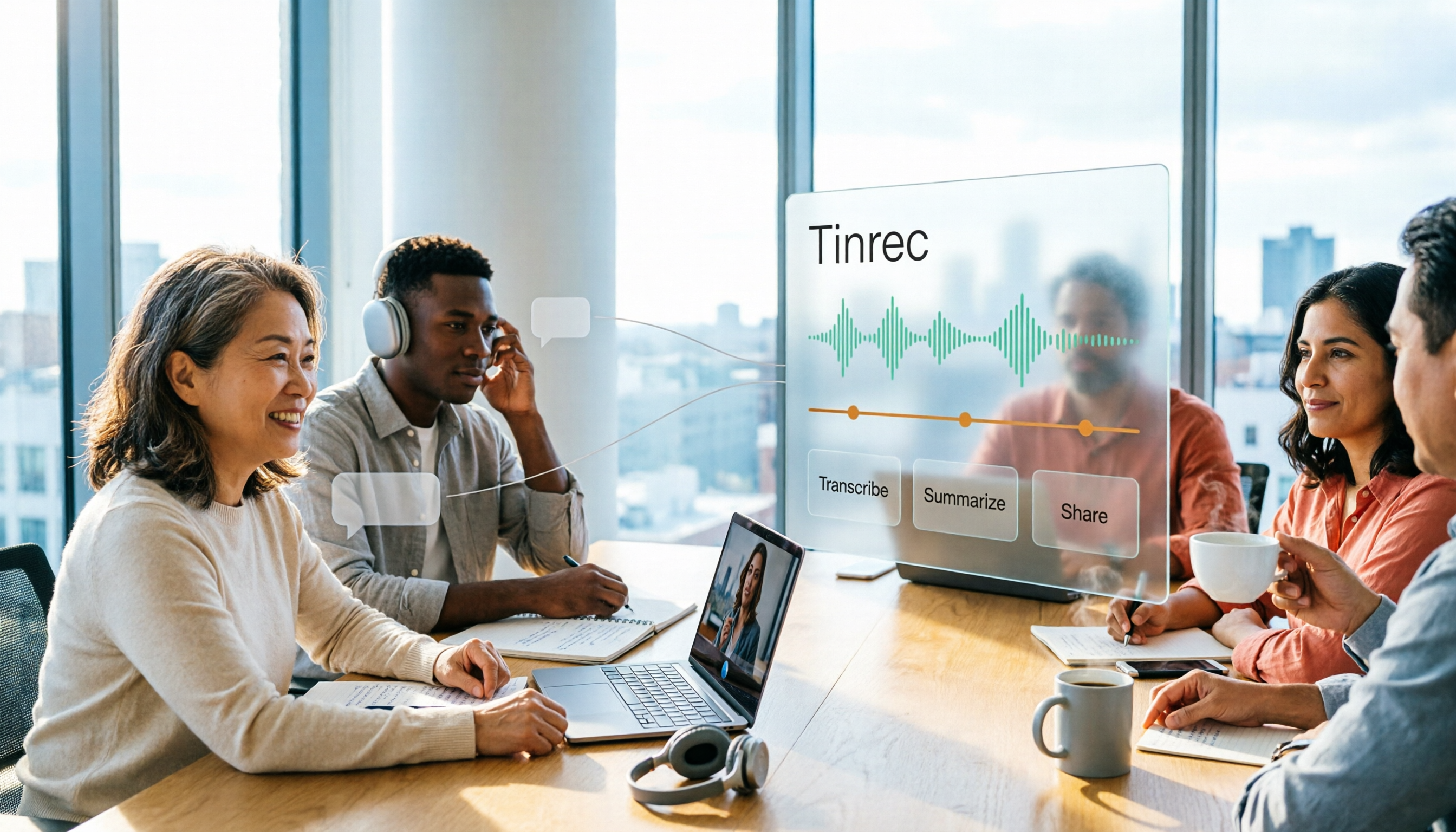
Tinrec vs Notta: 2 AI Voice Tools Tested for Meeting Notes & Transcription in 2026
Many people search for voice generation software, but the real pain point is organizing meeting audio. This hands-on comparison of Tinrec and Notta covers meeting capture, post-meeting organization, Chinese language experience, team collaboration, and data retention to help you choose the right tool for your workflow.

2026 Comparison of 4 Workplace Short Video Learning Summary Tools: Is Tinrec's AI Summary and Review Good Enough?
Forget short work videos right after watching? This article starts from the criteria of 'summary—notes—review' and compares Tinrec with general note-taking tools, bookmarking tools, and pure transcription tools in short video learning. It organizes 4 key comparisons, real usage scenarios for campus and internships, and concerns about free quotas and paid options to help you choose a workflow that truly helps you remember.
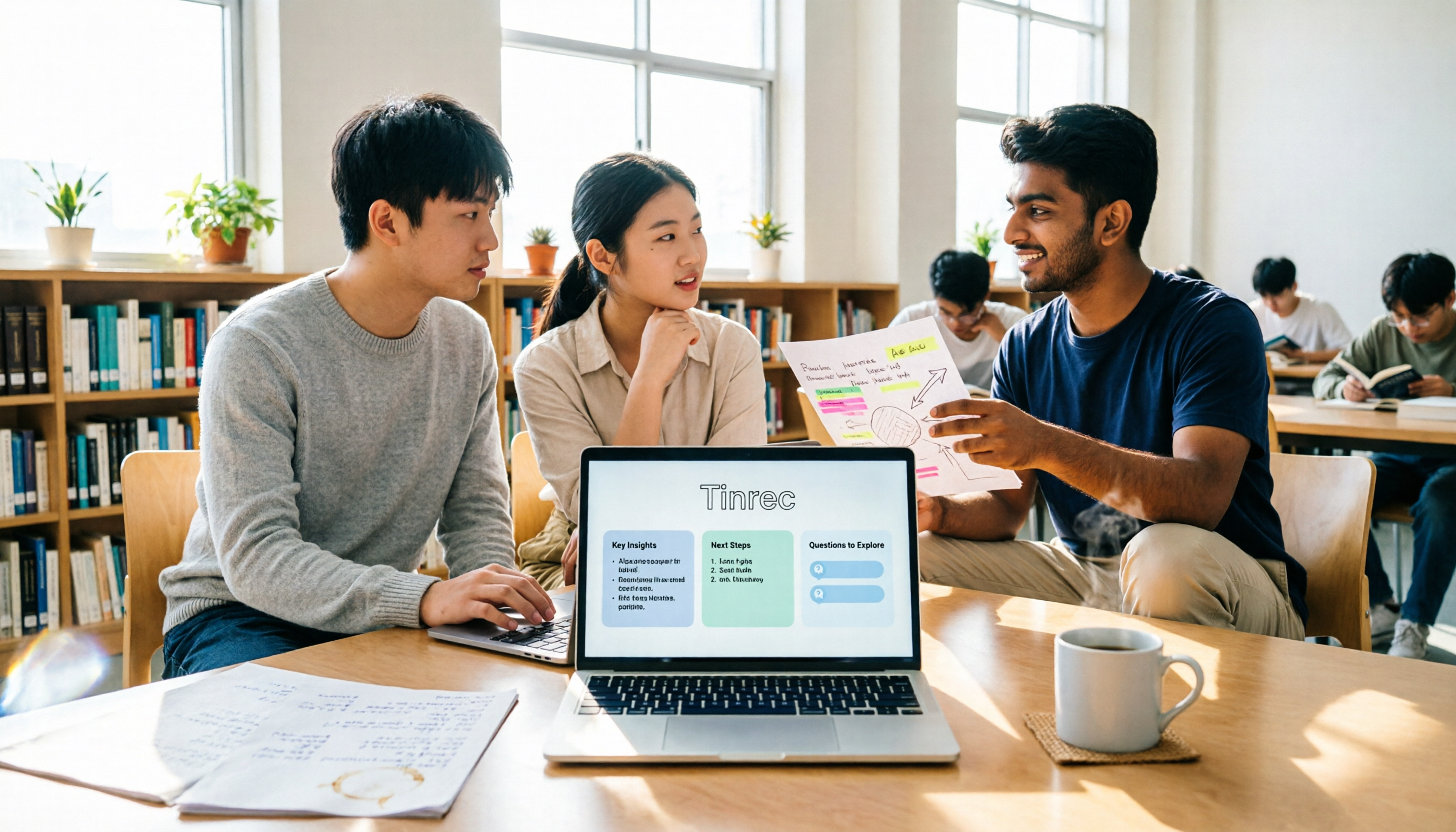
2026 Video Summarization Software Ranking Guide: Student-Tested Choices from Notta to Tinrec
This article starts from students' actual needs, organizes the key points for choosing video summarization software in 2026, and uses Tinrec as the core to compare the pain point that ordinary tools only provide transcripts. The content covers classroom notes, group reports, online courses, and interviews, helping you understand how AI summaries, to-do extraction, AI Q&A, and team collaboration can truly save time, and finally gives recommendations for students.

2026 Video Summarization Tools Compared: The Real Test Is Whether You Can Ask Follow-Up Questions and Keep Your Data
There are many video summarization tools, but most people only compare summary length. This article uses four angles—can you jump back to timestamps, can you ask follow-up questions, can you turn insights into action, and can team data be retained—to review the positioning and limitations of Tinrec, Felo AI, Monica, and WayinVideo, helping you find the right approach.

How to Transcribe Audio to Text in 2026: 5 Steps from Recording to Transcript
How do you choose an audio-to-text tool? This article covers 4 key buying factors, explains why a transcript alone isn't enough, and compares Tinrec, Otter.ai, Notta, and PLAUD in terms of positioning, pricing, and limitations, with final recommendations based on use case.

4 Best Automatic Video Summarizers in 2026: Which One Handles Chinese Summaries, Timestamps, and Team Records Best?
Too long to watch? This article starts with common pitfalls and outlines 4 key criteria for choosing an automatic video summarizer. It compares Tinrec, WayinVideo, Monica AI, and Notta on Chinese summaries, timestamp verification, post-meeting action items, and team data management, with a guide to avoid mistakes and pricing plans to help you find a tool that truly saves organization time.

Video Summarization Software Paid Plans in 2026: 5 Options Compared
How do you choose a paid video summarization tool? Using Tinrec as an example, this article breaks down five plans—Free, Weekly Pass, Pro Monthly, Pro Annual, and Team—covering video and meeting transcription, AI summaries, action items, Q&A, and team collaboration, plus buying tips and FAQs.

4 Phone Recording-to-Text Assistants Tested and Compared in 2026: Is the Free Version Enough or Should You Go Team?
How do you choose a phone recording-to-text tool in 2026? This article examines four key points: on-site recording and online meetings, post-transcription processing, free quota traps, and team governance. It compares four solutions—Tinrec, Notta, Granola, and PLAUD—explaining their suitable scenarios, limitations, and team pricing, helping you decide whether to start with a free version or purchase directly for your team.

4 Video Summarization Tools Tested in 2026: Which AI Q&A and Team Knowledge Base Is Best?
We tested four video summarization tools in 2026, comparing Tinrec, WayinVideo, Monica, and Notta across supported sources, AI Q&A, cross-platform support, and team collaboration to help you find the most time-saving and practical option.