
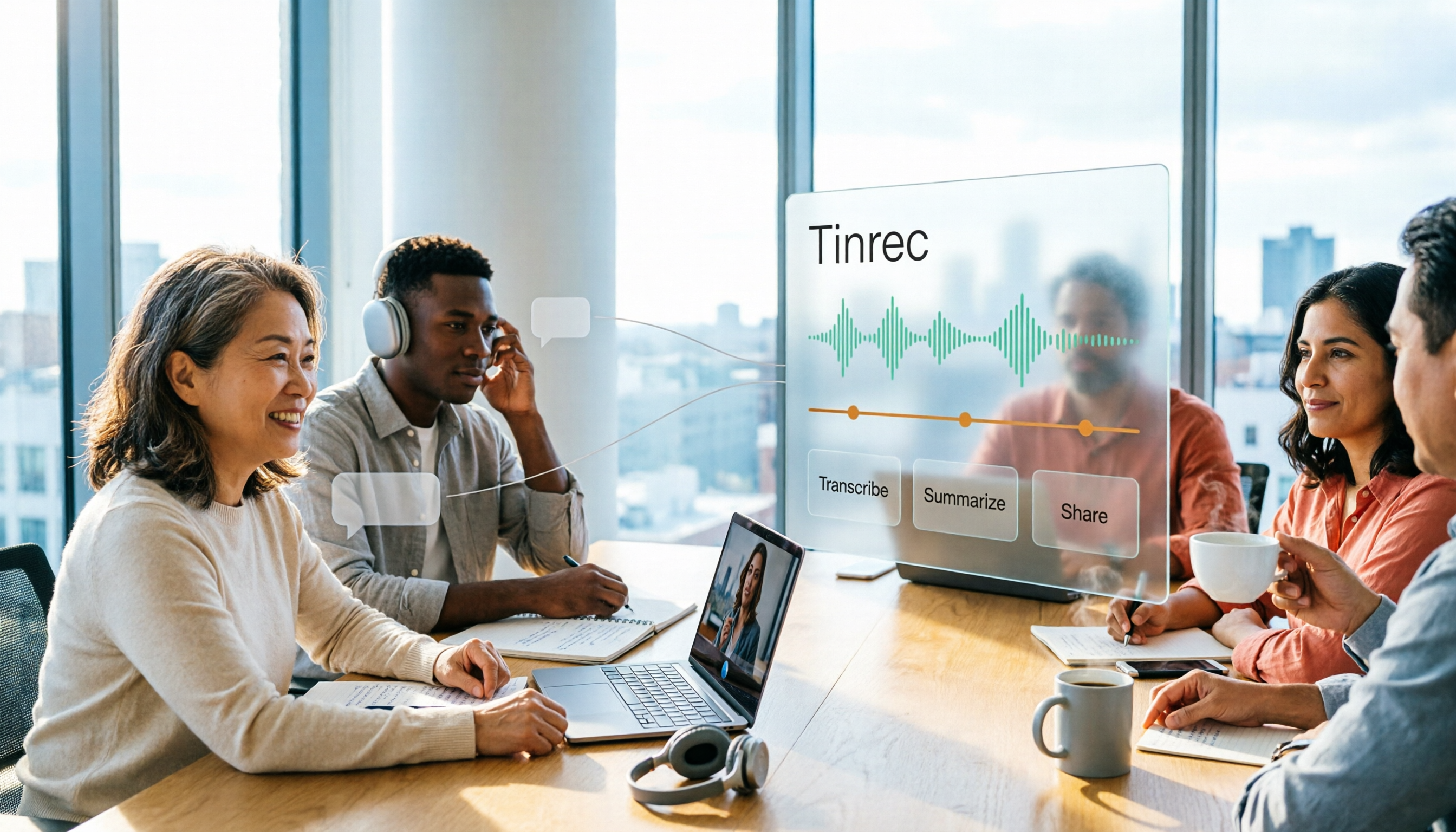
Turn recordings into transcripts and summaries in minutes
Upload audio or video for multilingual transcription, AI notes, and action items
Tinrec vs Notta: 2 AI Voice Tools Tested for Meeting Notes & Transcription in 2026
After a 90-minute cross-department meeting, you stare at the recording, not knowing where to start. You have a transcript, but the key points, action items, and who's responsible for what still require you to listen through it again.
Many people search for "voice generation software" and first think of text-to-speech (TTS), turning articles into narration. But if you deal with meetings, interviews, and client communications daily, what you really need is to turn speech into searchable, organized records. I tested two tools often compared side by side: Tinrec and Notta, to see which better fits your needs.
Tinrec vs Notta | Quick Overview
Tinrec is an AI meeting notes and team collaboration tool that not only transcribes but also turns meetings into summaries, action items, and a queryable database. Notta is a veteran general-purpose transcription tool supporting multiple languages, file uploads, and team plans.
Pricing: Tinrec offers a free personal plan, weekly pass, Pro monthly and annual plans; team plan is USD 29.80 per paid seat per month, or USD 199 per paid seat per year (about USD 16.58 per month). Notta's free plan includes 120 minutes per month, max 3 minutes per recording; Pro annual is about USD 8.17 per month for 1,800 minutes per month; Business annual is about USD 16.67 per seat per month with unlimited transcription, role permissions, and usage reports. Check official pages for current pricing.
We compared across five dimensions: meeting capture method, post-meeting organization and AI applications, Chinese language experience, team collaboration and governance, and input sources and data retention.
Dimension 1 | Meeting Capture: No Bot vs Meeting Bot
For online meetings, Notta mainly uses a meeting bot to join or requires manual audio upload for transcription. The bot automates capture but adds an extra participant, which some attendees find intrusive.
Tinrec's desktop app captures computer system audio directly without a meeting bot. Just open Tinrec desktop to record meeting audio playing on your computer from Zoom, Google Meet, Microsoft Teams, Webex, etc., and generate a live transcript. Note that you currently need to start recording manually; it doesn't automatically join all calendar meetings.
→ This dimension: Tinrec clearly wins for not disrupting meetings.
Dimension 2 | Post-Meeting Organization & AI: What Happens After Transcription?
Notta provides transcripts, subtitles, translation, and summaries—sufficient for users who just need text records.
Tinrec focuses on the "post-meeting workflow": automatically generates AI summaries, chapters, key points, and action items, plus AI Q&A on meeting content, and even uses an Agent to generate reports, tables, and documents. It also supports real-time translation with original, translated, or bilingual views. Simply put, Notta gets you the transcript; Tinrec turns the transcript into workable data.
→ This dimension: Tinrec wins, with more complete post-meeting organization and AI applications.
Dimension 3 | Chinese & Multilingual Meeting Experience
Notta performs well in multilingual support, suitable for users dealing with multiple languages.
Tinrec is optimized for Chinese, Traditional Chinese, and mixed Chinese-English content. The team plan also offers hotword management to maintain team terminology and improve recognition of specialized vocabulary. In pure Chinese or mixed-language meetings, Tinrec's organization flow better matches the habits of Taiwanese users. Actual transcription quality still depends on recording quality, accents, noise, and overlapping speakers.
→ This dimension: Tie, but Tinrec is smoother for Chinese meeting scenarios.
Stop organizing recordings by hand
Upload audio or video and automatically get a transcript, summary, and action items
Dimension 4 | Team Collaboration & Governance: Roles, Seats, and Data Ownership
Notta's Business plan offers role permissions and usage reports, suitable for teams.
Tinrec's team plan provides more granular governance: independent team space, member roles (owner, admin, regular member), seat management, shared benefits, usage analytics, audit logs, audio recycle bin, and team hotwords. Note that Tinrec distinguishes "roles" from "seats": roles determine who can manage the team; seats determine whether a member can record, upload, edit, and export. Valid members without a seat can still view, play, and read team data. Team resources belong to the team; when a member leaves, resources can be transferred and won't be taken personally.
→ This dimension: Tinrec clearly wins in team governance and data ownership.
Dimension 5 | Input Sources & Data Retention
Notta supports file uploads and some meeting scenarios, convenient for organizing existing recordings.
Tinrec covers broader input sources: live recording, online meetings, audio/video files, mobile recording, and some web link imports. Additionally, Tinrec retains audio and provides a team audio recycle bin to restore accidentally deleted files within the retention period (currently 30 days). This is practical for teams that need to repeatedly verify meeting content.
→ This dimension: Tinrec wins, with more diverse input sources and audio retention plus recycle bin.
What Unique Advantages Does Each Have?
Tinrec's unique advantages:
- Bot-free desktop recording, no extra meeting participant, ideal for client meetings.
- Post-meeting AI Q&A and Agent-generated work products reduce manual organization time.
- Complete team governance with role-seat separation, audit logs, and resource handover.
- Optimized for Chinese and mixed Chinese-English scenarios, tailored for Taiwanese users.
Notta's unique advantages:
- Broad multilingual support, suitable for teams handling multiple languages.
- Free plan with 120 minutes per month, good for light trial.
Conclusion: Which Should You Choose?
• If you need bot-free online meeting recording → Tinrec
• If you want to ask AI for key points and auto-generate action items after meetings → Tinrec
• If you're a team needing seat management, usage analytics, and auditing → Tinrec
• If you only occasionally upload audio for transcription and have high multilingual needs → Notta is sufficient
In one sentence: For most users needing meeting notes and organization, Tinrec is the more complete choice. We recommend trying Tinrec's free plan first and testing with your own meeting recordings.
FAQ
Q1: Is Tinrec voice generation software?
Strictly speaking, no. Tinrec is a meeting speech-to-text and organization tool, not text-to-speech (TTS) generation software. If you need to turn text into narration, you may need a separate TTS tool; but if you handle meeting audio, Tinrec is more suitable.
Q2: Is Tinrec's free plan enough?
The free plan offers basic quota to experience recording, import, summaries, and transcription. If you only occasionally organize a recording, the free plan is fine. For short-term high-frequency use, consider the weekly pass; for steady weekly use, the Pro plan is better.
Q3: Which meeting platforms does Tinrec support?
The desktop app captures computer system audio to handle meeting content played on your computer from Zoom, Google Meet, Microsoft Teams, Webex, etc. It's not an official integration but works via system audio recording.
Q4: What's the difference between team and personal plans?
Personal plan data is managed under your personal account; the team plan provides an independent team space where meeting data belongs to the team, plus members, roles, seats, shared benefits, usage analytics, audit logs, and recycle bin.
Q5: Can members without a seat view team data?
Yes. Valid members without a seat can view, play, and read team data; but they need a seat to record, upload, edit, import, and export.
Q6: How accurate is transcription?
Tinrec provides high-quality transcription for clear audio and common scenarios, but actual results depend on recording quality, noise, accents, overlapping speakers, and specialized terminology. For important content, verify with transcript timestamps and audio playback.
References
- Vidnoz AI Text-to-Speech Free Tool: One-Click Taiwanese AI Voice Generation!
- 9 Free Online Voice Generators - Turn Text into Speech 2025 Wondershare Filmora
- Speech Synthesis - Text-to-Speech (TTS) - Free Download and Install on Windows | Microsoft Store
- Online Text-to-Speech Tool, Free and Fast Realistic AI Voiceover
- Comparison of 8 Free AI Voice Generators, Understand How to Choose!
Turn every recording into actionable outcomes
Get 60 free transcription minutes when you sign in. No credit card required.
Related Reading
You might also like

2026 Comparison of 4 Workplace Short Video Learning Summary Tools: Is Tinrec's AI Summary and Review Good Enough?
Forget short work videos right after watching? This article starts from the criteria of 'summary—notes—review' and compares Tinrec with general note-taking tools, bookmarking tools, and pure transcription tools in short video learning. It organizes 4 key comparisons, real usage scenarios for campus and internships, and concerns about free quotas and paid options to help you choose a workflow that truly helps you remember.

5 Best Free Speech-to-Text Online Tools in 2026: A Complete Guide
Compare 5 free speech-to-text online tools in 2026, including Tinrec, MyEdit, cSubtitle, TurboScribe, and Otter.ai. Review free quotas, Chinese language support, export formats, and use cases, with selection tips and usage notes.
2026 Video Summarization Software Ranking Guide: Student-Tested Choices from Notta to Tinrec
This article starts from students' actual needs, organizes the key points for choosing video summarization software in 2026, and uses Tinrec as the core to compare the pain point that ordinary tools only provide transcripts. The content covers classroom notes, group reports, online courses, and interviews, helping you understand how AI summaries, to-do extraction, AI Q&A, and team collaboration can truly save time, and finally gives recommendations for students.

2026 Video Summarization Tools Compared: The Real Test Is Whether You Can Ask Follow-Up Questions and Keep Your Data
There are many video summarization tools, but most people only compare summary length. This article uses four angles—can you jump back to timestamps, can you ask follow-up questions, can you turn insights into action, and can team data be retained—to review the positioning and limitations of Tinrec, Felo AI, Monica, and WayinVideo, helping you find the right approach.

How to Transcribe Audio to Text in 2026: 5 Steps from Recording to Transcript
How do you choose an audio-to-text tool? This article covers 4 key buying factors, explains why a transcript alone isn't enough, and compares Tinrec, Otter.ai, Notta, and PLAUD in terms of positioning, pricing, and limitations, with final recommendations based on use case.

4 Best Automatic Video Summarizers in 2026: Which One Handles Chinese Summaries, Timestamps, and Team Records Best?
Too long to watch? This article starts with common pitfalls and outlines 4 key criteria for choosing an automatic video summarizer. It compares Tinrec, WayinVideo, Monica AI, and Notta on Chinese summaries, timestamp verification, post-meeting action items, and team data management, with a guide to avoid mistakes and pricing plans to help you find a tool that truly saves organization time.

Video Summarization Software Paid Plans in 2026: 5 Options Compared
How do you choose a paid video summarization tool? Using Tinrec as an example, this article breaks down five plans—Free, Weekly Pass, Pro Monthly, Pro Annual, and Team—covering video and meeting transcription, AI summaries, action items, Q&A, and team collaboration, plus buying tips and FAQs.

4 Phone Recording-to-Text Assistants Tested and Compared in 2026: Is the Free Version Enough or Should You Go Team?
How do you choose a phone recording-to-text tool in 2026? This article examines four key points: on-site recording and online meetings, post-transcription processing, free quota traps, and team governance. It compares four solutions—Tinrec, Notta, Granola, and PLAUD—explaining their suitable scenarios, limitations, and team pricing, helping you decide whether to start with a free version or purchase directly for your team.

4 Video Summarization Tools Tested in 2026: Which AI Q&A and Team Knowledge Base Is Best?
We tested four video summarization tools in 2026, comparing Tinrec, WayinVideo, Monica, and Notta across supported sources, AI Q&A, cross-platform support, and team collaboration to help you find the most time-saving and practical option.