

Turn recordings into transcripts and summaries in minutes
Upload audio or video for multilingual transcription, AI notes, and action items
2026 Comparison of 4 Meeting Recording Transcription Tools: Which One Turns Transcripts into Usable Meeting Documents?
A two-hour meeting, then two more hours organizing the transcript
It's 3 PM, and the online meeting just ended. You have a 90-minute recording and a scattered set of notes.
When you want to turn it into a meeting document you can send to your manager, the real pain begins: listening from the start, pausing, typing, then rewinding to confirm who said what.
If the meeting also includes English technical terms and several people talking over each other, organizing often takes longer than the meeting itself.
This article addresses exactly that: how to organize meeting recordings into documents, and where each of the 4 tools gets stuck in a real workflow.
Before organizing meeting recordings, understand these 4 key points
1. Do you want a transcript or a usable document? A transcript only solves the "listen and type" problem. But a usable meeting document usually also needs a summary, decisions, action items, and owners. If the tool only gives you a transcript, you still have to read it from start to finish yourself.
2. Where does the meeting audio come from? Online meetings (Zoom, Meet, Teams) and offline meetings are handled completely differently. Some tools require sending a "meeting bot" to join as a participant, while others capture system audio directly on your computer without affecting the participant list.
3. Recognition experience for Chinese and mixed Chinese-English. Meetings in Taiwan are rarely pure Chinese. Having three English product names in one sentence is normal, and this tests tools more than a purely English meeting.
4. Should audio files be kept? Who holds the data? Some tools keep only text and not audio, so you can't go back to verify later. If multiple people need to share, you also need to consider whether the data is tied to an individual account or a team space.
Tinrec — the most complete workflow
Tinrec is an AI meeting notes and collaboration tool for individuals and teams, supporting iOS, Android, and web.
It doesn't just turn voice into text; it turns the entire meeting into data you can continue to use.
During the meeting, no bot invitation needed. The desktop version captures your computer's system audio directly, handling meeting audio from Zoom, Google Meet, Microsoft Teams, and Webex without adding a bot to the meeting room as a participant. For offline meetings, you can use real-time recording to generate a transcript as you record. Note that this does not mean it automatically joins all calendar meetings—you still need to open Tinrec and start recording yourself.
After the meeting, the document already has a draft. After recording, AI generates a summary, chapters, and key points, and organizes action items from the discussion into to-dos. Long meetings are broken into structured sections, so you don't have to read from minute one to minute ninety. It can also generate mind maps to help understand relationships between topics.
After recording, you can keep asking it questions. This is where Tinrec differs most from pure transcription tools. You can ask questions directly about the meeting content, such as "Who mentioned the budget in the last meeting?" or "What concerns did the client have about the delivery date?" It answers based on semantic understanding rather than giving you a list of keyword search results. As historical meetings accumulate, this feature becomes more useful.
Output to your existing workflow. Organized content can be exported to Notion, Google Docs, OneNote, Dropbox, and other tools for further editing, and can also generate reports, tables, and meeting documents. For cross-language meetings, it supports real-time translation, viewable in original, translated, or bilingual mode.
Team version: meeting data belongs to the team, not individuals. For multi-person collaboration, Tinrec for Teams provides an independent team space. Meeting data is stored centrally, and new members can see historical meetings when they join. Admins can manage roles and seats, view usage trends and member rankings, query and export audit logs, and use the audio recycle bin to recover accidentally deleted audio files.
Here you need to distinguish "roles" and "seats": roles determine who can manage the team and members, while seats determine who can record, upload, edit, and export. Members who are active but have no seat can still view, play, and read team data, but cannot perform resource-usage operations.
Stop organizing recordings by hand
Upload audio or video and automatically get a transcript, summary, and action items
Pricing and quotas (subject to the official purchase page)
- Personal: The free version offers basic quota to try recording, importing, summaries, and transcription; there are also weekly cards, Pro monthly, and Pro annual plans.
- Team: The first eligible team trial is 7 days, 1 free seat, and 300 minutes of shared team import quota.
- Team monthly USD 29.80 per paid seat per month; annual USD 199 per paid seat per year, about USD 16.58 per month.
- Each paid seat provides 2,000 minutes of shared team import quota per month; under an active plan and seat, real-time recording currently does not deduct minutes.
Limitations to be honest about The free version has limited quota, and heavy users need to pay. Actual transcription and translation results are affected by recording quality, noise, accents, overlapping speech, and technical terms. It is not recommended to treat it as a guarantee that requires no verification; for important content, it is advisable to listen back to the transcript timestamps to confirm.
Who it's for If you frequently handle Chinese or mixed Chinese-English meetings, want a document ready to send right after the meeting, and also need to look back at historical meetings—Tinrec currently has the most complete workflow.
Besides Tinrec, what other options are there?
Notta: It offers multi-platform transcription, meeting notes, file import, translation, and team plans, with the highest overlap with Tinrec. The free version has 120 minutes per month and a maximum of 3 minutes per item; Pro annual is about USD 8.17 per month (1,800 minutes per month), and Business annual is about USD 16.67 per seat per month. Its multilingual performance is good, but AI Q&A and post-meeting content generation are not its strengths, and online meetings lean toward the meeting bot approach.
Granola: It also uses a bot-free approach, capturing audio from the desktop device, allowing real-time viewing, copying, and searching of transcripts, and combining with your handwritten notes to generate content. Basic is free, and Business is USD 14 per user per month. Note that it does not support uploading pre-recorded audio files and does not save meeting audio—so you can't go back to verify original words later, which is very different from Tinrec's approach of retaining recordings.
TurboScribe: It is positioned more like a cost-effective file transcription tool, focusing on long files and batch uploads. The paid version supports up to 10 hours or 5 GB per file and up to 50 files at once. Unlimited annual is USD 120 (about USD 10 per month). If you have dozens of historical recordings to convert to text at once, it's a good deal; but it does not handle real-time meetings and has no to-dos, Q&A, or team data accumulation.
Pitfall guide: the 3 most common mistakes when organizing meeting recordings
Pitfall 1: Thinking a transcript equals meeting notes. A transcript is raw material, not a finished product. A usable document needs decisions, action items, owners, and deadlines. When choosing a tool, first see whether it can directly produce these; otherwise you're just trading typing time for reading time.
Pitfall 2: Only looking at "how many free minutes" and not post-meeting processing. Transcription minutes are intuitive, but what really determines whether you'll keep using it is the post-meeting part: whether the summary is readable, whether action items are captured, whether you can ask questions, and whether you can export to the tools you already use.
Pitfall 3: Multiple people sharing one personal account. If team meeting data is tied to a personal account, personnel changes become a headache. For collaboration, choose a solution with a team space, roles, and seat management, so data belongs to the team and can be handed over, rather than leaving when the person leaves.
Conclusion: Which one should you choose?
Need Chinese and mixed Chinese-English meetings, and want a usable document right after the meeting → Tinrec.
Don't want an extra bot on the participant list for online meetings → Tinrec (desktop version captures system audio).
Want to ask AI directly after recording, "What was the conclusion of this meeting?" → Tinrec (AI Q&A and post-meeting content generation).
Meeting data needs to accumulate as a shared team asset, and you also need to manage seats and usage → Tinrec Team.
You have a bunch of historical recordings and just want to quickly convert them to text → TurboScribe (it's more cost-effective for this kind of batch file transcription).
It's recommended to start with the free version and try it once with a real meeting recording of your own. Whether the output can be directly turned into the document you want to send will be clear after one try.
References
- How to use AI for meeting minutes? How to organize meeting transcripts? | AI voice-to-transcript tutorial | 104 Career Power
- Get meeting minutes done! How to do AI voice-to-transcript? Gemini Notebook, Gemini, EchoScript operation analysis | 104 Career Power
- Gemini tutorial | AI automatically generates meeting minutes, a highly efficient note-taking method 100 times faster than handwriting - Workplace AI Training, Customer Service Outsourcing & Service Outsourcing - Chainsea Information
- Online AI voice, video, audio file automatic transcription - Free trial - cSubtitle
- No time limit! 3 free AI transcript tools, highly recommended! AI voice notes generate meeting records, presentations, mind maps | 104 Career Power
Turn every recording into actionable outcomes
Get 60 free transcription minutes when you sign in. No credit card required.
Related Reading
You might also like
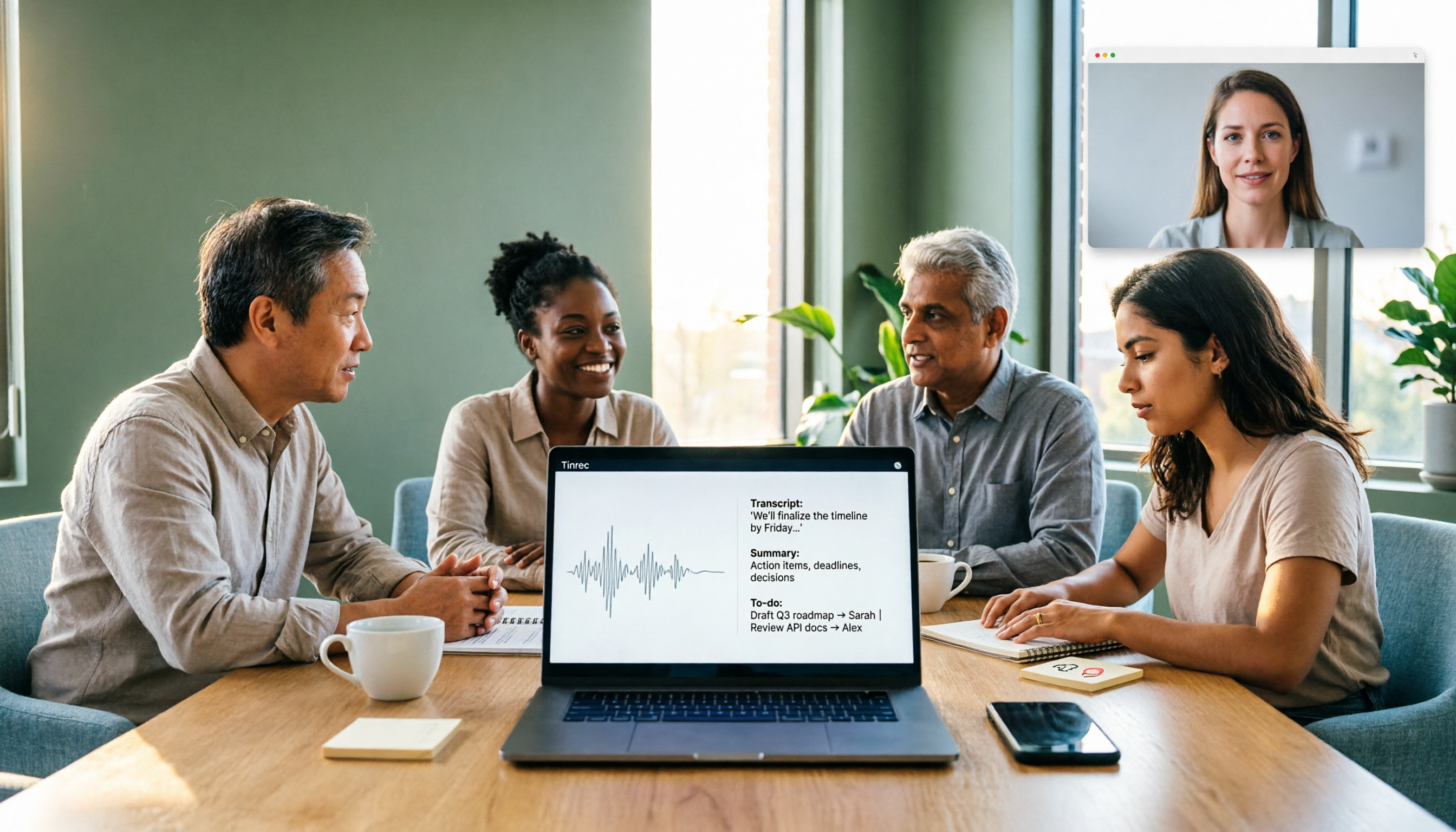
5 AI Recording Tools Tested for 2026: Which Saves the Most Time on Chinese Transcripts and Meeting Notes?
How to choose an AI recording tool in 2026? This article focuses on decision-making, comparing online meeting capture methods, Chinese and mixed Chinese-English transcription, AI summaries and action item extraction, team roles and seat management, and cost break-even points. It uses Tinrec as the primary hands-on example, guiding you from free versions to team plans to find the solution that truly saves time.

Best Free AI Meeting Notes Generators in 2026: 4 Options Compared
Tired of spending time after meetings writing up notes? This article starts with common pitfalls, explains what automatic meeting notes should really solve, outlines 5 key evaluation points, and compares four free options—Tinrec, Otter.ai, Granola, and Notta—covering their differences, limitations, and best use cases. It ends with a step-by-step starter checklist you can follow right away.
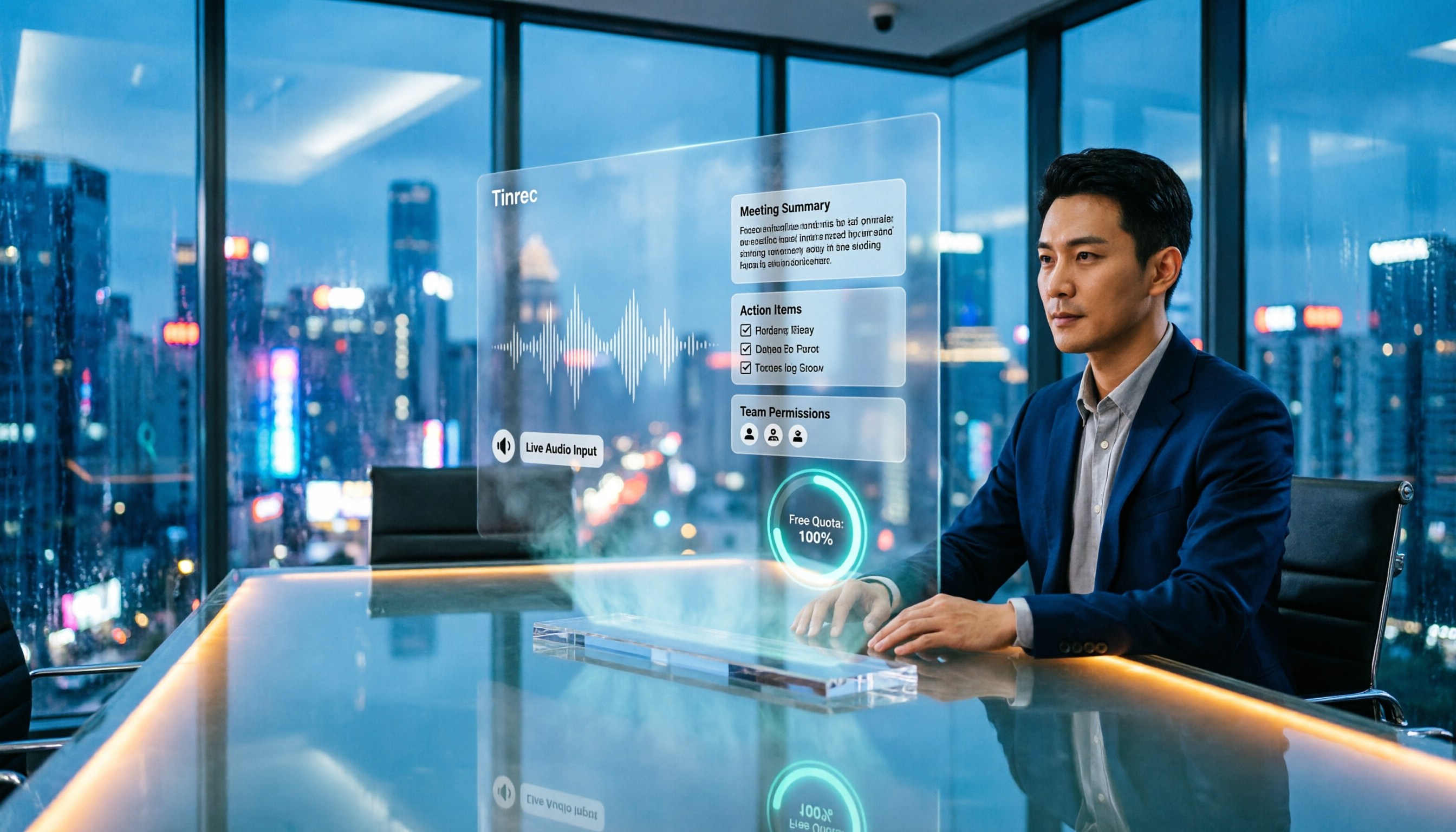
4 Meeting Transcription Apps Tested for 2026: Which Handles Chinese Meetings and Free Tiers Best?
For office workers, the worst part of a meeting isn't the meeting itself—it's the follow-up. This article tackles common misconceptions and compares 4 meeting transcription apps hands-on, helping you choose based on input sources, post-meeting output, meeting bots, and team permissions. We also honestly compare free tiers and pricing to find the best fit for Chinese-language meetings.
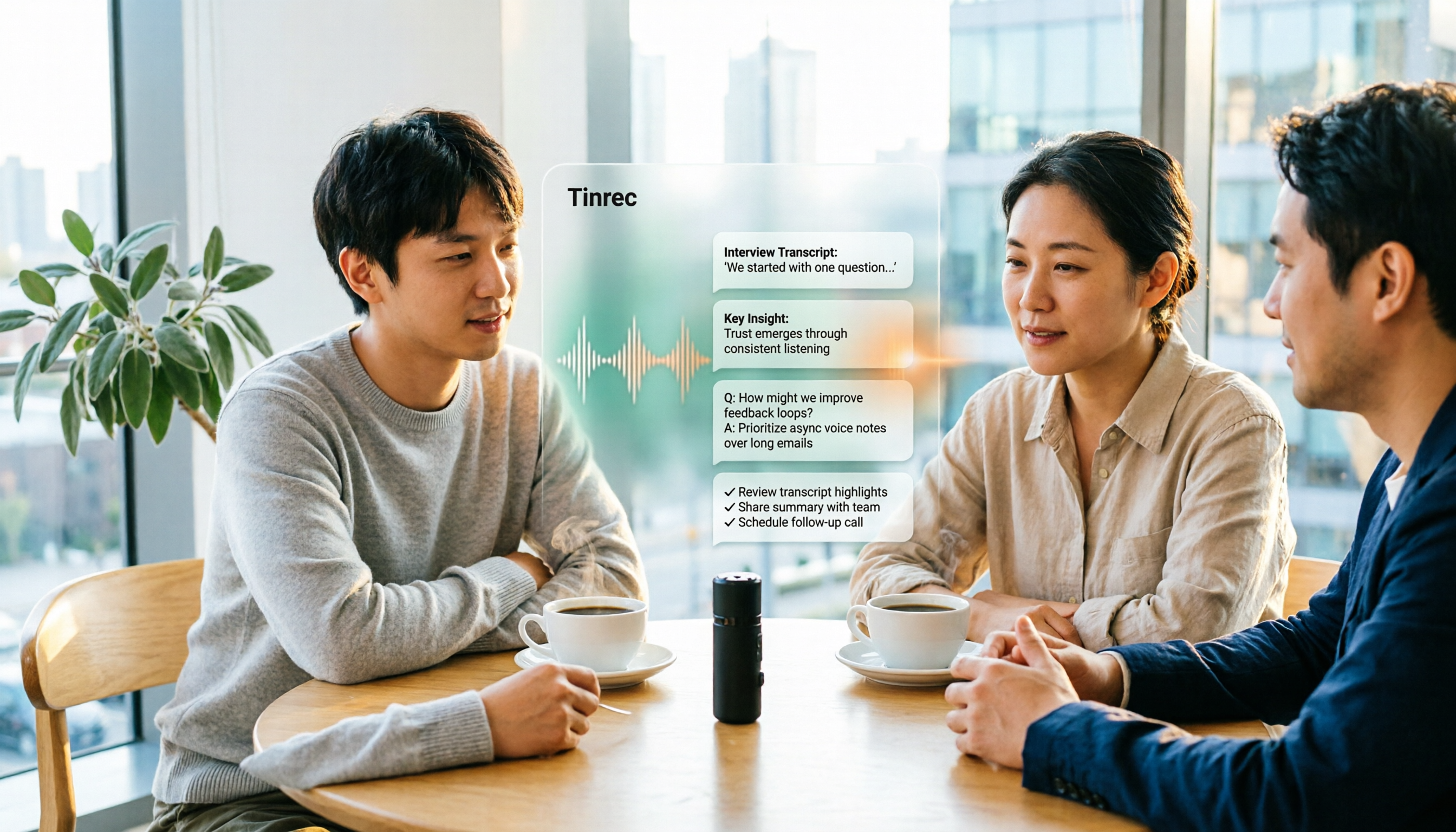
5 Interview Recording Transcription Tools Compared: Workflow Differences from Transcript to Actionable Summary
Spend an hour interviewing but three to four hours transcribing? This article starts with the question: do you need a transcript or a ready-to-use interview result? It explains what interview recording organization can do for you, its core capabilities, and uses Tinrec as an example to break down the complete workflow from recording, transcription to summary, AI Q&A, and action item extraction. Finally, it lists 5 purchasing considerations and common FAQs.

How to Transcribe Interview Recordings in 2026: 5 Steps from Audio to Transcript
Transcribing interview recordings isn't about finding the tool with the highest accuracy—it's about building a workflow from recording to transcript. Using Tinrec as an example, this article walks you through real-time transcription, AI summaries, AI Q&A, multi-format export, and team collaboration, plus 5 buying tips and FAQs.

How to Choose a Transcription Tool for Students in 2026: 5-Step Guide
From not being able to finish taking notes in class, to no one remembering the conclusions of group discussions, to needing to transcribe interviews for graduation projects—this article uses a student's perspective to outline 5 steps for choosing a recording-to-text tool, and shares how Tinrec is used in classrooms, discussions, interviews, and online courses.

Free YouTube Video Analysis Options in 2026: A Look at Tinrec's 3 Plans
YouTube videos too long and you just want the highlights? This article rounds up free YouTube video analysis options in 2026 and uses Tinrec as an example to show how to turn video links or audio files into transcripts, AI summaries, chapters, to-dos, and Q&A notes. It also compares the free version, individual paid plans, and team plans to help you decide which approach best fits your viewing and organizing habits.

4 Short Video AI Summary Tools Tested: Which One Best Captures Key Points from Course Videos?
As a senior information management student, I used AI video summary tools this semester to turn online courses, lecture videos, and my own class recordings into reviewable notes. This hands-on comparison of 4 short video AI summary tools breaks down 4 key points to consider when choosing, 4 common pitfalls, and which tool fits which use case.

Tinrec vs PLAUD Note 2026: 6-Dimension Comparison for Audio Transcription — Which Should You Choose?
Many people think audio-to-text transcription is simple, but the real challenge is that the output isn't directly usable. This article compares Tinrec and PLAUD across six dimensions—ease of use, online meetings, post-meeting organization, Chinese translation, team governance, and pricing—to help you decide which approach better fits your needs.