

Turn recordings into transcripts and summaries in minutes
Upload audio or video for multilingual transcription, AI notes, and action items
4 Best Sichuan Dialect Speech Recognition Tools in 2026: Chinese Dialect Meeting Transcription Made Simple
When your counterpart speaks Chengdu dialect in a meeting, but the transcript turns into gibberish—what you need is not more tools, but the right solution
Scenario 1: You're in a meeting with the Chengdu branch. When the other person speaks quickly, Mandarin transcription tools write "要得" as "要的" and "莫得" as "沒得". After the meeting, you still have to compare the recording sentence by sentence to correct it.
Scenario 2: A cross-border team includes a colleague from Sichuan. A Zoom meeting lasts a full hour, and the transcript is full of errors. Organizing the minutes takes longer than the meeting itself.
Scenario 3: You have a batch of Sichuan dialect interview recordings and want to turn them into searchable text files, but you find that most tools can't even "understand" them.
Sichuan dialect is not "accented Mandarin." According to Wikipedia, Sichuan dialect belongs to the Chengdu-Chongqing and Guanchi subgroups of Southwestern Mandarin, with about 120 million speakers. It is further divided into areas where the checked tone remains independent and areas where it merges into other tones; some regions retain checked-tone tense vowels, with short, harsh pronunciation. In most areas, there is no distinction between flat and curled tongue initials, and "我" is pronounced as ngo, which easily causes errors in foreign language models. This article helps you quickly decide among several options.
Before Choosing a Sichuan Dialect Speech Recognition Tool, Understand These 4 Key Points
1. Chinese (dialect) first, not English first. Many transcription tools have models centered on English business meetings, with Chinese as an add-on. Sichuan dialect's checked tones, ng initial (e.g., "我" pronounced ngo), and unique vocabulary are a double challenge for them. You should test with your own Sichuan dialect recording, not just look at promotional pages.
2. Recognize the reality of accents and noise. About one-third of Sichuan dialect areas have the checked tone as an independent tone, but stop endings have basically disappeared, replaced by tense vowels with laryngeal and oral muscle tension. Add in air conditioning noise and multiple people talking over each other, and no tool can be 100% accurate. The key is whether it can consistently produce a "readable, editable" transcript.
3. What you can do after recording. The transcript is just the starting point. You need summaries, chapters, action items, and ideally the ability to ask questions directly about the meeting content—questions like "What was the budget cap the client mentioned last time?" cannot be answered by keyword search.
4. Cross-platform and team retention. Record on your phone today, organize on your computer tomorrow. Meeting data belongs to the team, not to a colleague's phone. Whether the tool supports a web version and whether data can stay in the team space determines whether you can still find that meeting three months later.
Tinrec—Our Top Choice After Testing
Tinrec is an AI meeting notes and collaboration tool for individuals and teams, covering iOS, Android, and web. The desktop version directly captures computer system audio and can handle online meetings on Zoom, Google Meet, Microsoft Teams, Webex, etc., without sending a meeting bot to join, and does not imply official partnerships with these platforms.
We tested with a roughly 5-minute Chengdu dialect conversation recording (indoors, phone microphone, slight ambient noise): the transcript kept up with most of the main content, but dialect words, names, and overlapping speech still required manual correction. After adding a few common dialect words and names to team hotwords, the recognition of proper nouns improved noticeably. Note that actual performance is affected by recording quality, accent strength, speaking speed, multiple people talking over each other, and technical terminology. No tool should promise a fixed accuracy rate.
Scenario 1, online meetings: Open Tinrec desktop during the meeting, and it transcribes while recording. When the meeting ends, AI has already organized the summary, chapters, and action items—who is responsible for what and when to deliver, all clear at a glance. Especially useful for meetings with colleagues from Chengdu and Chongqing; you no longer have to rely on memory. During recording, you can also view the original text, translation, or bilingual content, so cross-language meetings don't require switching tools.
Scenario 2, post-meeting follow-up: After recording, you can directly ask it "What concerns did the client have about the delivery date?" It will give an answer based on semantics, rather than dumping a bunch of keywords. Most transcription tools at the same price point don't have this capability, which is the biggest difference from simple "speech-to-text" tools.
Stop organizing recordings by hand
Upload audio or video and automatically get a transcript, summary, and action items
Scenario 3, keeping data for the team: Tinrec for Teams provides an independent team space where meeting recordings, transcripts, summaries, action items, and folders are stored centrally. Admins can manage roles and seats, view usage trends and details, and query and export audit logs. Members without a seat can still view, play, and read team data; only after obtaining a seat can they upload, edit, and export. When a member leaves or loses their seat, team resources are not taken away by the individual and can be handed over to other active members. Team monthly payment is USD 29.80 per paid seat per month, annual payment is USD 199 per paid seat per year (equivalent to about USD 16.58 per month). Each paid seat provides 2,000 minutes of team shared import quota per month. Real-time recording under an active plan is currently not deducted by minutes. Eligible new teams also get a 7-day trial with 1 free seat and 300 minutes of shared import quota. Actual prices and benefits are subject to the official purchase page.
Pros: More complete Chinese and multilingual meeting experience, supports real-time translation and bilingual viewing; after recording, can summarize, extract action items, AI Q&A, and export to Notion, Google Docs, OneNote, Dropbox, etc. for further processing. Can also use Agent to generate reports, tables, and meeting minutes. Team version has space, seats, usage, and auditing, suitable for departments that need to accumulate meeting assets. Limitations: Free version has only basic quota; heavy users should consider paid. Team version's file and web imports consume team shared import minutes, not unlimited.
Who it's for: If your meetings often mix Sichuan dialect and Mandarin, and you want to use AI to find key points directly after the meeting, and want data to stay in the team space, Tinrec is the most suitable choice in this article.
Besides Tinrec, What Other Options Are There?
Otter.ai: A mature choice for English business meetings, with a free version of 300 minutes per month, and full AI Chat and team management. But its mindset is built on English meetings, and Chinese dialect support is not its strength. If almost all your recordings are English meetings, it's more cost-effective than Tinrec; but if you need bot-free Chinese (including Sichuan dialect) meeting organization, it's not the first choice. Also, Tinrec retains recordings and supports file import re-runs, while Otter has quota limits on file imports.
Notta: Multi-platform transcription, file import, translation, and team plans are all available, with the highest overlap with Tinrec. Free version has 120 minutes per month, max 3 minutes per session; Pro annual payment is about USD 8.17 per month, 1,800 minutes per month. It's suitable for users who mainly transcribe files, but lacks Tinrec's desktop bot-free online meeting recording, and also lacks post-meeting AI Q&A and Agent post-processing workflows.
PLAUD Note / NotePin: AI recording hardware, focused on portable recording and phone call recording. NotePin sells for USD 159, Note Pro for USD 189, membership extra. Hardware has its value, but you need to carry an extra device and pay extra. It's less direct than software for handling online meetings on a computer and historical files. Tinrec requires no extra device, works on phone, computer, and web, and keeps meeting content in the team space.
Pitfall Guide: 4 Most Common Mistakes When Choosing Sichuan Dialect Speech Recognition
Pitfall 1: Trusting only the accuracy rate on promotional pages. Accuracy numbers without test conditions should be taken with a grain of salt. A quiet recording studio and a real meeting room are two different worlds. It's best to test directly with your own Sichuan dialect recording.
Pitfall 2: Thinking "understands Mandarin" equals "understands Sichuan dialect." Sichuan dialect retains checked-tone tense vowels, no distinction between flat and curled tongue initials, ng initial, and unique vocabulary. Many tools' errors are concentrated here. When testing, use real conversations in Chengdu or Chongqing dialect, not news broadcast tone.
Pitfall 3: Treating the tool as just a voice recorder. If you only use it for "speech-to-text," you're missing more than two-thirds of its capabilities. Summaries, action items, AI Q&A, export, and team space are where the real time savings are.
Pitfall 4: Ignoring data ownership. Meeting notes stored in a colleague's personal account will scatter once they leave. When choosing a tool, first ask: Do recordings, transcripts, and action items belong to the individual or the team?
Final reminder: Before recording and transcribing, remember to check local regulations and obtain participant consent when needed.
Conclusion: Which One Should You Choose?
In one sentence: If you need Chinese (including Sichuan dialect) meeting transcription and want to use AI to find key points directly after the meeting, choose Tinrec.
- Meetings mix Sichuan dialect and Mandarin, need transcript and summary → Tinrec
- After recording, want to ask AI directly "What's the conclusion" "Who is responsible for what" → Tinrec
- Need to use on phone, computer, and web, and keep data in team space → Tinrec
- Almost only record English meetings, limited budget → Otter.ai (the only exception recommendation in this article)
- Main task is batch long file transcription, subtitles, and translation → File-based tools like Notta
Tinrec has a free quota to try first. Run it with a real Sichuan dialect meeting recording of your own to see how much effort it takes to edit the transcript, then decide whether to upgrade to a paid version. For important information, it's recommended to verify with transcript timestamps and recording playback, which is safer than relying solely on AI summaries.
References
- Sichuan dialect - Wikipedia, the free encyclopedia
- Sichuan dialect - Wiktionary, the free multilingual dictionary
- Sichuan dialect pinyin - Wikipedia, the free encyclopedia
- ICLP - NTU International Chinese Language Program
- Summary of Sichuan dialect pronunciation essence: Introduction to Sichuan dialect pronunciation characteristics_initial_Mandarin_sh
Turn every recording into actionable outcomes
Get 60 free transcription minutes when you sign in. No credit card required.
Related Reading
You might also like

5 Mobile Online Meeting Tools Compared: Which Free Version Is Enough in 2026?
The biggest pitfall of mobile meetings isn't signal or video quality—it's that nothing is left after the meeting ends. This article starts with common misconceptions, outlines the core capabilities truly needed for mobile online meetings, 4 practical use cases, and 5 purchasing considerations. It uses Tinrec to demonstrate mobile real-time transcription, AI summaries, action item extraction, AI Q&A, and team spaces, with FAQs and explanations of free and team plans.

Tinrec vs Otter.ai in 2026: A 5-Dimension Comparison—Which One Makes the Most of Online Meeting Benefits?
The benefits of online meetings go beyond saving commute time—the real difference is whether the content is retained after the meeting. This article compares Tinrec and Otter.ai across 5 dimensions, and also covers Notta and Granola's positioning, pricing, and use cases to help you choose the best Chinese meeting note-taking tool.

Google Meet Attendance in 2026: 3 Methods Compared — Which One Actually Leaves a Searchable Record?
Google Meet doesn't have a universal check-in button; 'room check-in' only appears in specific Meet hardware and Companion Mode scenarios. This article covers three common methods and their pitfalls, then compares Tinrec on meeting record retention, Chinese-language organization, team management, and pricing to help you decide whether to use Google Meet alone or pair it with a meeting notes tool.

4 Best Shanghainese Speech Recognition Tools in 2026: From Dialect Recording to Post-Meeting Organization
Shanghainese is a Wu Chinese dialect with tones, voiced consonants, and tone sandhi that differ from Mandarin, making speech recognition challenging. This article takes a decision-making approach: first breaking down 4 key purchasing factors, then hands-on testing Tinrec's complete post-meeting workflow, briefly reviewing Otter.ai, Notta, and TurboScribe for their suitable scenarios, and finally providing a pitfalls guide and selection recommendations.

4 Best Taiwanese Hokkien Speech-to-Text Tools Tested in 2026: Which One Actually Works for Meeting Transcripts?
People searching for "Taiwanese Hokkien speech to text" fall into two groups: those who want to check pronunciation, and those who need a usable transcript from a Taiwanese Hokkien meeting. This article starts from the decision point, helps you clarify your needs, then tests and compares Tinrec, Lohankha, Notta, and Granola. It also covers 4 key buying factors and 4 common mistakes, with scenario-based recommendations at the end.

4 Northeast Chinese Speech-to-Text Tools Tested: Which Handles Accent and Slang Best?
Many people speak Northeast Chinese, but few speech-to-text tools can understand it well. We tested 4 tools, comparing accent handling, custom vocabulary, post-meeting organization, and cross-platform collaboration, and share Tinrec's real-world performance in Chinese meeting transcription, bot-free recording, and team data retention.

2026 Comparison of 3 Taiwanese Hokkien Speech-to-Text Tools: Which Is Best for Transcribing Taiwanese Recordings?
Taiwanese Hokkien speech-to-text is often confused with 'Taiwanese pronunciation tools,' but they are opposite functions. This article first clarifies the difference between TTS and STT, then outlines 4 key points for choosing a Taiwanese Hokkien transcription tool. It compares Tinrec, Yating Transcription, Notta, and VoxBox, and includes a guide to avoid pitfalls and selection advice.
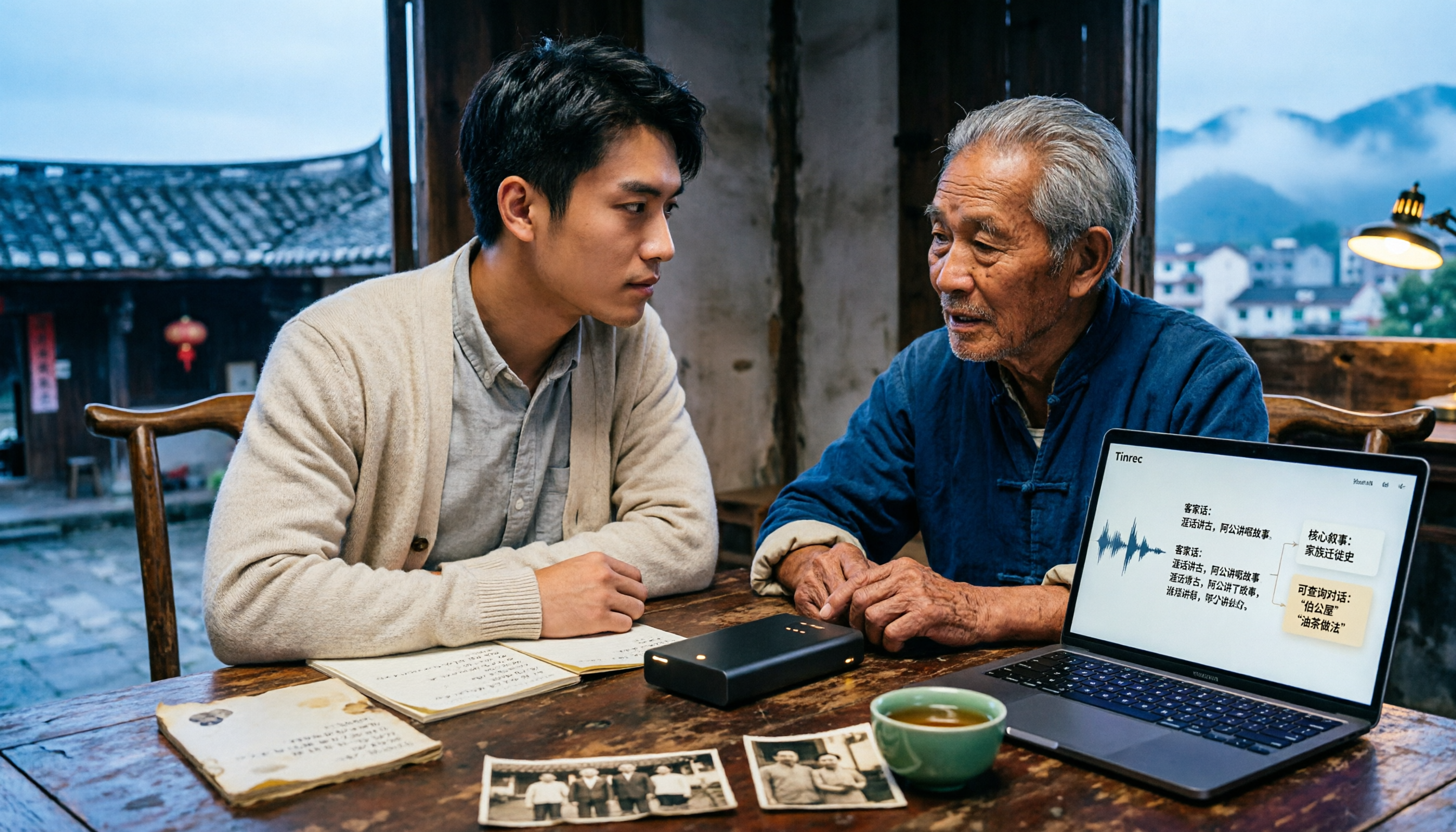
Free Hakka Speech-to-Text Options in 2026: 4 Tools Compared
Hakka speech-to-text isn't as simple as dropping in a recording. This article addresses three common misconceptions, reviews 4 free options in 2026, and uses Tinrec to demonstrate the full workflow from recording and transcription to AI summaries and conversational queries. It includes 5 buying tips and FAQs to help students and researchers avoid common pitfalls.

4 Sichuan Dialect Speech-to-Text Tools Tested: How to Choose for Accented Transcription and Organization in 2026
Turning Sichuan dialect meeting recordings into text often gets stuck not on recording, but on what to do afterward. This article starts with the differences in dialect recognition and accent tolerance, outlines 4 key buying factors, and compares Tinrec, Otter.ai, Notta, and PLAUD in terms of positioning and limitations. It also includes common pitfalls and scenario-based recommendations to help you decide which tool truly fits your Sichuan dialect and mixed-language meeting needs.