
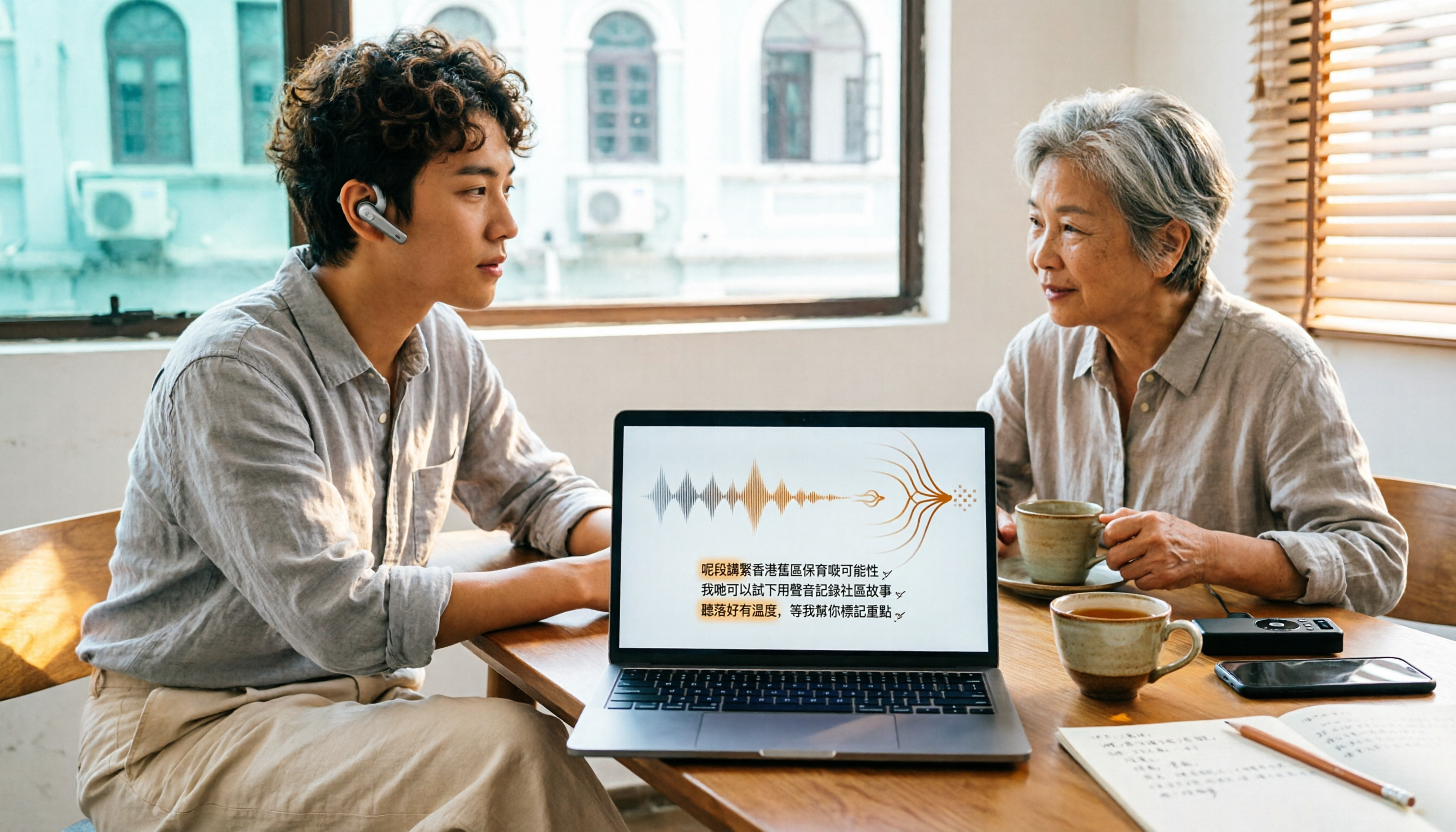
Turn recordings into transcripts and summaries in minutes
Upload audio or video for multilingual transcription, AI notes, and action items
How to Choose Cantonese Audio-to-Text in 2026: 5 Steps to Pick the Right Free Tool
Why Do You Need Cantonese Audio-to-Text?
I recently helped a Hong Kong client organize interview recordings, and I tried a round of tools that claimed to "support Cantonese."
Honestly, more than half were just Mandarin models forced to fit.
Mixed Chinese-English parts turned into gibberish, or the tool couldn't tell who was speaking.
It's the same in Taiwan.
More and more teams need to handle Hong Kong-style meetings, Cantonese client interviews, and Cantonese YouTube videos that need subtitles.
But Cantonese isn't a language you can dismiss with just the word "Chinese."
Typing a transcript by hand? A 1-hour recording will eat up about 3 hours of your time.
In this article, I'll list 6 options I've used or researched, from completely free to team collaboration.
At the end, I'll give you 5 steps that directly match your own use case.
Tinrec — The Most Complete AI Recording and Meeting Collaboration Assistant
One-sentence positioning: This is the only tool on the list that also handles "what happens after transcription."
Highlight 1: No meeting bot needed.
The desktop version directly captures your computer's system audio, so it works with Zoom, Google Meet, Microsoft Teams, and Webex.
The last thing you want in a client meeting is an extra bot on the list—this is very practical.
Highlight 2: After transcription, you can keep asking questions—this is the biggest difference from ordinary transcription tools.
The transcript automatically generates summaries, chapters, key points, action items, and mind maps.
You can also directly ask AI questions about the meeting content, such as "What was the budget cap the client mentioned last week?" without having to look back yourself.
Highlight 3: Mixed Chinese-English and multilingual processing.
Tinrec covers Chinese, Traditional Chinese, and multilingual meeting scenarios, and supports real-time translation and viewing in original, translated, or bilingual mode.
Teams can also maintain a glossary to feed in company-specific terminology.
Highlight 4: Export and post-processing.
Besides common file formats, you can export to Notion, Google Docs, OneNote, and Dropbox, and use Agent to generate reports, tables, and documents.
**Pricing:** The personal version has a free version to try first, plus weekly, Pro monthly, and Pro annual plans.
The team version offers a 7-day free trial, including 1 free seat and 300 minutes of team shared import quota; team monthly is USD 29.80 per paid seat per month, annual is USD 199 per paid seat per year (about USD 16.58 per month), with 2,000 minutes of team shared import quota per paid seat per month.
**Who it's for:** Workplace users who frequently hold online meetings, need to submit meeting minutes afterward, and want to keep data for the team.
Note that it won't automatically join every meeting on your calendar—you have to start the desktop version to record yourself.
Actual recognition performance is also affected by recording quality, accents, and overlapping speakers.
Subanana — A Free Preview Option Focused on Cantonese
Subanana is one of the few tools that puts "Cantonese" first, with its main focus on Cantonese speech-to-text.
Upload a recording, video, or paste a YouTube link, select Cantonese and output format (spoken or written, Traditional or Simplified), and within minutes you get a transcript with speaker separation and punctuation, handling mixed Chinese-English as well.
You can export SRT, VTT, TXT, DOCX, XLSX, and Markdown.
The first 15 minutes of each file can be previewed for free—this is very generous, letting you see how your recording performs before deciding whether to pay.
**Who it's for:** Individual users with short recordings, minimal budget, and just wanting to verify Cantonese recognition performance first.
cSubtitle — An Online Tool for Subtitling Without Registration
cSubtitle is an online speech-to-text and subtitle generation tool focused on Chinese processing.
No account registration needed—upload a video or audio file and it starts running, and within minutes you can download subtitle files with timestamps and transcripts.
Supports MP4, MOV, MP3, WAV, M4A, OGG, WMA, with a single file limit of 4GB and duration up to 5 hours.
The official claim is over 94% Chinese recognition accuracy, and the exported Word file includes time codes for easy playback and correction.
**Who it's for:** People with a bunch of videos to subtitle who don't want to create an account.
Google AI Studio (Gemini) — A Zero-Cost Cantonese Transcription Route
If you're the type who "doesn't want to be fooled by fake free again," this route is worth trying.
Stop organizing recordings by hand
Upload audio or video and automatically get a transcript, summary, and action items
Some users have shared that putting recordings into Google AI Studio with Gemini for transcription yields high Cantonese accuracy, supports long content, requires no complex API setup, and works on both desktop and mobile.
The biggest advantage is it's truly free, and after transcription you can directly ask it to summarize, organize, and conclude the transcript.
**Who it's for:** Individual workers willing to operate manually, with few recordings, wanting zero-cost Cantonese content processing.
Notta — A Multi-Language, Multi-Platform Transcription Tool
Notta covers multi-platform transcription, meeting notes, file import, translation, and team plans, with significant overlap with Tinrec.
Official pricing: Free version has 120 minutes per month, max 3 minutes per item; Pro annual is about USD 8.17 per month, 1,800 minutes per month; Business annual is about USD 16.67 per seat per month, offering unlimited transcription, role permissions, and usage reports.
**Who it's for:** Individuals or small teams that price by minutes and need multilingual processing.
TurboScribe — A Cost-Effective Choice for Batch Transcription of Large Files
TurboScribe takes the high cost-performance file transcription route, focusing on long files, batch uploads, subtitles, and translation.
Free version: 3 files per day, max 30 minutes per file; Unlimited annual is USD 120 (about USD 10 per month), paid version supports up to 10 hours or 5GB per file, and up to 50 files at once.
**Who it's for:** People with a backlog of historical recordings to process all at once.
It's not designed for live meetings—keep that in mind.
With So Many Options, How Should You Choose? 5 Steps
Step 1: First confirm whether you're dealing with "Cantonese" or a generic "Chinese."
Many tools claim to support Chinese but actually force a Mandarin model.
If you often have mixed Chinese-English, directly choose a solution with mixed Chinese-English processing capability (Tinrec covers Chinese and multilingual meeting scenarios, and teams can build their own glossary).
Step 2: Distinguish between "live meetings" and "post-event files."
If you have meetings every week and need to transcribe while meeting → Tinrec desktop version records Zoom, Meet, Teams without a bot, no need to invite a bot into the meeting.
If you just occasionally drop a file → Subanana or Google AI Studio is enough.
A bunch of videos to subtitle → cSubtitle.
Step 3: Think clearly about what you want after the meeting.
If you only need a transcript, free tools can solve it.
If you need summaries, chapters, action items, and the ability to ask questions about the meeting content → only Tinrec does this post-processing completely.
Step 4: Whether there's a team sharing need.
Should meeting data stay with the team, can new hires find old meetings, will data be taken away when someone leaves.
If you have these issues, it's the scope of the team version. Tinrec team space manages permissions by role and seat, and when members change, resources can be handed over to other members.
Step 5: Test with your own recordings, don't trust official numbers.
First use free quota (Tinrec free version, Subanana first 15 minutes free preview) to throw in the most difficult segment.
The kind with mixed Chinese-English and multiple people talking over each other.
Only pay if it passes—this is more accurate than reading ten reviews.
5 Things to Know Before Using Cantonese Audio-to-Text
1. "Free" usually has conditions.
Free preview, free minutes, free but limited duration—all count as free.
First check whether your recording will be cut off at 15 minutes or 120 minutes. Testing with Tinrec's free version or Subanana's free preview is the most accurate.
2. Cantonese is not Mandarin.
Mixed Chinese-English is the litmus test. When looking at tools, confirm whether they have model selection or evaluation specifically for Cantonese, not just a "Chinese" option in the interface.
3. Recording quality determines the upper limit of accuracy.
Noisy environments, multiple people talking over each other, and echo will lower recognition rates. No tool can guarantee 100%.
For important content, it's recommended to play back and verify against the transcript timestamps—don't skip this step.
4. A transcript is only a semi-finished product.
The real time-consuming part of a meeting is organizing key points, capturing action items, and writing minutes.
Tools that only output transcripts leave those next 2 hours to you; tools that automatically summarize, extract action items, and let you ask questions (like Tinrec) save you that part.
5. Teams need to look at data ownership.
Meetings recorded with a personal account—when the person leaves, the data goes with them.
The team version stores meetings in team space, manages usage eligibility by role and seat, and requires handover when members change.
Also, before recording, remember to obtain consent from participants in accordance with local regulations.
Conclusion
For Cantonese audio-to-text in 2026, there's no shortage of tools—what's lacking is tools that "actually understand Cantonese."
If you only occasionally transcribe a segment, Subanana's free preview or Google AI Studio is enough.
But if you have meetings every week, need to organize afterward, and want to keep data for the team, then something like Tinrec that goes from transcription all the way to summaries, Q&A, action items, and team space will save you more time than tools that only spit out transcripts.
First throw in a segment of your own Cantonese recording to see how it performs, then decide whether to use it long-term—this is the safest way to avoid pitfalls.
References
- Free Cantonese Speech-to-Text App 2026 | Subanana
- AI Speech-to-Text Fast Online Audio Transcription, Transcripts and Video Subtitles - Free Trial - cSubtitle
- Cantonese Text-to-Speech
- Free + Cantonese OK: How to Use Google AI Studio to Convert Your Recording...
- Online AI Speech, Video, Audio Automatic Transcription - Free Trial - cSubtitle
Turn every recording into actionable outcomes
Get 60 free transcription minutes when you sign in. No credit card required.
Related Reading
You might also like

5 Cantonese Speech-to-Text Tools Tested for 2026: Which Free Tier Actually Works?
A hands-on comparison of 5 speech-to-text tools that support Cantonese in 2026. This article examines free tier limits, Cantonese and mixed Chinese-English recognition, post-meeting summaries and action items, and cross-platform and team collaboration, explaining why Tinrec has become part of a mid-level manager's daily workflow, and honestly comparing when Subanana, Google AI Studio, and Otter.ai each make sense.

How to Choose Cantonese Speech-to-Text in 2026: 5-Step Test of Free Tools
Many Cantonese speech-to-text tools claim to be free, but file limits, language support, and post-meeting organization vary widely. This article uses 5 key steps to test and compare, and explains who Tinrec, Subanana, cSubtitle, and Google AI Studio are best for.

2026 Guide: Free Cantonese Audio to Text Solutions — Tinrec Free Tier + AI Meeting Summaries
This guide helps you avoid common pitfalls when converting Cantonese audio to text for free. We test Tinrec's free tier, transcripts, AI summaries, and team collaboration, and compare alternatives like Notta, Otter, and Google AI Studio to help you find the best Cantonese transcription workflow.

Tinrec vs Notta 2026: 5-Dimension Comparison for Cantonese Meeting Transcription
In 2026, choosing a Cantonese audio-to-text tool isn't about which is most accurate, but which workflow fits you best. This article compares Tinrec and Notta across 5 dimensions, covering differences like bot-free meeting recording, AI Q&A, and team spaces, plus use cases for Otter.ai and TurboScribe and 3 common pitfalls to avoid.

5 Cantonese Audio-to-Text Tools Tested and Compared in 2026: How to Solve the Transcription Pain Points Dcard Users Ask About Most
Discussions on Dcard about converting Cantonese audio to text mostly focus on two pain points: tools that don't understand Cantonese and privacy concerns about uploading files. This article starts from real-world use cases, compares the differences among 5 common approaches, and uses Tinrec as an example to explain how real-time transcription, bot-free meeting recording, AI summaries and Q&A, and team spaces solve these problems. It ends with 5 buying checkpoints and FAQs.

4 Cantonese Speech-to-Text Tools Compared for 2026: Free vs Paid Options Explained
How to choose a Cantonese speech-to-text tool in 2026? This article addresses common misconceptions and compares Tinrec, Otter.ai, PLAUD, and Notta on Cantonese support, free tiers, and post-meeting organization. It also provides 4 key buying factors and 3 pitfalls to avoid, helping you find the best transcription solution.

5 Best Cantonese Speech-to-Text Tools in 2026: Which Free Tier Actually Works?
Starting from a university group project with Cantonese discussions, this hands-on comparison tests free Cantonese speech-to-text tools on free quotas, mixed Chinese-English recognition, and post-meeting organization, sharing real-world experience using Tinrec in campus classes, interviews, and group collaboration.

Which Cantonese Audio-to-Text Tool Is Best? 2026 Hands-On Test of 5 Options, Top Pick for Chinese Meetings
The biggest pitfall when choosing a Cantonese audio-to-text tool is relying only on the official language list. This article first clarifies common misconceptions, then provides a hands-on testing process you can run yourself, and uses Tinrec to demonstrate a complete workflow from recording and transcription to summaries, action items, and team archiving, including pricing and plan limitations.
2025 Top 5 Cantonese Speech-to-Text Tools Tested: Which One Turns Transcripts into Usable Data?
After hands-on testing of several Cantonese speech-to-text tools in 2025, the key takeaway: getting a transcript is just the beginning. This article breaks down the complete workflow for Cantonese audio transcription, from real-time transcription and handling mixed Chinese-English to AI summaries and action items, team sharing, and purchasing considerations, with Tinrec demonstrating each step.