
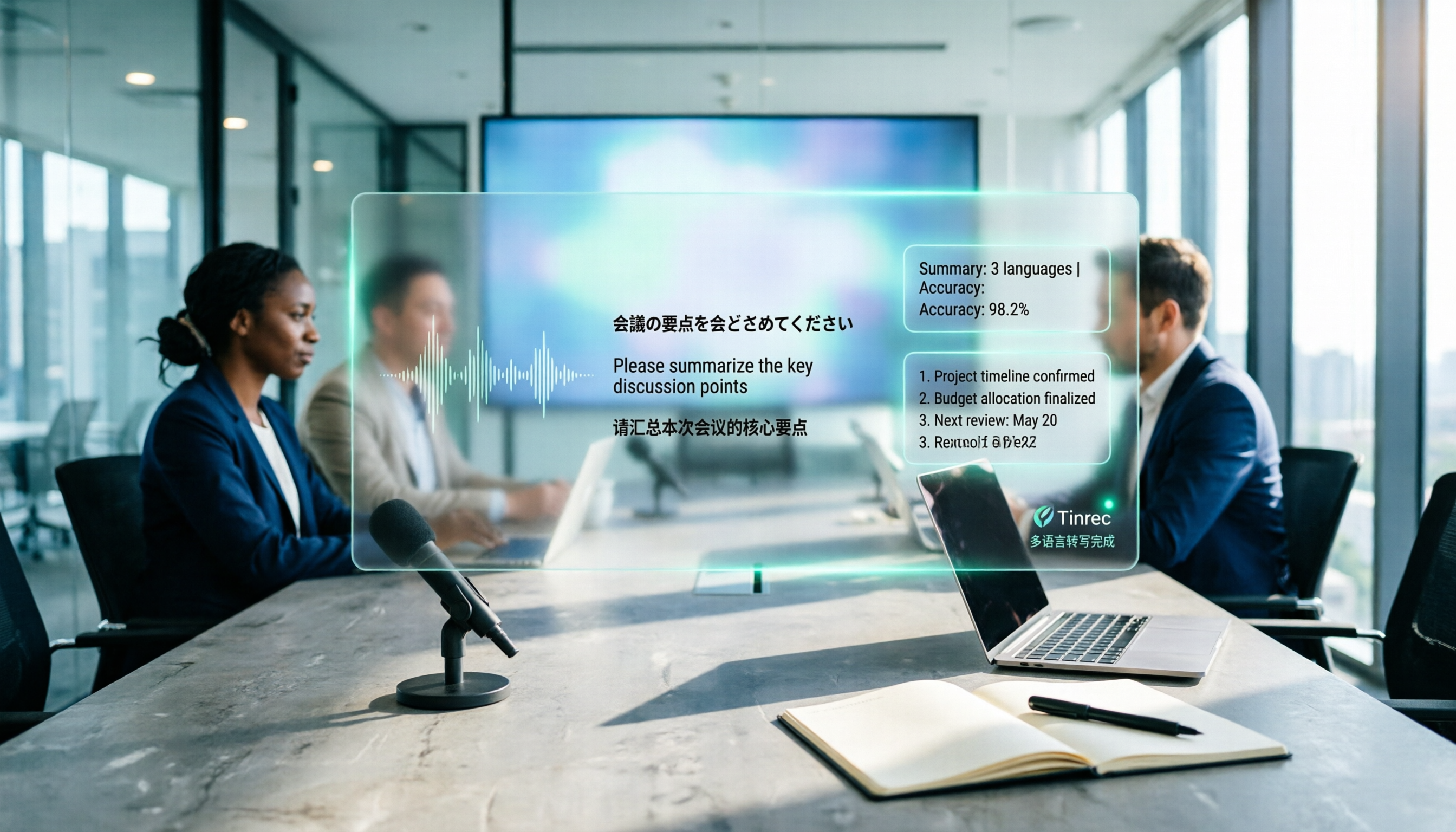
Turn recordings into transcripts and summaries in minutes
Upload audio or video for multilingual transcription, AI notes, and action items
How to Create a Multilingual Meeting Minutes Template in 2025: 5 Steps from Recording to Multilingual Summary
Wednesday afternoon international weekly meeting: the Japanese client speaks Japanese, the Singapore PM replies in English, the Taiwan team discusses in Chinese, and a few English product terms are mixed in. When the meeting ends, the manager asks only one question: "Where are the minutes?"—but all you have is a draft mixed with Chinese and English, where you can't tell who said what.
The reason multilingual meeting minutes are difficult is usually not that typing is too slow, but that three things happen at the same time: the languages need to match up, speakers need to be distinguishable, and conclusions need to be trackable. Below, we break down how to create a multilingual meeting minutes template in 2025 using 5 steps, then review 7 tool options you can use alongside them.
Why do multilingual meetings especially need a "minutes template"?
In a single-language meeting, you can get by with casual notes and later recollection. But as soon as two or more languages are involved, memory quickly becomes unreliable. Whether the Japanese "検討します" should be recorded in Chinese as "re-evaluate" or "reply after internal confirmation" depends on the context at the time, and writing it up afterward easily distorts the meaning. International teams also often have time zone issues; if it wasn't recorded during the meeting, following up the next day means waiting for another round.
A good multilingual meeting minutes template serves simultaneously as a transcript, a translation, and an action list. It lets people who weren't present understand, lets participants align, and gives the next meeting a basis.
What fields should a multilingual meeting minutes template have?
The table doesn't need to be complicated, but it needs to hold both the "original words" and the "actionable conclusions." You can refer to the following fields:
| Field | Purpose |
|---|---|
| Timestamp | Corresponds to the recording position for later playback and verification |
| Speaker | Indicates who spoke; essential for multi-person meetings |
| Original text | Preserves the original language to avoid translation distortion |
| Chinese summary | Helps the Chinese-speaking team understand quickly |
| Decision/Conclusion | The things actually finalized in this meeting |
| To-do items | Who, does what, and by when |
| Owner and deadline | Makes to-do items trackable |
| Notes/Terminology | Unified wording for proper nouns and products |
In practice, this table is unlikely to be completed by one person listening and typing at the same time, especially when three languages are being spoken simultaneously. This is also why most teams switch to AI tools: let the machine generate the transcript and translation first, then people handle judgment and annotations.
Complete a 2025 multilingual meeting minutes template in 5 steps
Step 1: Set up the fields and shared document before the meeting. Build the fields from the table above and place them where the team can edit them. Confirm the languages in advance and prepare terminology mappings so you don't get stuck on translation during the meeting.
Step 2: Start recording and real-time transcription as soon as the meeting begins. Recording isn't for listening to everything again afterward; it's to leave a replayable basis. Tools like Tinrec can record and transcribe at the same time, so the transcript is already being generated during the meeting, greatly reducing the time needed to fill in the table afterward.
Step 3: Keep real-time translation on and compare original text with translation. When someone speaks a non-Chinese language, reading bilingual content directly is faster than waiting for someone to translate. Tinrec supports viewing the original text, translation, or bilingual content during recording, so in cross-language meetings you can immediately confirm that both sides understand the same thing.
Step 4: After the meeting, use AI summaries, chapters, and to-dos to complete the table. The transcript is just raw material. Extract the summary, chapter highlights, and to-do items and fill them back into the "Decision" and "To-do" fields of the minutes template—that's the version you can hand to your manager.
Step 5: Archive it somewhere searchable so the next meeting can follow up. If minutes are saved as scattered Word files, you won't find them three months later. Put them in a searchable, queryable space, and before the next meeting you can directly ask, "What were the Japanese client's concerns about pricing last time?" and pull it up.
Option 1 | Tinrec—the most complete from recording and translation to team archiving
One-sentence positioning: turn meetings into searchable, collaborative, actionable team data.
Bot-free recording of online meetings. The Tinrec desktop version directly captures computer system audio. When handling Zoom, Google Meet, Microsoft Teams, Webex, and other meetings, there is no need to invite an extra meeting bot into the room, which feels most natural for external client meetings. After the user actively starts recording, the transcript is generated in real time.
Multilingual content and real-time translation. In addition to Chinese meetings, it can also handle mixed Chinese-English and multilingual content; during recording, you can switch between original text, translation, or bilingual view. Teams can also maintain "team hotwords" to standardize recognition habits for product names and proper nouns. Actual results are affected by recording quality, accents, noise, and overlapping speakers, so fixed accuracy rates should not be promised externally.
AI Q&A is its biggest difference from ordinary transcription tools. After the transcript is generated, you can ask questions directly about that meeting, such as "What three concerns did the client mention?" or "What did we promise?" You can also ask follow-up questions across multiple meetings. This is especially useful for multilingual meetings because you no longer have to go back through transcripts in three languages.
Produce usable documents directly after the meeting. In addition to summaries, chapters, to-dos, and mind maps, it can also export to Notion, Google Docs, OneNote, Dropbox, and other tools, or use an Agent for post-processing to generate reports, tables, and meeting minutes.
Stop organizing recordings by hand
Upload audio or video and automatically get a transcript, summary, and action items
Plans and who they suit. The personal version has a free version to first confirm transcription quality, plus a weekly pass, Pro monthly, and Pro annual, corresponding to short-term intensive use, stable weekly use, and long-term data accumulation. Teams that need multiple people to share meeting data can consider the team version: the first eligible team trial is 7 days, 1 free seat, and 300 minutes of team shared import quota; team monthly is USD 29.80 per paid seat per month, annual is USD 199 per paid seat per year (about USD 16.58 per month), each paid seat provides 2,000 minutes of team shared import quota per month, and real-time recording under an active plan is currently not deducted by minutes. The team version also includes member and seat management, usage analytics, audit logs, audio recycle bin, and team hotwords. Prices and promotions are subject to the official purchase page.
Option 2 | Notta—a veteran choice for multilingual transcription and translation
Notta overlaps most with Tinrec, covering multi-platform transcription, meeting minutes, file import, translation, and team plans. The difference is that Tinrec emphasizes bot-free recording, AI Q&A, and team data accumulation more. Notta's free version offers 120 minutes per month with a 3-minute limit per item; Pro annual is about USD 8.17 per month with 1,800 minutes per month; Business annual is about USD 16.67 per seat per month, providing unlimited transcription, role permissions, and usage reports. It suits individual users already accustomed to Notta's interface and mainly using file transcription and subtitles.
Option 3 | Subanana—a specialized solution for Cantonese and mixed Chinese-English meetings
If meetings often include Cantonese, or colloquial mixed Chinese-English phrases like "我哋 call 完之後 follow up," Subanana is an option optimized for this kind of context. It supports 95+ languages and continuously evaluates multiple speech recognition models, selecting by language; AI can also automatically distinguish different speakers. Through a meeting bot, it can connect to Google Calendar to automatically join and record. For output, you can choose written language to convert spoken language into formal written Chinese. It suits Hong Kong teams or meetings mainly conducted in Cantonese; for plans and pricing, please refer to the official page.
Option 4 | Otter.ai—a mature option for English business meetings
Otter is a mature AI meeting assistant covering Zoom, Microsoft Teams, and Google Meet, supporting real-time transcription, speaker identification, AI Chat, and team management. It has a strong advantage in established usage habits for English business meetings. Currently Basic is free with 300 minutes per month; Pro annual is about USD 8.49 per user per month, including 1,200 minutes of in-app recording per month and 10 file imports; Business provides management capabilities such as unlimited meetings and in-app recording. If meetings are mainly in English, it can be included in the comparison; if you need post-meeting organization for Chinese and mixed multilingual content, tools focused on Chinese experience and team accumulation will be closer to the need.
Option 5 | Fireflies.ai—meeting automation and team analytics
Fireflies' strengths are meeting automation, AI summaries, AskFred, and a large number of third-party integrations. Team analytics is especially useful for sales scenarios. Currently Free is USD 0, Pro is USD 10 per seat per month, Business is USD 19 per seat per month, and Enterprise is USD 39 per seat per month; note that its "unlimited transcription" is still affected by storage, file upload speed, and AI Credit rules. It suits teams that value meeting automation workflows and CRM-related integrations.
Option 6 | Granola—bot-free AI meeting notes
Granola also uses a bot-free approach, transcribing in real time through desktop system audio and microphone, then combining it with the user's handwritten notes to generate more targeted meeting content. Cross-meeting context organization is its feature. Basic is free, Business is USD 14 per user per month, and Enterprise is USD 35 per user per month. Note that it does not support uploading pre-recorded audio files and does not save meeting audio; if you need to keep recordings, process historical files, or do bilingual comparison, tools with more complete input sources and output formats will be more suitable.
Option 7 | TurboScribe—a file transcription option when the budget is zero
TurboScribe is closer to a cost-effective file transcription tool, focusing on long files, batch uploads, subtitles, and translation. The free plan allows 3 files per day, up to 30 minutes per file; Unlimited annual is USD 120 (about USD 10 per month), and the paid version supports files up to 10 hours or 5 GB, with up to 50 files uploaded at once. Its strength is "processing a large number of existing audio files at once," and it does not focus on real-time meetings and post-meeting collaboration, so it is more suitable for situations where you already have recording files and only need text output.
With so many options, how should you choose?
- Want one meeting to be completed from recording, bilingual transcript, summary, to to-dos in one go → Tinrec (the most complete AI Q&A, to-do, and export workflow after transcription)
- Don't want a meeting bot appearing in client meetings → Tinrec (desktop version captures system audio, applicable to Zoom, Meet, Teams, and Webex)
- Meetings are mixed multilingual and need real-time translation comparison → Tinrec (can switch between original text, translation, and bilingual view, and use team hotwords to standardize terminology)
- The team wants to centrally store meeting data and manage seats and usage → Tinrec team version (members, roles, seats, usage analytics, and audit logs all in one place)
- Need Chinese and multilingual transcription, and also want AI Q&A → Tinrec (can ask follow-up questions for a single meeting or across meetings)
- Only processing a large number of existing audio files with a limited budget → TurboScribe (free plan allows 3 files per day; confirm quality first)
- Mainly Cantonese or mixed Chinese-English → Subanana (optimized for Cantonese context, can output written language)
- Meetings are almost all in English and the team is already familiar with Otter → Otter.ai (mature for English business meetings)
Before using a multilingual meeting minutes template, know these 4 things
1. Confirm legality and consent before recording. Different countries and regions have different regulations on recording, and international meetings require even more attention. Obtain participant consent when needed.
2. Don't assume AI is always correct. Recording quality, accents, overlapping speakers, and technical terminology all affect results. For important numbers, amounts, and commitments, it is recommended to verify against transcript timestamps and recording playback, or maintain commonly used terms in hotwords.
3. In the team version, "role" and "seat" are two different things. Roles determine who can manage the team and settings, while seats determine whether members can record, upload, edit, and export. Members who are active but have no seat can still view, play, and read team data, but cannot perform resource-usage operations. In addition, the team version currently focuses on team-level sharing, not file-level granular permissions.
4. Look carefully at free quota limits. For example, Notta's free version has a 3-minute limit per item, Otter's free version has 300 minutes per month, and TurboScribe's free version allows 3 files per day. Free plans are suitable for first verifying transcription quality; evaluate paid options after long-term regular use.
Conclusion
The point of a multilingual meeting minutes template has never been to type down every sentence, but to let people speaking different languages align on the same conclusion. In 2025, the most practical way to do this is: use tools to handle transcripts and translation, use AI to handle summaries, to-dos, and follow-up questions, and finally put the data into a space the team can search together.
If you need a meeting experience for Chinese and mixed multilingual content, don't want a bot joining client meetings, and hope post-meeting data can continue to be queried, exported, and shared by the team, Tinrec is the most complete option on this list; it is recommended to first use the free version to confirm transcription quality, then choose a suitable plan based on usage frequency.
References
- The 26th National Conference on Linguistics Call for Papers Extension Announcement
- ASIAGLOT 2025 Multilingual Workshop – Events Calendar
- The 26th National Conference on Linguistics
- Chinese-English Meeting Minutes Template (2026) | Corporate, School, and Institutional Meeting Formats, Examples, and AI Auto-Generation Tutorial | Subanana
- Participation in International Organizations - Attendance at International Meetings
Turn every recording into actionable outcomes
Get 60 free transcription minutes when you sign in. No credit card required.
Related Reading
You might also like

2026 Comparison of 4 Meeting Productivity Tools: How to Save Time Before, During, and After Meetings
How can meeting productivity tools actually be effective? This article breaks down key usage points across three stages—before, during, and after meetings—and compares four tools: Tinrec, Granola, Notta, and PLAUD Note. It covers bot-free recording, AI Q&A, team seats, and actual pricing to help you choose the best fit.

Tinrec vs Otter.ai in 2026: A 5-Dimension Comparison — How to Run Meetings More Efficiently
Long, unproductive meetings are usually a process problem, not a tool problem. This article breaks down five key factors for choosing a meeting productivity tool, compares Tinrec with Otter.ai, Fireflies.ai, and Granola, and includes a pitfalls guide plus scenario-based recommendations.

Tinrec vs Notta 2026: 5-Dimension Comparison for Multilingual Meeting Notes
Multilingual meeting transcription tools aren't just about supporting the most languages. This article compares Tinrec and Notta across five dimensions: transcription vs. translation, recording methods, post-meeting organization, team collaboration, and pricing quotas. It also shares real-world pitfalls and selection insights from a mid-level manager who holds 15 meetings per week.

2026年5款多語言會議記錄工具實測對比:表格整理誰最省時間?
多語言會議記錄的難點不是找不到表格範本,而是會議當下中英夾雜、多人搶話,事後還得重聽錄音。本文實測5款AI會議記錄工具,從多語言辨識、會議採集方式、會後問答、團隊權限到避坑指南,帶你找出能把會議記錄表格自動填好的選擇,並說明Tinrec、Notta、Granola與Otter.ai各自適合誰。

2026 Comparison of 5 Meeting Productivity Tools: How to Make Pre-Meeting, In-Meeting, and Post-Meeting Effective
How can meeting productivity tools truly be effective? This article breaks down the three stages—pre-meeting planning, in-meeting notes, and post-meeting follow-up—and compares 5 tools including Tinrec, Otter.ai, Notta, and PLAUD. It covers selection criteria, common pitfalls, and suitable users, and explains Tinrec's team space roles, seats, usage, and audit governance.

4 Meeting Productivity Tools Tested and Compared for 2026: Is the Free Version Enough, and Is the Team Plan Worth It?
Ending a meeting with only three lines of notes is a daily reality for most office workers. This hands-on comparison of four meeting productivity tools breaks down recording methods, post-meeting organization, Chinese language performance, and team permissions, while honestly detailing free version limitations and paid pricing to help you find the one that truly saves meeting time.

4 Meeting Productivity Tools Tested for 2026: From Recording to Action Items, How to Really Save Time?
How can meeting productivity tools actually save time? This article starts with common pitfalls, breaks down what meeting productivity tools can do and their core capabilities, and uses Tinrec to demonstrate a 5-step workflow from recording, live transcription, AI summary to action item extraction. It also covers 5 key points to consider when purchasing and answers frequently asked questions.
6 Best Free Multilingual Meeting Transcription Tools in 2026
How do you choose a multilingual meeting transcription tool in 2026? This guide reviews 6 free and paid options, including Tinrec, Otter.ai, Notta, Granola, PLAUD Note, and TurboScribe. We compare multilingual transcription, real-time translation, AI summaries, action item extraction, and team collaboration features, with pricing and selection advice.

4 Multilingual Meeting Transcription Tools Tested in 2026: Which Saves the Most Time with Code-Switching and Bilingual Transcripts?
In multilingual meetings (code-switching, bilingual transcripts), we tested and compared Tinrec, Otter.ai, Granola, and Notta on transcription, real-time translation, post-meeting report output, and team collaboration. We also compiled selection criteria, pitfalls to avoid, and scenario-based recommendations.