

Turn recordings into transcripts and summaries in minutes
Upload audio or video for multilingual transcription, AI notes, and action items
2026 Comparison of 5 Meeting Productivity Tools: How to Make Pre-Meeting, In-Meeting, and Post-Meeting Effective
A two-hour meeting, then another two hours spent organizing transcripts, extracting key points, and setting action items. This is the daily reality for many professionals.
What's more troublesome is the actual meeting room: mixed Chinese and English, multiple people talking over each other, someone throwing in a new question out of the blue. The note-taker types furiously but still misses the conclusion.
If you've ever experienced "the meeting ended, but no one knows what to do next," this article is for you.
Before Choosing a Meeting Productivity Tool, Understand These 4 Key Points
Meeting efficiency isn't something a single tool can solve; it spans three stages: pre-meeting, in-meeting, and post-meeting. Before choosing a tool, consider these points.
First, where does the meeting audio come from? The most common approach for online meetings is to send a meeting bot to join as a participant, but this requires prior communication in most companies. Another approach is for the desktop version to directly capture the computer's system audio, so no stranger appears in the meeting.
Second, what does it give you after transcription? A tool that only provides a transcript is essentially throwing the organizing work back to you. Whether it can automatically generate summaries, chapters, and action items directly determines how much time you'll spend after the meeting.
Third, handling of Chinese and mixed Chinese-English. Meetings in Taiwan are rarely pure Chinese or pure English. Rather than looking at the number of supported languages advertised, it's better to confirm its performance on Chinese, mixed Chinese-English, and your company's specific terminology.
Fourth, can the team share and govern? If meeting data is scattered across individual accounts, it's lost when someone leaves. Team spaces, member roles, seat allocation, usage, and activity logs are what really matter when adopting for a team.
Tinrec — Our Top Choice After Actually Using It
Tinrec is an AI meeting notes and collaboration tool for individuals and teams, supporting iOS, Android, desktop, and web. It doesn't just convert audio to text; it organizes meetings into searchable, queryable, and actionable data.
Record online meetings without a meeting bot. This is one of its most practical differentiators: many meeting tools rely on a bot joining Zoom, Google Meet, Microsoft Teams, or Webex as a participant. Tinrec's desktop version takes a different path, directly capturing the computer's system audio, so no unfamiliar account appears in the meeting and you don't need to wait for the host to admit it. In practice, you just open the desktop version before the meeting starts and press record; the transcript grows as the meeting proceeds.
After the meeting, summaries, chapters, and action items are already arranged. Tinrec automatically generates summaries, chapters, and key points, and extracts action items from the discussion. For project meetings, this is far more practical than a full transcript—who is responsible for what and what to follow up on next time can be seen at a glance. It also provides mind maps to help you understand the topic structure of the entire meeting.
After recording, you can continue to ask it questions. Even better is the AI Q&A. You can directly ask "Who mentioned the budget in the last meeting?" and it gives a direct answer based on semantics, not a list of keyword search results. Data from multiple meetings can also be queried together. Meeting content can further generate reports, tables, and documents, or be exported to Notion, Google Docs, OneNote, Dropbox, etc. for further processing. During recording, you can also view the original text, translation, or bilingual content in real time, making mixed Chinese-English meetings relatively easy to handle.
Three advantages I most often tell readers. First, you don't need to negotiate with the host about a bot joining before the meeting; just open the desktop version and record. Second, you don't need to reorganize meeting minutes afterward; summaries and action items are laid out for you, and your job is to verify and fill gaps. Third, data stays in one place; next time you need to find the conclusion of a meeting from three months ago, you can just ask, without digging through folders.
Stop organizing recordings by hand
Upload audio or video and automatically get a transcript, summary, and action items
Limitations to note. The free version provides a basic quota, suitable for light use; if you have steady needs every week, consider a weekly pass or Pro. Importing audio files and web links consumes quota, so check your usage before bulk importing. Also, Tinrec does not promise a fixed accuracy rate—air conditioning noise, keyboard sounds, overlapping speakers, and technical jargon can all affect results. For important content, it's recommended to replay and verify with timestamps. Finally, it's not a calendar-based meeting bot; it won't automatically join all your meetings, and you need to initiate recording manually.
If a team wants to use it together. Tinrec for Teams is a separate team space, not multiple people sharing one account. Meeting data belongs to the team; when a member leaves, is removed, or loses their seat, their responsible resources are handed over to other members and are not taken away with the individual. For management, distinguish between roles and seats: roles determine who can manage members, audits, and team settings; seats determine whether one can record, upload, edit, and export. Members who are active but have no seat can still view, play, and read team data, but cannot edit. For benefits, the first eligible team trial is 7 days, 1 free seat, 300 minutes of team shared import quota; team monthly payment is USD 29.80 per paid seat per month, annual payment is USD 199 per paid seat per year, equivalent to about USD 16.58 per month, each paid seat provides 2,000 minutes of team shared import quota per month, and real-time recording under an active team plan is currently not deducted by minutes. The team version also includes hotword management, usage analytics, audit logs, and an audio recycle bin (currently retained for 30 days). Actual prices and benefits are subject to the official purchase page.
Who is it for? If you mainly hold meetings in Chinese or mixed Chinese-English, don't want a bot joining the meeting, want to use AI to find key points directly after recording, and use both phone and computer, Tinrec is the smoothest choice from this round.
Besides Tinrec, What Other Options Are There?
Otter.ai: A mature choice for English business meetings. Free version has 300 minutes per month; Pro annual payment is about USD 8.49 per user per month, including 1,200 minutes of in-app recording and 10 file imports per month. It now also has desktop capabilities, not just a meeting bot. But if you record Chinese or mixed Chinese-English content and want to consolidate meetings into shared team data, Tinrec's team space and post-export processing are smoother.
Notta: A multi-platform transcription tool with high overlap with Tinrec. Free version has 120 minutes per month, max 3 minutes per single content; Pro annual payment is about USD 8.17 per month including 1,800 minutes. It's suitable for file transcription and translation; but bot-free online meeting recording, AI Q&A, and post-meeting Agent processing are where Tinrec is relatively more complete.
PLAUD Note/NotePin: A representative of AI recording hardware. NotePin is USD 159, Note Pro is USD 189, Pro membership is about USD 99.99 per year including 1,200 minutes per month. Hardware has value for phone call recording and portable notes, but if you need to handle online meetings played on a computer and don't want to carry an extra device, Tinrec can do it via web, desktop, and mobile.
Pitfall Guide: The 3 Most Common Mistakes When Choosing Meeting Productivity Tools
Pitfall 1: Thinking that buying a tool will automatically improve meetings. This is the most common failure in adoption. If managers love to digress and people habitually complain afterward, the tool will just become another website no one logs into. Effective meetings still require basic conditions: clear goals, a prepared agenda, the right people attending, and someone actually following up afterward.
Pitfall 2: Only looking at transcription minutes and ignoring the post-meeting process. Minutes are just the entry ticket. What really eats your time is "reading a 40-minute transcript to extract key points." When choosing a tool, look at summaries, action items, Q&A, and export together—that's where time is saved.
Pitfall 3: Thinking of "team sharing" as file-level permissions. Team version permissions are usually team-level sharing, role-based governance, and seat-based usage control, not per-file visibility settings. Also note that before recording multi-person meetings, you should confirm company policies and obtain participant consent, especially for international meetings.
Conclusion: Which One Should You Choose?
- Mainly Chinese or mixed Chinese-English meetings → Tinrec (Chinese experience and team hotwords adjustable)
- Don't want a bot joining meetings → Tinrec (desktop captures system audio)
- Want to use AI to ask key points directly after recording → Tinrec (AI Q&A and Agent post-processing)
- Team needs sharing, member and usage management → Tinrec for Teams (roles, seats, usage, audit)
- Only record English, zero budget → Otter.ai free version (the only competitor scenario recommended in this article)
The value of a tool is to connect pre-meeting, in-meeting, and post-meeting into one line. If your problem is "the meeting ended, but data is scattered everywhere," you can start with Tinrec's free version basic quota to go through the process, confirm whether it fits your meeting habits, and then decide whether to move to the next plan.
References
- Meeting Management ~ 3 Keys to Improve Meeting Efficiency! | Taiwan Digital Training Course
- 5 Efficient Meeting Management Techniques to Stop Being Overwhelmed Before, During, and After Meetings | Yanguo Learning
- How to Choose a Meeting Management System? Feature Comparison and Adoption Evaluation Key Points (Including Enterprise Scenarios)
- 3 Meeting Minutes Templates and Techniques, AI Tool Introduction, Super Useful for Efficient Work! | Cake
- 12 Practical Tools for Working from Home: Video Conferencing, Project Management, To-Do Reminders All in One! | Manager Today
Turn every recording into actionable outcomes
Get 60 free transcription minutes when you sign in. No credit card required.
Related Reading
You might also like

2026 Comparison of 4 Meeting Productivity Tools: How to Save Time Before, During, and After Meetings
How can meeting productivity tools actually be effective? This article breaks down key usage points across three stages—before, during, and after meetings—and compares four tools: Tinrec, Granola, Notta, and PLAUD Note. It covers bot-free recording, AI Q&A, team seats, and actual pricing to help you choose the best fit.

Tinrec vs Otter.ai in 2026: A 5-Dimension Comparison — How to Run Meetings More Efficiently
Long, unproductive meetings are usually a process problem, not a tool problem. This article breaks down five key factors for choosing a meeting productivity tool, compares Tinrec with Otter.ai, Fireflies.ai, and Granola, and includes a pitfalls guide plus scenario-based recommendations.

Tinrec vs Notta 2026: 5-Dimension Comparison for Multilingual Meeting Notes
Multilingual meeting transcription tools aren't just about supporting the most languages. This article compares Tinrec and Notta across five dimensions: transcription vs. translation, recording methods, post-meeting organization, team collaboration, and pricing quotas. It also shares real-world pitfalls and selection insights from a mid-level manager who holds 15 meetings per week.

2026年5款多語言會議記錄工具實測對比:表格整理誰最省時間?
多語言會議記錄的難點不是找不到表格範本,而是會議當下中英夾雜、多人搶話,事後還得重聽錄音。本文實測5款AI會議記錄工具,從多語言辨識、會議採集方式、會後問答、團隊權限到避坑指南,帶你找出能把會議記錄表格自動填好的選擇,並說明Tinrec、Notta、Granola與Otter.ai各自適合誰。

4 Meeting Productivity Tools Tested and Compared for 2026: Is the Free Version Enough, and Is the Team Plan Worth It?
Ending a meeting with only three lines of notes is a daily reality for most office workers. This hands-on comparison of four meeting productivity tools breaks down recording methods, post-meeting organization, Chinese language performance, and team permissions, while honestly detailing free version limitations and paid pricing to help you find the one that truly saves meeting time.

4 Meeting Productivity Tools Tested for 2026: From Recording to Action Items, How to Really Save Time?
How can meeting productivity tools actually save time? This article starts with common pitfalls, breaks down what meeting productivity tools can do and their core capabilities, and uses Tinrec to demonstrate a 5-step workflow from recording, live transcription, AI summary to action item extraction. It also covers 5 key points to consider when purchasing and answers frequently asked questions.

6 Best Free Multilingual Meeting Transcription Tools in 2026
How do you choose a multilingual meeting transcription tool in 2026? This guide reviews 6 free and paid options, including Tinrec, Otter.ai, Notta, Granola, PLAUD Note, and TurboScribe. We compare multilingual transcription, real-time translation, AI summaries, action item extraction, and team collaboration features, with pricing and selection advice.
How to Create a Multilingual Meeting Minutes Template in 2025: 5 Steps from Recording to Multilingual Summary
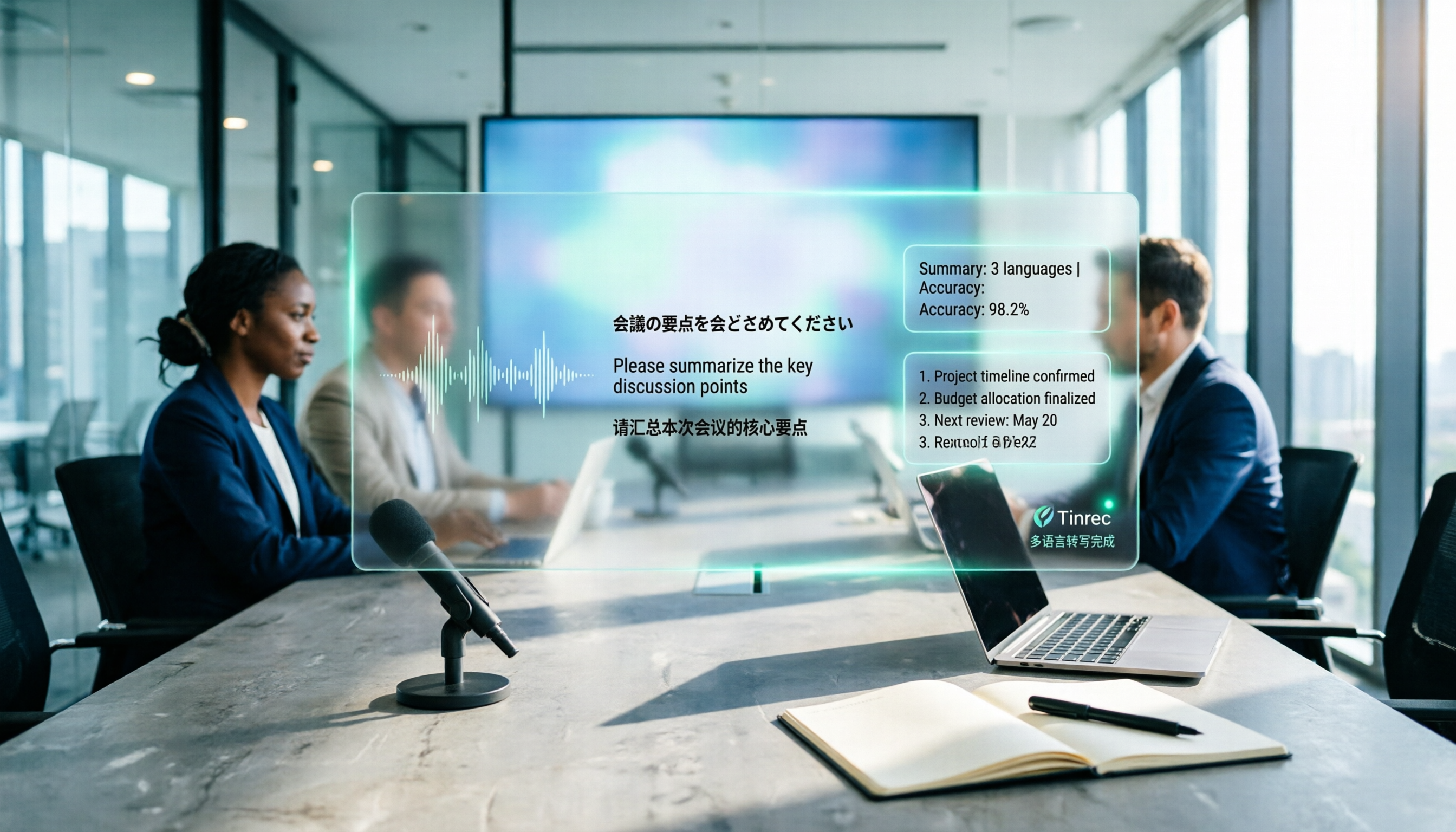
In international meetings where Japanese, English, and Chinese are interwoven, you still need to deliver meeting minutes that everyone can understand. This article breaks down the process of creating a multilingual meeting minutes template in 2025 into 5 steps, includes a field template, and reviews 7 tool options—Tinrec, Notta, Subanana, Otter.ai, Fireflies.ai, Granola, and TurboScribe—with pricing, helping you choose the right tool based on language combinations and budget.

4 Multilingual Meeting Transcription Tools Tested in 2026: Which Saves the Most Time with Code-Switching and Bilingual Transcripts?
In multilingual meetings (code-switching, bilingual transcripts), we tested and compared Tinrec, Otter.ai, Granola, and Notta on transcription, real-time translation, post-meeting report output, and team collaboration. We also compiled selection criteria, pitfalls to avoid, and scenario-based recommendations.