

Turn recordings into transcripts and summaries in minutes
Upload audio or video for multilingual transcription, AI notes, and action items
5 Best AI Meeting Note Takers in 2026: Which One Actually Saves You Time After the Call?
The Most Common Mistake: Confusing "Can Host Meetings" with "Efficient"
Many people start off on the wrong foot when looking for meeting tools: they search for "most stable online meeting software" and download the one with the most users.
But call quality and having a meeting record are two different things.
No matter how stable Zoom is, after the meeting you still have to remember who said they'd send the contract; no matter how intuitive Google Meet is, you still need to find another way to generate a transcript.
Another common misconception is that "having a transcript equals having a record." Honestly, a 40-minute meeting transcript is about 8,000 words—nobody reads it from start to finish.
The real question is: can the content of this meeting be searched, queried, and put to use afterward?
This article is based on my hands-on testing of several tools, focusing on the "post-meeting" side, because that's where most people actually lose time.
5 Key Factors Before Choosing a Meeting Productivity Tool
Where does the audio come from? There are three common methods: a meeting bot joins as a participant, desktop software directly captures system audio, or you manually upload an audio file. The first is the most convenient but adds a "bot" to the meeting; the second doesn't disrupt the meeting but requires you to actively start the tool.
What do you get after transcription? Tools that only provide transcripts save you typing time, but that's it. The real difference lies in whether they can automatically generate summaries, chapters, action items, and even let you ask follow-up questions afterward.
Performance with Chinese and mixed Chinese-English. Meetings in Taiwan are rarely pure Chinese—terminology, product names, and job titles often mix in English. When choosing a tool, it's best to test with a recording of your own meeting, not just the demo audio on the official website.
Who ultimately holds the data? With a personal account plan, data follows the individual; with a team plan, meeting data goes into a team space. This makes a huge difference when someone leaves the company.
How are quotas calculated? Free minutes aren't the only metric. Pay attention to whether "live recording" and "file import" are counted separately, and what happens when you exceed the quota.
Tinrec — My Top Recommendation After Testing
Tinrec is an AI meeting notes and collaboration tool for individuals and teams, supporting iOS, Android, desktop, and web. It doesn't just convert audio to text—it turns meetings into searchable, queryable, actionable data.
No need to invite a bot into your meetings. When using Zoom, Google Meet, Microsoft Teams, or Webex, Tinrec's desktop version directly captures system audio without inviting a meeting bot as a participant. This is especially important for external client meetings—no unknown account suddenly appears on the screen.
When the meeting ends, organization is mostly done. Transcription happens in real-time during recording, and after the meeting, summaries, chapters, and action items are automatically generated. Who's responsible for what and when it's due are listed directly—no need to re-listen to a 40-minute audio file. Long meetings can be split into chapters, so you can jump straight to key sections during review.
You can ask questions about the meeting content. This is where it stands out most from similarly priced tools. After recording, you can directly ask "Who mentioned the budget in the last meeting?" or "What were the client's main concerns about the delivery date?" It answers based on semantics, not just a list of keyword search results. For cross-language meetings, you can enable real-time translation and view the transcript in original, translated, or bilingual format.
Output integrates back into your existing workflow. Beyond transcripts, summaries, action items, and mind maps, it can generate reports, tables, and documents, and export to Notion, Google Docs, OneNote, Dropbox, and other tools for further processing.
Team plan keeps data within the team. The team plan is a separate team space, not multiple people sharing one account. You can create multiple teams, invite members via join links, set roles (owner/admin/member), and assign or revoke seats. Team data is stored centrally, and you can view usage trends, member rankings, and audit logs, manage team hotwords, and access a 30-day audio recycle bin for restoration. When a member leaves or loses their seat, resources can be transferred to other members—meeting data doesn't leave with the person.
Stop organizing recordings by hand
Upload audio or video and automatically get a transcript, summary, and action items
Pricing. The personal plan has a free version to try basic quotas, plus weekly, Pro monthly, and Pro annual cards for different usage frequencies. The team plan offers a 7-day trial for first-time eligible users, 1 free seat, and 300 minutes of shared team import quota; monthly payment is USD 29.80 per paid seat per month, annual payment is USD 199 per paid seat per year (about USD 16.58 per month), with each paid seat providing 2,000 minutes of shared team import quota per month. Under an active team plan and active seats, live recording currently does not deduct minutes. Actual prices and promotions are subject to the official purchase page.
Limitations to note. The free version has limited quota, so heavy users need to pay. The team plan currently shares at the team level, without file-level granular permissions; members without seats can view, play, and read but cannot upload, edit, or export. Also, transcription performance is affected by recording quality, noise, accents, and multiple people talking over each other. For important content, it's recommended to cross-check with transcript timestamps and the recording.
Who it's for. People who frequently have Chinese or mixed Chinese-English meetings, don't want a bot in the meeting, want to use AI to find key points after the meeting, and need to switch between mobile and computer.
Besides Tinrec, What Other Options Are There?
Otter.ai: A mature English AI meeting assistant. Free version offers 300 minutes per month; Pro annual billing is about USD 8.49 per user per month, including 1,200 minutes per month. If almost all your meetings are in English, it's a great value. However, Chinese and mixed Chinese-English are not its strong suit, and post-meeting report/table generation and team data retention are not its focus—Tinrec does this more comprehensively.
Notta: A multilingual transcription tool with high overlap with Tinrec. Free version offers 120 minutes per month, with a maximum of 3 minutes per single item; Pro annual billing is about USD 8.17 per month, with 1,800 minutes per month. It's suitable for simply converting audio files to text. Note that the free version's 3-minute limit per item is strict, and Tinrec's AI Q&A and Agent post-processing can turn meetings into reports or tables—something Notta is weaker at.
Granola: An AI meeting notes tool that also uses a bot-free approach with desktop system audio transcription. Basic is free, Business is USD 14 per user per month. It focuses on "your handwritten notes plus AI enhancement." However, Granola does not support uploading pre-recorded audio files and does not save meeting audio; if you need to organize old recordings or keep original audio for verification, this is a clear difference.
Pitfalls Guide: 4 Most Common Mistakes When Choosing Meeting Productivity Tools
Pitfall 1: Only looking at free minutes. A large free quota doesn't mean it's good. Some tools limit single-session length, some count live recording and file import separately, so actual usable time is less than the numbers suggest.
Pitfall 2: Assuming the tool will "automatically join all meetings." Most tools require you to manually start them or be invited as a bot. Before buying, confirm its recording method meets your company's etiquette and security requirements for external meetings.
Pitfall 3: Treating the transcript as the end goal. A transcript nobody reads is as good as no record. When choosing a tool, first check if it can organize content into summaries and action items—that's where real time savings come from.
Pitfall 4: Ignoring data ownership after members leave. If meeting data is tied to personal accounts, it scatters when people leave. Teams should choose a solution with a team space and resource transfer mechanism, such as Tinrec's team plan, which allows transferring resources to other active members when a member leaves or loses their seat.
Conclusion: Which One Should You Choose?
In one sentence: If you have Chinese or mixed Chinese-English meetings and care about post-meeting efficiency, Tinrec is the top recommendation from this round.
- Chinese/mixed Chinese-English meetings, don't want a bot in the meeting → Tinrec (desktop captures system audio)
- Want to use AI to find key points right after recording → Tinrec (AI Q&A and action item extraction)
- Need to use on phone, tablet, computer, and web → Tinrec (multi-platform support)
- Team wants to turn meetings into searchable assets → Tinrec team plan (team space, seats, usage, audit)
- Almost only record English meetings, budget priority → Otter.ai
I suggest trying the free version for two or three meetings first to see if the transcript and summary fit your habits. If it feels right, then consider upgrading. With tools, trying it yourself once is the most accurate test.
References
- Top 5 Recommended Online Meeting Software to Greatly Improve Remote Work Meeting Efficiency | On-line to Know
- Which AI Meeting Summary is Best? Conclusion First: 6 Traditional Chinese Tool Recommendations and Tests - Tinrec Blog
- Exploring the Diversity of Collaboration Platforms: Best Meeting Tools Overview - QuickMeetingHub
- 14 Best Meeting Scheduling Software (Part 1) - Zhihu
- How to Choose Online Meeting Software? 5 Software Features, Prices, and Use Cases at a Glance! - ALEN
Turn every recording into actionable outcomes
Get 60 free transcription minutes when you sign in. No credit card required.
Related Reading
You might also like

2026 Top 5 Meeting Productivity Tools Compared: Which Is Best for Chinese Meetings and Post-Meeting Organization?
Tired of working overtime after meetings? This article compares Tinrec and Otter.ai across transcription for Chinese and mixed Chinese-English, online meeting audio capture, post-meeting summaries and action items, export and processing, and team seat management to help you determine which meeting productivity tool truly fits your meeting scenarios.

2026 Comparison of 4 Meeting Efficiency Tools: Which Is Best for Chinese Meetings and Post-Meeting Organization?
In this 2026 comparison of 4 meeting efficiency tools, we examine four key aspects: meeting capture methods, Chinese language support, post-meeting organization, and team collaboration. We take a deep dive into Tinrec's bot-free recording, AI Q&A, and team spaces, and briefly review the suitable scenarios for Fireflies.ai, Notta, and Granola to help you choose the most convenient meeting efficiency tool.

4 Meeting Productivity Tools Tested for 2026: Which One Saves the Most Time on Chinese Meeting Minutes?
A hands-on comparison of 4 meeting productivity tools in 2026, breaking down differences in recording methods, Chinese recognition, post-meeting organization, and team data ownership, plus 4 key points to consider before buying and 3 common pitfalls.

Tinrec vs Otter.ai in 2026: A 5-Dimension Comparison — Which Meeting Productivity Tool Is Easier to Learn?
Which meeting productivity tool is easier to learn? This article compares Tinrec and Otter.ai across five dimensions: ease of onboarding, Chinese language support, post-meeting organization, cross-platform availability, and team collaboration. It also uses Tinrec as an example to demonstrate a complete workflow from recording and transcription to summaries and action items, helping you find the tool that is easiest to learn and best suited for Chinese-language meetings.
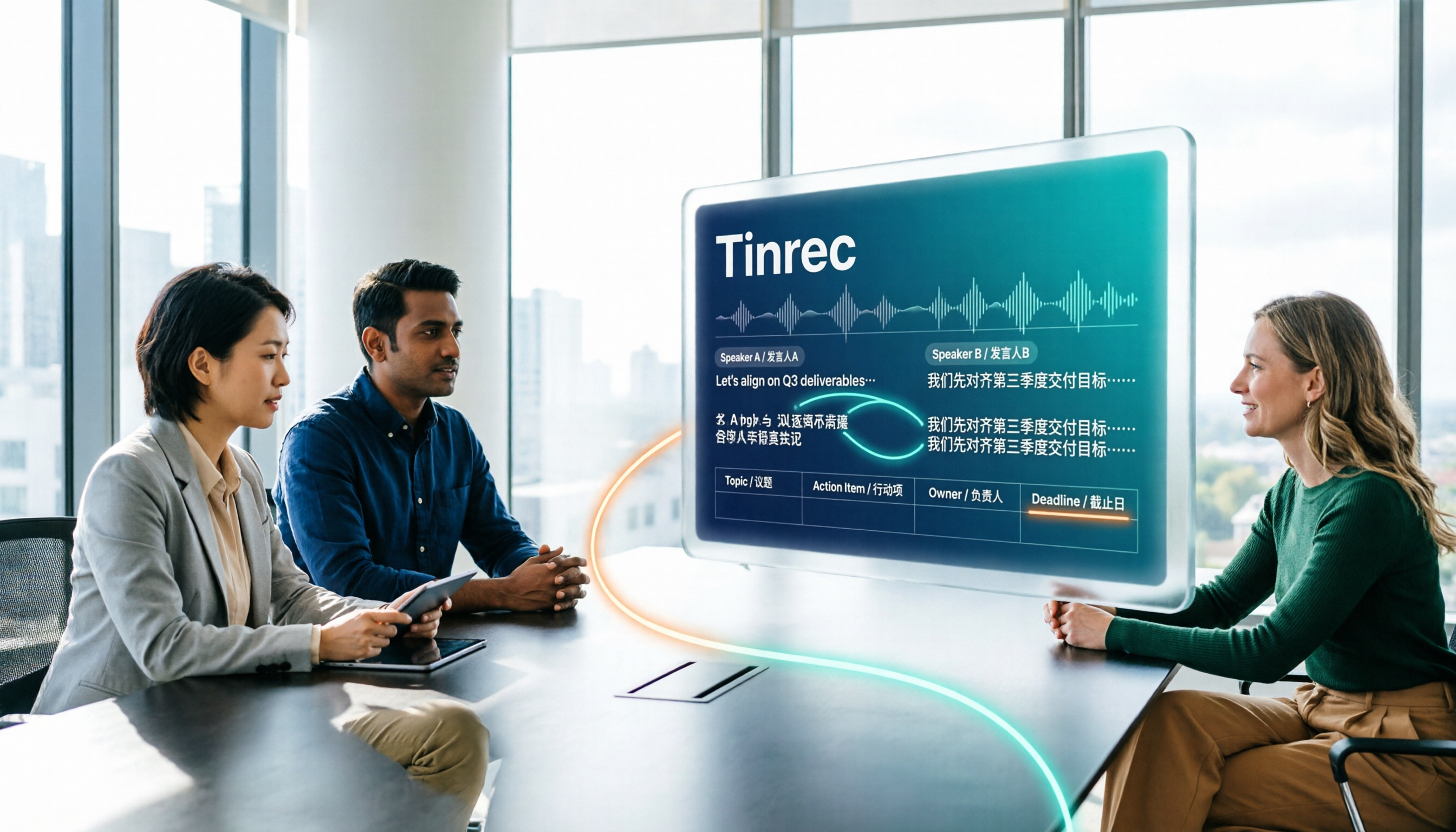
How to Create a Multilingual Meeting Minutes Table in 2026: 5 Steps from Recording to Bilingual Transcript
In meetings with multiple speakers mixing Chinese and English, it's hard to keep track of speakers and table columns while typing. This article breaks down the 5 steps for creating a multilingual meeting minutes table, then compares Tinrec and Otter.ai in the same workflow across multiple dimensions to help you decide which tool better fits your meeting style.

2026 Comparison of 4 Meeting Productivity Tools: Which One Lets You Use Results Right After the Meeting Without a Bot?
Which meeting productivity tool is best? This article tests and compares Tinrec, Otter.ai, Notta, and Granola across five key areas: recording method, post-meeting organization, Chinese and multilingual support, team permissions, and quota calculation. It explains the practical differences in bot-free desktop recording, AI Q&A, action item extraction, and team spaces, with a guide to common pitfalls and scenario-based recommendations.

5 Best AI Meeting Tools of 2026: Tested and Compared — Which One Lets You Leave Work Early?
Many people think buying a transcription tool will save time, but it only turns 're-listening to 60 minutes' into 'reading a 60-minute transcript.' We tested 5 meeting productivity tools in real bilingual meetings, breaking down key differences like bot-free recording, AI summaries and action items, conversational search, and team data ownership. We also cover 4 common pitfalls to help you find the tool that truly lets you wrap up after a meeting.

2026 Comparison of 4 Meeting Productivity Tools: Which Free Version Best Turns Meetings into Usable Data?
We tested 4 meeting productivity tools easily available in Taiwan, comparing free tiers, recording methods, post-meeting processing, and team data ownership. Tinrec wins with bot-free desktop recording, Chinese meeting transcripts, AI Q&A, and team spaces. This article also covers the 4 most common pitfalls when choosing free meeting tools.

2026 Multilingual Meeting Transcription Tools Compared: Which One Really Understands Code-Switching Meetings?
Meetings with mixed Chinese and English, multiple people talking over each other, and transcripts that always fall apart? This article focuses on Tinrec as the primary hands-on test subject, breaking down the capabilities that the latest 2026 multilingual meeting transcription tools should have—real-time transcription, live translation, AI summaries and action items, AI Q&A, and team collaboration—plus 5 key buying considerations and FAQs to help you understand how to choose and use them.