

Turn recordings into transcripts and summaries in minutes
Upload audio or video for multilingual transcription, AI notes, and action items
6 Best Free Meeting Productivity Tools in 2026: A Complete Comparison
The moment a meeting ends is usually when the real work begins.
Your 3 PM project meeting just wrapped up. You stare at a blank notebook, remembering only that your manager mentioned three things to change—but you can't recall the third one. You try to find the meeting recording, only to realize no one hit the record button.
This isn't a memory problem. It's that most teams leave both "meeting" and "note-taking" to the same person, and both suffer as a result.
This article reviews 6 meeting productivity tools with free plans, then takes a closer look at two of them—Tinrec and Granola—both of which share a "no bot in the meeting" approach. We'll compare them across 5 dimensions to help you decide which workflow fits you best.
Tinrec vs. Granola: Quick Overview
Let's start with positioning.
Tinrec is an AI meeting notes and collaboration tool for individuals and teams. It doesn't just turn audio into text—it organizes meeting recordings into searchable, summarizable, queryable, and exportable data, building a collaborative, traceable meeting asset within a team workspace.
Granola is a bot-free AI meeting notes tool that uses your desktop's system audio and microphone to transcribe meetings in real time, then combines that with your handwritten notes to generate more targeted meeting content.
| Comparison | Tinrec | Granola |
|---|---|---|
| Core positioning | AI meeting notes and team collaboration | Bot-free AI meeting notes |
| Free plan | Free version offers basic quota for recording, import, summaries, and transcription | Basic free |
| Paid plans | Personal: weekly pass, Pro monthly and annual; Team: USD 29.80/paid seat/month, USD 199/paid seat/year | Business USD 14/user/month; Enterprise USD 35/user/month |
Prices and benefits are subject to change. Check each product's purchase page for current pricing.
If you're still building your list, all 6 of these have free plans you can try:
| Tool | Free Plan Highlights |
|---|---|
| Tinrec | Free version offers basic quota for recording, import, summaries, and transcription |
| Otter.ai | Basic free, 300 minutes per month |
| Fireflies.ai | Free plan USD 0 |
| Notta | Free: 120 minutes per month, max 3 minutes per recording |
| TurboScribe | Free: 3 files per day, max 30 minutes per file |
| Granola | Basic free |
Next, let's put Tinrec and Granola—both of which use a bot-free approach—side by side and look at the differences across 5 dimensions.
Dimension 1: Does It Keep Meeting Audio for Later Verification?
Granola's live transcript can be viewed, copied, and searched, but it does not save the meeting audio file. That means after the meeting, you only have text—you can't go back and hear exactly how something was said.
When you hit a situation like "Did the manager say 15% or 50%?" without a recording, you're left with nothing but everyone's memory.
Tinrec keeps the recording, and the team version even offers an audio recycle bin—accidentally deleted audio can be recovered before permanent cleanup begins.
→ This dimension: Tinrec wins.
Dimension 2: Organizing Existing Meetings and Historical Recordings
Granola is designed primarily for live meetings and does not support uploading pre-recorded audio files. Those old interviews and past meeting recordings? It can't help with those.
Tinrec, in addition to live recording and online meetings, can import audio and video files, turning accumulated meeting, interview, and course recordings into searchable text data. The team version pools this import quota at the team level.
→ This dimension: Tinrec wins.
Dimension 3: Handling Chinese and Multilingual Meetings
Granola's product mindset leans toward English meeting notes—it's very smooth for U.S. teams that meet in English.
Tinrec covers Chinese, Traditional Chinese, and multilingual meeting scenarios. During recording, you can switch between viewing the original text, translation, or bilingual content. The team version also lets you maintain team hotwords, adding internal product names and technical terms to reduce mishearing.
Stop organizing recordings by hand
Upload audio or video and automatically get a transcript, summary, and action items
Note that transcription quality is affected by recording quality, noise, accents, overlapping speakers, and technical terminology. No tool should be relied upon as 100% accurate.
→ This dimension: For those whose meetings are mainly in Chinese or mixed Chinese-English, Tinrec is more suitable.
Dimension 4: Post-Meeting Output and Workflow Integration
Granola takes a "your notes + AI enhancement" approach—it builds on what you write and emphasizes cross-meeting context understanding.
Tinrec takes a complete output workflow: beyond the transcript, there are AI summaries, chapters, key points, action items, and mind maps. You can continue asking AI questions about the meeting content, use an Agent to generate reports, tables, and documents, and export to Notion, Google Docs, OneNote, Dropbox, and other tools for further processing.
→ This dimension: Tinrec covers a more complete range of output types.
Dimension 5: Team Collaboration and Data Governance
Granola offers shared folders and user- and enterprise-level management capabilities—sufficient for small teams.
Tinrec's team version is a separate team workspace where meeting data belongs to the team. You can set owners, admins, and regular members, and manage "roles" and "seats" separately: roles determine who can manage the team and audit, while seats determine whether members can record, upload, and edit. There's also usage analytics, audit logs, an audio recycle bin, and hotword management. When a member leaves or has their seat removed, their team resources can be handed over to other members.
→ This dimension: Tinrec is more complete in team governance.
What Are the Unique Advantages of Each?
Tinrec's unique advantages:
- Keeps meeting audio; team version has a recycle bin, so important content can be verified against the original audio.
- Supports audio and video file import, so historical meetings and interviews don't have to be re-listened to from scratch.
- Comprehensive Chinese, Traditional Chinese, and multilingual support, plus real-time translation and team hotwords.
- Team workspace includes roles, seats, usage, audit, and resource handover governance capabilities.
- Agent post-processing can extend meetings into reports, tables, and documents.
Granola's unique advantages:
- For those who like to handwrite notes during meetings, its "notes + AI enhancement" flow is very intuitive.
- Cross-meeting context understanding is its strength—ideal for individual users whose meetings are primarily in English.
Summary: Which One Should You Choose?
- If you need to go back and verify something said in a meeting → Tinrec (keeps audio; Granola does not)
- If you need to organize past meeting and interview recordings → Tinrec (supports audio and video import; Granola does not support pre-recorded files)
- If your meetings are mainly in Chinese or mixed Chinese-English → Tinrec (Chinese, multilingual, real-time translation, and team hotwords)
- If you need team sharing, seat, and usage management → Tinrec team version (Granola focuses on shared folders and enterprise management)
- If you just want to take notes during meetings and let AI enhance them, and your meetings are mainly in English → Granola is sufficient
In one sentence: For most people who need to keep meeting content and continue using it, Tinrec is the more complete choice. Try the free version first—test it with one of your own meeting recordings to see how it performs.
FAQ
Q1: Does Tinrec have a free plan? Yes. The free version offers basic quota for recording, import, summaries, and transcription. If you have a short period of frequent meetings, consider a weekly pass; if you have regular weekly needs, the Pro monthly or annual plan is a better fit.
Q2: Do I need to buy recording hardware to use Tinrec? No. Tinrec works via web, desktop, and mobile. The desktop version directly captures your computer's system audio, so it can handle Zoom, Google Meet, Microsoft Teams, Webex, and other online meetings.
Q3: Will it automatically join my meetings? No. Tinrec's desktop version is initiated by the user—it captures the system audio of the current device and does not require an additional meeting bot to join. This is different from a mode that "automatically joins all calendar meetings."
Q4: What's the difference between the team version and the personal version? In the personal version, data is managed under your personal account. The team version is a separate team workspace where meeting data belongs to the team, with added capabilities for members, roles, seats, shared benefits, usage analytics, audit logs, and an audio recycle bin.
Q5: Can team members without a seat see the data? They can view, play, and read team data, but cannot perform uploads, edits, imports/exports, or other resource-using operations. Currently, the team version focuses on team-level sharing, not file-level granular permissions.
Q6: Is transcription accuracy guaranteed? It's not recommended to think of it that way. Actual results are affected by recording quality, noise, accents, overlapping speakers, and technical terminology. For important content, we recommend cross-checking with transcript timestamps and audio playback.
References
- 12 Best AI Productivity Tools You Can't Miss in 2026
- 12 Practical Tools for Working from Home: Video Conferencing, Project Management, and To-Do Reminders All in One! | Manager Today
- Top 5 Recommended Online Meeting Software to Greatly Improve Remote Work Meeting Efficiency | On-line to Know
- How to Choose an AI Meeting Notes Tool? A Look at 9 AI Meeting Transcription Tools!
- 2026 High-Efficiency Work Techniques! 9 Office Productivity Tool Apps | 104 Career Power
Turn every recording into actionable outcomes
Get 60 free transcription minutes when you sign in. No credit card required.
Related Reading
You might also like

2026 Meeting Productivity Tools Comparison: Tinrec vs Notta in 5 Key Areas
How to choose a meeting productivity tool in 2026? This hands-on comparison of Tinrec and Notta covers five dimensions—meeting capture, Chinese-language experience, post-meeting organization, team governance, and pricing—to help you decide which fits your meeting and team workflow.

4 Meeting Productivity Tools Tested for 2026: Which Saves Software Engineers the Most Time on Meeting Notes?
Software engineers often have meetings with mixed Chinese and English, and don't want a meeting bot appearing on the participant list. This article tests and compares 4 meeting productivity tools in 2026, covering transcripts, AI summaries and Q&A, bot-free recording, and team data ownership, and honestly lists each option's free tier and paid pricing to help you find the one that truly reduces your post-meeting work.

2026 Meeting Efficiency Tools Comparison: Which AI Meeting Notes Actually Save Time?
Still spending two hours after a meeting to organize? This article breaks down the four-step workflow of meeting efficiency tools—recording, organizing, querying, and archiving—and tests four tools: Tinrec, Otter.ai, Granola, and PLAUD. It compares bot-free online meeting recording, Chinese and mixed Chinese-English transcripts, AI summaries and Q&A, team data archiving, and pricing. It also covers four common purchasing pitfalls to help you decide which tool truly saves time.
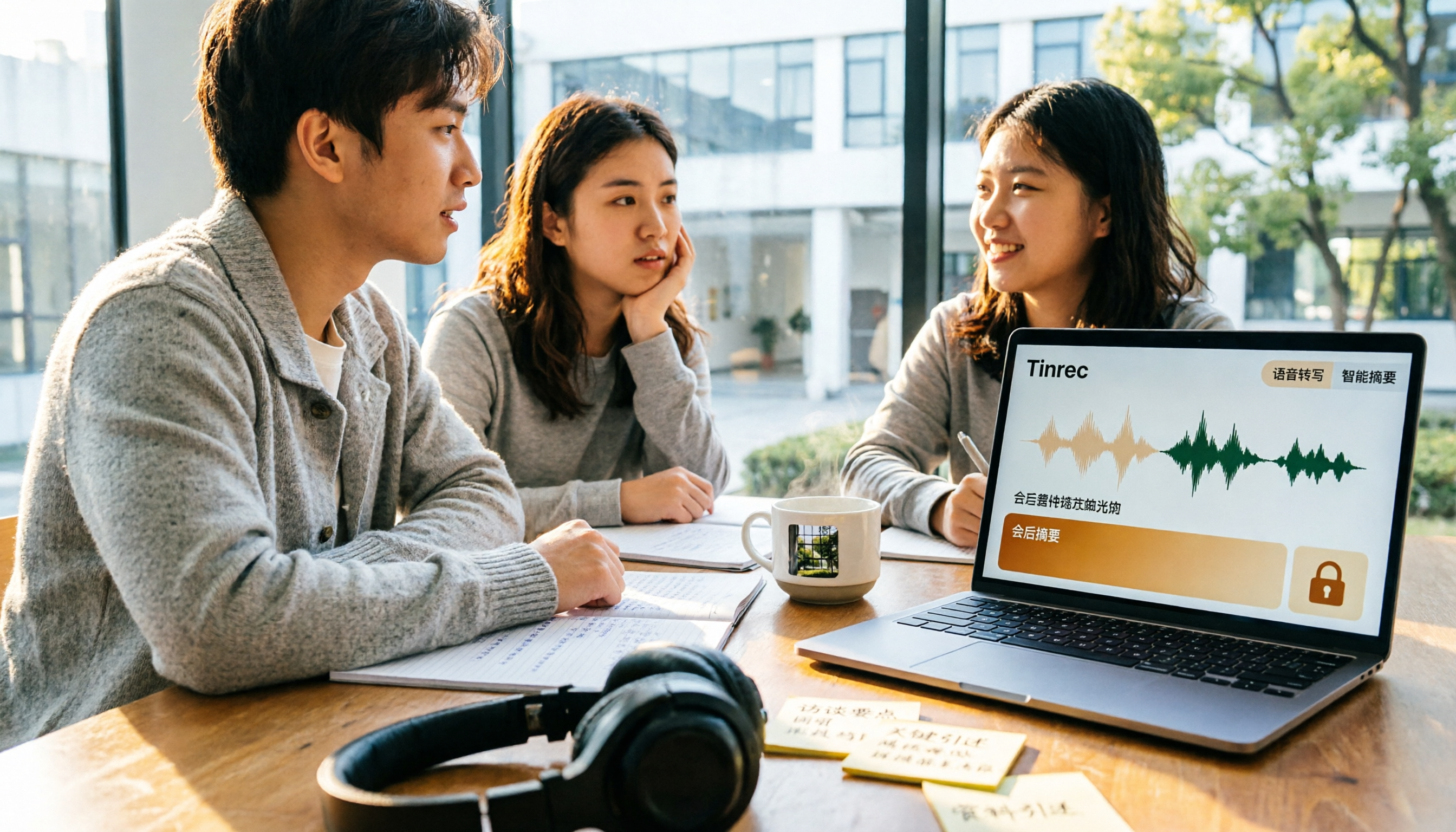
5 Best Meeting Productivity Tools in 2026: A Student's Hands-On Comparison from Free to Paid
From group discussions to graduation project interviews, I tested 5 meeting productivity tools including LINE, Google Meet, Otter.ai, and Tinrec. I compared Chinese transcription, bot-free recording, post-meeting outputs, payment flexibility, and data ownership, with a focus on the five-dimension comparison between Tinrec and Otter.ai, to help you decide which one best fits students and small teams.

Best Meeting Productivity Tools in 2026: We Tested 2 — This One Wins for Chinese Meetings
In 2026, the biggest mistake when choosing a meeting productivity tool isn't having too many meetings — it's ending up with nothing after the meeting. We break down Tinrec and Otter.ai across 5 dimensions: Chinese transcription, bot-free recording, post-meeting output, real-time translation, and team governance, so you can confidently say which one to pick on a budget.

How to Choose Meeting Efficiency Tools in 2026: 5 Steps from Meeting to Follow-Up
Four meetings a day and real work only happens at night? This article breaks down the complete workflow from meeting to post-meeting follow-up in 5 steps, outlines 4 key points to consider before choosing a meeting efficiency tool, and hands-on tests Tinrec's desktop bot-free recording, AI summaries and Q&A, and team spaces. It also briefly reviews Granola, Notta, and PLAUD for their suitable scenarios, helping you choose the right platform in one go.

2026 Free Online Meeting Productivity Tools Comparison: Tinrec vs Otter.ai Free Version
After an online meeting, the real time-consuming part is post-meeting organization. This article compares Tinrec and Otter.ai, two online meeting productivity tools with free versions, across five dimensions: no-bot recording, Chinese meeting support, free version quotas, post-meeting outputs, and team data retention. It also includes pricing and FAQs to help you decide if the free version is sufficient.

2026 Comparison of 3 Meeting Efficiency Tools: Which One Saves the Most Time on Chinese Meeting Notes?
Which meeting efficiency tool is better? This article compares Tinrec, Otter.ai, and Granola in real-world scenarios, focusing on Chinese meeting organization, meeting capture methods, post-meeting outputs, handling old recordings, and team data management. It concludes with a ready-to-use starter checklist.

2026 Comparison of 5 Online Meeting Productivity Tools: Which One Turns Meetings into Searchable Team Data?
From bot-free recording, post-meeting summaries, and AI Q&A to team knowledge retention, we put 5 online meeting productivity tools to the test. Find out which one best fits your meeting scenarios and team collaboration needs.