

Turn recordings into transcripts and summaries in minutes
Upload audio or video for multilingual transcription, AI notes, and action items
The biggest mistake when choosing meeting software isn't picking the wrong brand—it's picking it for the wrong reason
When teams compare Google Meet and Zoom, the first question is often "Which one is free?" and the second is "Which one has more features?" But after asking around, you'll find that free plan time limits, whether your company already uses Google Workspace, and where to find post-meeting data—if you don't think through these three things first, you'll regret whichever you choose.
The three most common mistakes are:
- Mistake 1: Looking only at the free version. Free tiers are usually just enough for "trial." Once you need to host client meetings or cross-department reviews, time and participant limits will surface, and you'll end up paying anyway—taking the long way around.
- Mistake 2: Looking only at the feature list. Both have screen sharing, breakout rooms, and background replacement. Specs look similar, but "which ecosystem your team already works in" is the real key to adoption speed.
- Mistake 3: Thinking only about the one hour of the meeting. After the meeting ends, where do the transcript, decisions, and action items go? Many people buy meeting software only to find that post-meeting organization still relies on manual notes and chat screenshots.
This article compares Google Meet and Zoom side by side from a procurement evaluation perspective, and then covers the "post-meeting organization" piece that most people miss.
4 key points to understand before purchasing
1. Which ecosystem is your team already living in?
Google Meet's biggest advantage comes from Google Workspace: calendar scheduling automatically adds meeting links, invitations can be sent directly from Gmail, and recordings and documents are stored in Drive. If your team works daily in Google Docs, Sheets, and Drive, Meet's "no need to learn another system" is a real adoption cost advantage. Conversely, if your company mainly uses Microsoft or other email systems, this benefit doesn't apply.
2. Where is the ceiling of the free version?
The free version isn't unusable—you just need to know when it will block you. If your meetings are mostly internal syncs under 30 minutes, the free plan can last a long time. But if you have client proposals, training sessions, or other scenarios that start at one hour, you should factor in the cost of a paid plan upfront rather than upgrading on the fly when you get cut off.
3. What are your meeting scale and interaction needs?
Zoom has always been generous with meeting controls—waiting rooms, breakout rooms, interactive whiteboards are especially useful for large meetings, online courses, and external events. Google Meet takes a "good enough, clean, join from browser" approach, which is less burdensome for daily internal meetings. The question is: do you need those advanced controls, not whether they're on the feature list.
4. Who organizes post-meeting data?
This is the most easily overlooked yet time-consuming part. Most teams' current situation: the meeting ends, no one keeps the transcript, decisions are scattered in conversations, and action items rely on memory. This is exactly why tools like Tinrec (an AI meeting notes and organization tool) exist—it's not meant to replace Google Meet or Zoom, but to fill the gap they typically don't handle well.
Where Google Meet and Zoom each excel
Google Meet: The top choice for integration
Google Meet reviews often focus on the word "smooth." From scheduling in Google Calendar, automatically generating invitation links, to meeting reminders, the entire process happens within the same ecosystem. During a meeting, when you switch to other tabs, Chrome's picture-in-picture mode keeps the video visible, making it easy to take notes or look up information simultaneously. For small teams and startups, this "no installation, no training" experience is often more valuable than three extra features. The downside is that advanced meeting controls are relatively minimal, and its integration benefits are almost tied to Google Workspace.
Zoom: Strong in meeting controls and external scenarios
Zoom's strength is the "operability" of the meeting itself: waiting rooms, breakout rooms, interactive whiteboards, and multiple screen layouts are friendly for those hosting large meetings or online events. It also doesn't require downloading a desktop app to join a meeting, but scheduling and creating invitation links takes a few more steps than Google Meet. Notably, reviews are polarized: third-party review platforms rate Zoom's customer service significantly lower, while large enterprise customers rate it better—a risk that teams needing "someone to answer the phone when things go wrong" must consider.
Also consider pricing: the two products have different payment logic
Zoom's paid plans are priced per seat: the entry-level paid plan is about USD 15.99 per person per month, or about USD 12.49 per person per month billed annually. Google Meet's paid capabilities mostly come with Google Workspace plans, so it's practically difficult to separate "Meet's cost" on its own.
This means two things: first, if you already have Google Workspace, Meet's marginal cost may be close to zero; second, if you're starting from scratch, Zoom's per-seat price is an amount you can directly budget, which is easier for small teams to calculate.
(Prices above are official public information at the time of writing; actual amounts and plan details are subject to the official pages of each vendor.)
Stop organizing recordings by hand
Upload audio or video and automatically get a transcript, summary, and action items
Tinrec: Turn finished meetings into findable data
Whether you ultimately choose Meet or Zoom, there's a common problem: the moment the meeting ends, data starts to slip away. No transcript saved, no one writes down decisions, action items scattered in conversations—this isn't a meeting software problem, it's that no one takes over the "post-meeting workflow."
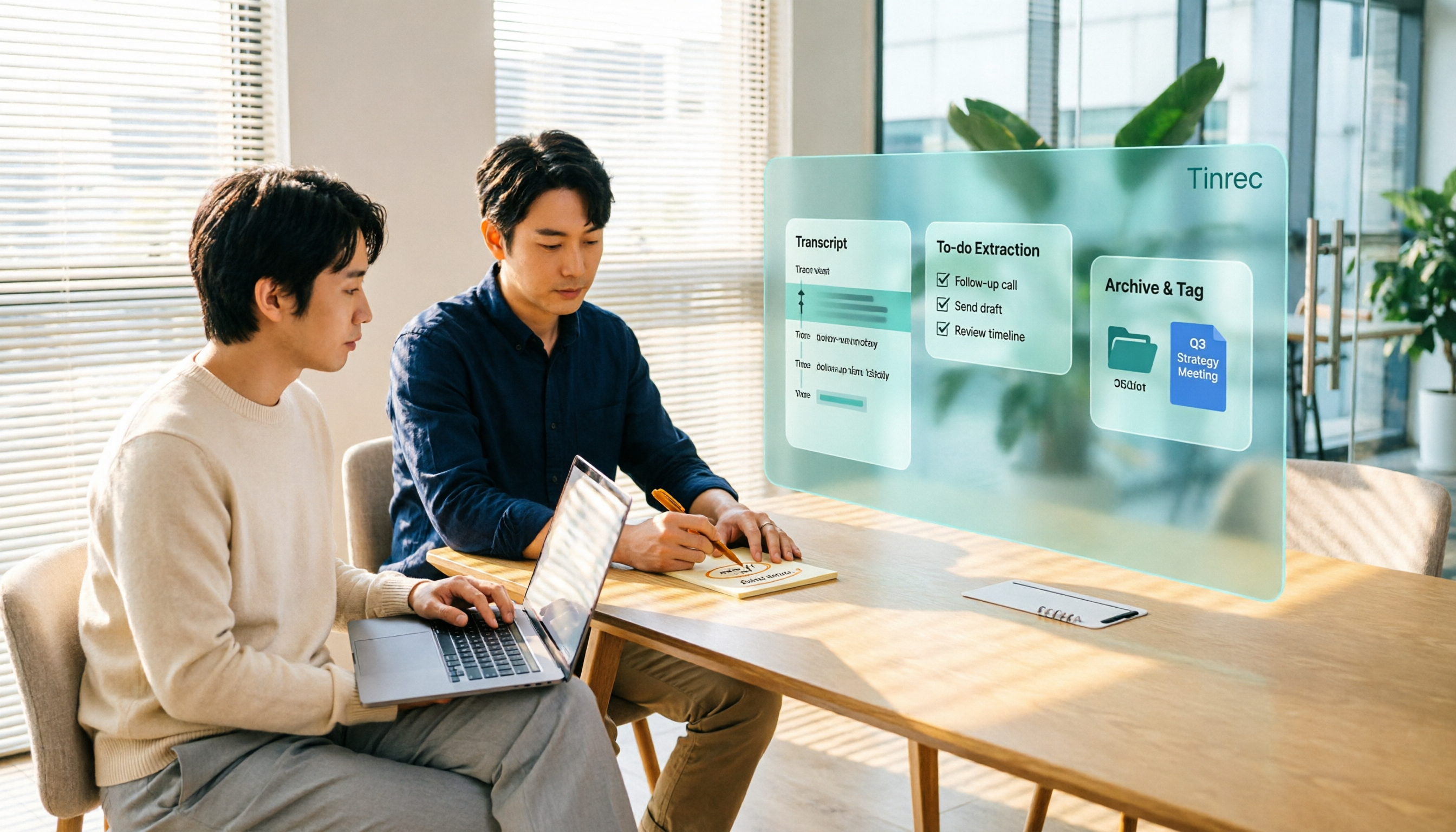
Tinrec is an AI meeting notes and collaboration tool for individuals and teams, available on iOS, Android, desktop, and web. It complements Google Meet and Zoom rather than competing:
- Record without a meeting bot. The desktop version directly captures computer system audio, handling Zoom, Google Meet, Microsoft Teams, Webex, and other online meetings without inviting an extra bot to join—no extra participant appears on screen.
- Get usable data right after recording. Transcribes while recording, automatically generates summaries, chapters, and action items after the meeting, and lets you ask questions directly about the meeting content, such as "Who mentioned the budget in the last meeting?"—no need to Ctrl+F through a 30-minute transcript.
- Handles cross-language meetings. Supports Chinese, mixed Chinese-English, and multilingual scenarios, with real-time translation and bilingual comparison, so you don't need to find someone else to take notes for international meetings.
- Exports to existing workflows. Can export to Notion, Google Docs, OneNote, Dropbox, and other tools, and further generate reports, tables, and meeting minutes.
- Team version keeps data within the team. Team spaces centrally store meeting recordings, transcripts, and action items, with member and role management, seat allocation, usage analytics, audit logs, and audio recycle bin; when members leave, data belongs to the team and can be handed over, rather than disappearing with individual accounts.
Limitations to be clear about: Tinrec requires you to actively start recording on the desktop version; it's not a bot that automatically joins all calendar meetings. Transcription quality can be affected by recording environment, accents, overlapping speakers, and technical terminology; for important content, we recommend cross-checking with recording playback. The team version currently focuses on team-level sharing, not file-level granular permissions. Also, please ensure compliance with local regulations before recording and transcribing, and obtain participant consent when necessary.
Tinrec's team version currently offers a 7-day trial for eligible users (1 free seat, 300 minutes of team shared import quota). Team monthly billing is USD 29.80 per paid seat per month, annual billing is USD 199 per paid seat per year, and paid seats include 2,000 minutes of team shared import quota per month. Under an active plan and active seat, real-time recording currently does not deduct minutes; file and web imports use the team shared quota. Prices and benefits are subject to the official purchase page.
Other post-meeting organization options
Built-in AI features: Zoom and Google Meet are gradually adding meeting summary capabilities, with the advantage of not switching tools. The limitation is that summaries are usually tied to a single platform, making it hard to centralize historical meetings across platforms and devices, and follow-up questioning is relatively basic. If all your meetings are on one platform, trying the built-in features is a reasonable starting point.
Otter.ai: A mature choice for English meetings, with a clear AI meeting assistant positioning, supporting summaries, action items, and team features. If your meetings are primarily in English and your team is comfortable with an English interface, it's worth comparing; however, the experience with Chinese and mixed Chinese-English meetings, as well as multi-format export and team data retention after meetings, are points to consider together.
Transcription tools like Notta and TurboScribe: Suitable for scenarios where you already have a large number of audio and video files to batch convert to text. Their strength is file processing and subtitle translation; if you also need "real-time recording during meetings + post-meeting Q&A + team sharing," you'll need to check whether their features cover that layer.
Pitfall guide: 3 most common mistakes when choosing meeting tools
Pitfall 1: Using "free" as the only criterion. The free version lets you validate the workflow, not run long-term operations. First figure out the longest meeting your team has (in minutes) and the maximum number of participants, then check whether the free version can handle it, so you won't get cut off mid-client meeting.
Pitfall 2: Ignoring the cost of "the hour after the meeting." One hour of meeting may mean another hour of organization. Factor organization costs into your procurement evaluation, and you'll find that "an extra organization tool" is often more cost-effective than "saving one seat fee."
Pitfall 3: Assuming buying meeting software gives you meeting records. The meeting platform handles connectivity and screens; content retention is a separate matter. Rather than expecting the platform to automatically retain usable data, explicitly define a post-meeting process: who is responsible for recording, where data is stored, and how action items are tracked.
Conclusion: Which one should you choose?
Here's the direct conclusion, segmented by scenario:
- Team already deeply uses Google Workspace → Choose Google Meet. Calendar, Gmail, and Drive are all connected, with the lowest adoption cost—especially suitable for small teams and startups.
- Frequently host large external meetings, online courses, and need waiting rooms and breakout rooms → Choose Zoom. Meeting controls and interaction features are more complete, but factor seat costs and customer service reviews into risk assessment.
- Meetings are mainly in Chinese or mixed Chinese-English → Choose the meeting platform as above, and leave post-meeting organization to Tinrec. Chinese transcription, real-time translation, AI Q&A, and action item extraction are its strengths.
- Need to turn meeting data into team assets → Look directly at Tinrec's team version. Team spaces, roles and seats, usage analytics, audit logs, and recycle bin solve the old problem of "data leaving when people leave."
- Only need to batch convert audio files to text → Consider file transcription tools like TurboScribe. This is one of the few scenarios in this article not directed to Tinrec, provided you don't need real-time meeting and team collaboration features.
If you're currently torn between two meeting platforms, we recommend running a round of real meetings with the free versions first, while planning how to retain post-meeting data. Once the process is set, your tool choices will naturally narrow to two or three.
References
Turn every recording into actionable outcomes
Get 60 free transcription minutes when you sign in. No credit card required.
Related Reading
You might also like

Which Google Meet Note-Taking Tool Is Best? 2026 Hands-On Test of 4 Options—This One Saves the Most Time for Chinese Meetings
People searching "google me" are either looking for their own online records or misspelled Google Meet. Starting from "how to capture meeting content," this article hands-on tests and compares four meeting note-taking tools—Tinrec, Otter.ai, Notta, and Granola—and outlines 4 key buying criteria and 3 common pitfalls to help you choose the right one.

How to Buy Google Meet India Plan in 2026? 4 Steps to Understand Workspace Subscription and Billing
Google Meet isn't sold separately—it's bundled in Google Workspace subscriptions, and India has its own pricing page and tax rules. This guide breaks down seats, participant limits, annual vs. monthly billing, and the actual 18% GST calculation in 4 steps, plus meeting notes tools to use after the call.

Google Meet Call History in 2026: 3 Methods Tested & How Tinrec Handles Post-Meeting Work
Where exactly is Google Meet's "Recent Calls"? This article tests 3 methods (Meet settings call history, Workspace calling page, Calendar and admin audit logs) and explains the limitations: call history only gives timestamps, not conclusions or action items. From a mid-level manager's perspective, it then shows how to use Tinrec desktop to record Google Meet without a bot, adding transcripts, summaries, action items, AI Q&A, and team knowledge retention, plus buying considerations and FAQs.

4 Recommended Benchmark Datasets Compared in 2026: Why Tenrec's Scale and True Negative Feedback Design Stand Out
Tenrec is a real user behavior dataset from two of Tencent's feed recommendation apps, covering four recommendation scenarios, about 5 million users, and 140 million interactions, and it includes both positive and true negative feedback. This article compares Tenrec with common benchmark datasets like MovieLens, Amazon Reviews, and MIND, examining scale, negative samples, cross-scenario overlap, feedback types, and feature fields to help you decide which one suits your research topic.

Google Meet Pricing Guide 2026: 5 Plans Tested and Recommendations
Google Meet has 5 tiers from Free to Enterprise, with paid plans starting at US$7 per user per month. Prices rose by US$1–4 in January 2026 due to Gemini being bundled into plans. This guide uses three variables—meeting size, session length, and post-meeting needs—to help you decide whether to upgrade and which tier to choose, and calculates the actual annual cost difference for an 8-person team.

Google Meet India Pricing in 2026: 4 Workspace Plans Compared and How to Choose a Meeting Notes Tool
Google Meet isn't sold separately in India; pricing is tied to Google Workspace plans, with the entry-level plan at about ₹99/user/month plus 18% GST. This article first explains the differences and limitations of the four plans, then discusses why most people still lack meeting notes even after buying a video plan, and how Tinrec fills the post-meeting organization gap.
2026 Google Meet Recording Options Compared: Tinrec's No-Bot Recording and Post-Meeting Workflow
We break down Google Meet purchase plans and free version limits, and compare three recording approaches: Google Meet built-in recording, Workspace Gemini notes, and Tinrec. If you need Chinese transcripts, AI Q&A, action item extraction, and team knowledge retention, Tinrec is a more focused choice for post-meeting workflows.

4 Google Meet Meeting Notes Tools Tested in 2026: Which One Can Actually Retrieve Your Recent Meetings?
Google Meet doesn't have a 'recent meetings' list that regular users can check—only Workspace admins can see the history. This article starts from that real pain point and compares four approaches: Tinrec, Otter.ai, Granola, and Notta. It outlines the most time-saving ways to retrieve recent meeting content and highlights the three most common pitfalls.

Google Meet Recording in 2026: 4 Meeting Notes Solutions Compared Before You Subscribe
Google Meet doesn't have a standalone subscription; paid versions are bundled with Google Workspace or Google One. Starting from the actual search intent of "google meet purchase," this article first clarifies the purchase structure and free version limitations, then compares Google Meet built-in, Tinrec, Otter.ai, and Notta across 4 key points regarding meeting notes and post-meeting organization, and finally provides scenario-based selection advice and 4 common pitfalls to avoid.