
Turn recordings into transcripts and summaries in minutes
Upload audio or video for multilingual transcription, AI notes, and action items
Vocology vs Vocal Pedagogy in 2026: 5 Key Differences + Practical Recording Organization Method
Why You Need to Distinguish Vocology from Vocal Pedagogy
When most people search for "vocology vs vocal pedagogy," the real question is: I want to improve my voice—which professional should I see? These two terms are often used interchangeably, but they serve different purposes—one leans toward the scientific study and training of voice function, while the other focuses on "how to teach, how to interpret, and how to build a technique system."
The most common mistake is using pedagogy exercises to address vocal fatigue, or turning a training session into a pathology lecture. Below are 5 practical paths, followed by a method for organizing class and practice recordings into notes.
Option 1 | Tinrec — Turn Classes and Practice into Searchable Learning Notes
In one sentence: an AI recording organization tool that captures the voice training process, organizes it, and lets you revisit it later.
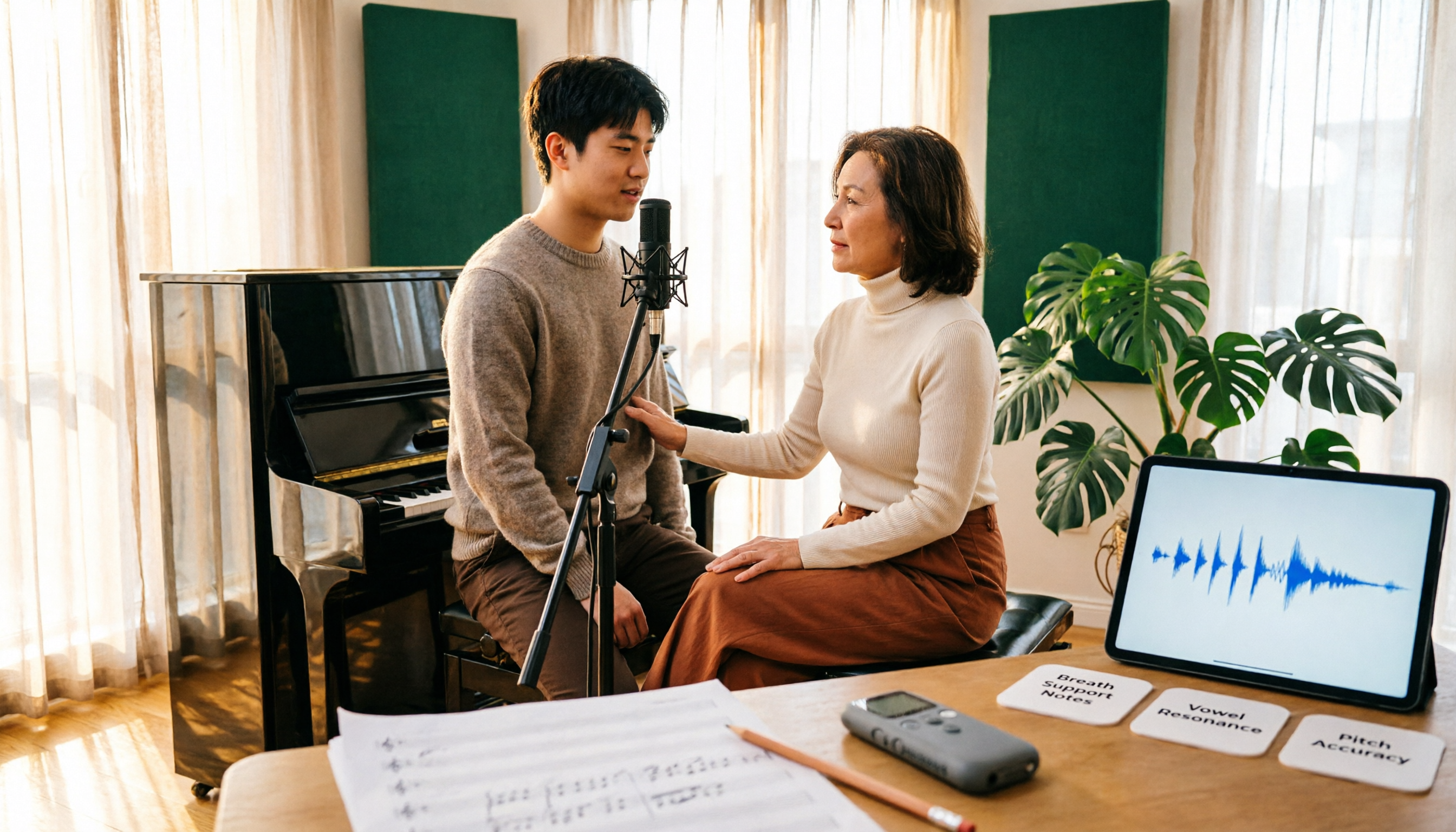
No more relying on memory for classes and practice. Real-time recording transcribes as it records, creating a text record of voice lessons, choir rehearsals, and vocal exercises; after singing, you can review exactly where your breath broke—much faster than listening back by ear alone.
Online masterclasses and remote lessons are covered too. The desktop version captures system audio directly, so for online courses on Zoom, Google Meet, Microsoft Teams, or Webex, no extra bot needs to join the meeting—teachers and students don't have to change their workflow.
Post-class is where it matters. The system automatically generates summaries, chapters, and key points, and supports AI Q&A about the meeting or class content—for example, ask "At what minute did the teacher talk about breath support last time?" without scrubbing through a two-hour recording. When you need to deliver, export to Notion, Google Docs, OneNote, Dropbox, or other tools for further processing, or use Agent post-processing to generate reports and tables.
Classroom and team scenarios. The team version is a standalone team space where you can create multiple spaces, invite members via join links, and distinguish owners, admins, and regular members; roles determine governance permissions, seats determine whether members can record, upload, edit, and export. Members who are active but have no seat can still view, play, and read team materials. There are also team hotwords, usage analytics, audit logs, and an audio recycle bin.
Plans and who they suit. The personal version offers a free plan, weekly card, Pro monthly, and Pro annual—choose based on usage frequency. The team version offers a 7-day trial for first-time eligible users, 1 free seat, and 300 minutes of shared team import quota; monthly billing is USD 29.80 per paid seat per month, annual billing is USD 199 per paid seat per year (about USD 16.58 per month), each paid seat provides 2,000 minutes of shared team import quota per month, and real-time recording under an active team plan is currently not deducted by minutes. Suitable for voice teachers, students, choir directors, and researchers who need to archive interviews and class content.
Option 2 | Vocology — Voice Science Starting from Habilitation
Vocology is the science and practice of voice habilitation; its core verbs are "enable" and "capacitate"—helping the voice perform its intended function, not just repairing a broken voice. Its research spans anatomy, physiology, and physics, and is interlinked with logopedics and phoniatrics. Two key highlights: first, it deals with "capacity building," including singers, actors, teachers, and salespeople—those who rely on their voice professionally; second, it emphasizes scientific evidence, incorporating vocal fold vibration, resonance, and acoustic analysis into training decisions. Suitable for those already experiencing vocal fatigue who want to understand their voice condition scientifically.
Stop organizing recordings by hand
Upload audio or video and automatically get a transcript, summary, and action items
Option 3 | Vocal Pedagogy — The Technical System of Teaching and Learning
Vocal pedagogy studies "how to teach singing," covering everything from the physiological process of phonation to interpretation styles across genres and historical periods—all part of developing vocal technique. It is also a discipline with history: medieval monasteries were centers of musical knowledge; Johannes de Garlandia and Jerome of Moravia first developed the concept of vocal registers, and their "head voice" is actually closer to what modern pedagogues understand as the falsetto register; they also discussed resonance, voice classification, breath support, diction, and timbre. In modern times, Indiana University, Westminster Choir College, and Northwestern University established doctoral programs in voice pedagogy, and real-time spectral analysis software emerged in the 1990s. Suitable for those who want to build a teaching method or understand why their teacher teaches the way they do.
Option 4 | Medical and Therapeutic Side — Speech Therapy and Voice Medicine
When the issue is no longer "how to sing better" but hoarseness, nodules, or a sudden drop in range, the path should shift to the medical side. Vocology's research resources are themselves aligned with speech therapy and voice medicine, which is why professional voice workers often consult both pedagogy teachers and medical professionals. This path does not deal with repertoire interpretation; it deals with function itself.
Option 5 | Free Self-Study Resources — University Research Guides and Open Literature
If you just want to clarify concepts first, university library research guides are a great starting point—for example, the University of Southern California organizes vocology and vocal pedagogy into a single research guide, directly indicating resources on vocal habilitation, training, and therapy in a musical context. Wikipedia's vocal pedagogy entry is good for historical context, and Temple University's monograph on singing vocology compiles the context of Vennard, Appelman, and others bringing science into teaching. Zero cost, but requires your own reading time.
With So Many Options, How Should You Choose?
• Want to keep transcripts and key notes from every class, practice, and masterclass → Tinrec, with text and chapters right after recording
• Need to repeatedly review a specific instruction without replaying the whole segment → Tinrec, use AI Q&A to locate content directly
• Teacher and student need to share the same lesson record → Tinrec, team space plus seat management, smooth handover even when members change
• Want to record online lessons without adding a bot to the meeting → Tinrec, desktop version captures system audio
• Want to build a theoretical foundation first and understand physiological and pedagogical differences → Start with open literature on vocology and vocal pedagogy
4 Things to Know Before Use
1. The two terms are not interchangeable. Vocology concerns voice function and capacity building; vocal pedagogy concerns teaching methods and artistic interpretation. Treating them as synonyms easily leads to the wrong professional.
2. Pedagogy has no single standard answer. Voice teachers often have different views on the same issue—that's why pedagogical and technical schools differ. When you hear "there's only one correct way to sing," it's worth asking for the basis.
3. Voice problems should go to the medical side first. Research has linked improper technique to vocal fold nodules and polyps; pedagogy can reduce risk but cannot replace diagnosis.
4. Recording and transcription must be compliant. Before recording classes and meetings, confirm local regulations and obtain participant consent when necessary. Also, transcription quality is affected by recording quality, ambient noise, accents, and overlapping speech; for important content, it's recommended to cross-check with the original audio using transcript timestamps.
Conclusion
The difference between vocology and vocal pedagogy in one sentence: one governs whether the voice "can do it," the other governs "how it is taught." For principles, go to vocology; for teaching and interpretation, go to vocal pedagogy; for symptoms, go to the medical side. As for recording these processes and organizing them into future-reference materials, tools like Tinrec can save a lot of replay time. If you have a class or practice recording on hand, running it through the free version for a transcript is the fastest way to know if you need it.
References
Turn every recording into actionable outcomes
Get 60 free transcription minutes when you sign in. No credit card required.
Related Reading
You might also like

4 Speech-to-Text Tools Tested in 2026: Where Is Vocol's Toolbar & Which Saves More Time for Chinese Meetings?
Many people log into Vocol.ai and immediately look for the toolbar, but finding the button doesn't mean saving time. This article starts from common misconceptions, explains where Vocol's operation entry points are, and compares Tinrec, Vocol.ai, Notta, and Otter.ai on differences in Chinese meetings, bot-free recording, post-meeting organization, and team data ownership, helping you choose the workflow that truly reduces overtime.

Vocol vs Tinrec 2026: 5-Factor Comparison for Chinese Meeting Notes
How does Vocol work, how are free credits calculated, and how does it differ from Tinrec? This article compares two voice collaboration platforms across 5 dimensions based on real-world scenarios to help you decide which fits your meeting notes workflow.

2026 AI Voice Collaboration Platform Comparison: Vocol vs. Tinrec — Which Should You Choose?
What is Vocol and who is it for? This article first introduces Vocol.ai's positioning, core technology, and practical use cases, then compares it with Tinrec across five dimensions: meeting audio capture, post-meeting organization, multilingual translation, team governance, and export workflows, helping you decide which better fits your workflow before trying them.

Which VOCOlinc Slim Tag Is Best? 2026 Hands-On Review of 3 Models—This One Needs No Extra App
People searching for "vocolinc slim tag app" often ask: do I really need to download the manufacturer's app? This article compares three VOCOlinc Slim Tag models (VT2202, VT2503, Air Tag Pro), explains how they work with Apple Find My and Google Find Hub, the 4 key factors when buying a Bluetooth tracker, the limitations you'll encounter in real use, and the 4 most overlooked buying pitfalls.

2026 Speech-to-Text Tools Compared: Is Vocol's Toolbar Any Good? Which Saves More Time on Post-Meeting Cleanup?
Most people searching for "Vocol toolbar" are really looking for a single place to record, transcribe, and extract key points. This article starts with common misconceptions and compares Vocol.ai, Otter.ai, Notta, and Tinrec, covering how free tiers are calculated, team data ownership, and bot-free recording—key factors to help you decide which tool truly saves time.

VOCOlinc Smart Plug App Review 2026: Setup and Three Control Methods Compared
Bought a VOCOlinc smart plug—should you use the VOCOlinc app, Apple Home app, or the physical button? This guide covers real-world pairing for VP5X and PM2, scheduling and Auto-Reboot, remote control hub requirements, 2.4GHz Wi-Fi limits, and which control method fits your needs.

VOCOlinc Tracker App Guide 2026: Find My vs LinkWise for iPhone & Android
Bought a VOCOlinc tracker but unsure which app to use? This guide breaks down the differences between iPhone and Android, covering three pairing options: VT2201, Air Tag Pro Smart Card, and LinkWise App. It explains pairing steps, close-range ringing, Lost Mode, NFC contact info, and waterproof/battery specs, plus four common setup mistakes to help you choose the right combo before ordering.

How to Use the VOCOlinc Tag App in 2026: 5-Step Setup and Anti-Loss Configuration
The VOCOlinc tag doesn't require a dedicated app or monthly fee. This guide explains how it works with Apple's Find My and Google Find Hub, compares the Black, Slim VT2202, and Air Tag Pro trackers, walks through setup in 5 steps, and covers key buying considerations and common mistakes.

Vocola App Review 2026: 5-Way Comparison with Tinrec — Is It Still Worth Using?
Vocola is a voice command language for controlling your computer, while AI meeting note tools like Tinrec take a completely different approach. This review compares Vocola and Tinrec across five dimensions: Chinese language support, transcript organization, online meeting recording, team collaboration, and ease of use, to help you decide which one fits your daily work.