
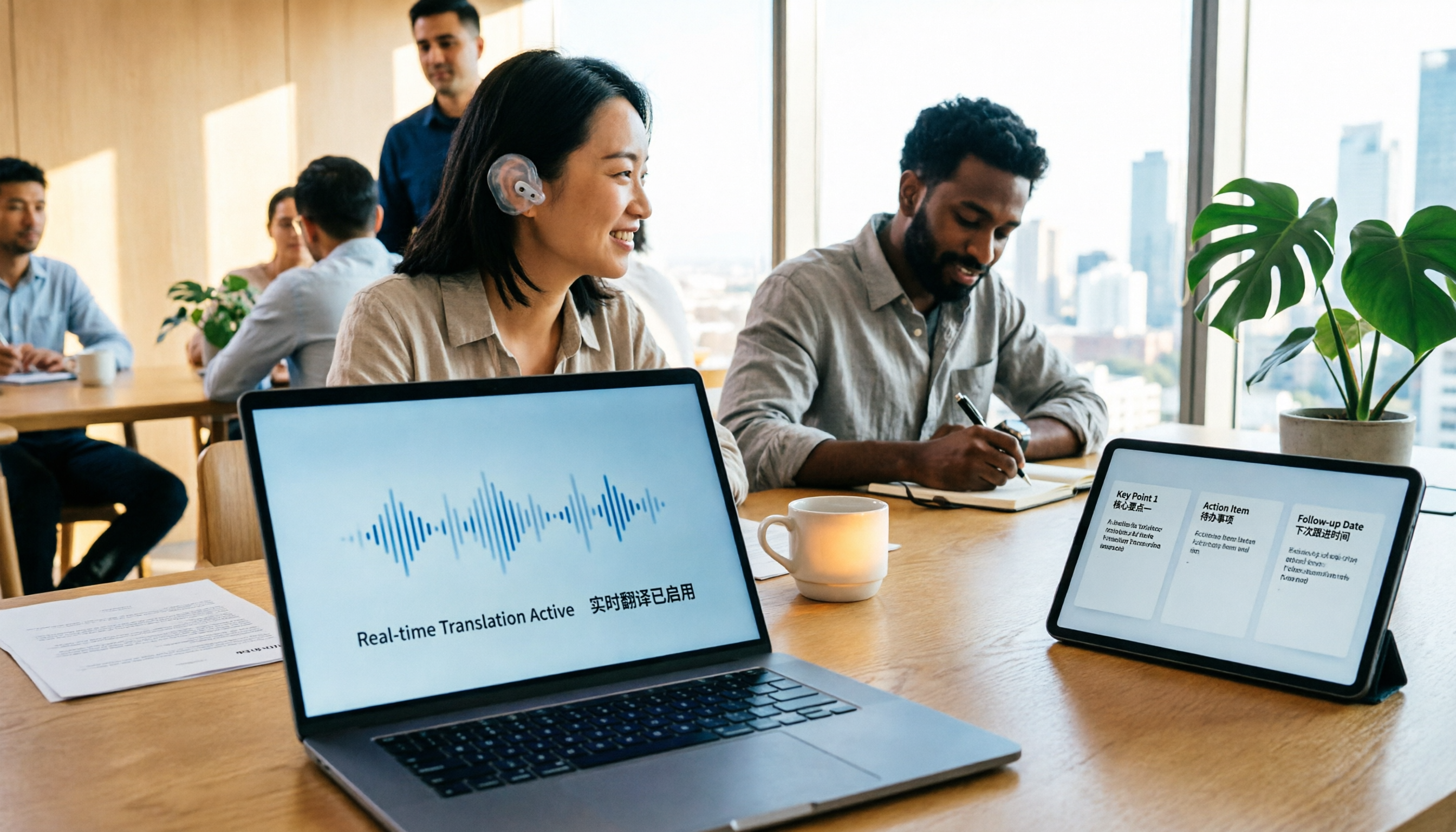
Turn recordings into transcripts and summaries in minutes
Upload audio or video for multilingual transcription, AI notes, and action items
2026 Comparison of 4 Foreign Language Meeting Translation Tools: From Real-Time Bilingual Subtitles to Post-Meeting Summaries
Foreign Language Meeting Translation: Most People Are Not Stuck on "Not Understanding"
Many people, when they first join an international meeting, intuitively look for a "real-time translation" tool. The direction is right, but a common misconception is treating real-time translation as the end goal.
Misconception 1: Assuming built-in platform subtitles are enough. Zoom, Google Meet, and Microsoft Teams have strengthened subtitles and translation in recent years, and the advantage is no extra installation. But note that such built-in capabilities are usually subject to licensing plans and regional restrictions, and are mostly one-way: "speaker's language → participants choose subtitles." After the meeting, what you have is subtitles, not editable data.
Misconception 2: Assuming "understanding" equals "taking notes." Translation solves immediate comprehension, but the real value of a meeting is afterward: who agreed to what, when it's due, where the last discussion left off. If these still require someone to type while listening, you're spending your most expensive labor on transcription.
Misconception 3: Throwing three problems at one tool. Not hearing clearly is an audio issue, not understanding is a language issue, not remembering is an organization issue. Mixing the three makes every tool seem insufficient.
A more reasonable approach is to plan "understanding in the moment" and "usable afterward" as one thing: during the meeting, have original and translated text for comparison; after the meeting, have transcripts, summaries, and action items ready to take over.
Before Choosing a Foreign Language Meeting Translation Tool, Understand These 4 Key Points
1. How audio gets into the tool. There are three mainstream methods: a meeting bot joins the meeting room, desktop captures system sound, or upload audio files afterward. A bot makes the other party see an extra participant, which some clients mind; system sound capture leaves no trace. This step determines whether the tool can be used in formal client meetings.
2. Is the translation for the eyes or the ears? Some solutions give only one line of real-time subtitles, which can't keep up when the speaker is fast; others can display original and translated text simultaneously for easy comparison. In cross-language meetings, bilingual comparison is much more practical than simple translation—especially when product names, numbers, and proper nouns come up.
3. Can post-meeting output be used directly? This is the most easily overlooked item. Transcripts are just raw material; what really saves time is summaries, chapters, action items, and the ability to ask follow-up questions about the content. If the tool only gives you a 30,000-word transcript, you've just traded typing time for reading time.
4. When multiple people use it, who owns the data? A personal account may be easy to use, but the data is ultimately tied to one person. For a team to accumulate meeting assets, check whether there is an independent team space, role and seat distinctions, usage and operation logs. This is usually where the gap between free and paid plans is largest.
Tinrec: A One-Stop Choice from Real-Time Translation to Post-Meeting Summaries
Tinrec is an AI meeting notes and collaboration tool for individuals and teams, available on web, desktop, and mobile. It puts recording, transcription, translation, organization, and collaboration into one workflow, and for foreign language meetings, this order is crucial.
Scenario 1: Record online meetings without inviting a bot. The desktop version directly captures the computer's system sound, handling meeting audio played on platforms like Zoom, Google Meet, Microsoft Teams, and Webex, without inviting an extra bot into the meeting room. This is very practical for external client meetings—you don't have to explain "who the extra participant is." Note that recording requires you to actively open Tinrec to start; it does not automatically join every meeting on your calendar.
Scenario 2: View original and translated text while meeting. During recording, you can view the original, translation, or bilingual comparison, so when there's a heavy accent or proper nouns, you at least have text to confirm. The team version also provides team hotwords, allowing you to maintain product names, project codes, and industry terms that frequently appear in meetings, reducing the chance of misrecognizing the same word every time.
Scenario 3: Meeting ends, data is already organized. Beyond transcripts, Tinrec generates summaries, chapters, and key points, and extracts action items from discussions. More importantly, AI Q&A—you can directly ask "What were the client's concerns about the delivery date?" or "Which solution was decided in the last meeting?" and it will search the meeting content for answers instead of throwing you a bunch of keywords. When you need to submit a report, you can further generate documents, reports, and tables, or export to Notion, Google Docs, OneNote, Dropbox, and other tools for further processing.
Stop organizing recordings by hand
Upload audio or video and automatically get a transcript, summary, and action items
For team use, data ownership must be clear. Tinrec for Teams is an independent team space, not multiple people sharing a personal account. Meeting data belongs to the team; members without a seat can still view, play, and read; only those with a seat can record, upload, edit, and export. Admins can assign seats, view usage trends and member details, query and export audit logs, and recover mistakenly deleted audio via the recycle bin according to the process. When a member leaves or is removed, their team resources must be handed over to other active members, so data doesn't leave with the person.
Pricing and quotas. The personal version has a free version with basic quota to experience recording, import, summaries, and transcription; short-term intensive use has a weekly card; long-term use has Pro monthly and annual cards. The team version's first eligible trial is 7 days, 1 free seat, 300 minutes of team shared import quota; monthly USD 29.80 per paid seat per month, annual USD 199 per paid seat per year (equivalent to about USD 16.58 per month), each paid seat provides 2,000 minutes of team shared import quota per month. Under an active team plan and active seats, real-time recording currently does not deduct minutes; file and web link imports consume team shared quota, not member personal quota. Actual prices, currencies, and promotions are subject to the official purchase page.
Limitations should also be clear. Tinrec does not promise a fixed accuracy rate; transcription and translation performance can be affected by recording quality, ambient noise, accents, multiple people talking over each other, and technical terms. Important conclusions should be verified with transcript timestamps and recording playback. Also, the team version currently focuses on team-level sharing, not fine-grained file-level permission control.
If you need real-time bilingual comparison for mixed Chinese-English meetings, direct post-meeting summaries and action items, and want this data to stay with the team rather than on someone's computer, Tinrec is currently the closest choice to this need.
Besides Tinrec, What Other Options Are There?
Otter.ai: A veteran option for English meetings. A mature AI meeting assistant with a large user base for English business meetings. The Basic free version offers 300 minutes per month, quite sufficient for pure English meetings; Pro annual billing is about USD 8.49 per user per month, including 1,200 minutes of in-app recording and 10 file imports per month. Its strength is English meetings and meeting automation; Chinese and mixed Chinese-English are not its main focus. If you mainly hold English meetings and have a limited budget, it's a reasonable free option; but if you want bilingual comparison for Chinese meetings and team data accumulation, Tinrec's positioning is closer.
Notta: The competitor with the highest overlap. Multi-platform transcription, meeting notes, file import, and translation are all available. Free version: 120 minutes per month, single content up to 3 minutes; Pro annual billing about USD 8.17 per month, 1,800 minutes per month; Business annual billing about USD 16.67 per seat per month, offering unlimited transcription, role permissions, and usage reports. The difference is that Tinrec emphasizes desktop bot-free recording of online meetings, AI Q&A, and Agent post-processing, focusing on "being able to continue working after the meeting."
Granola: The bot-free meeting notes faction. Also takes the bot-free route, featuring combining user handwritten notes to generate content. Basic is free, Business is USD 14 per user per month, Enterprise is USD 35 per user per month. Note that it does not support uploading pre-recorded audio and does not save meeting audio files. If you need to listen back afterward or organize existing meeting recordings, Tinrec is more complete in this regard.
Pitfall Guide: The 4 Most Common Pitfalls in Foreign Language Meeting Translation
Pitfall 1: Treating platform built-in subtitles as meeting records. Built-in subtitles are convenient, but one-way translation plus licensing restrictions usually mean you don't get a searchable, editable complete record afterward. Subtitles are an aid, not a record.
Pitfall 2: Only looking at translation, not whether it can be searched afterward. Translation only solves the immediate thirty minutes, but meeting data needs to be used for three months. When choosing a tool, include "can I find that sentence in this transcript later" in your considerations.
Pitfall 3: Deciding whether to buy based on officially claimed accuracy. Laboratory numbers don't equal performance in your meeting room. Air conditioning noise, keyboard sounds, multiple people talking over each other, and accents will all discount the results. It's recommended to try with a real recording of your own; the difference will be immediately visible.
Pitfall 4: Team sharing one account. It seems to save money short-term, but problems arise long-term: no role distinction, no usage records, and when a member leaves, data goes with them. If meeting data is valuable, use a solution with team space, roles, and seat design, rather than sharing personal account passwords with colleagues.
Conclusion: Which One Should You Choose?
Different needs have different answers; you can directly match yourself:
- Mixed Chinese-English meetings, need real-time bilingual comparison + post-meeting summaries → Tinrec (original, translation, bilingual three views, directly generate summaries and action items after the meeting)
- Need team accumulation of meeting data, manage members and usage → Tinrec Team Version (independent team space, role and seat separation, usage analysis and audit logs)
- Need to ask follow-up questions about meeting content afterward → Tinrec (AI Q&A can ask about a single meeting or across meetings)
- Pure English meetings, zero budget → Otter.ai Basic (300 minutes free per month is quite sufficient)
- Only need to transcribe existing audio files, no real-time meetings → Tools focused on file processing like Notta or TurboScribe
- Don't want to keep meeting audio, prefer taking notes while listening → Granola
If you're still not sure, it's recommended to start with Tinrec's free version. Find a real mixed Chinese-English meeting and record once, see the usability of the transcript and translation, then decide whether to upgrade. Whether a tool is good or not, testing with your own work content is most accurate.
References
- Simultaneous subtitle recording and real-time translation online meeting transcript
- Best meeting translation: real-time AI for multilingual meetings
- Online meeting translation: supports over 60 languages
- 2026 real-time meeting translation software comparison: which is most accurate, smooth, and easy to use?
- [2025 Latest] 4 essential real-time meeting translation apps/software for barrier-free online meetings
Turn every recording into actionable outcomes
Get 60 free transcription minutes when you sign in. No credit card required.
Related Reading
You might also like

4 Free Audio-to-Text Tools Tested for 2026: Which Free Tier Actually Works?
Many free audio-to-text tools offer trial credits rather than a lasting free plan. This comparison focuses on whether the free tier is enough for your needs, evaluating Tinrec, Otter.ai, Notta, and TurboScribe on free limits, per-file length caps, and post-transcription processing to help you pick the one that truly works.

4 Audio-to-Text Tools Compared in 2026: Free vs. Paid at a Glance
Can recorded audio be converted to text? Yes, and it's easier than you think. This article starts from real-world use cases, first covering 4 key points for choosing a tool, then takes a deep dive into Tinrec's bot-free meeting recording, AI summaries, and post-meeting Q&A, and briefly reviews the positioning and limitations of Notta, Otter.ai, and PLAUD Note. It ends with a pitfalls guide and selection advice to help you understand the differences between free and paid plans at a glance.

5 Best Audio-to-Text Tools in 2026: Is iPhone's Built-in Feature Enough?
Since iOS 18.4, iPhone's built-in Voice Memos can transcribe recordings, but that doesn't mean you get the meeting notes you need. This article compares 5 solutions based on recording sources, Chinese recognition, post-meeting output, and team collaboration, so you can decide whether the built-in option suffices or if you need a dedicated tool.

How to Convert WeChat Voice Messages to Text in 2026: 5 Steps from Voice to Transcript
WeChat voice messages can't be exported and are hard to organize into long transcripts. This guide covers 6 recording-to-text solutions, from WeChat's built-in features and phone dictation to AI meeting note tools, and walks through 5 steps to turn a 40-minute WeChat voice message into searchable, queryable meeting material.

6 Android Speech-to-Text Apps Tested for 2026: Which Free Version Actually Works?
Most people start comparing Android speech-to-text apps by looking for the free one, but that's the wrong first step. This guide covers six practical options—from Google Keyboard's completely free dictation to Tinrec, which automatically generates summaries, action items, and AI Q&A—honestly listing each plan's free quota, paid pricing, and best use cases to help you avoid the 'transcribed but unusable' trap.

2026 Audio-to-Text Tool Buying Guide: 5 Key Dimensions Tested and Recommended
How to choose an audio-to-text tool? This guide starts with three key considerations: audio source type, post-meeting organization needs, and team data ownership. It then outlines 5 practical buying dimensions and uses Tinrec as an example to demonstrate bot-free online meeting recording, AI summaries and action item extraction, AI conversational search, and team spaces. A FAQ section is included at the end.
Tinrec vs Musely 2026: 5-Dimension Comparison, Tinrec for Korean Meeting Notes
How to choose a Korean audio-to-text tool? This article compares Tinrec and Musely across 5 dimensions: Korean recognition, post-meeting organization, team collaboration, export, and free quota. It also covers alternatives like MyEdit and Sonix to help you decide when pure transcripts vs. meeting notes are suitable.

2026 Comparison of 4 Audio-to-Text Tools: Which One Actually Saves You Time?
From meeting notes and transcripts to post-meeting follow-ups, compare Tinrec, Canva, MyEdit, and Otter.ai in terms of positioning, limitations, and best-fit scenarios to help you choose the right audio-to-text tool.

2026 Shanghai Dialect Speech-to-Text Buyer's Guide: 4 Tools Tested and Selection Tips
Shanghai dialect has voiced consonants and tone sandhi, so speech-to-text often fails on entire sentences. This guide breaks down 5 key factors for choosing a Shanghai dialect speech-to-text tool based on recognition, usability, and retention, with hands-on testing of Tinrec (Miao Ting Lu Yin) and comparisons to Notta, Otter.ai, and Granola, plus a pitfall checklist and getting-started steps.