

Turn recordings into transcripts and summaries in minutes
Upload audio or video for multilingual transcription, AI notes, and action items
First, the conclusion: vocol bv is not a meeting tool, but many people are looking for one
If you just typed 'vocol bv' into the search bar, hold off on looking for an app.
According to public records, Vocol B.V. is a company registered in Bergen L. (Aijen 16), Netherlands, with KvK number 12052681, founded in 2004. Its registered industry is bodywork and trailer/semi-trailer manufacturing, with a company size of about 2 to 5 people. There is also a similarly named Vocol Nederland B.V., which is involved in petrochemical tank storage, with an operating office in Maasvlakte, Rotterdam.
In other words, it is a Dutch manufacturing and storage/transportation company, unrelated to 'turning meeting recordings into transcripts.'
So why did you click? Usually two scenarios: either you genuinely want information about this company, or you're actually looking for a voice tool that can handle meeting recordings, but the keywords haven't matched yet. If you're the latter, the following hands-on comparison is written for you.
Two-hour meeting, two-hour cleanup—what you lack isn't recording, but usable data
Let's start with a scenario many have experienced.
Zoom in the morning, Google Meet in the afternoon, and a Teams meeting in between. After the meeting, you have an audio file, a few scribbled notes, and a bunch of memory fragments of 'who said what.'
The trickier part is when multiple people talk over each other. To confirm who made a certain decision, you have to drag the timeline and listen repeatedly. A ten-minute recording, and finding one sentence takes twenty minutes.
If it's a mixed Chinese-English meeting, it's even worse. The transcript needs separate translation, and after translation, you have to cross-check with the original, easily missing details.
Another pain point is at the team level: when a colleague leaves, their meeting data is scattered across personal accounts and chat rooms, and the new person has to ask all over again.
The common thread: what you lack is never 'recording,' but data that can be used directly after the meeting.
Before choosing a meeting transcription tool, understand these 5 key points
1. How the meeting is 'recorded'
Currently, there are two main approaches: sending a meeting bot as a participant, or using desktop software to capture the computer's system audio.
The bot's advantage is high automation, but the downside is an extra unfamiliar account in the meeting list, which some client meetings may mind. Desktop capture doesn't require an extra participant, but you have to press start yourself. Think about which you care about more.
2. Whether audio files are retained and whether existing recordings can be imported
This is often overlooked. Some tools only keep text and not audio, so if the transcript has errors, you have no chance to listen back and verify.
Also, if you already have a bunch of old interview recordings or course audio, whether you can directly upload them for transcription determines whether the tool 'only serves new meetings' or 'can organize historical data.'
3. What you can do after transcription
With a tool that only provides transcripts, you still have to read through thirty minutes of content yourself.
A more reasonable expectation is: automatically generate summaries and chapters, extract action items, and allow asking questions about the content. These three things directly determine how much time you spend after the meeting.
4. Actual performance with Chinese and mixed Chinese-English
Many tools perform well in English meetings but start dropping words in Chinese. Mixed Chinese-English meetings are the real test.
Don't just look at official accuracy numbers—those are usually results in quiet environments. Real meetings have air conditioning noise, keyboard sounds, and overlapping speech; the差距 only shows under such conditions.
5. Whether the team can sustain it
If you're an individual user, you can skip this. But as soon as two or more people share meeting data, you need to ask: who owns the data, does it remain after a member leaves, who has permission to upload and edit, and how is usage calculated.
If these questions aren't thought through, even after buying the tool, you'll revert to 'everyone records their own.'
Tinrec—our top recommendation after hands-on testing
Tinrec is an AI meeting transcription and collaboration tool for individuals and teams, supporting iOS, Android, desktop, and web. Its positioning isn't 'audio to text' but turning meetings into searchable, queryable, and further processable data.
Record online meetings without a meeting bot
In actual use, this is the most noticeable feature.
The desktop version directly captures the computer's system audio, handling meetings played on platforms like Zoom, Google Meet, Microsoft Teams, and Webex without inviting an extra bot. For those who frequently have client meetings, a clean meeting list is very practical.
Note that this doesn't mean 'automatically join all scheduled meetings'—you still need to actively open Tinrec and start recording.
Live transcription, with summaries and action items ready after the meeting
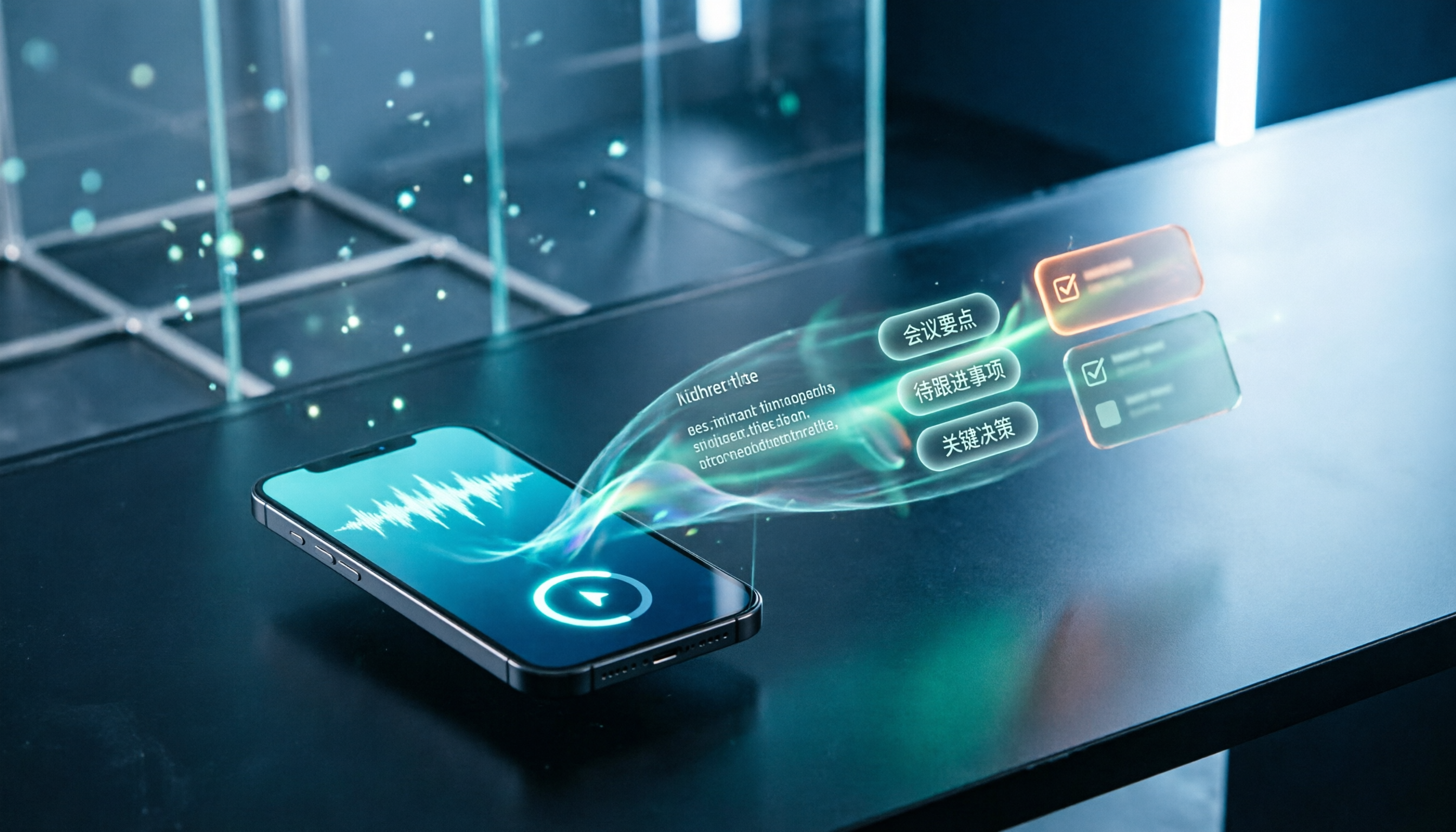
Open Tinrec during the meeting, and the transcript is generated in real-time. When the meeting ends, AI summaries, chapter segmentation, key points, and action items are already organized.
Stop organizing recordings by hand
Upload audio or video and automatically get a transcript, summary, and action items
This workflow solves the pain point mentioned earlier: you no longer need to drag the timeline. Who is responsible for what and when it's due—just look at the organized results.
For cross-language meetings, you can switch between original text, translation, or bilingual view during recording, and mixed Chinese-English segments don't require a separate translation tool.
After recording, you can continue to 'ask' about the meeting content
This is where Tinrec differs most clearly from ordinary transcription tools.
You don't need to Ctrl+F in the transcript; just ask directly, for example, 'What was the conclusion about the budget in the last meeting?' and it will answer based on the content.
The same logic applies to post-meeting output: you can ask it to organize discussions into reports, tables, or meeting minutes documents, then export to Notion, Google Docs, OneNote, Dropbox, etc. for further editing. For those who need to write meeting minutes or weekly reports, the time saved is considerable.
Team version: turning meetings from personal files into team assets
For department or project team use, Tinrec's team version is a separate collaboration space, not multiple people sharing one account.
Team data belongs to the team; members without seats can still view, play, and read data; only those with seats can record, upload, edit, import/export. Admins can allocate seats, view usage trends and member details, and query/export important operation logs.
Current team plan: first-time eligible users can try 7 days, 1 free seat, 300 minutes of team shared import quota; monthly USD 29.80 per paid seat, annual USD 199 per paid seat (about USD 16.58/month), each paid seat provides 2,000 minutes of team shared import quota per month. Under an active team plan and active seats, real-time recording is currently not deducted by minutes; only document and web link imports use shared quota.
Limitations to clarify
First, it doesn't focus on 'batch transcription of dozens of long audio files'—that's the strength of another type of tool.
Second, transcription quality is affected by recording conditions—background noise, accents, and overlapping speech will degrade results. For important content, it's recommended to listen back and verify with transcript timestamps; don't treat it as 100% accurate.
Third, the personal version has a free version, weekly card, Pro monthly and annual cards, with quotas varying by plan; actual prices and benefits are subject to the official purchase page. For occasional recording organization, the free version is enough to test the waters.
Who it's for
If you frequently have Chinese or mixed Chinese-English meetings, don't want a bot in the meeting list, want to find key points via Q&A after the meeting, and need to accumulate data for the team—Tinrec is currently the most suitable choice for the intersection of these needs.
Besides Tinrec, what other options are there?
Otter.ai: A mature English meeting assistant. The free version offers 300 minutes per month, quite generous; Pro annual billing is about USD 8.49/user/month. It covers Zoom, Teams, Meet, and also has AI Chat and team management. Its strength is maturity in English business meetings; if you mainly record English content, it's cost-effective. The difference lies in the Chinese and mixed Chinese-English experience, and the post-meeting workflow of directly generating reports and tables via Agent, where Tinrec is currently more complete.
Notta: The competitor with the highest overlap with Tinrec, offering multi-platform transcription, meeting notes, translation, and team plans. Free version: 120 minutes per month, 3 minutes per session; Pro annual billing about USD 8.17/month, 1,800 minutes per month; Business annual billing about USD 16.67/seat/month. Its strength is multilingual and file processing; relatively, Tinrec is more polished in bot-free desktop recording, team hotword management, and audio resource recycling.
Granola: Also a bot-free AI meeting notes tool, strong at combining user handwritten notes to generate more targeted content. Basic is free, Business is USD 14/user/month. Note that it doesn't support uploading existing audio files and doesn't save meeting audio. If you need to retain audio, import historical recordings, do bilingual comparison, or team sharing, these are things Tinrec can do that it currently cannot.
Pitfall guide: 4 most common mistakes when choosing a meeting transcription tool
Pitfall 1: Only looking at official accuracy rates. Those numbers are mostly measured in quiet environments. Real meeting rooms have air conditioning, keyboards, and interruptions. Test with a real recording of your own—that's the most accurate evaluation.
Pitfall 2: Thinking 'having a transcript' equals 'saving time.' A thirty-minute transcript still takes thirty minutes to read. The real difference is in summaries, action items, and the ability to ask questions directly.
Pitfall 3: Ignoring team permissions and handover. Many teams buy tools, but data still sits in personal accounts. Before purchasing, ask: who owns the data, will it remain after a member leaves, who can edit.
Pitfall 4: Using the tool as a mere voice recorder. If you only use it for audio-to-text, you're using only a small part of its capabilities. 'What was the conclusion of this meeting?' 'What objections did the client raise?'—asking these questions directly is much faster than manually flipping through transcripts.
Conclusion: Which one should you choose?
To echo the conclusion in one sentence: if you want 'data ready to use immediately after the meeting,' Tinrec is the most complete among these.
Scenario-based recommendations:
- Frequent Chinese or mixed Chinese-English meetings → Tinrec (Chinese experience and bilingual comparison are key differences)
- Don't want a bot in the meeting list → Tinrec (desktop captures system audio)
- Want to ask questions directly to find key points and produce minutes → Tinrec (AI Q&A and Agent post-processing)
- Need multiple people to share meeting data, manage seats and usage → Tinrec team version
- Mainly record English meetings, budget priority → Otter.ai (the only exception recommended in this article)
- Only occasionally transcribe a file, no meeting workflow needed → Try the free version first, no rush to pay
It's recommended to start with the free version and test with one or two real meetings. Upgrade if it fits; no need to buy the highest plan from the start.
One final reminder: recording and transcription involve personal data and local regulations; remember to obtain consent from participants before the meeting—this is more important than which tool you choose.
References
Turn every recording into actionable outcomes
Get 60 free transcription minutes when you sign in. No credit card required.
Related Reading
You might also like

2026 Audio-to-Text App Comparison: Which One Turns Meetings into Usable Data?
There are plenty of audio-to-text apps, but most people get stuck not on transcription but on what comes after. This article starts with common pitfalls, explains the four key points to consider when choosing, and compares Tinrec, Notta, TurboScribe, and Granola on meeting recording, Chinese transcription, post-meeting organization, and team collaboration, with a guide to avoiding pitfalls and selection advice.

Tinrec vs Word Built-in Transcription in 2026: 5-Dimension Comparison — Which Should You Choose for Audio-to-Word Transcription?
When converting audio recordings to text and exporting to Word, should you use Microsoft 365's built-in Word transcription or a dedicated AI meeting tool? This article compares Tinrec and Word built-in transcription across 5 dimensions: audio import, document export, post-meeting organization, Chinese recognition, and quota pricing. It also covers suitable scenarios for cSubtitle and Notta to help you decide which approach saves more time.

2026 Comparison of 2 Phone Recording-to-Text Tools: Tinrec vs PLAUD Note — Which Is Better for Mobile Users?
The most common misconception about phone recording-to-text is thinking you need to buy a voice recorder first. This article compares Tinrec and PLAUD Note across five dimensions: ease of use, online meetings, Chinese transcription, post-meeting organization, and team collaboration, with pricing and free quota details to help you decide which approach fits your recording habits.
How to Record LINE Calls in 2026: 5-Step Guide
LINE doesn't have a built-in call recording feature, and screen recording often captures only your own voice. This guide covers the actual steps for iPhone (iOS 26 Native Capture) and Android in 2026, common failure reasons, and legal reminders. It also explains how to use Tinrec to turn recordings into transcripts, summaries, and action items.

LINE Voice Messages Expired in 2026? 5 Steps to Rescue and Back Up
Can't hear LINE voice messages or missing call recordings? This guide covers three different LINE recording retention rules, 5 rescue and backup steps, the real limits of Keep Notes, and how to turn recovered audio into transcripts and action items—so one-time voice messages become long-term usable data.

4 Audio-to-Text Software Compared (2026): Which Handles Chinese Meetings and Post-Meeting Work Best?
Starting from the real workflow of organizing interview and meeting recordings, this comparison examines Tinrec, Notta, TurboScribe, and Otter.ai across input sources, post-meeting organization, Chinese-language experience, and team collaboration. It also covers key buying factors and common pitfalls to help you find the right transcription workflow.

3 LINE Recording No Sound Alternatives Tested for 2026: Which One Turns Conversations into Searchable Text?
Open a LINE voice message and the progress bar moves but there's no sound? Most people get the first step wrong. This guide first helps you distinguish between "can't hear playback" and "can't record the other person's voice," walks you through a three-minute troubleshooting check, then compares three alternatives—Tinrec, Plaud, and Notta—to see which one can actually save that audio and turn it into searchable, queryable data.

4 LINE Call Recording Methods Tested for 2026: How to Turn Recordings into Usable Meeting Notes
LINE doesn't have a built-in call recording feature, but the real challenge isn't recording—it's what to do with the audio file sitting on your phone afterward. This article starts with common misconceptions and compares four approaches: iPhone integrated calls, Android screen recording, external recording devices, and computer-based recording. It then explains how to use Tinrec to turn call recordings into searchable, queryable meeting materials you can share with your team.

Best Way to Record LINE Calls? 4 Methods Tested in 2026, and Why Tinrec Makes Organizing Effortless
LINE does not have a built-in call recording feature. This article covers the 4 most common ways to record LINE calls in 2026 and compares iPhone's built-in screen recording with Tinrec (秒聽錄音) on audio capture, transcription, post-meeting organization, multilingual support, and team collaboration—so you can decide which method to use and how to turn recordings into searchable, queryable meeting data.