

Turn recordings into transcripts and summaries in minutes
Upload audio or video for multilingual transcription, AI notes, and action items
2026 Recording Organization Tools Buying Guide: 6 Tested Picks and Recommendations
The keyword 'good tape near me' is actually ambiguous: tape can mean adhesive tape or recording tape. If you type this into a search box, you're probably not looking to buy a roll of packing tape, but rather a recording solution that's 'ready to use, records clearly, and can be organized afterward.' (By the way, if you really are looking for physical tape, stores like Home Depot and Ace Hardware offer in-store stock checks—that's outside the scope of this article.)
I spent five years doing procurement evaluations at a mid-sized company, helping choose CRM and project management tools, and also handling meeting notes. I've seen too many teams get stuck at this stage—usually not because the tools aren't powerful enough, but because they evaluate in the wrong order. The three most common pitfalls:
- Treating free minutes as the only metric: You end up buying a tool that transcribes smoothly but can't organize anything, and meetings still go unreviewed.
- Thinking recording is just pressing the red button: No one dares to open a 90-minute audio file, and transcripts gather dust in the cloud.
- Buying hardware before thinking through the workflow: You buy a voice recorder, use it fewer than three times, and it ends up in a drawer.
The real question to ask is: 'Can this tool turn a meeting into information that's still findable and usable next week?' Below are six options ranging from free to team editions, with clear recommendations at the end.
Why do you need a recording solution that 'records and is usable'?
Three scenarios almost every team has encountered: after a cross-department meeting, two weeks later no one remembers why that proposal was rejected; you record a bunch of client interviews, and when it's time to write a proposal you have to listen from the beginning; new hires have no searchable historical meeting data to catch up on their own.
In recent years, AI meeting tools have matured rapidly. The market has grown from 'meeting bots that join automatically' to another approach: bot-free recording that doesn't enter the meeting room but directly captures computer system audio. With more choices, evaluation becomes harder. This article breaks down six options so you can clearly explain in a meeting why you chose this one.
Tinrec (Miao Ting Lu Yin) — Turn meetings into searchable, collaborative team data
One-line positioning: An AI meeting notes and collaboration tool for individuals and teams, handling what happens 'after the meeting ends.'
Key highlights
- Bot-free recording of online meetings: The desktop version directly captures computer system audio, working with Zoom, Google Meet, Microsoft Teams, Webex, and other meetings without inviting a bot into the room and having your manager ask 'Who is this?' Note that this is user-initiated recording, not automatically joining all calendar meetings.
- More than just transcripts: After the meeting, it automatically generates summaries, chapters, key points, and action items, and can even break long meetings into mind maps. What really sets it apart is AI Q&A—you can directly ask 'In the last pricing meeting, what exactly was the client concerned about regarding the annual contract?' without re-listening to two hours.
- Output back to existing workflows: Supports export to Notion, Google Docs, OneNote, Dropbox, and other tools, and can also use Agent post-processing to generate reports, tables, and documents.
- Team edition is a standalone collaboration space: Team spaces, role and seat management, usage analytics, audit logs, audio recycle bin, and team hotwords are all within the same governance framework. When members leave, team resources belong to the team and won't be taken away by individuals.
- Chinese and multilingual meetings: Supports Chinese, Traditional Chinese, and multilingual transcription, with real-time translation and viewing in original, translated, or bilingual mode—ideal for meetings mixing Chinese and English.
Plans and pricing: The personal edition offers a free version, weekly pass, Pro monthly, and Pro annual—choose based on usage frequency. The team edition offers a 7-day trial for first-time eligible users (1 free seat, 300 minutes of team shared import quota); monthly USD 29.80 per paid seat per month, annual USD 199 per paid seat per year (about USD 16.58/month); each paid seat provides 2,000 minutes of team shared import quota per month, and real-time recording under an active team plan is currently not deducted by minutes. Actual prices and benefits are subject to the official purchase page.
Who it's for: Departments and small-to-medium businesses that primarily hold Chinese meetings, don't want bots in the meeting room, and need to turn meeting content into team assets. If you just want to transcribe a file first, the personal edition's free quota lets you test the waters.
Otter.ai — The long-standing benchmark for English business meetings
Positioning: A mature AI meeting assistant covering meeting transcription, speaker identification, AI Chat, and team management; in recent years it also offers desktop capabilities, so it's not just a meeting bot.
Highlights: Highest mindshare for English business meetings—most colleagues have heard of it; complete workflow and integration ecosystem.
Pricing: Basic free, 300 minutes per month; Pro annual billing equivalent to USD 8.49 per user per month, including 1,200 minutes of in-app recording per month and 10 file imports; Business offers unlimited meetings and in-app recording plus more management capabilities (actual prices may be affected by promotions).
Who it's for: Companies where meetings are primarily in English and that need mature integrations and team management.
Notta — Multilingual transcription, highest overlap with Tinrec
Positioning: A multi-platform transcription tool covering meeting notes, file import, translation, and team plans—the closest in features to Tinrec on this list.
Highlights: Broad multilingual support; mature experience with file transcription and subtitle output.
Pricing: Free 120 minutes per month, 3 minutes per single item; Pro annual billing equivalent to USD 8.17 per month, 1,800 minutes per month; Business annual billing equivalent to USD 16.67 per seat per month, offering unlimited transcription, role permissions, and usage reports.
Stop organizing recordings by hand
Upload audio or video and automatically get a transcript, summary, and action items
Who it's for: Users who need multilingual transcription and primarily work with existing audio files and subtitles.
Fireflies.ai — Meeting automation and sales analytics
Positioning: A meeting assistant centered on meeting automation, AI summaries, AskFred, and extensive third-party integrations.
Highlights: Large number of integrations, mature sales scenario analytics and CRM connections; complete team analytics reports.
Pricing: Free USD 0; Pro USD 10 per seat per month; Business USD 19 per seat per month; Enterprise USD 39 per seat per month (annual billing). Note that 'unlimited transcription' is still subject to storage, file upload speed, and AI Credit rules—it shouldn't be understood as all capabilities being completely unlimited.
Who it's for: Teams with digitized sales processes that need to feed meeting data into CRM and analytics tools.
Granola — Bot-free plus human note enhancement
Positioning: An AI meeting notes tool that also takes the bot-free approach, using desktop system audio and microphone for real-time transcription, then combining with user-typed notes to generate meeting content.
Highlights: Blends 'human-written key points' with 'AI-supplemented details' for output that better matches personal thinking; good cross-meeting context linking.
Pricing: Basic free; Business USD 14 per user per month; Enterprise USD 35 per user per month. Note that it supports viewing, copying, and searching real-time transcripts, but does not support uploading pre-recorded audio files or saving meeting audio.
Who it's for: People who primarily hold English meetings, are used to typing while listening, and don't need to keep audio files.
TurboScribe (free/low-cost option) — High value for batch file transcription
Positioning: A low-cost file transcription tool focused on long files, batch uploads, subtitles, and translation.
Highlights: Low price threshold, suitable for processing large volumes of existing audio files at once; paid version supports up to 10 hours or 5 GB per file, and up to 50 files per upload.
Pricing: Free 3 files per day, 30 minutes per file; Unlimited annual USD 120, equivalent to about USD 10 per month.
Who it's for: People who have a pile of pre-recorded audio files to transcribe but don't really need real-time recording, post-meeting collaboration, or team governance.
With so many options, how should you choose?
| Option | Core positioning | Free plan | Paid starting price | Who it's for |
|---|---|---|---|---|
| Tinrec | AI meeting notes and team collaboration | Personal edition free quota | Personal weekly pass/Pro; Team USD 29.80/seat/month | Chinese meetings, bot-free recording, team knowledge retention |
| Otter.ai | AI meeting assistant | 300 minutes per month | Pro annual billing equivalent to USD 8.49/user/month | English business meetings, mature integrations |
| Notta | Multilingual transcription | 120 minutes per month (3 minutes per item) | Pro annual billing equivalent to USD 8.17/month | Multilingual files and subtitles |
| Fireflies.ai | Meeting automation and sales analytics | Free USD 0 | Pro USD 10/seat/month | Sales processes, CRM integration |
| Granola | Bot-free meeting notes | Basic free | Business USD 14/user/month | English meetings, no audio retention |
| TurboScribe | Batch file transcription | 3 files per day | Annual USD 120 (about USD 10/month) | Large volume of pre-recorded files, low budget |
Match your needs and the choice becomes much faster:
- Want an all-in-one 'record → transcript → summary → action items → export' flow, and meetings are in Chinese → Tinrec, the only option on this list that combines bot-free recording, AI Q&A, Agent post-processing, and team governance.
- Don't want a meeting bot joining the room → Tinrec desktop version; Granola is also bot-free but doesn't save audio or support uploading existing recordings.
- Need to turn meetings into team assets: members, seats, usage, audit → Tinrec team edition; Otter Business and Notta Business also have team-level capabilities, but the Chinese meeting experience and desktop bot-free recording are Tinrec's differentiators.
- Cross-language meetings need real-time bilingual comparison → Tinrec's real-time translation and bilingual view, plus AI Q&A follow-up after the meeting.
- Meetings primarily in English, integration ecosystem is the top priority → Otter or Fireflies.
- Zero budget, just want to transcribe one or two files → TurboScribe free version with 3 files per day, or first run through the complete flow with Tinrec personal edition's free quota.
- Need a physical device for on-the-go recording, including phone call recording → Recording hardware like PLAUD (NotePin USD 159, Note Pro USD 189; Pro membership USD 99.99/year, 1,200 minutes per month).
4 things to know before using a recording tool
1. First confirm 'can you record?' Recording involves local regulations and participant consent—especially for international meetings, check each country's rules. The right approach is to spend 10 seconds at the start of the meeting explaining that it will be recorded, the purpose, and how it will be stored afterward—much cheaper than fixing things later.
2. Don't trust fixed accuracy rates. Any claim of 98% or 99% should be taken with a grain of salt; actual performance depends on recording quality, ambient noise, accents, overlapping speakers, and technical terminology. A more practical approach is to build a team hotword list so product names, internal codes, and abbreviations are recognized correctly—Tinrec team edition has a team hotword feature for this.
3. Look at free tier limitations, not just minutes. Notta free version caps at 3 minutes per item, TurboScribe free version at 3 files per day—these limits are about usage rhythm, not total volume. Think about whether you're a 'sporadic daily user' or have 'two long meetings a week' so you don't pick a tool with impressive-looking quotas that gets stuck in practice.
4. Team edition is not multiple people sharing one account. Distinguish roles and seats: roles determine who can manage the team and audit, seats determine whether you can record, upload, edit, and export. In Tinrec team edition's design, for example, active members without seats can still view, play, and read team data but cannot upload or edit; deleted audio goes to the recycle bin with a 30-day retention period.
Conclusion
The value of meeting notes isn't 'did we record it' but 'can we still use it two weeks later.' If you only compare free minutes, it's easy to pick a tool that transcribes smoothly but can't organize anything.
For teams that primarily hold Chinese meetings and need team knowledge retention, Tinrec is the most complete choice on this list: desktop bot-free recording solves capture, summaries/action items/AI Q&A solve understanding, export and Agent post-processing connect back to workflows, and team spaces/seats/usage/audit solve governance. Those with limited budgets can start with the personal edition's free quota to run through the 'recording to minutes' flow once, confirm the team will actually use it, then discuss seats and procurement.
If 90% of your meetings are in English, Otter or Fireflies will be smoother; if you only occasionally transcribe a file, TurboScribe's free quota is enough. Tools have no absolute strengths or weaknesses—only whether the workflow fits.
References
Turn every recording into actionable outcomes
Get 60 free transcription minutes when you sign in. No credit card required.
Related Reading
You might also like

The Complete 2026 Guide to Finding the Right Taper Barber: 3 Steps from Selection to Communication to Follow-Up Records
When you search for 'good taper barbers near me,' you're really trying to answer three questions: Who can actually do a taper? How can I verify their skill? Can I get the same result next time? This guide breaks down a repeatable process—from judging a barber's portfolio and pre-cut consultation to keeping records for your next visit—and shows how Tinrec turns each consultation into a searchable, reviewable record.

How to Cancel Your Good Tape Subscription in 2026: Step-by-Step Guide and a Better Meeting Notes Alternative
Canceling takes five minutes—the real hassle is your meeting data living in someone else's account. This guide first explains how to cancel the Good Tape transcription service and magazine subscription, then looks at the workflow: after canceling, how do you keep using transcripts, summaries, and action items, and what role Tinrec plays.

How to Transcribe Good Tape Videos in 2026: 3 Steps to Transcripts + AI Meeting Notes
Many people upload a video to a transcription tool, get the transcript, and think they're done—only to re-listen to the recording later to find key points. This guide walks through the actual Good Tape video-to-text workflow, breaks down 3 common pitfalls, and shows how to use Tinrec to turn transcripts into summaries, action items, and shareable team meeting materials.
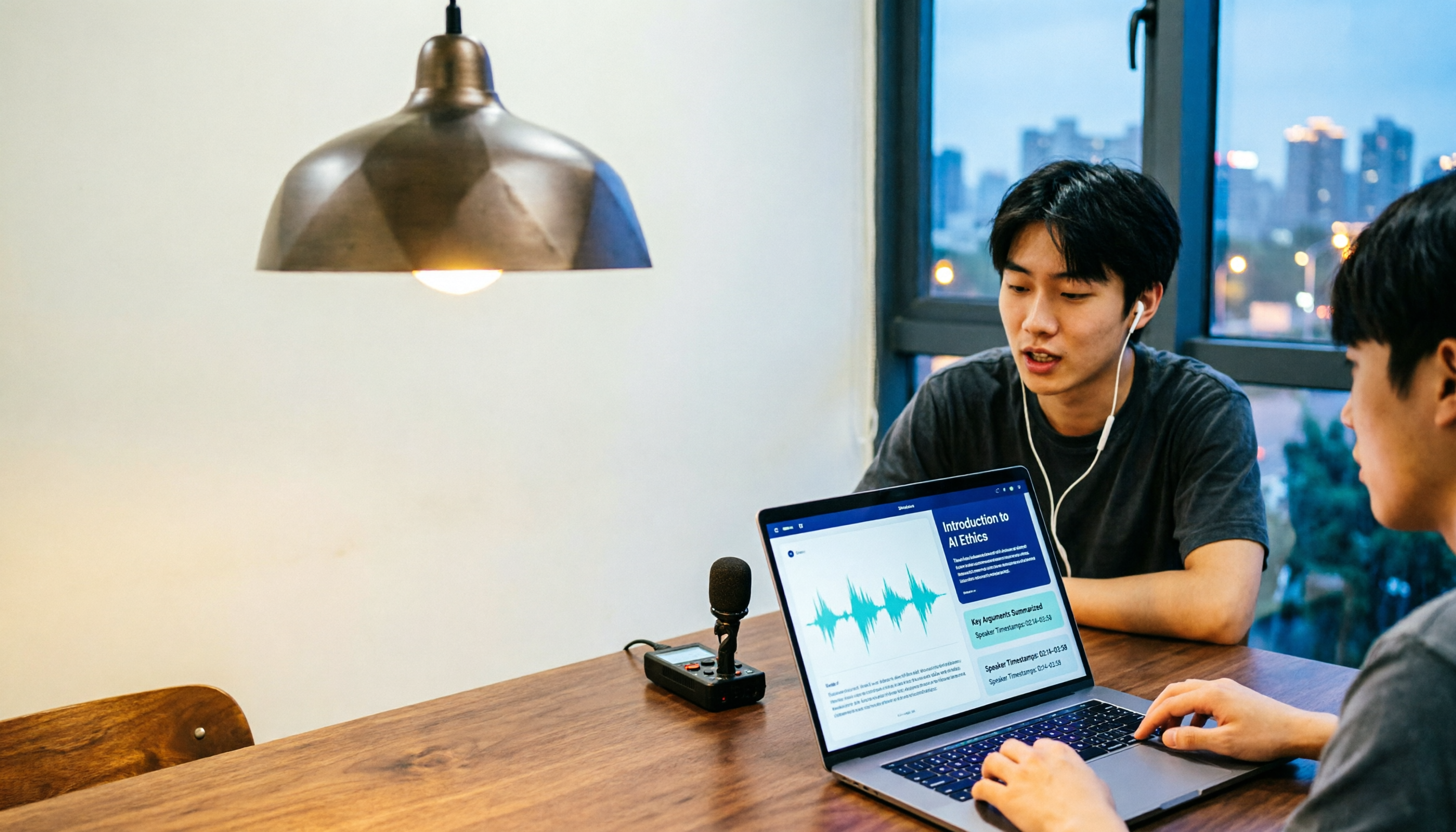
Notta in 2026: Hug Atelier Pendant Lamp vs. Audio-to-Text Tool – Differences, Features, and Practical Uses
Searching for 'notta' and getting a Turkish design brand's pendant lamp? This guide first clarifies that Hug Atelier's Notta pendant lamp and the audio-to-text tool are two different things, then breaks down from a student's perspective how audio-to-text can help: in classes, group discussions, project interviews, and online lectures. Using Tinrec as a hands-on example, it explains core capabilities, the 5 most common pitfalls when choosing a tool, and FAQs.

Good Tape vs Tinrec 2026: 5-Dimension Comparison — Which Is Better for Chinese-Speaking Teams?
Good Tape reviews are everywhere, but is it really right for your meeting scenarios? This article breaks down Good Tape and Tinrec across 5 dimensions—Chinese transcription, meeting capture, post-meeting organization, team governance, and data privacy—and offers clear recommendations based on budget and needs.

How to Use Good Tape in 2026: 5-Step Transcription Tutorial (Tinrec Hands-On Comparison)
If you searched for a good tape tutorial, you probably have a recording sitting there and not enough time. This guide walks through all 5 steps of Good Tape—from logging in, uploading, selecting language, proofreading, to exporting—and at each step, I note how and why I later switched to Tinrec, including recording online meetings without bots, AI summaries and action items, and the practical differences of team spaces.

How Notta AI Works in 2026: A Complete Guide to the Process and a Hands-On Comparison with Tinrec
Many people searching for "how does Notta AI work" really want to understand the process behind AI meeting note-taking tools. This article breaks down the four steps—audio capture, speech-to-text, semantic organization, and follow-up output—from a mid-level manager's perspective, and uses Tinrec in real weekly meetings, one-on-ones, and client meetings to honestly explain usage limits and the differences between team roles and seats.

6 Free Audio Transcription Options in 2026: Good Tape and More
How much free transcription does Good Tape offer? This guide rounds up six free audio-to-text options—from Good Tape's 1-hour trial and Otter's 300 monthly minutes to Tinrec's meeting summaries and team collaboration—listing each plan's free limits, pricing, and best use cases so you can pick one that actually works.

Tinrec vs Good Tape 2026: 5-Factor Comparison for Chinese Meetings
Good Tape reviews are mixed—is it worth paying for? I compare Tinrec and Good Tape across 5 dimensions: Chinese transcription, online meeting capture, post-meeting outputs, team governance, and pricing transparency. I cite Trustpilot user feedback and third-party tests to help you decide if it's worth your time.