
Turn recordings into transcripts and summaries in minutes
Upload audio or video for multilingual transcription, AI notes, and action items
You typed "good taper barbers near me" into the search bar.
But behind that query are three harder questions:
Who really knows how to do a taper? How can I judge if they're good? Can I get the same cut next time?
In my experience, map apps can't answer any of these.
So this article won't give you a list of "nearby barbershops." You can get that in three seconds on a map.
What I want to talk about is the process: how to go from "getting lucky once" to "getting it right every time."
Before You Search "Near Me," Answer These 4 Questions
Question 1: Do you want a taper or a fade?
A taper fade gradually narrows the sides and back while keeping natural volume; a skin fade goes down to the skin.
Mix up these terms and you'll get a very different cut.
Question 2: What height suits your hair type and growth pattern?
Coarse hair, natural curls, and hair that grows against the grain all call for different starting points for the taper.
What looks good on someone else may not work for you.
Question 3: How often can you commit to maintenance?
A trim every three weeks versus every three months requires a different approach from the barber.
If you don't discuss this upfront, things will start to go wrong after the first cut.
Question 4: Do you want "good once" or "good repeatedly"?
The former depends on the barber's skill that day; the latter depends on records.
Without answers to these four questions, walking into any shop is just a gamble.
How to Tell If a Shop Really Does Tapers: Look at 3 Things
1. Does their portfolio include close-ups of the back and sides?
A taper's craftsmanship shows in the blend on the sides and back. A portfolio with only front-facing photos tells you nothing.
2. Do they list their parameters?
A barber who's willing to write "#1 clipper on the sides, taper starts two fingers above the ear" in a post is usually also willing to align with you when you sit down.
3. Do reviews mention "weeks later"?
Reviews that only say "looked great after the cut" aren't reliable. People who say "still looked good in week three" are truly evaluating the technique.
These three things can help you filter out 80% of the wrong shops.
But the remaining 20% depends on those twenty minutes in the chair.
Success Isn't About Technique—It's About the 5 Minutes Before the Cut
I've seen too many failures where the problem wasn't the barber's skill.
The problem was miscommunication.
You say "a little shorter on the sides," and he hears 0.5 mm. You say "leave it long on top," and he leaves six centimeters.
You get home, wash your hair, and realize the whole head isn't what you wanted.
Worse, the mistake repeats.
Because three months later, you're back in the same chair, and all you remember is "last time was pretty good," but you can't say exactly how it was cut.
So my approach is simple: record those five minutes of consultation.
My Approach: Using Tinrec to Turn a Haircut into a Repeatable Record
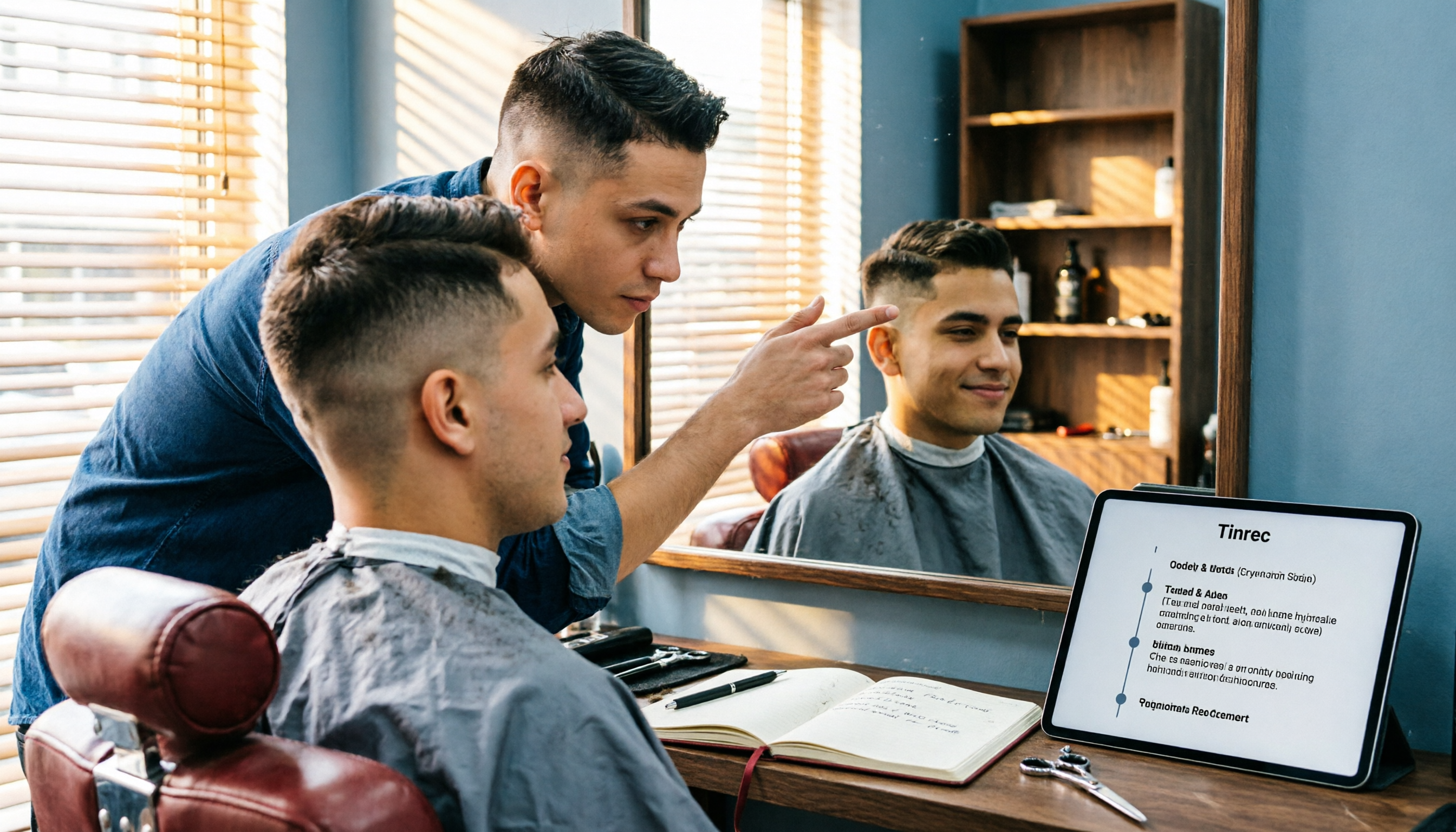
I walk in, sit down, pull out my phone, and ask: "Can I record this? I want to note today's cut so I can refer to it next time."
Most barbers respond, "Sure, that actually makes it easier to explain."
Then I open Tinrec on my phone and start live recording, placing the phone on the table.
By the time the consultation ends, the transcript is already there.
The key here isn't "recording"—it's "not having to organize it afterward."
Tinrec converts the conversation into a transcript, then automatically generates a summary and chapters, and even extracts action items like "come back in four weeks to trim the sides."
I do nothing, and the record is done.
Before my next visit, I don't need to recall anything—I just open that record.
5 Practical Capabilities of Tinrec for This
Live audio transcription.
Text appears as you speak, not after the recording ends. While the consultation is still going, I can glance at the text to confirm I heard the clipper number correctly.
AI summary and chapters.
A twenty-minute conversation gets organized into structured key points—cut parameters, maintenance advice, next-time notes—listed separately. This is more reliable than a memo I write from memory.
Stop organizing recordings by hand
Upload audio or video and automatically get a transcript, summary, and action items
Action item extraction.
Things like "come back in four weeks to trim the sides" or "next time try not to go as high" are forgotten as soon as they're said. Tinrec turns them into a checklist.
AI Q&A.
This is my most-used feature. Before my next appointment, I just ask: "What clipper number did we use on the sides last time? Where did the taper start?"
It answers based on the record, not by throwing a bunch of keywords at me.
Multi-format export.
Records can be exported to Notion, Google Docs, OneNote, or Dropbox, keeping them with my other notes.
For a studio with multiple barbers, team spaces offer another use—put every consultation record in one place so clients don't have to start from scratch when switching barbers.
(Team plans are priced per seat; first-time eligible users get a 7-day trial and 1 free seat. Actual pricing and benefits are subject to the official purchase page.)
Four Practical Scenarios
Scenario 1: First time with a new barber.
With a barber you don't know, alignment is crucial. Recording the consultation gives you a basis for the cut—what he said, what you agreed to—all searchable later.
Scenario 2: Moving to a new city or shop.
The hardest part of moving is having to explain what you want all over again. Open your old record—the transcript even has the clipper numbers—and show it to the new barber.
Scenario 3: Recording for kids or elderly family members.
Kids' natural curls, elderly parents' changing hair volume—you have to re-explain every time. Record once, then pull it up for reference later.
Scenario 4: Long-term regular visits.
After three or five records, you'll see your maintenance cycle, preferred taper height, and deal-breakers. These things used to exist only as feelings, impossible to articulate.
5 Criteria for Choosing a Taper Barber (and How to Record Them)
1. See if they ask about your maintenance frequency.
A barber who asks "How often do you get a trim?" will cut differently. This conversation is worth keeping because it directly determines your next appointment.
2. See if they can give specific parameters.
"A little shorter" is a feeling; "number 1 clipper" is a parameter. Someone who gives parameters is usually also willing to be recorded.
3. See if pricing and timing are transparent.
In the US, men's haircuts typically range from $30 to $65, with tips usually 15–20%; in Taiwan, prices vary widely by shop. Willingness to state prices upfront is part of professionalism.
4. See if they're willing to let you record.
This itself is an indicator. Those who agree usually have confidence in their explanations.
5. See if they keep your previous records.
Good barbers remember you, but people get busy and tired. So I'd rather keep my own record—stored in Tinrec, so both sides have a reference.
Frequently Asked Questions
Q: How often should a taper be trimmed?
A: Most people fall in the 3–4 week range, depending on your hair growth speed and workplace requirements. Record your barber's advice during the first consultation so you don't have to guess later.
Q: Will recording make the barber feel untrusted?
A: It depends on how you ask. Notify first, get consent, and explain that the purpose is "to note the cut for next time." Most people react positively. Also be mindful of local laws regarding recording.
Q: What if I don't know how to describe a hairstyle?
A: Use photos and recordings together. Photos give direction; recordings capture parameters. Relying on adjectives alone is the most error-prone approach.
Q: Is Tinrec's free version enough?
A: For personal use, start with the free version—it has a basic quota for recording, importing, summarizing, and transcribing. If you get a haircut once a month, usage is low. If you have concentrated needs in the short term, consider a weekly pass or Pro.
Q: I'm just an individual—do I need the team version?
A: No. The team version is for studios with multiple barbers and members sharing the same records. For personal haircut records, the personal version is sufficient.
Conclusion: Turn "Finding a Barber" into a Repeatable Process
Finding someone who can do a taper isn't hard. The hard part is making "getting it right" repeatable.
My process has only three steps:
1. Use portfolios and reviews to filter out the wrong shops.
2. Sit down, align first, and record the consultation.
3. Before your next visit, open the record and walk in prepared.
The first step determines whether you'll step on a landmine. The second and third determine whether you'll keep stepping on the same one.
The tool here is just a supporting player—the real star is the habit of "keeping communication."
Test it step by step, and you'll gradually find your own system.
References
Turn every recording into actionable outcomes
Get 60 free transcription minutes when you sign in. No credit card required.
Related Reading
You might also like

2026 AI Meeting Transcription Tools Compared: Is Notta's Free Plan Enough? Which Free Tier Is Most Generous?
People searching "Notta AI free" usually want to know: what the free plan can actually do, whether the 3-minute per-recording limit is real, and when to upgrade. This article breaks down Notta's free plan limits from a buying perspective and compares the free and entry-level plans of Tinrec, Otter.ai, and Granola, with buying tips and pitfalls to avoid, to help you decide which tool to use.

Good Tape Free? 2026 Comparison of 3 Free Transcription Models: Which One Is Enough?
Is Good Tape free? Yes, the free plan allows 3 transcripts per month, each up to 30 minutes, plus a one-time 1-hour trial. This article breaks down three free models—limited count, limited minutes, and limited trial—and compares them with Tinrec's free plan. Learn how to evaluate free quotas, use them for meeting notes and interview organization, and understand team roles and seats to choose the one that truly fits your needs.

in nottata Meaning Explained: 3 Key Uses, Examples, and Similar Words
What does in nottata mean? Starting from the meaning of nottata, this article breaks down the key uses of the time expression in nottata, organizes common collocations like fare nottata and nottata bianca with practical examples, compares notte, di notte, and nottetempo, and clarifies the 3 most common misunderstandings.

Is Harleen Nottay Married? What Public Records Reveal and What They Don't
Is Harleen Nottay married? This article compiles information from public sources like IMDb, BBC, Facebook, Instagram, and LinkedIn to explain why there is no reliable answer about her marital status and highlights common verification pitfalls.
2026 Hockey Stick Tape Guide: 4 Blade Taping Styles, Grip & Shaft Tips, and How to Choose
From four common blade taping styles and grip/shaft techniques to choosing based on position and surface, learn how to tape a hockey stick. Plus, a practical method for recording your test results so you can find your feel without relying on memory.

How to Cancel Your Good Tape Subscription in 2026: Step-by-Step Guide and a Better Meeting Notes Alternative
Canceling takes five minutes—the real hassle is your meeting data living in someone else's account. This guide first explains how to cancel the Good Tape transcription service and magazine subscription, then looks at the workflow: after canceling, how do you keep using transcripts, summaries, and action items, and what role Tinrec plays.

How to Transcribe Good Tape Videos in 2026: 3 Steps to Transcripts + AI Meeting Notes
Many people upload a video to a transcription tool, get the transcript, and think they're done—only to re-listen to the recording later to find key points. This guide walks through the actual Good Tape video-to-text workflow, breaks down 3 common pitfalls, and shows how to use Tinrec to turn transcripts into summaries, action items, and shareable team meeting materials.

Notta in 2026: Hug Atelier Pendant Lamp vs. Audio-to-Text Tool – Differences, Features, and Practical Uses
Searching for 'notta' and getting a Turkish design brand's pendant lamp? This guide first clarifies that Hug Atelier's Notta pendant lamp and the audio-to-text tool are two different things, then breaks down from a student's perspective how audio-to-text can help: in classes, group discussions, project interviews, and online lectures. Using Tinrec as a hands-on example, it explains core capabilities, the 5 most common pitfalls when choosing a tool, and FAQs.

Good Tape vs Tinrec 2026: 5-Dimension Comparison — Which Is Better for Chinese-Speaking Teams?
Good Tape reviews are everywhere, but is it really right for your meeting scenarios? This article breaks down Good Tape and Tinrec across 5 dimensions—Chinese transcription, meeting capture, post-meeting organization, team governance, and data privacy—and offers clear recommendations based on budget and needs.