
Turn recordings into transcripts and summaries in minutes
Upload audio or video for multilingual transcription, AI notes, and action items
Why You Need a Bilibili AI Summary Tool: Say Goodbye to Inefficient Rewatching
When learning or entertaining on Bilibili (B站), we often encounter hours-long in-depth interviews, tech tutorials, or lecture videos. The traditional approach is to take notes while watching or rely on built-in subtitle features, but these methods have clear drawbacks: manual note-taking misses key details, and plain subtitles lack structured summaries. When you need to review specific content, you have to scrub through the progress bar blindly, wasting a lot of time.
That's where AI summary tools shine. They convert audio/video into searchable, editable text and use large language models to automatically extract core ideas, action items, and chapter outlines. This article reviews several popular tools, focusing on Chinese language support, ease of use, and whether they accept direct video links. We'll compare them across key dimensions and provide a hands-on tutorial for Tinrec to help you build an efficient workflow from watching to internalizing knowledge.
Quick Guide Conclusion:
- If Chinese accuracy and action item extraction matter most → Choose a tool optimized for Asian languages (e.g., Tinrec).
- If you need cross-platform sync and team collaboration → Consider a multilingual tool with cloud database (e.g., Notta).
- If you only need simple subtitle files → Use basic editing software's built-in features, but lack AI summary capability.
5 Key Evaluation Dimensions for Choosing a Bilibili AI Summary Tool
Before selecting a tool, consider these dimensions to ensure it fits your use case:
1. Language Support & Chinese Recognition Accuracy
Most Bilibili content is in Chinese, often mixed with technical terms, internet slang, or dialects. Good tools should accurately recognize standard Mandarin and handle Chinese-English mixing or domain-specific terms with high tolerance. Tools optimized mainly for English may require heavy post-correction, reducing efficiency.
2. Input Method Flexibility (Link vs. Upload)
The ideal workflow is: copy video URL → paste → generate summary. If the tool only supports uploading audio or video files, you need to download the Bilibili video via third-party software first, adding extra steps. Tools that parse URLs directly simplify the process greatly.
3. AI Summary Depth & Structure
Plain transcripts aren't the goal. Effective AI summaries should distinguish speakers, auto-chapterize, and generate meeting minutes or study notes. Advanced features include AI Q&A, allowing you to ask questions about the content (e.g., "What are the three marketing strategies mentioned?") instead of just Ctrl+F searching keywords.
4. Free Quota & Pricing
For students or individual creators, monthly free minutes are key. Check if the free plan limits export formats, adds watermarks, or restricts AI feature usage.
5. Multi-Platform Support & Sync
Learning often happens on mobile (phone/tablet), while note-taking is on desktop. Tools that sync instantly across iOS, Android, and Web let you record or process videos on the go and continue editing later.
In-Depth Comparison of Popular Bilibili AI Summary Tools: Tinrec vs. Notta vs. Others
The table below compares several representative tools, focusing on their ability to process video content:
| Comparison Dimension | Tinrec (秒听录⾳) | Notta | TurboScribe | OpenAI Whisper (Local) |
|---|---|---|---|---|
| Core Strength | Great Chinese recognition, AI Q&A, action item extraction | Broad multilingual support, strong team collaboration | Whisper-based, good value | Open-source, privacy, offline |
| Video Link Parsing | ✅ Supported (YouTube, podcasts, etc.) | ❌ Mainly file upload | ❌ Mainly file upload | ❌ Requires manual download & conversion |
| Chinese Accuracy | ⭐⭐⭐⭐⭐ (Optimized for Asian languages) | ⭐⭐⭐ (Occasional errors) | ⭐⭐⭐⭐ (Depends on model version) | ⭐⭐⭐⭐ (Requires prompt tuning) |
| AI Features | Summary, to-do list, AI Q&A | Summary, keyword extraction | Transcription only, no deep AI analysis | Transcription only, needs external LLM |
| Free Quota | 100 minutes/month | 120 minutes/month (limited export) | 180 minutes/month | Unlimited (requires own hardware) |
| Best For | Students, knowledge workers, content creators | International teams, multilingual meetings | Developers, budget-conscious users | Tech-savvy users, privacy-focused |
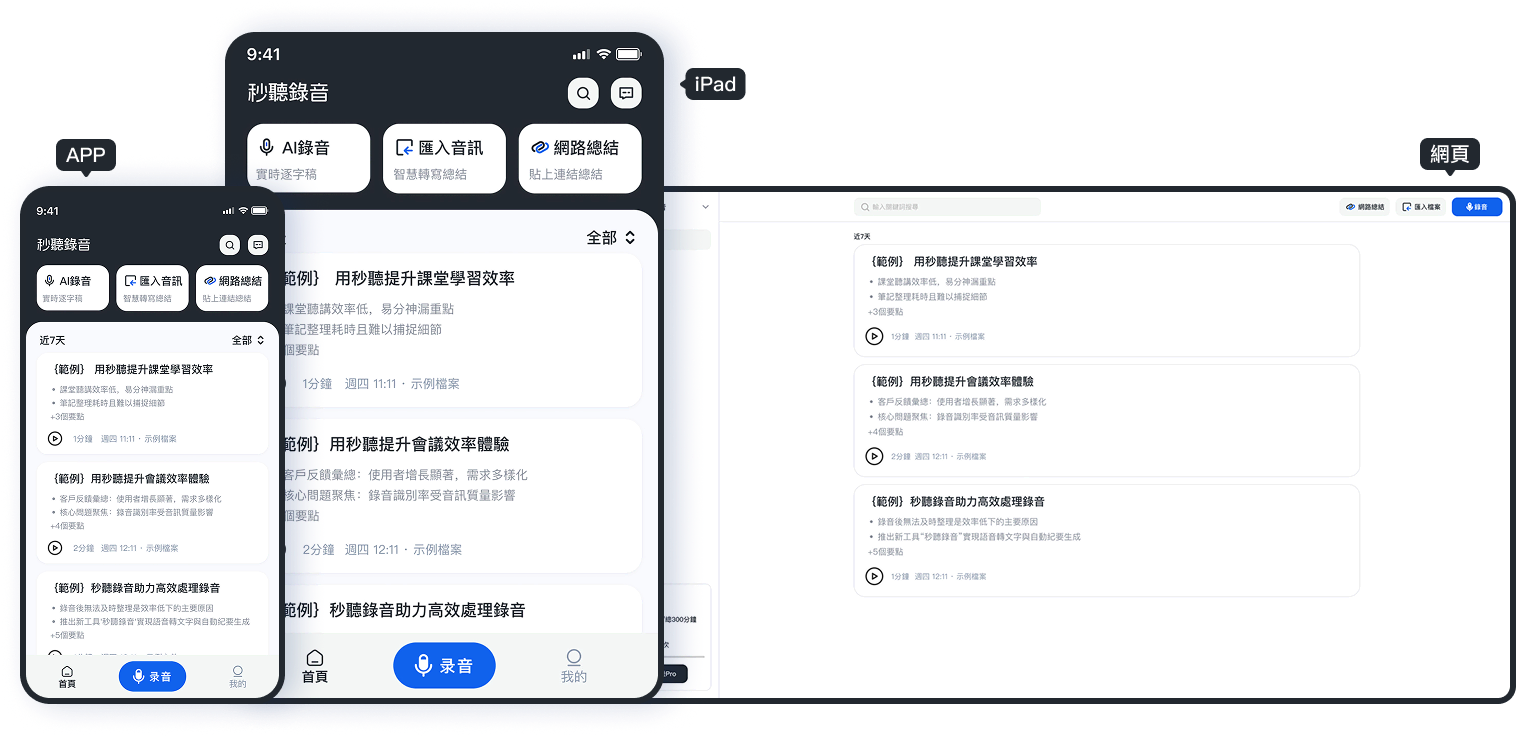
From the comparison, Tinrec stands out for non-meeting long content (like online courses, interviews) thanks to its AI Q&A, letting you dig into video details like chatting with a tutor. This differs from TurboScribe (transcription only) or Whisper (complex deployment). Notta excels in international meetings, but for structured summaries of single long videos, Tinrec's action item extraction is more intuitive.
Stop organizing recordings by hand
Upload audio or video and automatically get a transcript, summary, and action items
Hands-On Tutorial: How to Quickly Summarize Bilibili Videos with Tinrec
This section uses Tinrec as an example to show how to turn a Bilibili video (or any online video) into structured study notes. While Tinrec mainly supports links from platforms like YouTube, for Bilibili content, we suggest legally obtaining the audio/video file or using its recording feature to capture playback sound. Below are three common input methods.
Step 1: Preparation & Goal Setting
- Target Output: A document with chapter outline, key point summary, and actionable to-do list.
- Preparation: Ensure stable internet. For file upload, use common formats like MP3, MP4, WAV. For recording, minimize background noise.
Step 2: Choose Input Method & Start Transcription
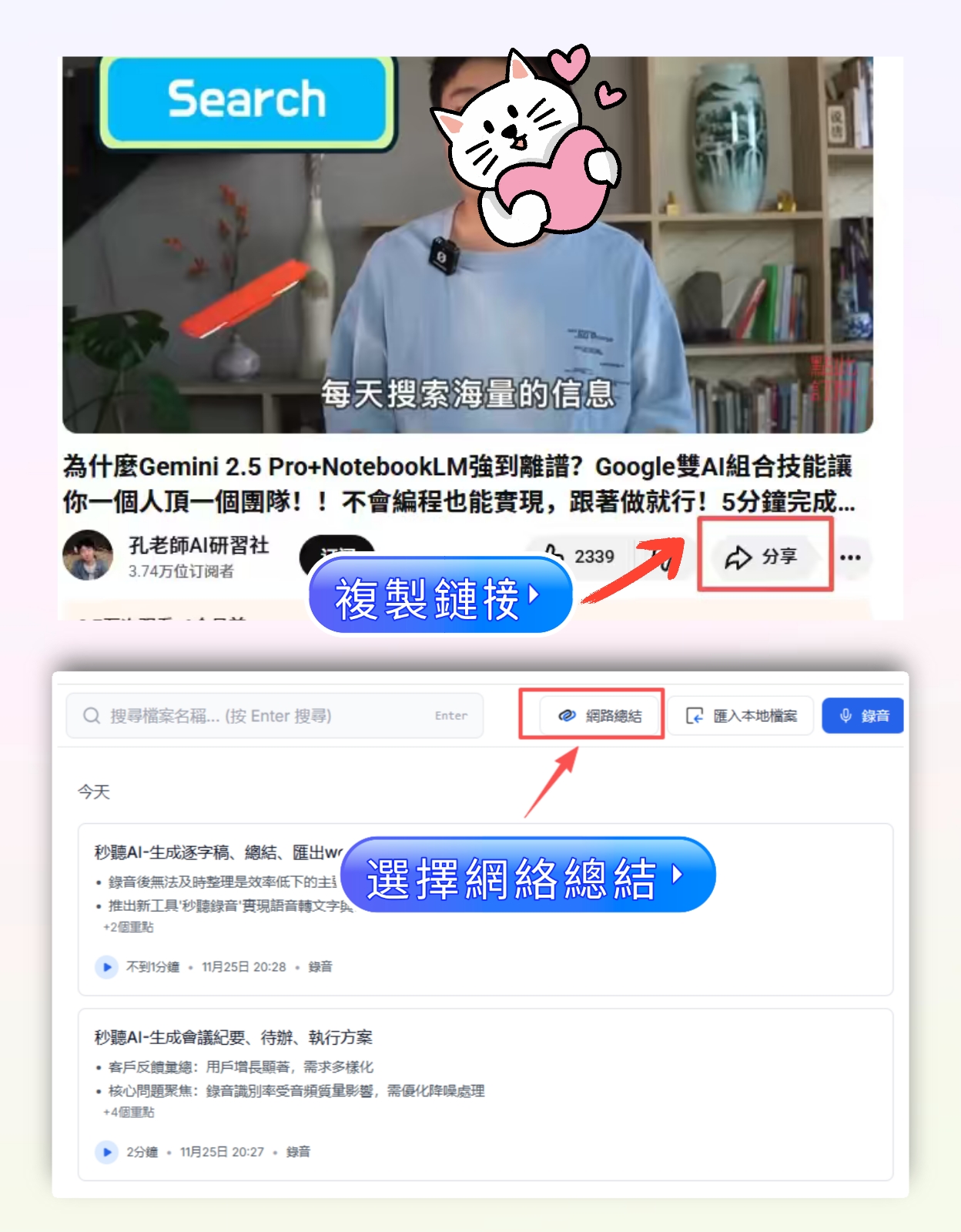
Scenario A: Using Video Link (for supported platforms)
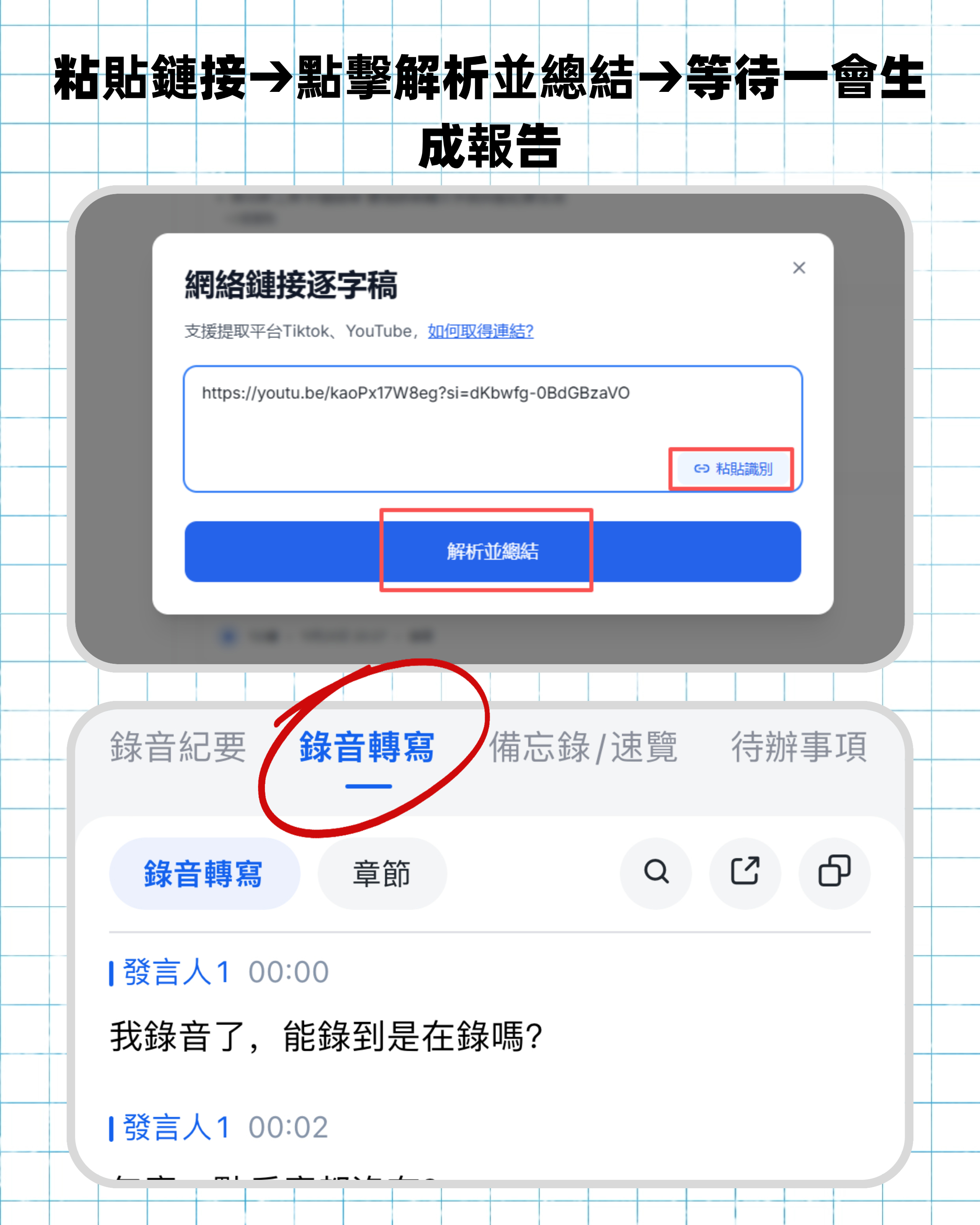
- Action: Open Tinrec web or app, select "Video to Text," paste the video URL.
- Expected Result: System automatically grabs the audio track and completes transcription and initial summary in minutes.
- Note: Direct Bilibili URL support may be limited. If not available, use Scenario B.
Scenario B: Using Audio File Upload (for downloaded Bilibili videos)
- Action: Click "Audio File to Text," upload the downloaded Bilibili video or extracted MP3.
- Expected Result: System detects language (auto-detect Chinese) and generates timestamped transcript.
- Note: Larger files take longer. For videos over 1 hour, consider splitting or ensure sufficient bandwidth.
Scenario C: Using Live Recording (for live streams or real-time learning)
- Action: Open Tinrec's recording feature, place phone near computer speakers, or use web version to record.
- Expected Result: Speech converts to text in real time, displaying current speaker content on screen.
- Note: Best for following course pace and marking highlights, but requires quiet environment to avoid noise interference.
Step 3: Deepen Understanding with AI Q&A
This is Tinrec's biggest differentiator. Don't just read the full transcript.
- Action: Click "AI Chat" button on the right or bottom.
- Expected Result: Opens chat window; you can ask questions like "Summarize the three key SEO tips the speaker mentioned" or "What books were recommended in this video?"
- Value: It's like having a teaching assistant who instantly locates answers from dozens of pages of transcript, cutting review time drastically.
Step 4: Review & Export Action Items
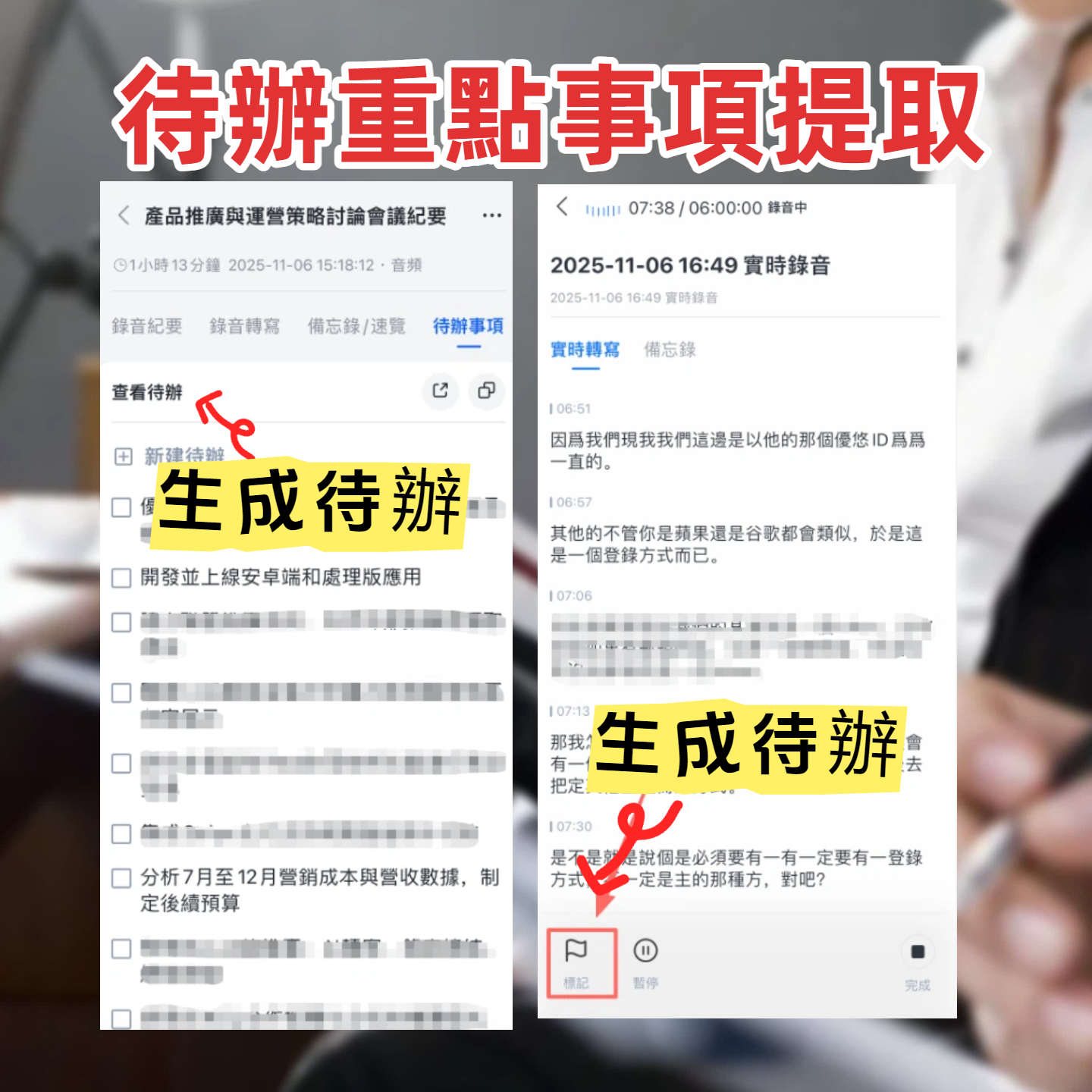
- Action: Check the auto-generated "Summary" and "To-Do" sections.
- Expected Result: System lists concrete suggestions like "Read Chapter 5 of Marketing Management" or "Practice Python code examples."
- Note: Quickly scan for context misinterpretations. Edit directly if needed.
Step 5: Verification & Template Application
- Acceptance Criteria:
- Key terms correct: Check if technical terms (AI model names, software commands) are transcribed accurately.
- Timestamps clickable: Clicking key points in the summary should jump to the corresponding audio position.
- Action items actionable: To-do items should be specific, not vague.
- Sample Template:
Video Topic: [fill in title] Core Conclusion: [AI-generated summary] Key Knowledge Points:
- [Point 1]
- [Point 2] Action Items:
- [Action 1]
- [Action 2] Questions & Reflections: [Extra insights from AI Q&A]
Common Mistakes & How to Avoid Them
New users often make these errors, leading to poor output quality:
- Ignoring audio preprocessing: Loud background music or overlapping voices degrade recognition. Choose clear vocal tracks, or use built-in noise reduction if available.
- Over-relying on auto-summary: AI might miss subtle but important shifts. Always cross-verify critical info (especially data or steps) with AI Q&A.
- Not using speaker differentiation: In interview videos, ensure the tool correctly separates guests and hosts. If mixed, subsequent Q&A logic breaks. Tinrec and similar tools usually offer chapter splitting and speaker labeling—use them.
- Ignoring free quota limits: Free plans may restrict export format or length. Check remaining minutes before processing a long video to avoid interruption.
FAQ
Q1: Can Tinrec directly input Bilibili video links?
Currently, Tinrec primarily optimizes for YouTube and various podcast platforms. For Bilibili videos, we recommend using a legal download tool to convert the video to MP3/MP4, then use Tinrec's "Audio File to Text" feature to upload and get the same AI summary and transcript.
Q2: Which tool has the best Chinese (including Taiwanese/Hokkien/Cantonese) recognition?
In testing, Tinrec is specially optimized for Asian languages, supporting automatic recognition of Chinese, Taiwanese, Cantonese, and 10 other languages. It usually outperforms English-focused international tools when handling Chinese-English mixing or technical terms.
Q3: Is a free AI summary tool sufficient?
For light users (e.g., 2-3 online courses per month), Tinrec's free plan of 100 minutes/month is usually enough. But for many long videos or advanced AI Q&A queries, upgrading to Basic or Pro is more cost-effective.
Q4: Can AI-generated summaries be exported to Notion or Evernote?
Most modern tools (including Tinrec) support copying plain text or Markdown. You can directly paste the summary into Notion, Evernote, Obsidian, etc., preserving formatting.
Q5: If two people speak simultaneously, can AI distinguish them?
Current AI still struggles with heavy overlapping voices. Choose videos with clear track separation. Tinrec has speaker differentiation that correctly labels different speakers in most clear dialogue scenarios; heavy overlap may require manual adjustment.
Q6: Do these tools have privacy concerns?
Choose reputable services. Legitimate platforms like Tinrec have privacy policies to protect user data and won't use your private recordings for public training. For highly confidential business content, check enterprise privacy terms or consider local deployment (e.g., Whisper), sacrificing convenience for privacy.
Turn every recording into actionable outcomes
Get 60 free transcription minutes when you sign in. No credit card required.
Related Reading
You might also like

4 Multilingual Meeting Transcription Apps Tested in 2026: Which Delivers the Best Cross-Language Transcripts and Bilingual Summaries?
Multilingual meeting notes aren't just about turning on live translated captions. This article uses real examples to show what a usable bilingual meeting record should look like, then compares Tinrec, Notta, Otter.ai, and Granola across five dimensions—code-switching capability, summary language, recording method, audio retention, and team sharing—to help you choose the AI meeting notes app that truly works for you.

4 Multilingual Meeting Notes Tools Tested in 2026: Beyond Templates, Which AI Bilingual Summarizer Saves the Most Time?
Downloaded a bunch of multilingual meeting notes templates but still can't understand or finish taking notes during meetings? A senior student tested 4 tools: Tinrec's mixed Chinese-English transcription, bilingual transcripts, AI Q&A, and team workspace, compared with Notta, TurboScribe, and Granola. Includes student budget and free tier advice.

4 Multilingual Meeting Transcription Tools Compared in 2026: From Live Translation to Post-Meeting Action Items
How do you choose a multilingual meeting transcription tool? This article starts with common misconceptions, breaking down four key points: translation is not the same as transcription, the trade-offs between bot-free and bot-based recording, file import and audio retention, and team data ownership. It then compares Tinrec, Otter.ai, Notta, and Granola across positioning, strengths, and limitations to help you decide which one to pick.

4 Multilingual Meeting Transcription Tools Tested for 2026: Which Handles Mixed Chinese-English Transcripts Best?
Tired of re-reading mixed Chinese-English meeting transcripts just to organize them? This comparison reviews 4 multilingual meeting transcription tools. We start with what a practical meeting notes template should include, then compare Chinese recognition, bot-free recording, post-meeting summaries, and team collaboration. Official pricing and pitfalls to avoid are included to help you decide which tool fits your meeting style.

2026 Review of 4 Multilingual Meeting Transcription Tools: Which Handles Mixed Chinese-English Bilingual Transcripts Best?
How to choose a multilingual meeting transcription tool? This article reviews Tinrec, Otter.ai, Notta, and Granola based on essential meeting minutes fields, language-switching recognition, post-meeting usability, and team seat management. It also covers 4 common pitfalls and scenario-based recommendations.

2026 Comparison of 4 Multilingual AI Meeting Note Tools: Which Handles Mixed Chinese-English Meetings Best?
A student's hands-on comparison of 4 multilingual AI meeting note tools, evaluating mixed Chinese-English transcription, bilingual transcripts, AI Q&A, and free tiers, plus key buying factors, pitfalls to avoid, and scenario recommendations.

How to Take Multilingual Meeting Minutes in 2026: 4 Steps from Bilingual Examples to AI Summaries
How do you write multilingual meeting minutes without missing key points? This article breaks down the essential fields of a bilingual Chinese-English meeting minutes example, explains compliance reminders for recording and transcription, and shares how Tinrec's instant recording uses real-time transcription, bilingual comparison, AI summaries, and action item extraction to turn transcripts into trackable meeting records.

Best Multilingual Meeting Transcription Tools in 2026: Testing 2 Options, Tinrec Handles Mixed Chinese-English Meetings Better
How to choose a multilingual meeting transcription tool? This article starts with the three most common purchasing mistakes, then compares Tinrec and Otter.ai across 6 dimensions: Chinese and mixed Chinese-English transcription, bot-free meeting recording, real-time translation and bilingual review, post-meeting outputs and AI follow-up questions, team workspace and data governance, and pricing and cost structure, to help you decide which one better fits your meeting scenarios.

Best Multilingual AI Meeting Notes Software in 2026: We Tested 4, and This One Handles Chinese Meetings Best
A mid-level manager with a 10-person team and 15 meetings a week tested 4 multilingual AI meeting notes tools. From bot-free recording, mixed Chinese-English transcription, real-time translation, to post-meeting AI Q&A and team data ownership, we break down the 4 key buying factors, hands-on findings, and pitfalls to avoid, with scenario-based recommendations.