
Turn recordings into transcripts and summaries in minutes
Upload audio or video for multilingual transcription, AI notes, and action items
Why Transcribing Podcasts Is So Hard: Shared Pain Points for Creators and Learners
In this era of booming audio content, podcasts have become a key source of knowledge for many. However, audio has a fatal flaw: it's linear and hard to search. Whether you're a content creator turning interviews into articles or a student reviewing key points, you've likely faced these three frustrating moments:
- High time cost: A 60-minute interview manually transcribed takes at least 3–4 hours for an experienced person. That's a major productivity killer for creators.
- Hard to find info: When you want to revisit "a stat mentioned around 20 minutes in," you end up scrubbing back and forth, wasting time.
- No structured output: Raw transcripts are full of filler words and spoken language—just "text bricks" that aren't readable notes or social posts, requiring more work to polish.
So choosing an AI tool that "understands" content—not just transcribes it—is key to boosting productivity in 2026.
Market Comparison: Which Tool Is Best for Traditional Chinese Users?
Many speech-to-text tools exist (e.g., Otter.ai, Good Tape), but for users in Taiwan, Traditional Chinese support and mixed Chinese-English recognition are top priorities. Plus, simple "transcription" isn't enough anymore—AI analysis matters.
Below, we compare typical transcription tools with Tinrec (秒聽錄音), which emphasizes real-time understanding:
| Dimension | Traditional Transcription Tools (General) | Tinrec (秒聽錄音) |
|---|---|---|
| Core Focus | Accurate text, archival | From audio to action, understanding & output |
| Input Methods | Mostly file upload only | YouTube/Podcast URL parsing, file upload, live recording |
| Language Support | Good for single language, poor with mixed | 10 languages (Chinese, English, Japanese, etc.), optimized for Chinese-English mix |
| Content Search | Keyword search only (Ctrl+F) | AI chat query (Semantic Search): Ask your audio like a person |
| Outputs | Transcript (with timestamps) | Transcript + AI meeting minutes + Action items |
| Use Cases | Legal records, outsourced transcription | Content creation, study notes, meeting follow-ups |
As shown, if you need to turn podcasts into blog posts, social media content, or study notes, tools with AI summaries and URL parsing save way more time than basic transcription software.
In-Depth Tinrec Review: More Than Transcription—Your Content Analyst
After testing several tools, Tinrec stands out for podcast and long-form interview processing, especially for those needing "repurposing" or "quick takeaways."
Stop organizing recordings by hand
Upload audio or video and automatically get a transcript, summary, and action items
1. Direct Link Import – No Download Needed
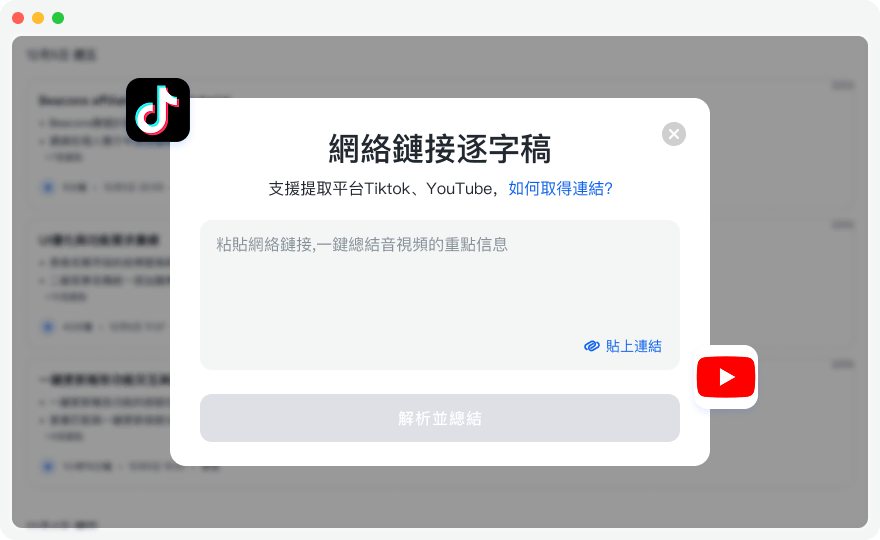
Most tools require you to download MP3/MP4 files and upload them, which is space-consuming and time-wasting. Tinrec supports pasting YouTube or podcast URLs directly; the system parses and transcribes them in the cloud, simplifying the workflow.
2. AI Chat Query: Find Answers by Asking
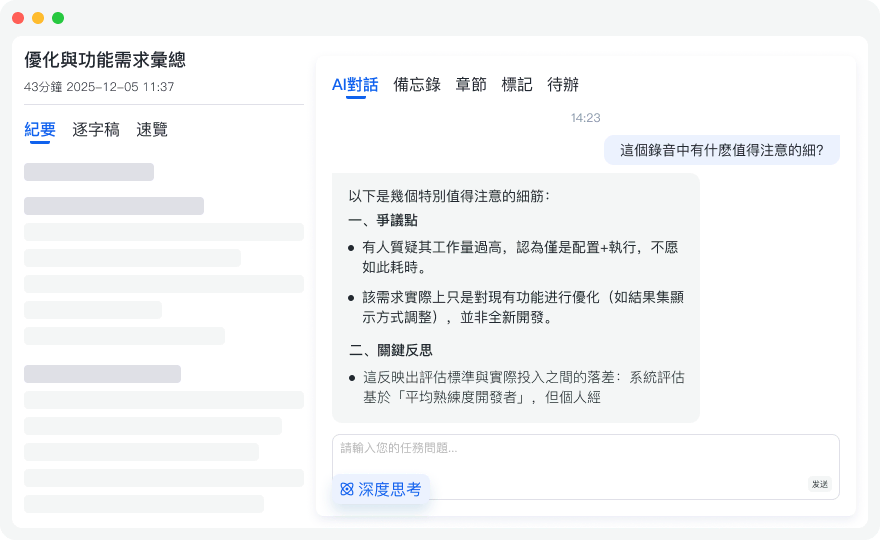
This is the biggest difference from traditional tools. A raw transcript can be tens of thousands of words—exhausting to scan. Tinrec's built-in AI chat query (like ChatGPT) lets you ask:
- "What was the host's conclusion about remote work in this episode?"
- "List the three books the guest recommended."
The AI answers based on the audio, turning recordings into a searchable database.
3. Auto-Extract Action Items & Structured Summaries
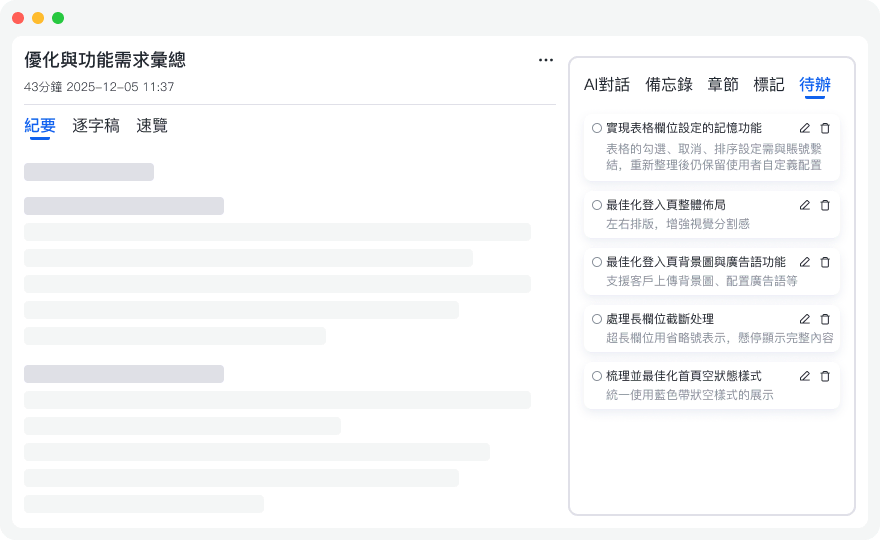
For meeting-style podcasts or interviews, Tinrec auto-generates a summary, key conclusions, and action items after transcription. You don't need to read the whole transcript to grasp 80% of the core info—perfect for show notes.
Tutorial: Turn a Podcast into a Blog Post in Minutes Using AI
Here's how to use Tinrec's workflow to digest a 1-hour podcast in 10 minutes.
Step 1: Get the Link & Start Transcription
Go to the Tinrec podcast/video-to-text page. Copy and paste a YouTube video or podcast audio link, then click start. It supports Chinese, English, Japanese, Korean, and more—with auto-detection for mixed Chinese-English content.
Step 2: Review the AI Auto-Generated Summary
Don't jump straight to the transcript. First, check the AI smart summary on the right. It lists chapter highlights, speaker sentiment, and core points—helping you quickly spot the best parts.
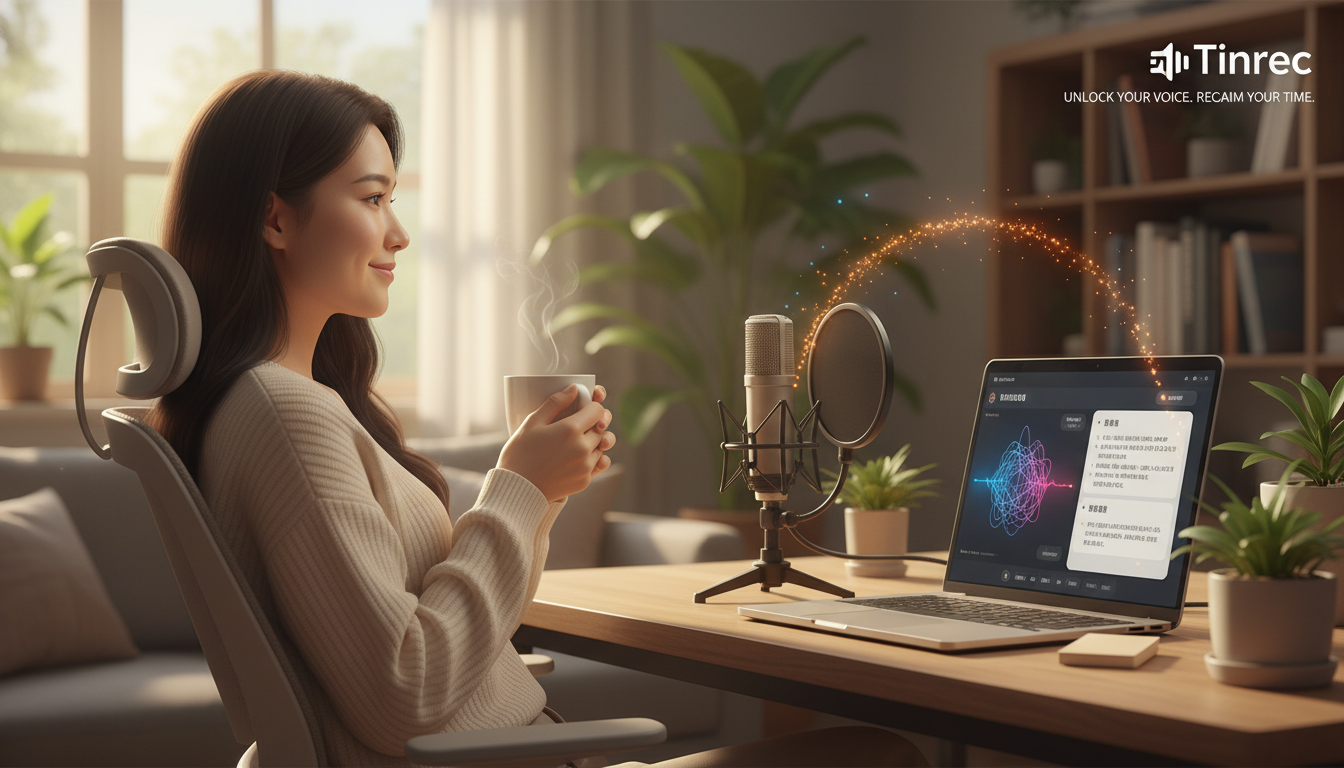
Step 3: Mine Quotes with AI Chat
To make your article lively, pull direct quotes. Use the AI chat box below and type:
"List 5 quotes from the speaker about time management, with timestamps."
The system filters the original sentences—just copy and paste.
Step 4: Export & Edit
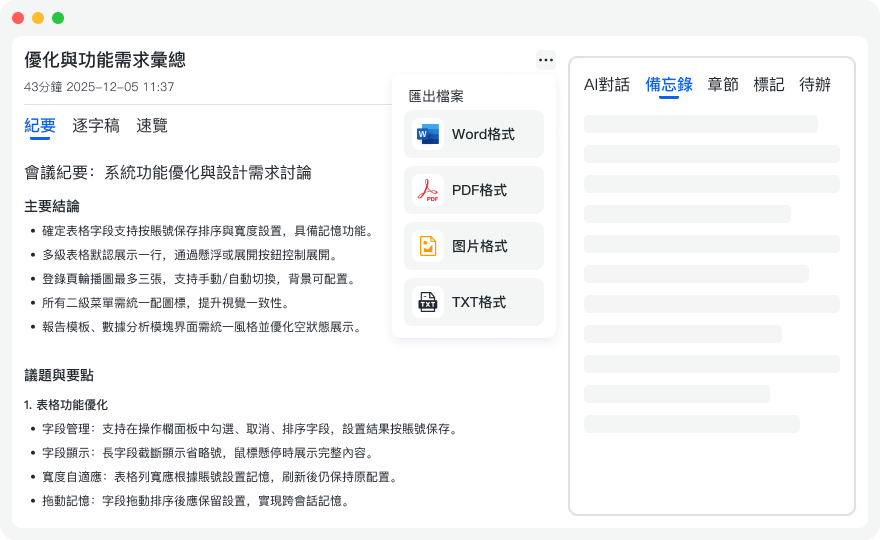
Once satisfied, use the multi-format export (Word, PDF, TXT, etc.) to download the transcript and summary. Tweak a bit, and you're ready to publish a blog post or social media recap.
FAQ
Q1: What languages does Tinrec support for podcast transcription? Currently supports 10 languages including Chinese (Traditional/Simplified), English, Japanese, Korean, German, Taiwanese Hokkien, and Cantonese. Recognition is specially optimized for the common Chinese-English mix and Taiwanese Hokkien content.
Q2: How much free usage is available? Tinrec offers a free plan with up to 100 minutes of transcription per month—enough for occasional short interviews or single podcast episodes. For heavy use, consider upgrading to Basic or Pro.
Q3: Can I record and transcribe directly on my phone? Yes. Tinrec syncs across iOS, Android, and Web. Record interviews or meetings on your phone app, then open the transcript and summary on your computer—seamless.
Q4: Does the AI chat query cost extra? No, AI chat query (smart Q&A based on your audio) is included in the standard features. Both free and paid users can use it within their quota to quickly search audio highlights.
Q5: Can I edit the transcript? Absolutely. The transcript supports online editing. You can fix proper nouns, adjust paragraphs, and the changes sync to exported files.
Q6: Can I upload iPhone voice memo files (m4a)? Yes. Tinrec's audio-to-text feature supports m4a, mp3, wav, mp4, and more common formats. You can directly upload files from iPhone Voice Memos.
Turn every recording into actionable outcomes
Get 60 free transcription minutes when you sign in. No credit card required.
Related Reading
You might also like

2026 AI Meeting Notes Tools Tested: How to Write Sales Meeting Notes Without Missing Deal Signals
The hard part of sales meeting notes isn't typing speed—it's deciding what will still matter three months later. Starting from 'who will read these notes,' this article covers 4 key judgments for sales meeting notes, 4 common mistakes, and compares Tinrec, Otter.ai, Notta, and Granola on Chinese meetings, bot-free recording, and post-meeting organization to help you choose the right approach for your team.

2026 Sales Meeting Notes Tools Compared: Which One Turns Customer Words into Action Items?
How do you write sales meeting notes without them turning into a transcript? Starting from the real pain points salespeople face after customer meetings, this article covers 4 key selection criteria, compares Tinrec with Otter.ai, Notta, and Granola, and highlights the 4 most common note-taking mistakes.

2026 Smart Meeting Collaboration Tools Comparison: Tinrec vs Otter.ai Across 5 Dimensions — Which Handles Chinese Meetings Better?
Meeting tools aren't just about transcription speed. This article starts with common purchasing pitfalls and compares Tinrec and Otter.ai across 5 dimensions: meeting capture methods, Chinese and mixed Chinese-English recognition, post-meeting organization and AI follow-up, team governance, and quota and pricing. It includes a comparison table and FAQ to help you decide which tool better fits your meeting scenarios.

2026 Smart Meeting Collaboration Platform Buying Guide: 4 Hands-On Tests and Selection Advice
Can't find conclusions after a meeting? The problem often isn't transcription accuracy—it's choosing the wrong approach from the start. This guide focuses on three decision points: how meetings are recorded, what you get afterward, and who ultimately holds the data. We hands-on test Tinrec and compare it with Otter.ai, Notta, and Granola, including quota calculations and tips to avoid pitfalls with roles and seats, helping you choose the platform that truly works for you.

How to Use Sales Meeting Notes in 2026: 5 Steps from Recording to Deal Tracking
Sales meeting notes don't end with a transcript. This article addresses common mistakes and outlines 5 steps for recording, organizing, and following up before, during, and after meetings, plus practical differences in team plans regarding seats and data handover.

2026 Smart Meeting Collaboration Tools Compared: Which One Handles Post-Meeting Work Without a Meeting Bot?
Many people think meeting tools only need transcription, but the real trouble is finding key points after the meeting, tracking action items, and keeping team data from walking out the door with individuals. This article compares Tinrec, Otter.ai, Notta, and Granola using the same meeting workflow, and covers selection criteria, common pitfalls, and team seat concepts to help you choose a smart meeting collaboration tool that fits your team.

Tinrec vs Zoom in 2026: 5-Dimension Comparison — How to Choose an AI Meeting Collaboration Platform
Meetings scattered across Teams, Meet, and Webex mean records get scattered too — a real pain point for many teams. This article compares Tinrec and Zoom across five dimensions from the perspective of consolidating cross-platform meetings, explaining what problems bot-free recording, post-meeting summaries and action items, AI Q&A, team spaces, and seat governance each solve, and outlines five key considerations when choosing an AI meeting collaboration platform.

2026 Smart Meeting Collaboration Tools: 4 Top Picks Tested and Compared
Tired of working overtime on meeting notes? We tested four smart meeting collaboration tools in real meeting scenarios for 2026, comparing bot-free recording, mixed Chinese-English transcription, AI Q&A, and team seat management. We also highlight key buying factors and common pitfalls to help you choose the right one.

2026 Smart Meeting Assistant Comparison: Tinrec vs Fireflies.ai — How They Work and Where They Differ
A side-by-side comparison of two smart meeting assistants, breaking down meeting capture, Chinese-language experience, post-meeting output, team governance, and pricing, plus a practical workflow from meeting to deliverable to help you decide which fits your budget and use case.