
Turn recordings into transcripts and summaries in minutes
Upload audio or video for multilingual transcription, AI notes, and action items
Facing hour-long YouTube lectures, courses, or interview videos? Do you often find it time-consuming to extract key points? Especially when there are no captions (CC) or the content is in a non-native language, manual transcription is nearly impossible.
This article highlights 5 must-try "video-to-text" tools in 2026. We test and compare them across Traditional Chinese recognition accuracy, support for videos without captions, AI summarization capabilities, and cross-device convenience.
Quick Picks:
- Best for free & academic research: Google's NotebookLM.
- Best for Mac local privacy & high accuracy: MacWhisper.
- Best for workflow, action items & AI chat queries: Check out Tinrec.
- Lightweight browser extensions: Choose Glasp or tactiq.io.
Why You Need a Dedicated YouTube-to-Text Tool
Simple "speech-to-text" is no longer enough for modern work and learning. Next-gen AI tools don't just convert audio to text; they solve three core pain points:
- Salvation for videos without captions: Many high-quality overseas videos or live stream archives lack CC subtitles. Traditional extension tools can't handle them; you need tools with automatic speech recognition (ASR) that listen and transcribe directly.
- Non-linear information absorption: With AI summaries and timestamps, you can click on text to jump to the corresponding video segment without watching from start to finish.
- Turning content into action: Transform simple records into "to-do items" or "mind maps," applying video content to real work projects.
In-Depth Comparison of 5 Popular YouTube-to-Transcript Tools
To help you choose the right tool intuitively, here's a feature comparison table:
| Feature Dimension | Tinrec (秒聽錄音) | NotebookLM | MacWhisper | Glasp | tactiq.io |
|---|---|---|---|---|---|
| Core Focus | Audio/video-to-text + action decisions | Learning notes & knowledge base | High-accuracy local transcription on Mac | Web social highlighter | Real-time captions for meetings/videos |
| Support for videos without captions | ✅ Yes (AI speech recognition) | ✅ Yes | ✅ Yes | ❌ Requires CC subtitles | ❌ Requires CC/auto-generated captions |
| Chinese support | Excellent (includes Taiwanese Hokkien, Cantonese, etc., 10 languages) | Excellent | Excellent (selectable model size) | Depends on original video subtitles | Weak (mainly English/Latin languages) |
| AI chat queries | ✅ (Q&A about content) | ✅ | ✅ (requires API or Pro) | ✅ (connects ChatGPT) | ✅ (connects AI) |
| Device support | Web / iOS / Android | Web | Mac / iOS | Browser extension | Browser extension |
| Key Highlights | Auto-extract to-do items, multi-device sync | Free, import multiple sources | Local processing, high privacy | Easy to use, lightweight | Real-time capability |
Detailed Analysis of Each Tool & Use Cases
1. Tinrec: From Transcription to Action – The All-in-One Assistant
For users dealing with multilingual content (e.g., cross-border meeting recordings, overseas educational videos), Tinrec offers a complete workflow. It doesn't just convert YouTube links to text; it emphasizes "post-processing applications."
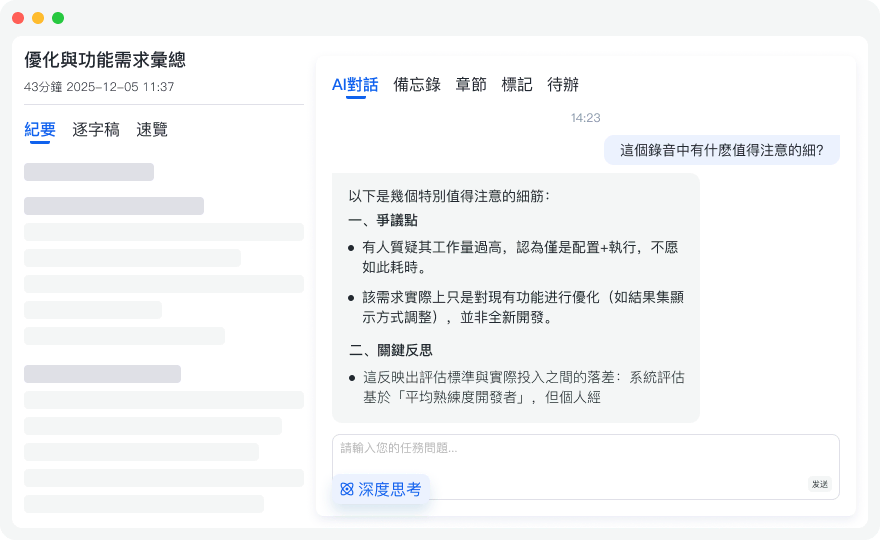
- Unique Differentiator: Besides generating transcripts, Tinrec automatically produces "smart summaries" and "actionable to-do items," ideal for workers who need to generate reports or execute tasks after watching videos. Its AI chat function lets users query video content like "asking a person," not just keyword search.
- Language Capability: Supports automatic recognition of 10 languages including Chinese, English, Japanese, Korean, German, Taiwanese Hokkien, Cantonese, etc., making it very friendly for Traditional Chinese environments.
Stop organizing recordings by hand
Upload audio or video and automatically get a transcript, summary, and action items
2. NotebookLM: Google's Powerful Knowledge Base
NotebookLM is Google's free AI note-taking tool. Its strength lies in "integration." You can dump YouTube links, PDFs, and Google Docs into it, and let AI answer questions based on these sources.
- Advantages: Completely free, extremely fast transcription (an 8-minute video takes about 1 minute), and leverages Google's powerful models.
- Limitations: Sometimes fails on very long videos, and its main functionality is currently web-based, lacking real-time recording integration on mobile.
3. MacWhisper: The Ultimate Choice for Mac Users
If you're a heavy Mac user and value privacy, MacWhisper is the top pick. It uses your computer's local computing power to run OpenAI's Whisper model.
- Advantages: Supports multiple output formats (srt, html, docx), can tag speakers. Since it runs locally, no need to worry about data upload to the cloud. The Pro version is very feature-complete.
- Limitations: Consumes hard drive space (model files are large), and transcription speed depends on your computer's hardware specifications.
4. Glasp & tactiq.io: Lightweight Browser Extensions
These two tools are suitable for "light users."
- Glasp: Displays transcripts directly next to the YouTube page, making it easy to copy and highlight. However, it heavily depends on whether the video has CC subtitles.
- tactiq.io: Focuses on real-time use, no registration required, but similarly limited by CC subtitles, and its support for Chinese subtitles is currently unstable.
Practical Tutorial: How to Turn a YouTube Video into a Searchable Note
Here we use Tinrec as an example to demonstrate how to convert a YouTube video without captions into a note with key summaries and enable content retrieval.
Step 1: Copy the Video Link
Find the video you want to process on YouTube (e.g., product launch, tutorial course) and copy its URL.
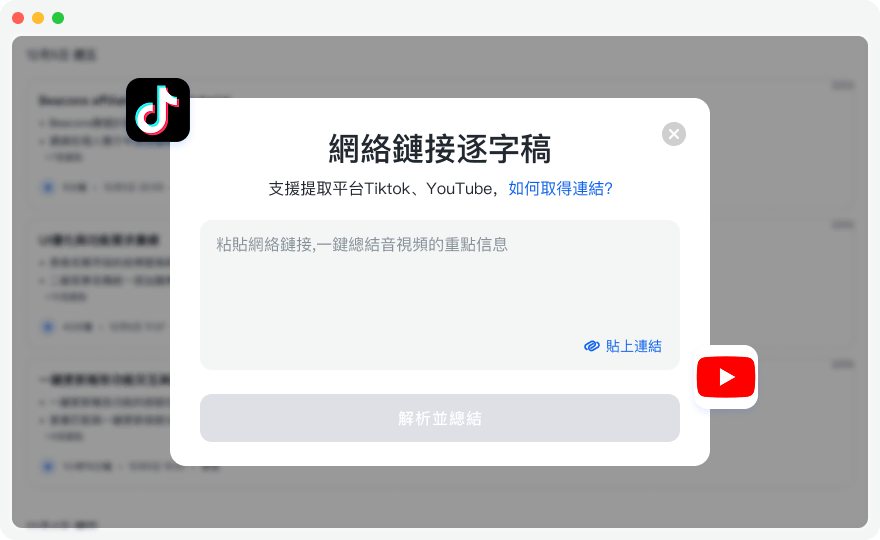
Step 2: Use the "Video to Text" Function
Go to Tinrec's web version or app, select the "Podcast/Online Video to Text" feature. Paste the copied link, and the system will start parsing.

Step 3: Get Transcript & Summary
After parsing, you won't just get a long string of text. The system automatically identifies speakers (if multiple) and generates a structured "Meeting/Content Summary".
- Transcript: Click on text to hear the corresponding audio segment.
- Summary: Quickly browse the video's core arguments.
- Action Items: If the video includes tutorial steps or suggestions, AI automatically extracts them as a checklist.
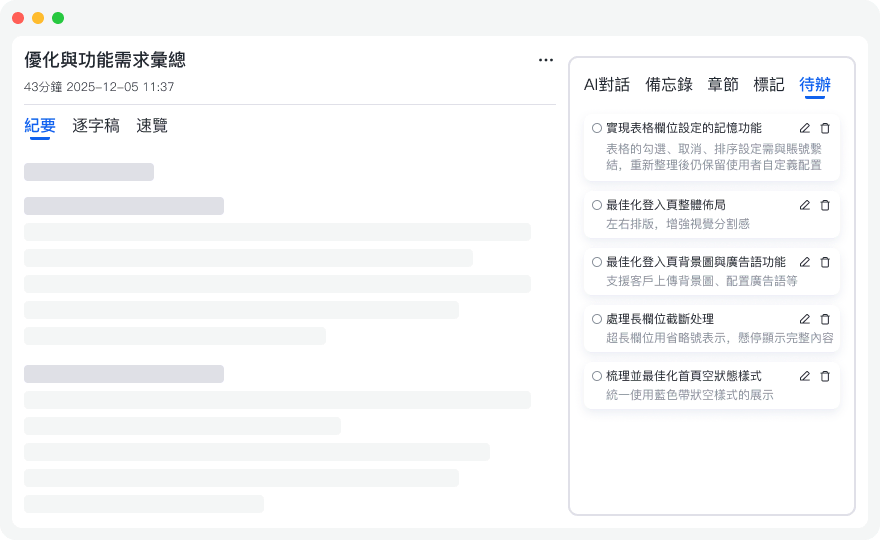
Step 4: Use AI Chat to Dig into Details
If you don't want to rewatch the entire video and are only interested in a specific topic (e.g., "What did the video say about the iPhone's battery life?"), simply type your question into the AI chat box on the right side. Tinrec will give a precise answer based on the recording content, saving you the hassle of Ctrl+F searching.
Frequently Asked Questions (FAQ)
Q1: Can these tools still work if the YouTube video itself has no CC subtitles?
Yes. But you'll need tools with automatic speech recognition (ASR) capabilities, such as Tinrec, MacWhisper, or NotebookLM. Extensions like Glasp or tactiq.io usually just "grab" existing subtitle files, so they won't work if the video has no subtitles.
Q2: Can I convert YouTube to text on an iPhone or mobile device?
Most browser extensions don't work on mobile. Opt for services that support multiple platforms. For example, Tinrec has iOS and Android apps, allowing you to paste links directly on your phone; NotebookLM can be used via a mobile browser.
Q3: Can the generated transcript be exported as subtitle files?
It depends on the tool. MacWhisper supports output in .srt and .vtt formats, which is great for creators. Tinrec also allows exporting and sharing the organized content for further editing.
Q4: How accurate is Traditional Chinese recognition?
Current mainstream AI models (like Whisper or the model used by Tinrec) have very high recognition accuracy for Traditional Chinese. However, accuracy can be affected if the video has loud background music or the speaker has a very heavy accent (e.g., regional dialects). Tinrec specifically boasts support for Taiwanese Hokkien and Cantonese, giving it an edge when processing local Taiwanese content.
Q5: Do these tools have free versions?
- NotebookLM: Currently completely free.
- Tinrec: Offers a free tier (monthly credits), with Basic or Pro plans for heavy transcription needs.
- MacWhisper: Has a free version (uses a smaller model), with Pro available for purchase.
- Glasp: Free to use.
Q6: Besides YouTube, can I transcribe my own audio files?
Yes. Both Tinrec and MacWhisper support uploading local audio or video files (e.g., mp3, mp4, wav) for transcription, which is very helpful for organizing meeting recordings or interview files.
Turn every recording into actionable outcomes
Get 60 free transcription minutes when you sign in. No credit card required.
Related Reading
You might also like

2026 Top 5 Real-Time AI Meeting Notes Compared: Tinrec vs Notta vs Plaud — Which One Should You Choose?
The real pain point of meeting notes isn't whether they can be transcribed, but how to use them after transcription. This article starts with common misconceptions, outlines the positioning of 5 highly discussed real-time AI meeting note tools, and focuses on the differences between Tinrec, Notta, and Plaud. It compares meeting capture methods, post-meeting outputs, audio retention, team governance, and pricing plans to help you decide which one fits your meeting scenario.

2026 AI Meeting Notes Guide: Tinrec's Bot-Free Recording & Auto-Generated To-Dos
How do you choose an AI meeting notes tool? This article examines Chinese recognition, recording methods, post-meeting organization, and team data ownership, comparing Tinrec, Notta, Otter.ai, and Granola, plus four common pitfalls to help you find a solution that truly saves time after meetings.

5 Best Meeting Notes Apps of 2026: Which Free Version Is Actually Enough?
Still spending an hour after every meeting writing up notes? This comparison puts five common meeting notes app approaches side by side—covering Chinese recognition, how meetings are captured, post-meeting organization, team permissions, and pricing—and explains how Tinrec handles recording, transcription, summaries, action items, and AI Q&A within its free tier.

2026 Meeting Recording Tools: Bot-Free Recording + AI Action Item Management
A mid-level manager who attends 15 meetings a week shares hands-on insights: starting from the decision point of whether to let a meeting bot join, this article breaks down 4 key factors for choosing a meeting recording tool, and explains the real-world experience, limitations, and use cases of Tinrec's desktop bot-free recording, AI summary and action items, Q&A, and team plan roles and seat management.

Tinrec vs Otter.ai: Which AI Transcription Tool Is Right for You in 2026?
Choosing an AI transcription tool isn't just about speed—it's about language support, meeting capture methods, post-meeting organization, and team data governance. This comparison of Tinrec and Otter.ai breaks down key dimensions to help you decide which tool fits your meeting needs.

What Is Real-Time Transcription in 2026: Definition, 4 Key Factors, and Tool Comparison
What is real-time transcription and how does it differ from transcribing recordings? This article explains the definition and how it works in plain language, outlines 4 key factors to consider, and compares Google Live Transcribe, Yating, Notta, and Tinrec in Chinese meetings, post-meeting organization, and team collaboration, with scenario-based recommendations.

4 Meeting Transcription Tools Tested: Which AI Saves the Most Time on Chinese Transcripts and Summaries?
After a meeting, do you spend another two hours organizing the audio recording? This article compares four meeting transcription tools—Tinrec, Notta, Otter.ai, and Granola—on Chinese transcription, AI summaries and action items, bot-free recording, team collaboration, and pricing to help you find the most time-saving solution.

3 iPhone Audio-to-Text Apps Tested in 2026: How Long Can You Record and Which Saves the Most Time After Meetings?
How long can an iPhone actually record? This article first breaks down the storage, battery, and file interruption risks of the built-in Voice Memos app, then compares 3 audio-to-text tools from a student's perspective—covering free quotas, single-recording limits, post-meeting organization, and AI Q&A capabilities—to help you decide whether the built-in recorder is enough or if you need an AI recording assistant that delivers key points right after recording.
Google Live Transcribe vs Tinrec in 2026: 5-Dimension Comparison — Which Is Better for Meeting Notes?
Google Live Transcribe & Sound Notifications is an Android accessibility tool known for being free, providing real-time transcripts, and sending environmental sound alerts. Tinrec focuses on meeting notes and team collaboration. This article compares them across 5 dimensions—transcription and organization, online meeting recording, AI Q&A, audio file import, and team management—to help you decide which one to use for meeting notes.