
Turn recordings into transcripts and summaries in minutes
Upload audio or video for multilingual transcription, AI notes, and action items
Facing a one-hour meeting recording or lecture content, do you ever feel overwhelmed? Traditional audio files are like data graveyards—recorded but rarely revisited, and transcribing them is a time-consuming chore. Especially after recording on an iPhone or Android phone, quickly converting speech to text and extracting key summaries is a top priority for many professionals and students.
This article reviews popular voice-to-text tools on the market. Besides compiling top picks from mybest's recommendations (such as Notta and Transkriptor), we also include Tinrec, which offers a complete AI workflow, for a multi-dimensional comparison. We evaluate from four angles: recognition accuracy, summarization capability, free plan limits, and ease of use, helping you find the best productivity tool.
Quick Navigation Conclusion:
- If you just need a simple transcript on a budget: Consider built-in phone features or pay-per-minute tools.
- If you need real-time transcription and value AI summaries and action items: Choose a tool with full AI analysis (like Tinrec or Notta) to drastically reduce post-meeting organization time.
Why You Need an AI Voice-to-Text Tool: Three Common Pain Points
Before choosing a tool, let's clarify the three core problems with audio organization, which will determine what type of software you need.
1. Low Information Density, High Review Cost
Traditional voice recorders or phone memos capture sound that is essentially "unscannable." To confirm a detail, you often have to scrub back and forth repeatedly; organizing a 1-hour recording usually takes 2-3 hours of transcribing. The primary task of AI tools is to convert "time-based content" into "readable text."
2. Verbose Transcripts Lack Key Decisions
Many free tools only provide a "play-by-play" transcript filled with filler words and repetitions. For meeting notes, real value lies in "conclusions" and "to-do items." New-generation AI tools not only transcribe but also automatically generate summaries.
3. Multilingual and Search Difficulties
In international meetings or foreign language classes, mixed languages (e.g., Chinese mixed with English) are hard to recognize accurately. Also, without keyword search for specific sections, recordings essentially lose their knowledge management value.
2026 In-Depth Comparison of Popular Voice-to-Text Tools
We selected highly discussed tools on the market for a feature comparison, including chart-toppers Notta and Transkriptor, and Tinrec, which emphasizes a complete workflow.
Tool Feature Comparison Table
| Dimension | Tinrec (Instant Voice Recorder) | Notta | Transkriptor | Built-in Phone / Free Tools |
|---|---|---|---|---|
| Core Focus | Recording → Understanding → Action workflow | All-in-one transcription assistant | Multi-purpose & translation oriented | Basic memo |
| Supported Languages | 10 languages: Chinese, Japanese, English, Korean, German, Taiwanese, Cantonese, etc. | 50+ languages | 100+ languages | Varies by system |
| Real-time Transcription | Yes (transcribes while recording) | Yes | Yes | Partial support |
| AI Summary / Action Items | Auto-generates meeting minutes, conclusions, to-do items | AI summary supported | AI assistant supported | No |
| AI Q&A / Chat | Yes (ask questions about the recording) | Yes | Yes | No |
| Video / Link Transcription | Yes (YouTube/podcast links) | Yes | Yes | No |
| Free Plan | 100 minutes per month | 120 minutes per month (limited features) | Trial limit | Fully free (basic features) |
| Ideal Use Case | Teams and individuals focused on "post-meeting execution" | General-purpose recording | Those with high translation needs | Quick, short notes |
Review Insight: If your only need is "turn audio into text," tools like Transkriptor or built-in phone features are sufficient. But if your pain point is "action after organization"—for example, extracting 5 to-dos from a 2-hour meeting or needing to "query" the recording—then tools with deep AI understanding like Tinrec or Notta will better meet your needs.
Stop organizing recordings by hand
Upload audio or video and automatically get a transcript, summary, and action items
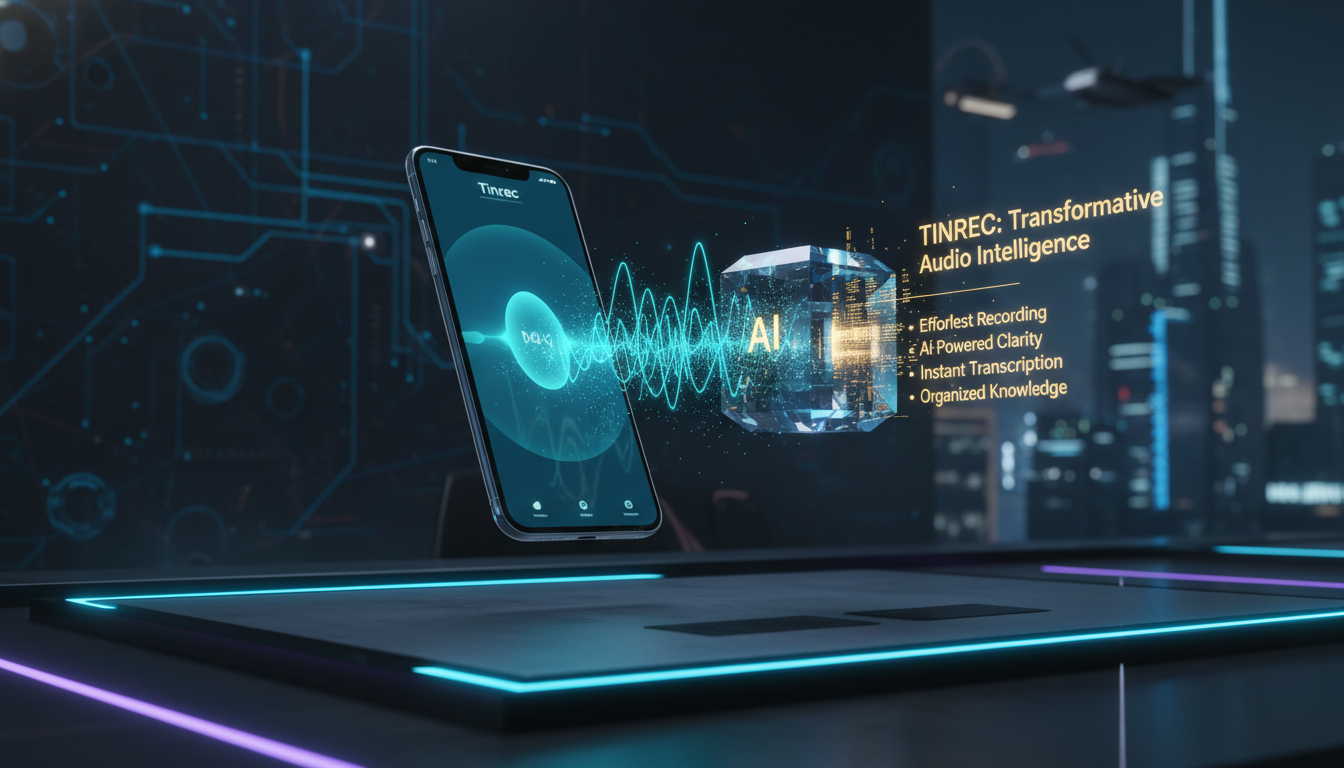
Tinrec (Instant Voice Recorder) Deep Dive: From Recording to Action
Among the many tools, Tinrec has a unique design philosophy—it's not just a transcription tool, but emphasizes retrieval and application. Here are key features in real work scenarios:
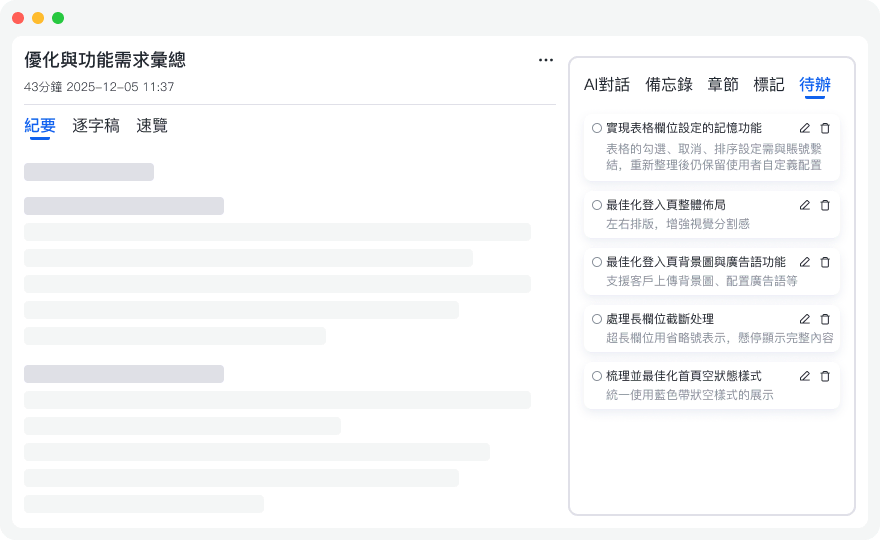
1. More Than a Transcript: A Decision Aid
Tinrec solves the problem of traditional transcripts that make you miss the forest for the trees. After transcription, it uses AI to analyze context and generate structured meeting minutes and action items. This means you don't need to read the entire transcript; just look at the AI-extracted conclusions to start working.
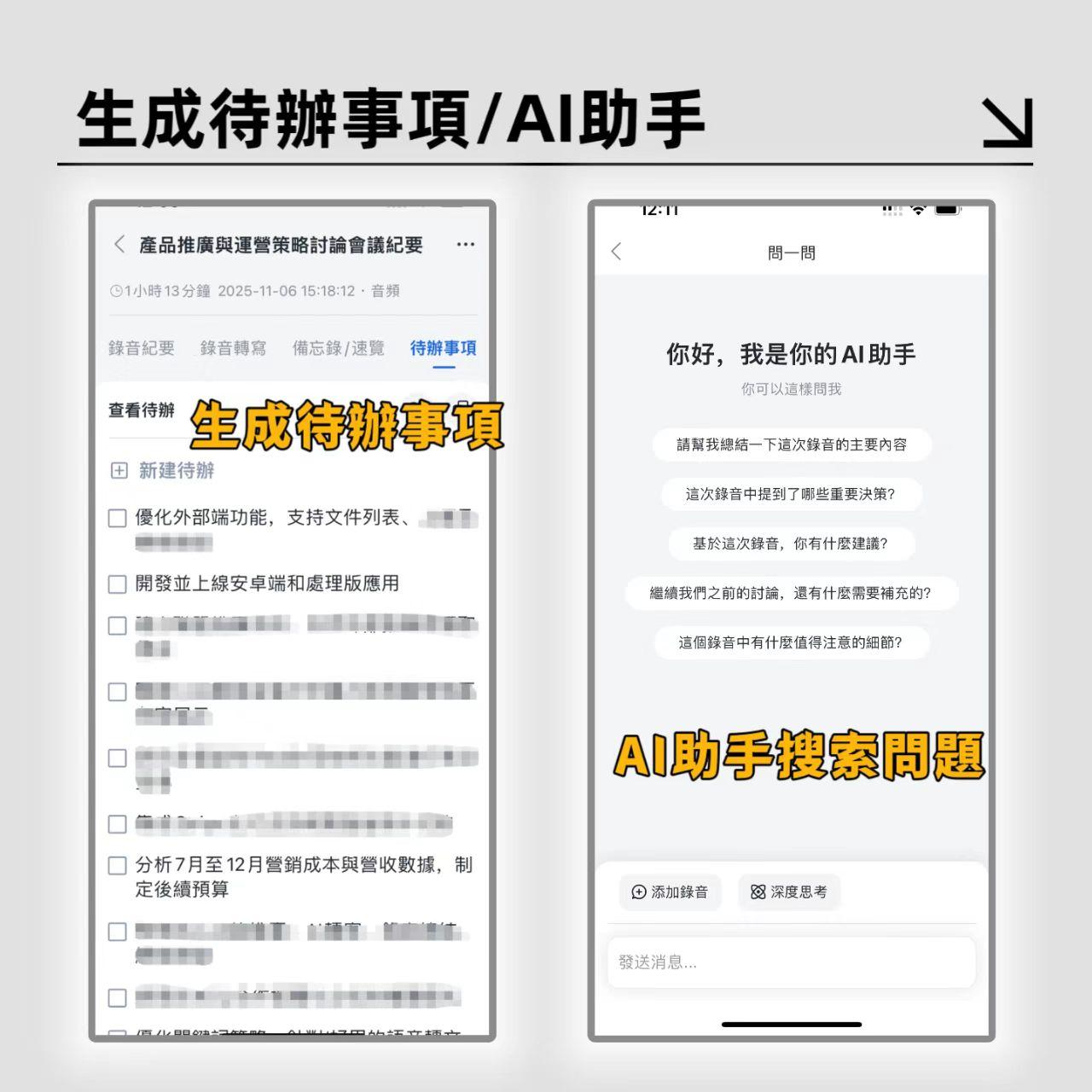
2. Query Recording Content Like Asking a Person
This is the biggest difference from traditional tools. Traditional tools only allow Ctrl+F keyword search, but if the speaker uses different wording, you can't find it. Tinrec has a built-in AI Q&A feature. You can ask directly: "What was the project manager's conclusion on the budget?" or "What are the key exam points mentioned in this lecture?" The AI answers based on the recording, drastically reducing information retrieval costs.
3. Diverse Input: Even Videos Can Be Transcribed
Besides live recording and uploading audio files, Tinrec also supports direct input of YouTube or podcast URLs. This is especially useful for content creators who need to organize online course notes or competitor analysis, eliminating the tedious step of downloading files.
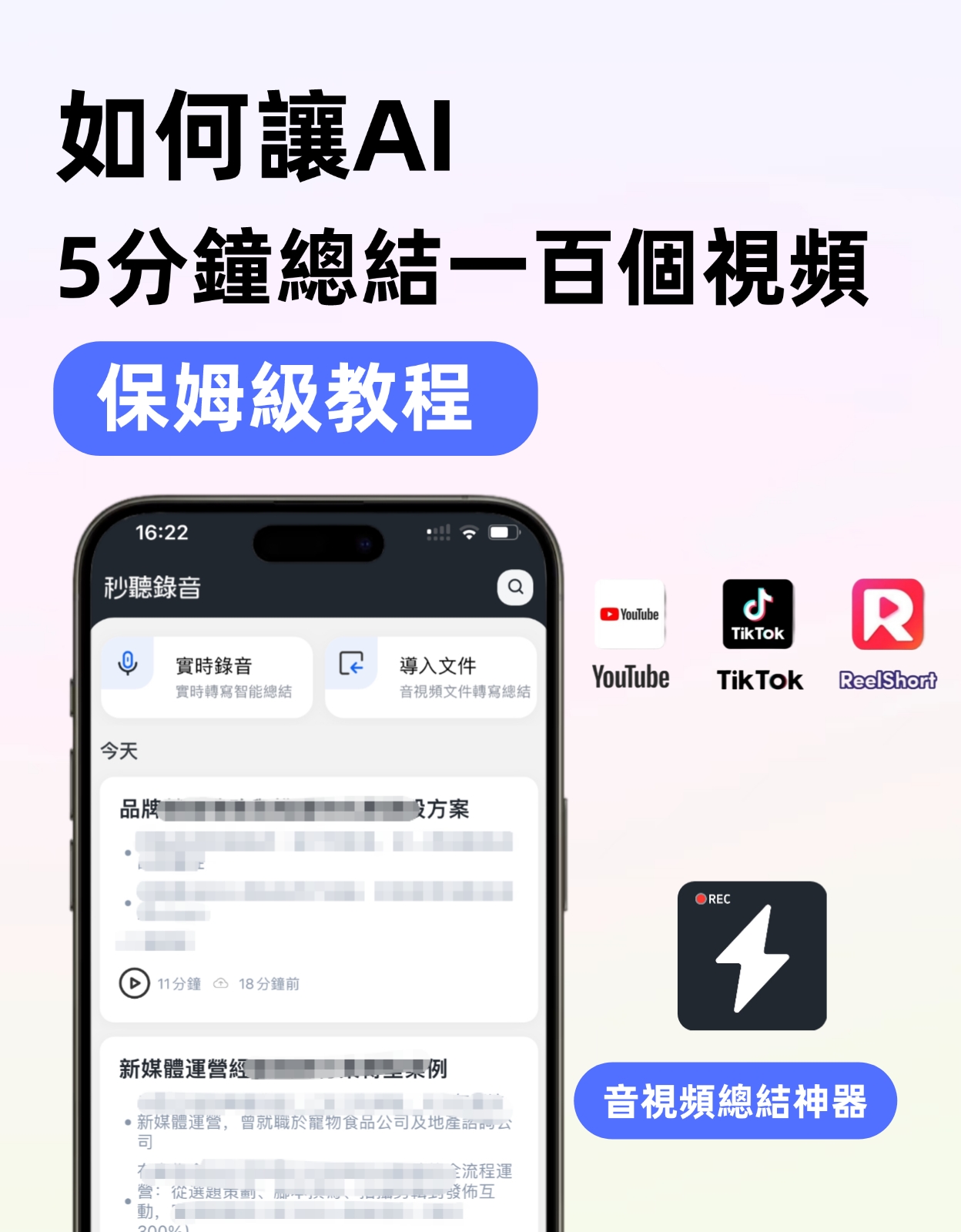
Practical Tutorial: How to Complete Meeting Notes in 3 Steps with AI Tools
Below, we use Tinrec's interface as an example to show how to turn a chaotic meeting into clear documents. Most similar AI tools follow a similar workflow.
Step 1: Choose Recording or Import Mode
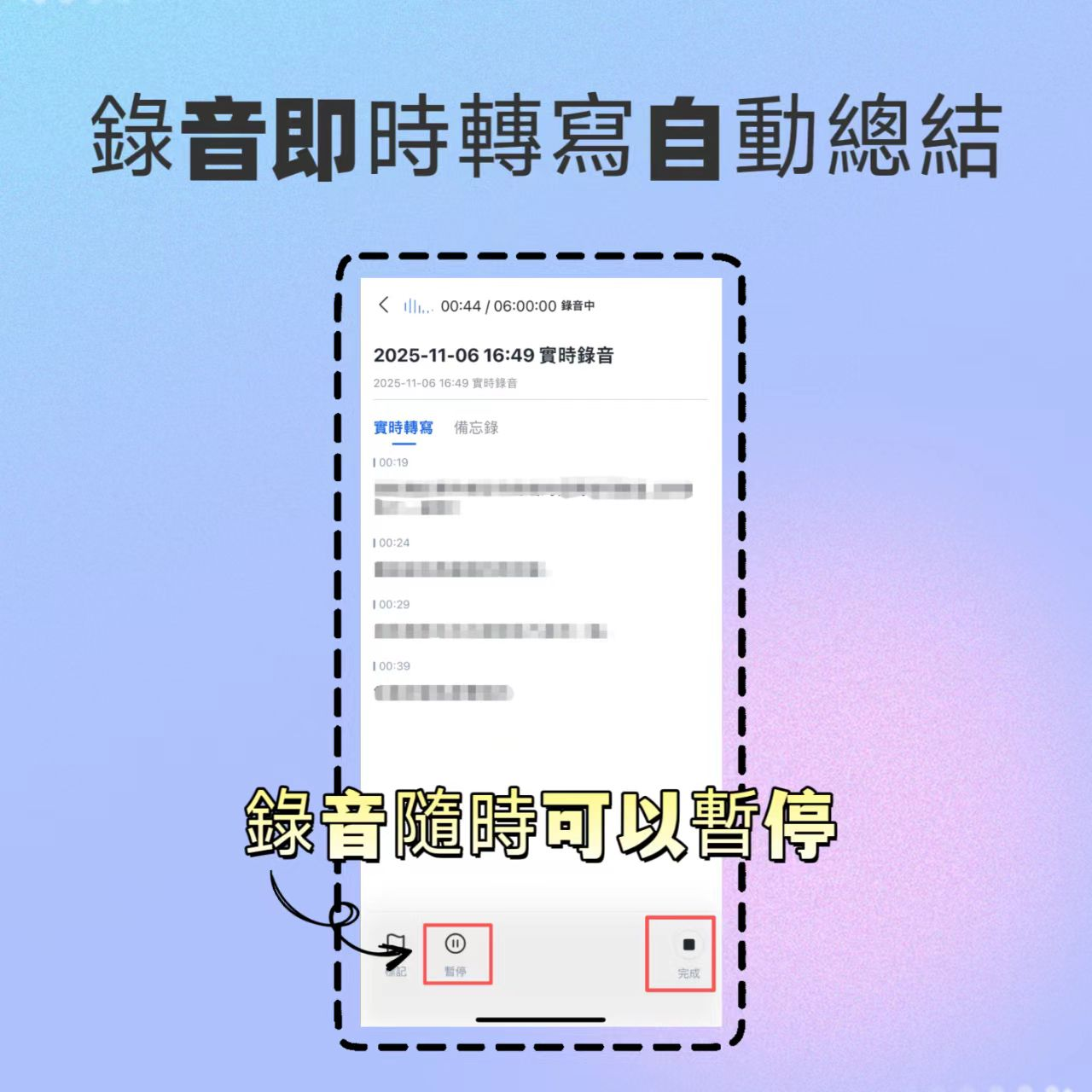
- Live Meeting: Open the app or web version, click Real-time Transcription. This mode supports "transcribe while recording," showing text line by line as you record, ideal for scenarios needing instant confirmation.
- Existing File: If you already have an audio file from a recorder, select Audio File to Text and drag the file to upload. Tinrec supports speaker diarization, automatically identifying different speakers' sections.
Step 2: AI Smart Analysis and Summary
After recording ends, the system automatically transcribes. Don't just stare at the transcript; click the "AI Summary" feature. The system will produce:
- Full Summary: A one-line overview of the meeting's key points.
- Section Breakdown: Automatic segmentation by topic.
- To-Do Items: A list of who should do what by when.
Step 3: Dialog-Based Detail Confirmation
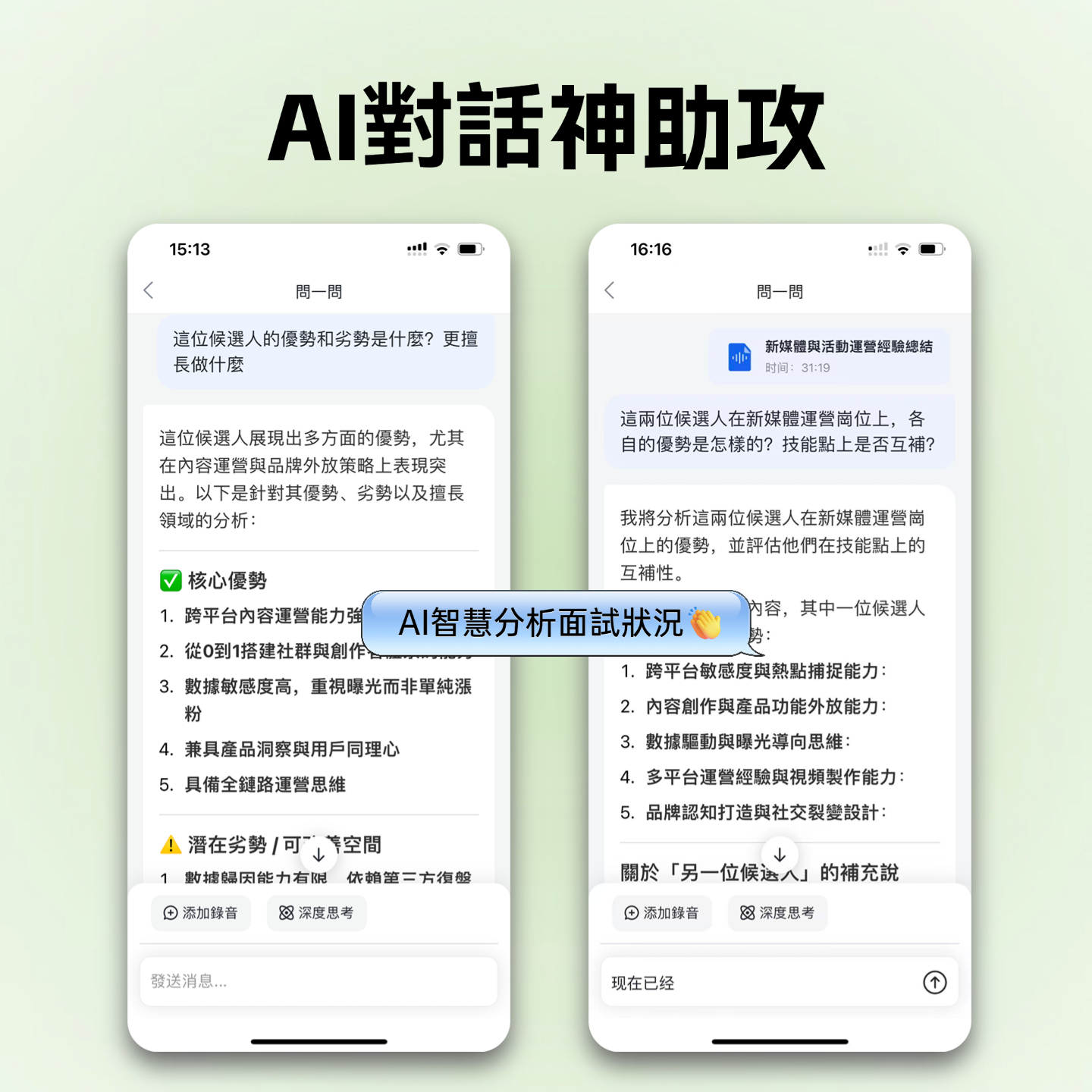
If some details in the summary are unclear, no need to replay the audio. Use the AI Q&A feature. Type your question in the chat box, such as: "What was the outcome of the discussion on the marketing budget?" The system will search the recording and provide an answer.
Frequently Asked Questions (FAQ)
Q1: Are there usage restrictions on iPhones?
Most mainstream AI recording apps (like Tinrec, Notta) support iOS, Android, and web synchronization. However, due to iOS privacy restrictions, third-party apps usually cannot directly record internal audio from phone calls or LINE calls—they can only record ambient sound from the microphone.
Q2: How many free minutes do free plans offer? Are they enough?
It varies. For example, Tinrec's free plan offers 100 minutes of recording per month, suitable for occasional meetings or interviews. Notta and other tools offer similar free minutes. If you are a heavy user (e.g., journalist, executive assistant), consider a paid plan to unlock unlimited recording or advanced export features.
Q3: How accurate is the transcription? What about dialects?
Current mainstream AI models achieve over 95% accuracy for Chinese. For dialects, some tools (like Tinrec supporting Taiwanese and Cantonese) are specially optimized. However, in very noisy environments or when multiple people speak over each other, accuracy may drop. It's best to stay close to the audio source when recording.
Q4: Can I transcribe Google Meet or Teams meetings directly?
Yes. Two methods: one is to use the web version's recording feature (with system audio recording permission); another is to use tools with a "virtual bot" that joins the meeting. Tinrec's web version is suitable for recording while on a computer meeting, directly generating notes.
Q5: Is it safe to upload data to the cloud?
This is a major concern for enterprise users. When choosing a tool, check its privacy policy. Reputable paid software usually promises not to use user data for purposes other than model training and offers the option to delete data. If you have highly confidential needs, consider on-premise solutions.
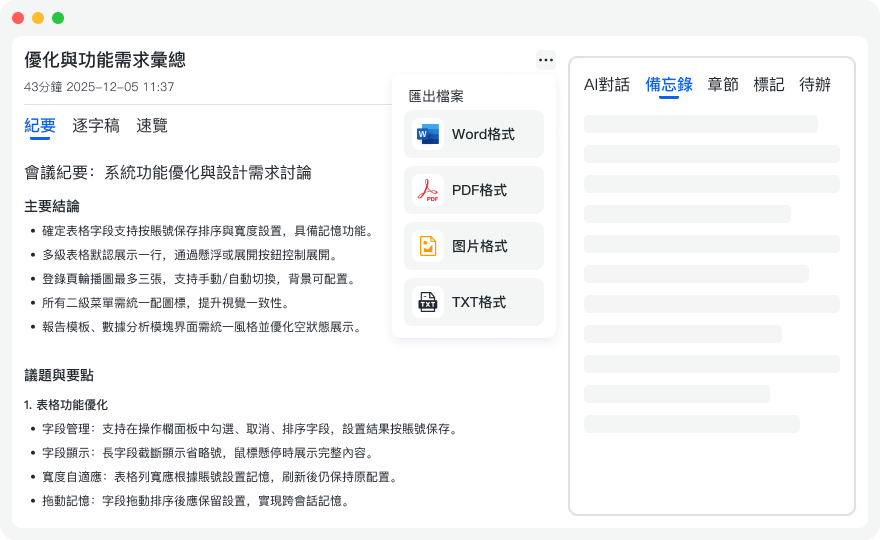
Q6: What export formats are supported?
For ease of editing, professional tools typically support export to TXT, Word, PDF, and SRT subtitle files with timestamps. Tinrec supports multiple format exports, making it easy to paste text into Notion or Word for further report editing.
Turn every recording into actionable outcomes
Get 60 free transcription minutes when you sign in. No credit card required.
Related Reading
You might also like

5 Best AI Meeting Note Tools Tested in 2026: Can You Take Accurate Chinese Meeting Minutes Without a Bot?
Meetings are tiring enough; taking minutes afterward is even more so. This hands-on comparison of 5 AI meeting note tools, including Tinrec, Granola, Otter.ai, and Notta, shows you how to choose and use them to turn Chinese meetings into searchable, collaborative action items—no meeting bot required.

How to Use AI Meeting Notes in 2026: 5 Steps from Recording to AI Summary
Still typing meeting minutes by hand? This article tests Tinrec to show you how to complete recording-to-text, AI summary, and to-do organization in 5 steps, and compares it with Notta and other tools to explain why Tinrec is better suited for Hong Kong professionals.

2026 Meeting Transcription Comparison: Tinrec's Bot-Free Recording, AI Summaries, and Team Collaboration
How to choose a meeting transcription tool in 2026? This article focuses on Tinrec, comparing Otter, Notta, and Granola, and explains bot-free recording, AI summaries, team collaboration, and key pitfalls to avoid.

How to Download Speech-to-Text in 2026? A Complete 5-Step Guide
Looking for a speech-to-text tool in 2026? Tinrec helps you convert recordings to text and download transcripts in 5 steps, with buying tips and FAQs. A must-read for professionals.
2026 Hands-On Comparison of 3 AI Meeting Recorder & Transcription Tools: Which AI Meeting Notes Actually Save You Time?
A mid-level manager tests 3 AI meeting recording and transcription tools, covering bot-free recording, Chinese speech recognition, AI summaries, and team collaboration, to reveal which one is most worth using.

5 Best AI Meeting Recorder & Transcription Tools in 2026: A Hands-On Comparison for US Professionals
A mid-level manager tests meeting transcription tools, sharing real-world experience with Tinrec to show how AI meeting notes can save hours of post-meeting work, plus buying tips and practical use cases.

2026 Test: Tinrec vs Plaud Note for Chinese Meeting Transcription – Which Is Better?
Addressing common pain points from Dcard about recording-to-text, this comparison reviews Tinrec's instant recording and Plaud Note's meeting transcription, AI summarization, cross-device support, and pricing to help you decide between a hardware recorder and an AI meeting tool.

2026 Hands-On Review of 3 Meeting Transcription Tools: Which Is Best for Chinese Meetings?
Many people think meeting transcription is just about recording with a free app, only to end up with a huge block of text that still needs manual cleanup. This hands-on review focuses on Tinrec, showing you how to choose an AI meeting notes tool that truly saves time, and compares 3 common solutions on the market to help you make the right purchasing decision.

The Complete Guide to Converting Meeting Recordings to Text in 2026: Use Tinrec to Auto-Generate Transcripts, Summaries, and Action Items
Still manually transcribing meeting recordings? This article introduces how Tinrec can help you quickly convert meeting recordings into text, automatically generate summaries, chapters, and action items, and support AI Q&A, multi-format export, and team collaboration, so you no longer have to re-listen to recordings word by word.