
Turn recordings into transcripts and summaries in minutes
Upload audio or video for multilingual transcription, AI notes, and action items
Faced with hour-long YouTube lectures, interviews, or course videos, do you also find it too time-consuming to "re-listen" and wish you could directly get a text transcript? Many people try to find tools that automatically generate transcripts, but they often get stuck on issues like "the video has no CC subtitles," "low Chinese recognition accuracy," or "can't operate on mobile."
This article tests and organizes popular AI transcription tools on the market, comparing their performance in handling videos without subtitles, real-time summarization, and multilingual support. If you value "free credits" and "data integration," consider Google's solution; if you're a heavy Apple ecosystem user, Mac-specific tools might be the first choice; and if you need a cross-device (phone/computer) solution with AI chat functionality, this article also provides corresponding options.
Why You Need Professional Video-to-Text Tools?
Although YouTube's built-in caption function is convenient, it often has the following shortcomings for learning and work purposes:
- Lack of structure: Built-in captions are usually a stream of text without paragraphs and with messy punctuation, making them hard to read.
- Cannot distinguish speakers: In interview videos, it cannot identify who is speaking.
- Dependent on creator settings: If the creator hasn't enabled CC subtitles, many third-party tools become useless.
- Lack of follow-up actions: A plain text transcript cannot automatically generate "summaries" or "mind maps," requiring manual organization.
Therefore, choosing an AI tool that can "understand" audio and convert it into structured notes is key to improving information absorption efficiency.
Review of 5 Popular YouTube Video-to-Text Transcription Tools
Below are 5 carefully selected tools covering different use cases. You can choose based on your device and needs.
1. NotebookLM (Best for Data Integration & Learning)
An AI note-taking tool from Google, its biggest feature is being completely free and requiring no installation. It can not only convert YouTube videos to text but also serve as a "knowledge base" source for queries.
- Pros: Very fast (an 8-minute video takes about 1 minute), works without CC subtitles, fully cloud-based.
- Cons: Very long videos (e.g., several hours) may fail to transcribe, and its focus is more on "organization" than pure transcript output.
2. MacWhisper (Top Choice for Mac Users)
A powerful application designed for macOS, using OpenAI's Whisper model to perform computations locally.
- Pros: High privacy (data stays on your computer), supports videos without subtitles, can distinguish speakers, supports exporting to SRT/PDF and other formats. Chinese recognition accuracy is very high with the Pro version.
- Cons: Only available for Mac computers, and high-precision models consume significant disk space and computing power.
3. Glasp (Lightweight Browser Extension)
If you don't want to leave the YouTube page, Glasp is a Chrome/Safari browser extension that displays transcripts directly next to the video.
- Pros: Intuitive to use, generates summaries directly in the side panel on the page, supports one-click copying of content to other AI tools.
- Cons: Major drawback: heavily relies on the video's CC subtitles. If the video has no subtitles or cannot automatically generate English translations, Glasp cannot work.
4. Tinrec (Cross-Platform & Mobile Solution)
Tinrec (Miao Ting Lu Yin) is a multi-platform tool supporting iOS, Android, and web. Besides basic recording-to-text, it offers a dedicated import feature for "online videos" and emphasizes an "AI chat query" function.
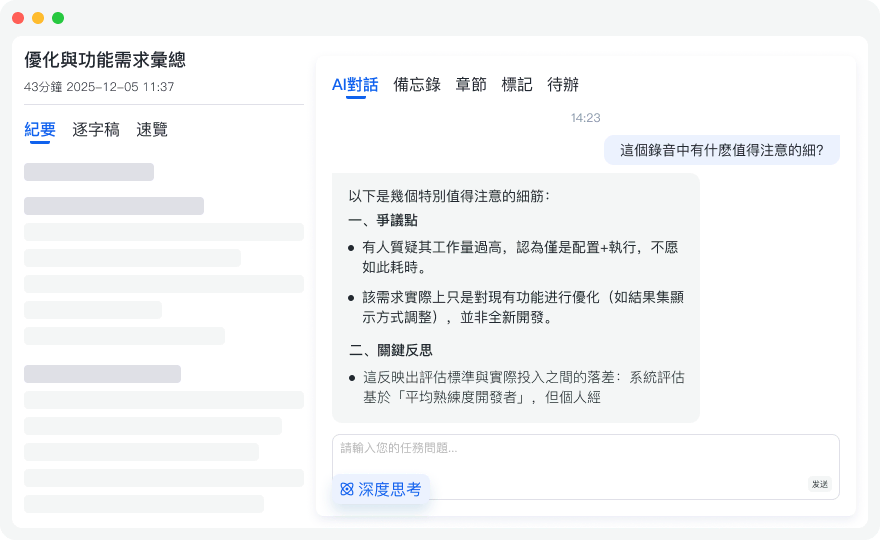
- Pros: Not limited to computers; works on mobile. Supports converting YouTube links directly to text and summaries, and has an "AI Chat" feature that lets you query video content like asking a person (e.g., "What are the three conclusions mentioned in the video?").
- Cons: Free users have a monthly recording time limit (100 minutes); heavy users may need a subscription.
5. tactiq.io (Online Meeting & Simple Transcription)
A no-installation, no-registration online service suitable for users who need quick content extraction.
Stop organizing recordings by hand
Upload audio or video and automatically get a transcript, summary, and action items
- Pros: Just paste a link on the webpage to generate transcripts, simple interface.
- Cons: Highly dependent on subtitles (must have CC), and based on testing, support for non-English subtitles (e.g., Chinese) is poor, often failing to capture them.
2026 In-Depth Tool Comparison Table
To help you choose more intuitively, here is a comparison based on key dimensions:
| Dimension | NotebookLM | MacWhisper | Tinrec (Miao Ting Lu Yin) | Glasp | tactiq.io |
|---|---|---|---|---|---|
| Platform Support | Web | macOS only | iOS / Android / Web | Browser extension | Web / Extension |
| No-Subtitle Videos | ✅ Supported (AI audio transcription) | ✅ Supported (local processing) | ✅ Supported (cloud recognition) | ❌ Not supported | ❌ Not supported |
| Chinese Accuracy | Good | Very high (Pro version required) | Very high (multilingual recognition) | Depends on YouTube subtitles | Poor |
| AI Value-Added Features | Note integration, mind maps | Requires API integration | AI chat, summaries, action items | Summary generation | Summary generation |
| Best Use Case | Students/research organization | Professional editing/Mac users | Cross-device/meetings/mobile notes | Quick video browsing | Temporary English-to-Chinese |
Practical Tutorial: How to Convert YouTube Videos into Actionable Notes
Different tools have different workflows. Below, using "converting a lecture video without subtitles into key notes" as an example, we explain how to operate.
Method 1: Using MacWhisper (Best for Heavy Desktop Processing)
- Download and install MacWhisper.
- Copy the YouTube URL and select the "Open URL" function.
- The software will download the audio and start transcription (speed depends on computer performance).
- After transcription, edit speaker names and export as Word or Markdown format.
Method 2: Using Tinrec (Best for Mobile/Cross-Platform Quick Access)
If you're on the go with only your phone, or don't want to install large software, use this process:
- Copy link: In the YouTube app, copy the link of the video you want to organize.
- Paste and import: Open Tinrec (web or app), go to the "Podcast/Online Video to Text" section, and paste the URL.
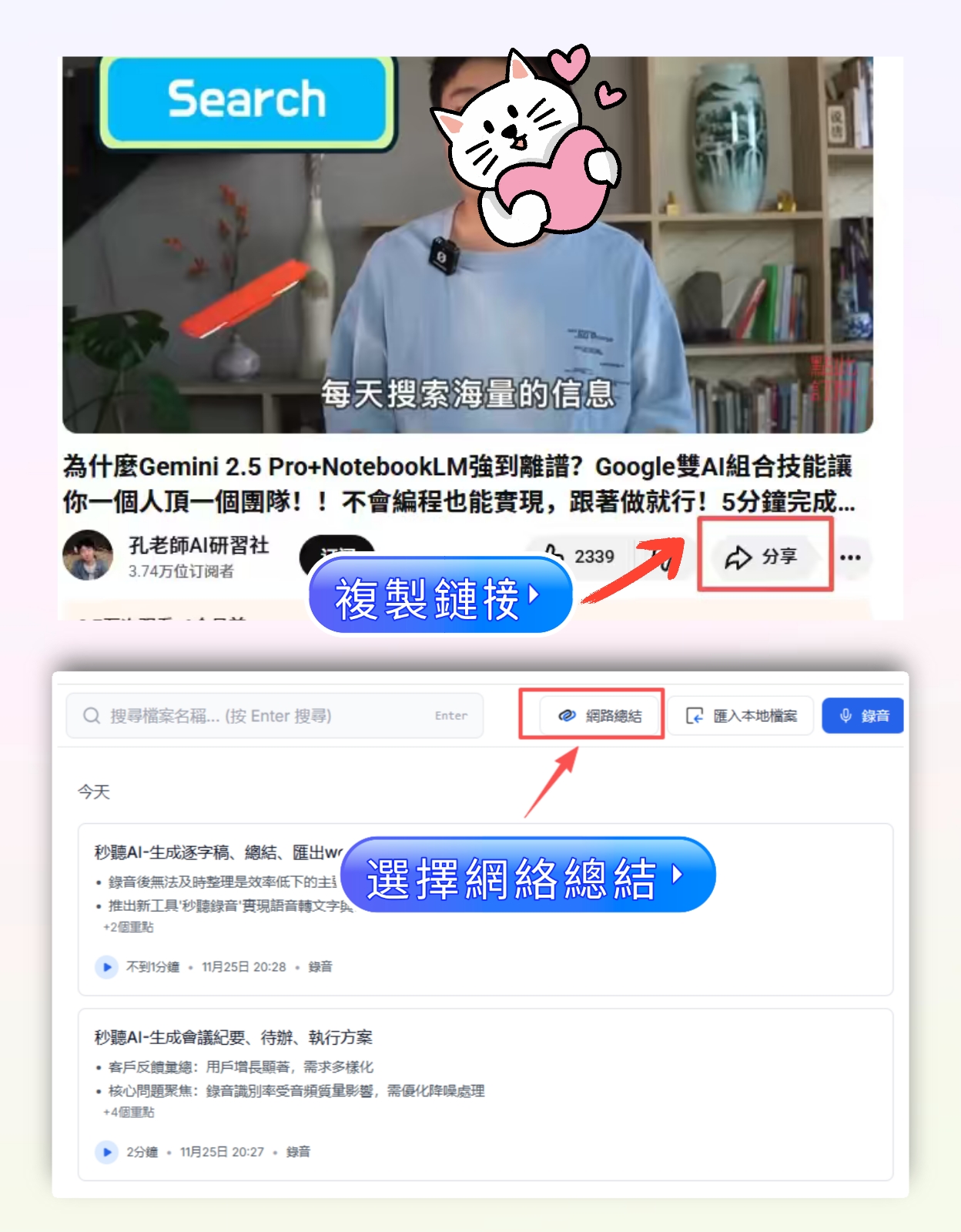
- Wait for generation: The system will automatically transcribe in the cloud without consuming phone performance.
- AI chat query: After obtaining the transcript, if the content is too long, use the "AI Chat" feature and enter commands like "Summarize the 3 marketing strategies mentioned in this video" to quickly extract information.
Method 3: Using Glasp (Best for Quick Browsing)
- Install the Glasp browser extension.
- Open the YouTube video page.
- Click the Glasp panel that appears on the right, and confirm the video has CC subtitles.
- Click Copy Transcript to copy the text.

Frequently Asked Questions (FAQ)
Q1: Why can't some tools convert my YouTube video? Usually because the tool (like Glasp, tactiq.io) relies on YouTube's CC subtitle system. If the creator hasn't uploaded subtitles, these tools won't work. In such cases, switch to tools with "speech recognition models" like MacWhisper or Tinrec.
Q2: Do these tools support iPhone or Android phones? Most extension-based tools (Glasp) only work on desktop browsers. MacWhisper is Mac-only. If you need to operate on mobile, choose services that support both web and app, such as Tinrec or open NotebookLM in a mobile browser.
Q3: Can the generated transcript be exported as a subtitle file (SRT)? MacWhisper and Tinrec usually support exporting text with timestamps as SRT format, making it convenient for creators to import directly into editing software. NotebookLM focuses more on plain text note organization and doesn't easily export subtitle files.
Q4: Is the free version sufficient? If you're a light user, NotebookLM is a completely free and good choice. Tinrec offers 100 minutes of free transcription per month, suitable for occasional meeting or short video processing. MacWhisper's free version uses a smaller model with lower accuracy; professional use may require an upgrade.
Q5: How long does video-to-text transcription take? It depends on the processing method. NotebookLM and Tinrec use cloud computing; typically, a 10-minute video takes about 1-2 minutes. MacWhisper's speed depends on your computer's chip performance.
Q6: Can I directly ask questions about the transcribed text? Traditional tools only provide text, but next-generation AI tools (like NotebookLM and Tinrec) support "conversational querying." You don't have to read thousands of words; just ask the AI, "What is the conclusion of this video?" or "What is the speaker's view on topic X?" saving a lot of time.
Summary: How to Choose the Best Tool for You?
- No CC subtitles, need accurate Chinese: Prioritize MacWhisper (Mac users) or Tinrec (cross-platform users).
- Only need quick summaries, rely on browser: Choose Glasp, but ensure the video has subtitles.
- Students making reports, heavy data organization: NotebookLM is the most powerful free organization tool.
- Need mobile operation, handle meetings and videos: Tinrec's app and web interoperability offer the greatest convenience, especially for professionals who need to extract "action items" from recordings/videos.
Turn every recording into actionable outcomes
Get 60 free transcription minutes when you sign in. No credit card required.
Related Reading
You might also like

2026 Best AI Meeting Transcription Tools Compared: Which Saves the Most Time for Chinese Meetings?
Starting from the decision of which recording-to-meeting-notes tool to choose, this hands-on comparison evaluates Tinrec, Otter.ai, Notta, and Granola on meeting recording methods, Chinese and mixed Chinese-English processing, post-meeting organization, and team collaboration. It also covers 4 key buying factors, 4 common pitfalls, and scenario-based recommendations.
5 Cantonese Speech-to-Text Tools Tested in 2026: Which Saves More Time on Cantonese Transcripts and Post-Meeting Organization?
Looking for a speech-to-text tool that accurately recognizes Cantonese? This article starts with the three most common pitfalls, then covers key points for choosing a Cantonese transcription tool based on real tests, free quotas, and team pricing differences. It also uses Tinrec as an example to demonstrate the complete workflow from recording and transcription to summaries, action items, and team knowledge retention.

2026 Meeting Notes App Comparison: Which AI Summarizer Saves Managers the Most Time?
A mid-level manager leading a 10-person team and attending 15 meetings a week tested five meeting notes apps and shares the criteria for choosing one. From post-meeting organization speed, AI summaries and action items, and online meeting recording methods, to team data ownership and seat management, this explains how Tinrec works in real meeting scenarios, where its limits are, and how to choose between the free and team versions.

5 Best AI Meeting Transcription Tools in 2026: Which Free Plan Is Most Generous?
Tired of replaying meeting recordings to write notes? We break down 5 key factors for choosing an AI meeting transcription tool and compare Tinrec, Granola, Notta, and PLAUD on transcription, AI Q&A, action item extraction, and team collaboration. We also cover free plan limits, pricing, and common pitfalls to help you pick the most time-saving option.

Tinrec vs PLAUD Note 2026: 5-Dimension Comparison — Which Is More Complete for Meeting Transcripts and Post-Meeting Organization?
The biggest pitfall with meeting recording transcripts isn't audio quality — it's that the text gets ignored after transcription. This article compares Tinrec and PLAUD Note across 5 dimensions: meeting capture methods, post-transcript organization, file import and cross-device support, team collaboration and governance, and cost structure, helping you decide between a software workflow and recording hardware.

2026 Top 5 Real-Time AI Meeting Notes Compared: Tinrec vs Notta vs Plaud — Which One Should You Choose?
The real pain point of meeting notes isn't whether they can be transcribed, but how to use them after transcription. This article starts with common misconceptions, outlines the positioning of 5 highly discussed real-time AI meeting note tools, and focuses on the differences between Tinrec, Notta, and Plaud. It compares meeting capture methods, post-meeting outputs, audio retention, team governance, and pricing plans to help you decide which one fits your meeting scenario.

2026 AI Meeting Notes Guide: Tinrec's Bot-Free Recording & Auto-Generated To-Dos
How do you choose an AI meeting notes tool? This article examines Chinese recognition, recording methods, post-meeting organization, and team data ownership, comparing Tinrec, Notta, Otter.ai, and Granola, plus four common pitfalls to help you find a solution that truly saves time after meetings.

5 Best Meeting Notes Apps of 2026: Which Free Version Is Actually Enough?
Still spending an hour after every meeting writing up notes? This comparison puts five common meeting notes app approaches side by side—covering Chinese recognition, how meetings are captured, post-meeting organization, team permissions, and pricing—and explains how Tinrec handles recording, transcription, summaries, action items, and AI Q&A within its free tier.

2026 Meeting Recording Tools: Bot-Free Recording + AI Action Item Management
A mid-level manager who attends 15 meetings a week shares hands-on insights: starting from the decision point of whether to let a meeting bot join, this article breaks down 4 key factors for choosing a meeting recording tool, and explains the real-world experience, limitations, and use cases of Tinrec's desktop bot-free recording, AI summary and action items, Q&A, and team plan roles and seat management.