
Turn recordings into transcripts and summaries in minutes
Upload audio or video for multilingual transcription, AI notes, and action items
Have you ever spent 3 hours pausing, rewinding, and typing just to transcribe a 1-hour YouTube interview or online course? For content creators, students, or professionals who need to organize meeting notes, converting video to text is an essential productivity tool. However, many tools on the market have inconsistent recognition accuracy for Traditional Chinese, or offer very limited free credits.
This article will review 7 popular YouTube to transcript tools in 2025, comparing them across dimensions such as Traditional Chinese accuracy, AI summary capabilities, editing convenience, and free plans, along with a detailed specification comparison table.
Quick Buying Guide:
- If you need to create video subtitles (SRT): Prioritize Vidnoz AI or Veed.
- If you need to turn videos into notes/action items/knowledge base: Try Tinrec (Miao Ting Lu Yin).
- If you need a real-time browser extension: Tactiq is a good choice.
Why Do You Need a YouTube to Transcript Tool?
In the age of digital content explosion, converting YouTube videos to text is not just about "watching subtitles"—it brings real traffic and efficiency benefits:
- Boost Video Reach: According to actual test data from Discovery Digital Networks, adding subtitles to videos increased views by 13.48% within 14 days, and long-term views grew by 7.32%.
- Enhance SEO Performance: Search engines can't "listen" to videos, but they can "read" subtitles. Tests by software company SafeNet showed that videos with transcripts saw significant search ranking improvements within two weeks, even reaching the first page.
- Perfect for Pro Creation and Learning: For creators, transcripts can be quickly turned into blog posts; for students and researchers, it's a necessary step to structure audiovisual content into notes.
2025: Comparison of 7 Selected YouTube to Traditional Chinese Tools
Based on features and use cases, here are 7 tools worth considering:
1. Tactiq: The Browser Extension Lifesaver for the Lazy
Best for: Light users who need instant subtitles. Tactiq is a "completely free" YouTube-to-text tool (primarily as a browser extension). Users simply paste a video link or activate it during playback to generate a transcript via ASR technology. Its advantages include no registration required and one-click copy and download as TXT, making it suitable for quick, informal recordings.
2. Vidnoz AI: The One-Click Subtitle Tool for Creators
Best for: Creators who value video production and multilingual translation. Vidnoz AI boasts up to 99.8% accuracy and multilingual support. It automatically identifies speakers and adds punctuation to subtitles, saving hours of post-production. Besides transcription, it offers AI tools like text-to-video, making it creator-friendly for outputting SRT or JSON formats.
3. Tinrec (Miao Ting Lu Yin): From "Transcription" to "Knowledge Management" AI Assistant
Best for: Professionals and students who need to turn recordings/videos into notes, action items, and decision summaries.
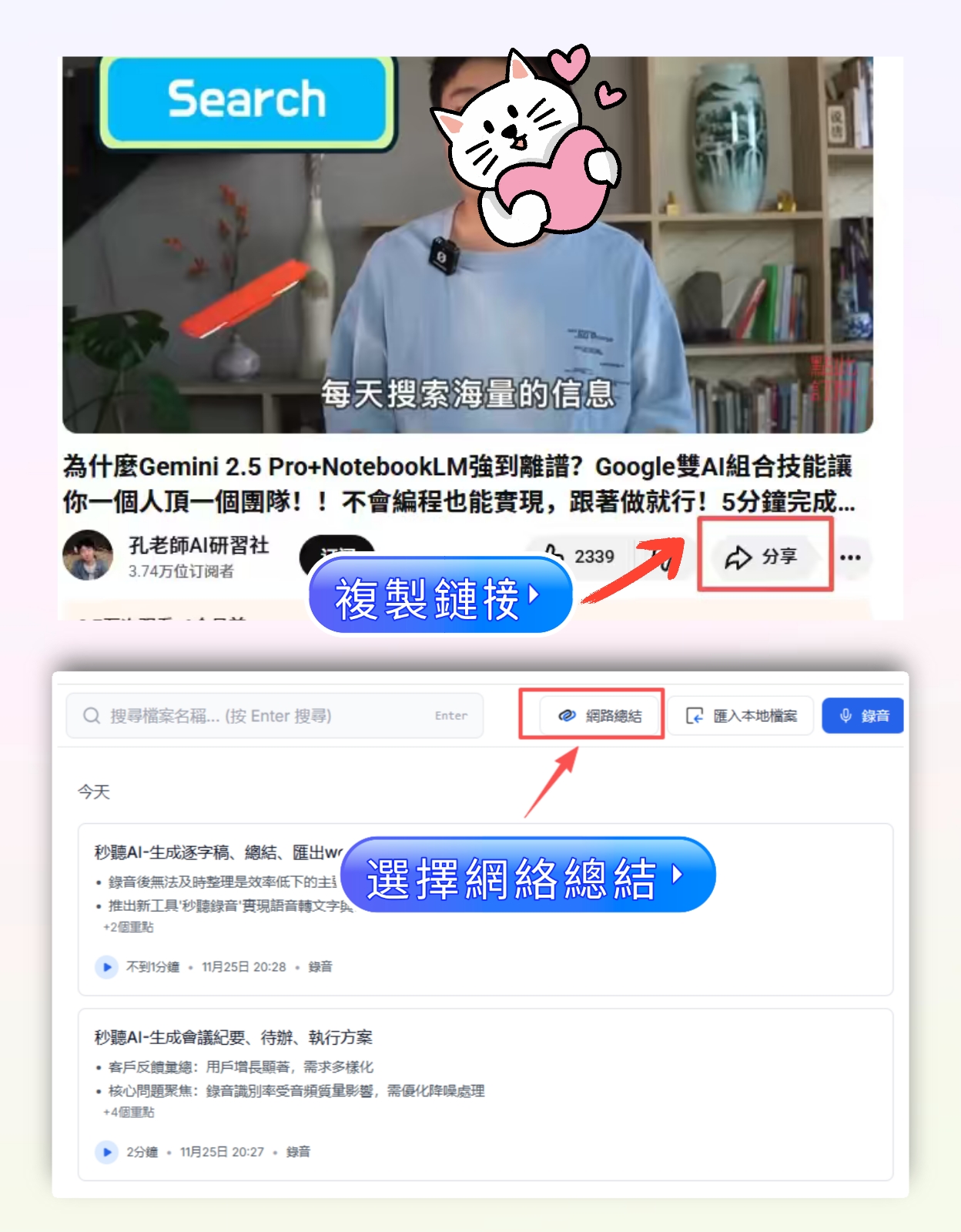
Unlike tools that only provide transcripts, Tinrec focuses on "understanding" and "application." It supports parsing YouTube video links directly into text and automatically generates key summaries and action items using AI. Tinrec supports Traditional Chinese, Taiwanese Hokkien, Cantonese, and more, making it ideal for organizing long interviews or online courses.
Key Differentiators:
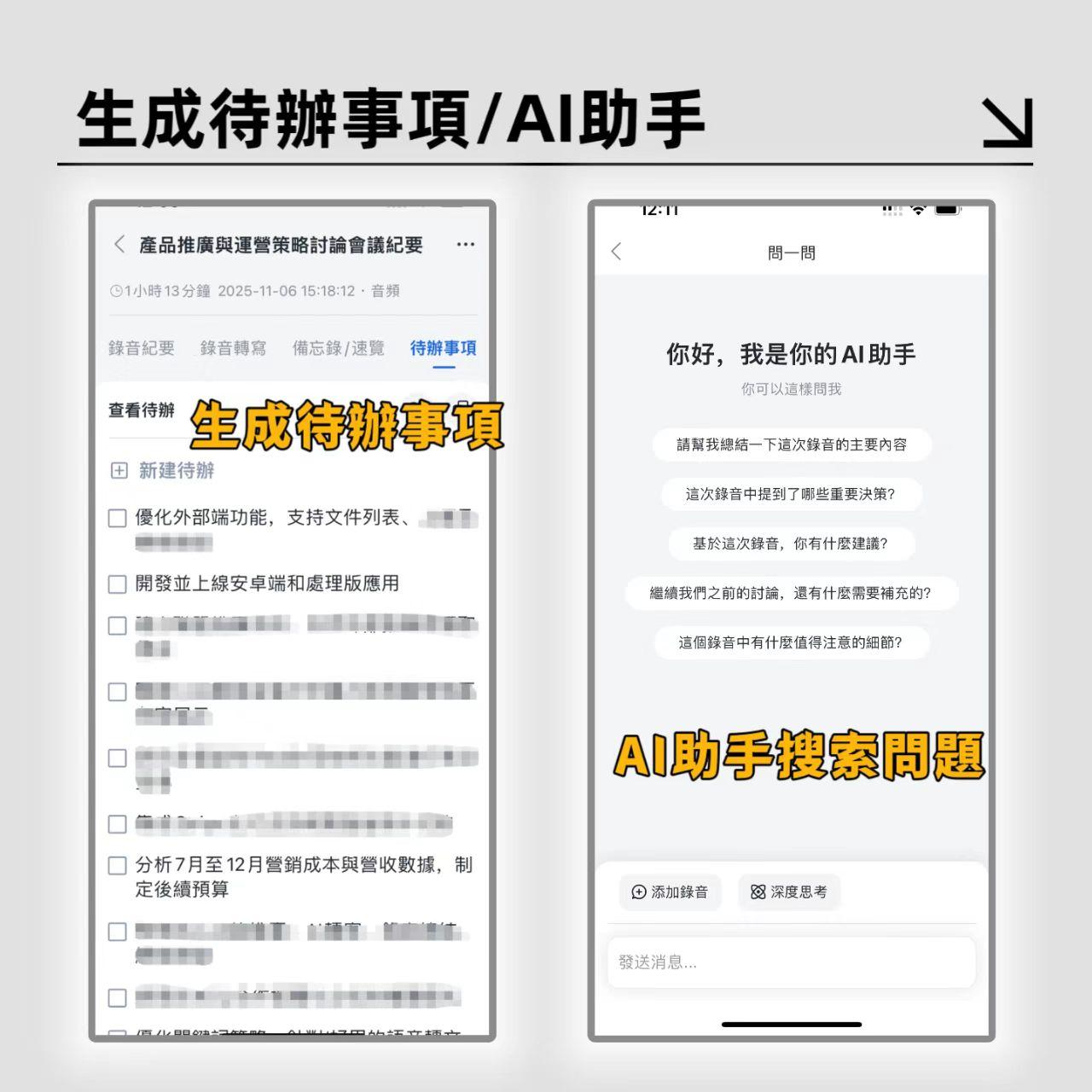
- AI Chat Query: No need to Ctrl+F through the transcript; directly ask AI like "What is the conclusion about market trends in this video?" and the system answers based on content.
- End-to-End Workflow: From recording/link import → transcript → key notes → share/export, all in one seamless flow.
Stop organizing recordings by hand
Upload audio or video and automatically get a transcript, summary, and action items
4. Maestra AI: Multi-Function Dubbing and Translation
Best for: Teams with multilingual dubbing needs. Maestra AI excels at automatically translating transcripts into 125+ languages and even generating voiceovers. While some advanced features require payment, its speaker identification and timeline markers are very clear.
5. GitMind: Visual Mind Map Organization
Best for: Users who prefer visual learning. GitMind, besides transcription, offers a unique "speech-to-mind-map" feature that structures video content, allowing users to grasp core concepts without watching the entire video.
6. Turboscribe: Bulk File Processing Expert
Best for: Enterprises that need batch processing of large audio files. Known for GPU-accelerated transcription and batch processing, supporting up to 50 files per upload. Supports 98+ languages, suitable for archiving large volumes of historical data.
7. Veed: Professional Video Editing Integration
Best for: Video editors. Veed is a powerful online video editor with transcription functionality to assist editing. Supports GPU-accelerated processing and allows direct subtitle alignment with footage within the editor.
Deep Dive: 7 Tools Specification and Feature Comparison Table
To help you decide quickly, here is a core dimension comparison table:
| Tool | Traditional Chinese Support | Core Feature | AI Summary/Action Items | Pricing/Free Strategy |
|---|---|---|---|---|
| Tinrec | Excellent (incl. Taiwanese Hokkien/Cantonese) | Real-time recording transcription, AI chat query, link parsing | Yes (auto-generated) | Free: 100 minutes/month |
| Tactiq | Average | Browser real-time capture | No | Completely free (basic features) |
| Vidnoz AI | Excellent | Subtitle generation, multilingual translation | No | Completely free |
| Maestra | Excellent | Voice dubbing, multilingual translation | No | Partial free (time-limited) |
| GitMind | Average | Voice to mind map | Yes (summary) | 30 minutes/day free |
| Turboscribe | Excellent | Batch upload, GPU acceleration | No | 3 files/day (30 min each) |
| Veed | Excellent | Integrated video editing | No | 10 minutes export/day free |
Hands-On Tutorial: How to Quickly Turn YouTube Videos into AI Notes
If your goal is not just to "read subtitles" but to "organize content," here's a workflow using Tinrec as an example to show how to turn a long video into actionable notes:
Step 1: Get the Video Link or File
First, copy the YouTube video link you want to organize, or prepare a downloaded audio/video file.

Step 2: Import and Transcribe
Go to the Podcast/Online Video to Text feature page, paste the link, and Tinrec will automatically parse the audio track and start transcribing. If you are on-site (e.g., in a class or meeting), you can use the live recording to text feature to watch the transcript generate in real-time as you record.
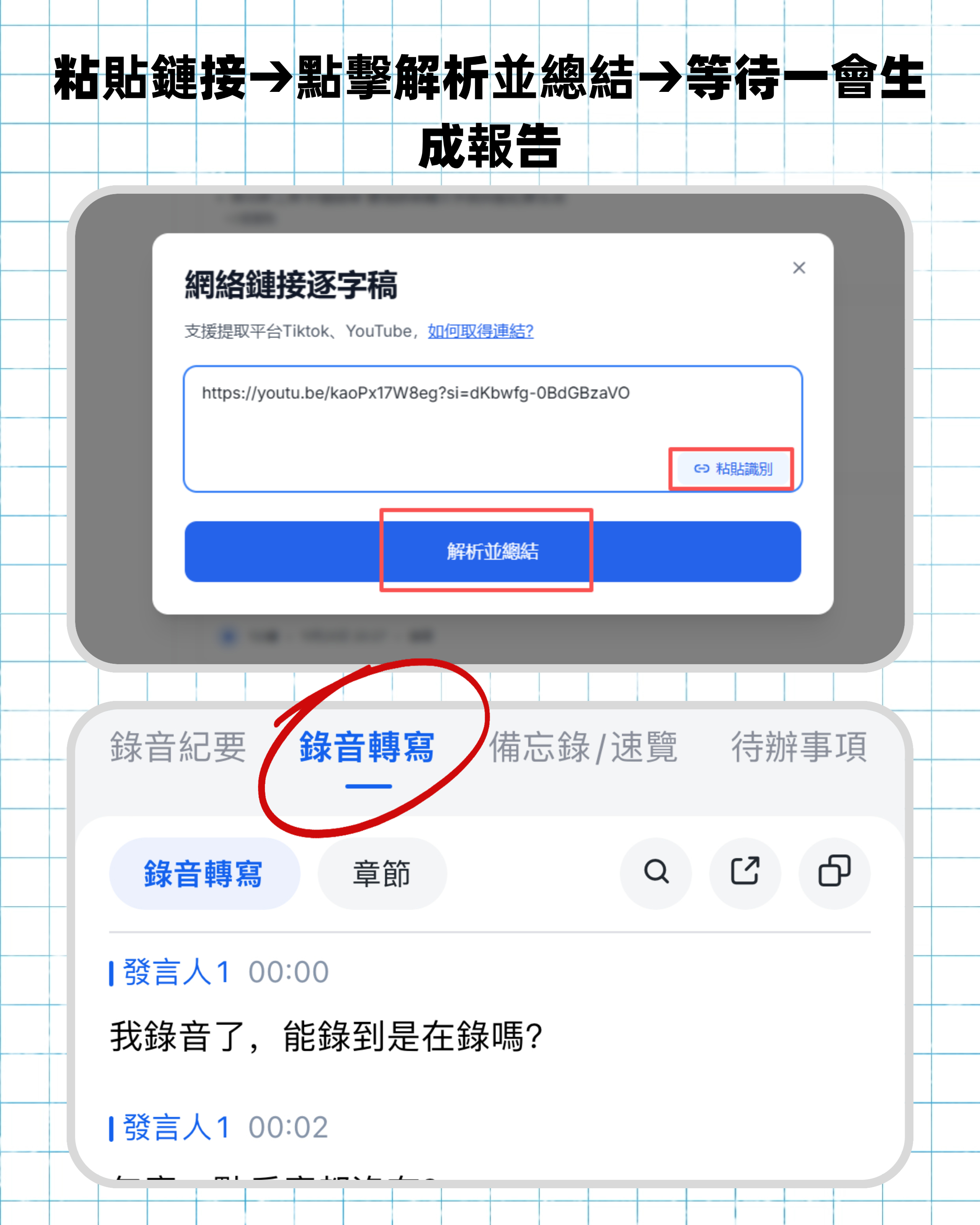
Step 3: Get AI Summary and Action Items
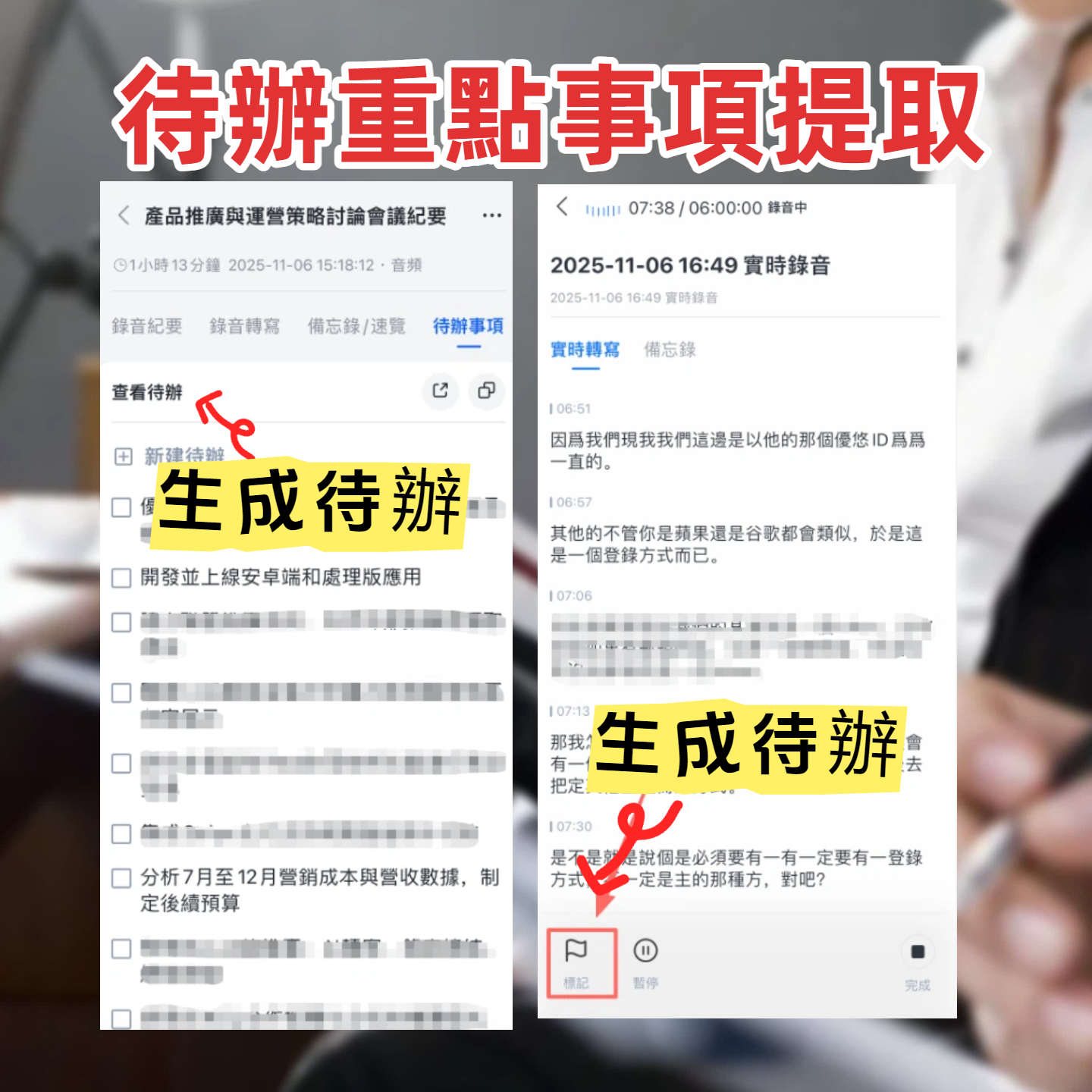
After transcription, the system automatically identifies speakers and generates an "AI meeting minutes" summary, including:
- Key Topics: Main subjects discussed in the video.
- Conclusions: The speaker's final viewpoints.
- Action Items: If the video contains teaching steps or meeting decisions, the system automatically lists what to do next.
Step 4: Use AI Chat to Query Details
If the transcript is too long and you don't want to read from start, use the AI Chat Query feature. For example, input: "What is the speaker's view on SEO trends?" The AI will search the entire recording and summarize the answer, which is more precise than traditional keyword search.
Frequently Asked Questions (FAQ)
Q1: Do these tools work on iPhone or Android phones? Most web-based tools (like Vidnoz, Turboscribe) work on mobile browsers. Tinrec additionally offers iOS and Android app support, making it convenient to record or view notes anytime, anywhere.
Q2: How accurate are YouTube to transcript tools? Modern AI tools (like Tinrec, Maestra) typically achieve over 95% accuracy, though it can be affected by background music or speaker accents (e.g., heavy dialects). Choosing tools that support Taiwanese Hokkien or specific accent recognition can improve accuracy.
Q3: Can I use these for Teams or Google Meet recordings? Yes. You can first download the meeting recording, then upload it via the "audio file to text" feature. Tinrec supports importing various audio and video formats for parsing.
Q4: What are the typical free plan limitations? Common limitations include daily transcription duration (e.g., Veed limits 10 minutes), export format restrictions, or inability to use advanced AI summary features. We recommend choosing a plan based on your usage frequency.
Q5: Can I edit the exported text? Yes, all tools recommended here (like Tinrec, Vidnoz) provide online editors to fix typos or reorganize paragraphs, and export as Word, PDF, or SRT subtitle files.
Q6: How to handle YouTube videos without subtitles? That's exactly what these tools excel at. Even if the original video has no CC subtitles, these tools generate text by "listening" to the audio, so they don't rely on YouTube's native subtitle system at all.
Turn every recording into actionable outcomes
Get 60 free transcription minutes when you sign in. No credit card required.
Related Reading
You might also like

2026 Hands-On Comparison of 4 Meeting Transcription Tools: Which AI Notes Really Save You Time?
Recent discussions on Dcard show many people struggling with two-hour meetings followed by two hours of note-taking. This article takes a purchasing decision perspective, comparing Tinrec, Otter, Notta, and PLAUD in terms of accuracy, AI summaries, cross-platform support, and free tiers to help you choose a tool that truly saves time.
5 Best Meeting Transcription Apps in 2026: Which AI Notes Really Save You Time?
We tested multiple meeting transcription tools, and Tinrec stood out for its bot-free recording, strong Chinese support, and team collaboration features—ideal for professionals who need quick meeting notes.

5 Meeting Transcription Tools Tested in 2026: Which Saves the Most Time for Chinese Meetings?
We tested multiple meeting transcription tools, evaluating Chinese speech recognition, AI summaries, action item extraction, and team collaboration to help you find the best choice for office workers.

Tinrec vs Otter 2026: 5-Dimension Hands-On Comparison – Which Is Better for Chinese Meeting Notes?
When it comes to meeting recording transcription, Tinrec and Otter are both popular choices. This article compares them across 5 dimensions: bot-free recording, Chinese transcription, post-meeting organization, team management, and pricing, to help you decide which is better for Chinese-speaking users and team collaboration.

2026 Tested: 4 Meeting Transcription Tools Compared—No More Overtime for Cantonese Meeting Notes
Tired of transcribing meeting recordings by hand? We tested Tinrec, Otter.ai, Notta, and MyEdit to find the most time-saving meeting notes solution for Hong Kong professionals in 2026.

4 Meeting Transcription Apps Tested in 2026: Which One Lets You Skip Overtime?
Spending two hours in a meeting and another two organizing notes? We tested 4 AI meeting transcription tools, focusing on bot-free recording, AI summaries, and team collaboration. Verdict: Tinrec is the best fit for Hong Kong professionals.

4 Best Speech-to-Text Tools Tested in 2026: Take Meeting Notes Without a Bot
Turning meetings, interviews, and lectures into transcripts can save hours if you use the right tool. This hands-on comparison of Tinrec, Notta, Otter, and Granola highlights key selection criteria and step-by-step usage, helping you find the best speech-to-text solution for Chinese meetings.

2026 AI Meeting Recorder Comparison: Tinrec vs Otter.ai – Which Is Better for Chinese Speakers?
Choosing the right meeting transcription tool in 2026? This hands-on comparison of Tinrec and Otter.ai covers 5 key dimensions: Chinese transcription, bot-free recording, post-meeting organization, team collaboration, and file import – helping you find the best fit for your meeting notes needs.

How to Convert Meeting Recordings to Chinese Subtitles in 2026? 5-Step Tinrec Tutorial: A Notta User's Switch Story
A hands-on tutorial on converting meeting recordings to Chinese subtitles, comparing Tinrec and Notta, with 5 steps to use Tinrec for recording, transcribing, translating, and organizing meeting notes—perfect for Hong Kong professionals.