
Turn recordings into transcripts and summaries in minutes
Upload audio or video for multilingual transcription, AI notes, and action items
After a two-hour Cantonese department meeting, facing a recording full of Chinese-English mixing (Chinglish), are you still painfully replaying and typing out every word, or are you already using AI tools to automatically generate meeting notes?
Cantonese voice recognition has always been a pain point for users, not only because of the gap between spoken and written language, but also due to the frequent "Chinese-English mixing" phenomenon in workplace communication (e.g., "Can you check that file for me?"). This renders many standard Chinese recognition tools ineffective. This article will walk you through 5 voice-to-text tools that support Cantonese in 2026, comparing them objectively across dimensions such as recognition accuracy, AI summarization capability, and free tier allowance.
Quick Navigation Conclusion:
- If you just need simple personal dictation: Prioritize your phone's built-in keyboard or Google Docs.
- If you need to organize long meetings and extract action items: Choose a tool with AI thinking capabilities (e.g., Tinrec or competitors like Otter).
- If you value file security and multi-device syncing: Look for paid plans that support cloud encryption.
Why Is Cantonese Voice Recognition So Hard? Three Common Pain Points
Before choosing a tool, we need to understand why traditional "speech-to-text" software often fails with Cantonese:
- Spoken vs. Written Discrepancy: The difference between spoken and written Cantonese is huge. If the tool directly transcribes into colloquial characters (e.g., "嘅", "喺"), it often requires secondary editing in formal documents.
- Code-Switching: The communication habits of Hong Kong and overseas Chinese heavily mix English terms. Single-language model tools often recognize English words as similar-sounding Chinese gibberish.
- Lack of Semantic Summarization: Traditional tools just give you 10,000 words of verbatim transcript, which doesn't help efficiency. You need "conclusions" and "to-do items."
Top 5 Cantonese Transcription Tools in 2026: Comparison
Addressing the above pain points, we selected 5 different types of tools for a side-by-side comparison, including professional AI tool Tinrec, free tool Google Docs, and tech-driven Whisper-based apps.
Tool Category Breakdown
- Tinrec (Instant Listen Recording): All-in-one AI assistant, emphasizing a complete workflow from recording to action, supporting multilingual recognition and AI chat.
- Google Docs (Voice Typing): Basic, completely free, suitable for real-time dictation, but does not support audio file import.
- Apple's Built-in Dictation: Convenient, suitable for iPhone users for quick replies or notes, not for long meetings.
- Good Tape: File-based, built on Whisper model, ideal for media professionals transcribing interview recordings.
- Otter.ai: Strong in English, though primarily focused on English, often used as a baseline in mixed-language scenarios (Cantonese support is weak).
Core Feature Comparison Table
| Dimension | Tinrec (Instant Listen Recording) | Google Docs | Apple's Built-in Dictation | Good Tape | Otter.ai |
|---|---|---|---|---|---|
| Cantonese Support | Excellent (including Chinese-English mixed) | Average (requires language switch) | Average (short sentences okay) | Excellent | Not supported |
| Real-time Transcription | Supported | Supported | Supported | Not supported (file only) | Supported |
| Audio File Import | Supported (multiple formats) | Not supported | Not supported | Supported | Supported |
| AI Summary/Action Items | Auto-generated | None | None | Transcript only | Excellent English summaries |
| AI Chat Query | Supported (can ask about content) | None | None | None | Supported (English) |
| Free Tier | 100 minutes/month | Unlimited | Unlimited | 3 files/month | 300 minutes/month |
Stop organizing recordings by hand
Upload audio or video and automatically get a transcript, summary, and action items
Deep Dive: Tinrec's Differentiated Performance in Cantonese Scenarios
Among many tools, Tinrec (Instant Listen Recording) is not merely a "transcription tool" but an "AI recording assistant" designed for work scenarios. Compared to traditional tools, it has several significant information architecture advantages when handling Cantonese content:

1. Solving the "Transcribe but Not Summarize" Problem
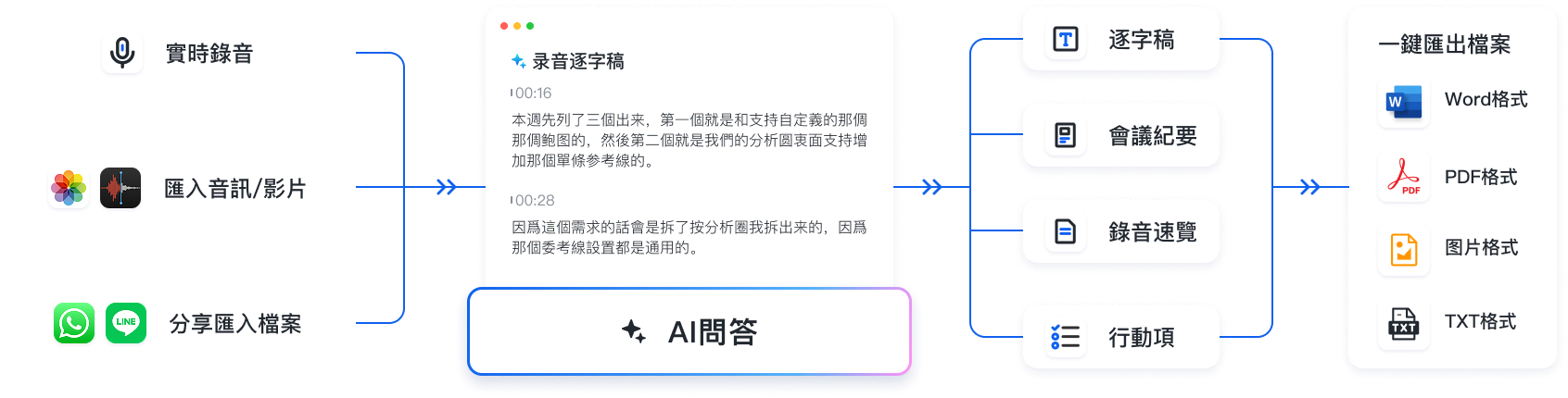
Most tools stop after outputting a wall of text, leaving users to spend time reading. Tinrec, after transcription, automatically uses AI to analyze context and generate Meeting Minutes and Action Items. This is especially effective for lengthy Cantonese meetings, automatically filtering out filler words and retaining key decisions.
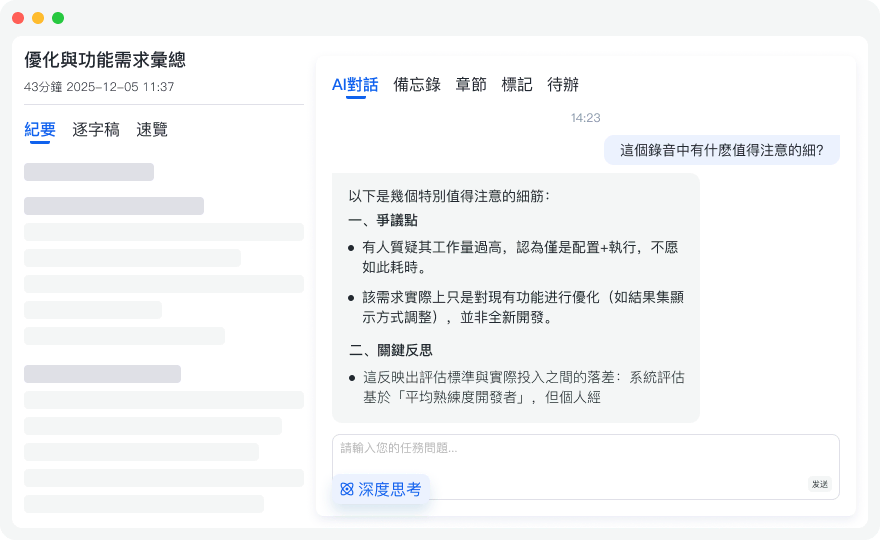
2. Search Recordings Like Asking a Person: AI Chat Query
This is the biggest difference between Tinrec and traditional transcript software. Facing a 3-hour training recording, you don't need to use Ctrl+F and guess keywords. You can directly ask the AI in the chat box: "What was the number the manager mentioned about the Q4 budget?" Tinrec will answer directly based on the recording content. This changes how we use recordings—from "passive reading" to "active inquiry."
3. Multi-Device Sync and Flexible Source Support
In addition to mobile app recording, Tinrec also supports file upload via web version, and even YouTube/Podcast link to text. This is a huge efficiency boost for creators or students who need to organize Cantonese YouTube video content.
Tutorial: How to Quickly Organize a Cantonese Meeting with AI Tools
Below we use Tinrec as an example to demonstrate how to transform a Cantonese meeting with Chinese-English mixing into structured text records quickly.
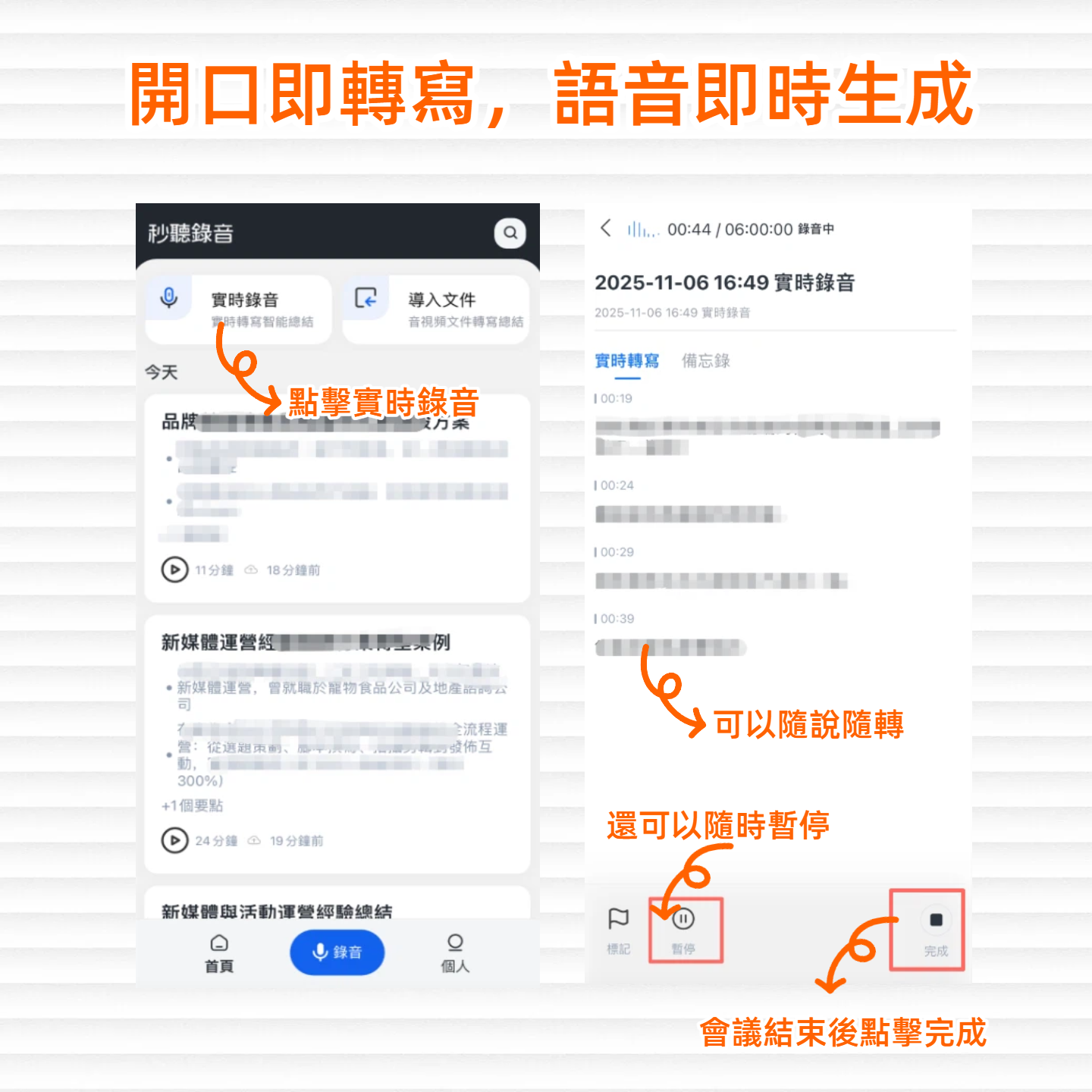
Step 1: Start Recording or Import a File
- Scenario A (Live Meeting): Open the Tinrec app or web version, tap "Start Recording." The system will transcribe speech to text in real-time, displayed on screen—great for listening and reading simultaneously.
- Scenario B (Existing File): If you already have a recording file (m4a, mp3, wav), select "Import Audio" to upload.
- Scenario C (Online Video): Copy a YouTube or TikTok video link and paste it directly into the parsing field.
Step 2: Language Setting and Recognition
Before recording or uploading, ensure the language setting includes "Cantonese" or select auto-detect. If the meeting contains many English proper nouns, Tinrec's multilingual model typically handles mixed contexts automatically without manual switching.
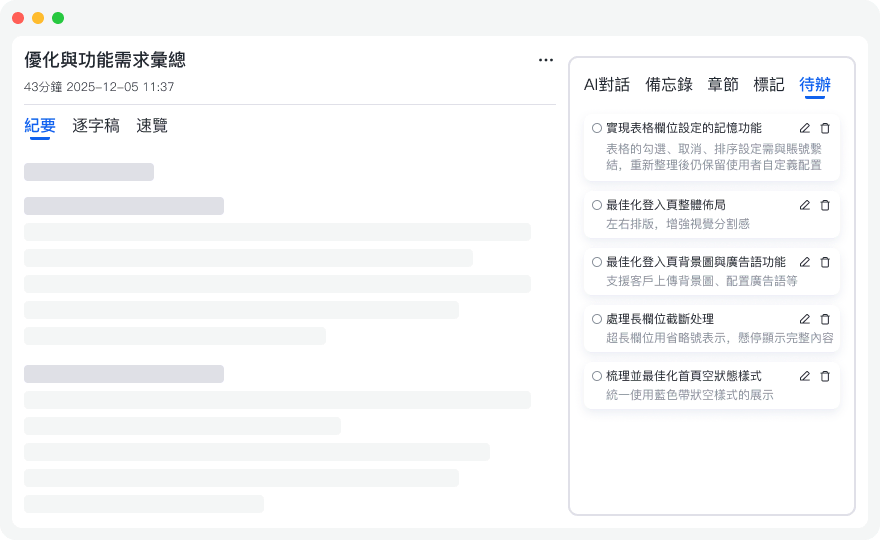
Step 3: Generate AI Summary and Action Items
After transcription, tap "AI Analysis" or check the auto-generated summary page. The system will organize messy spoken dialogue into bullet-pointed highlights.
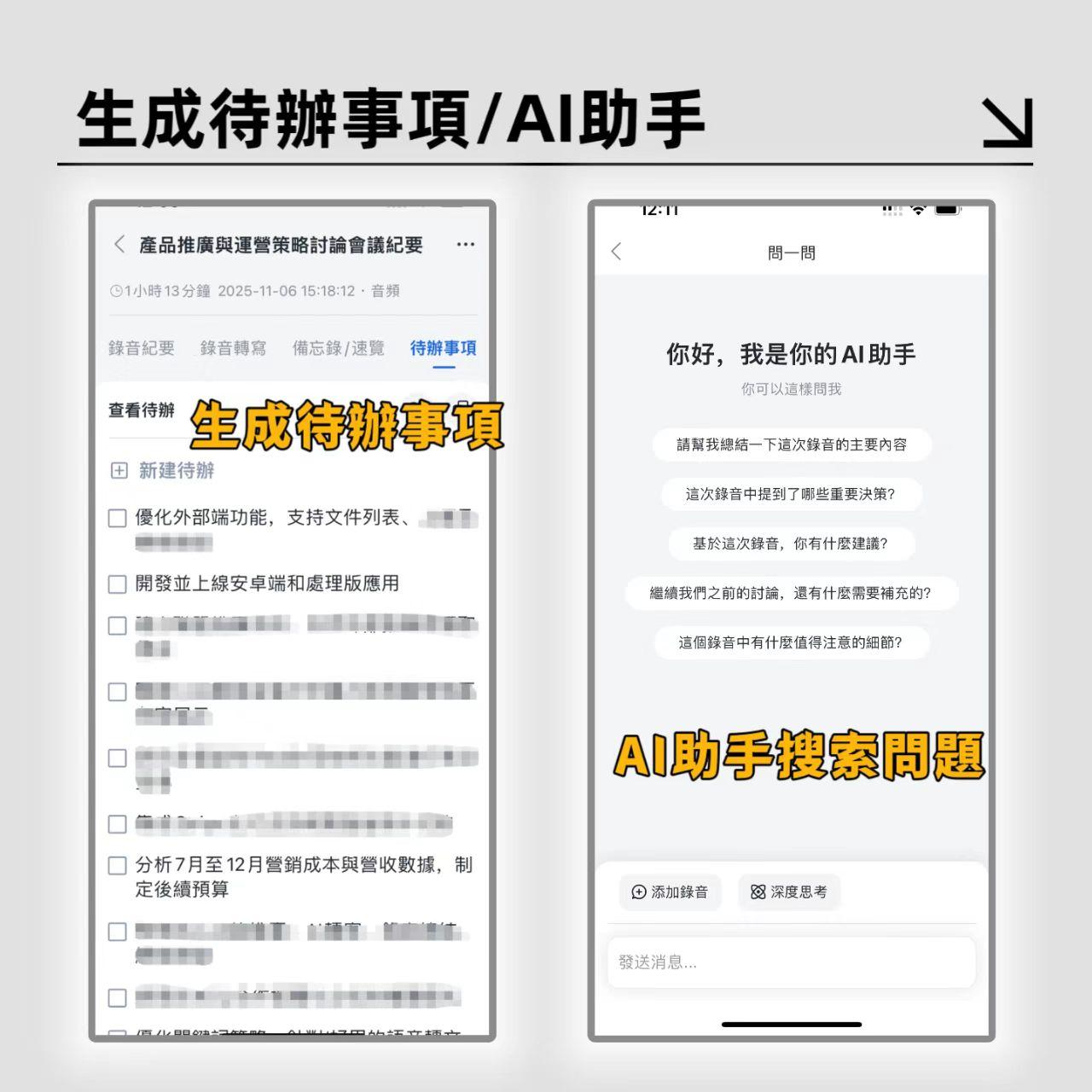
- Checkpoint: Verify that the "Action Items" accurately capture the tasks assigned in the meeting.
Step 4: Use AI Chat to Fill Gaps
If the summary missed a detail (e.g., a specific deadline), use the "AI Chat" feature on the right to query. Once confirmed, you can export as Word or PDF and share with your team.
Frequently Asked Questions (FAQ)
Q1: Is the recognition rate high for Cantonese mixed with English (Chinglish)? Traditional offline tools have low recognition rates for mixed languages. We recommend cloud-based tools (e.g., Tinrec, Whisper-based) that rely on large language models (LLMs), as they have better contextual understanding and can effectively distinguish between English words and Cantonese sounds.
Q2: Are these tools free? Are there time limits? Google Docs and built-in phone features are usually completely free but basic. Professional AI tools like Tinrec offer 100 minutes of free transcription per month, suitable for light users to try core features. For heavy transcription needs, a Pro subscription is typically required.
Q3: Can the recording distinguish who is speaking? This feature is called "Speaker Diarization." Tinrec and some paid tools support this function, automatically labeling text as "Speaker 1," "Speaker 2," etc., which is crucial for organizing meeting notes.
Q4: What export formats are available? For easy editing, choose tools that support export as txt, docx (Word), pdf, and srt (subtitle file). The srt format is especially convenient for video creators adding subtitles.
Q5: Does it work on both iPhone and Android? Tinrec supports iOS, Android, and the web version, with data syncing across your account. Apple's built-in dictation is limited to iOS, while Google Docs works best on desktop.
Q6: What about privacy and security? For corporate meeting recordings, choose paid services with clear privacy policies, and avoid free online conversion sites of unknown origin. Tinrec offers account management and encrypted transmission, suitable for business use.
Turn every recording into actionable outcomes
Get 60 free transcription minutes when you sign in. No credit card required.
Related Reading
You might also like

2026 Zoom Meeting Real-Time Translation Comparison: Which Tool Gives You Bilingual Subtitles and Post-Meeting Transcripts?
Zoom's built-in captions are not the same as cross-language translation, and translation is not the same as a usable post-meeting record. This article addresses three common misconceptions and compares three approaches: platform built-in features, human simultaneous interpretation, and desktop AI real-time translation. It also explains how Tinrec uses bot-free recording to solve both real-time comprehension and post-meeting organization.
What Does 'Otter' Mean in Chinese? 3 Common Meanings and Translation Contexts Explained (2026)
The Chinese translation of 'otter' is most commonly '水獺' (shuǐ tǎ), meaning otter. However, it can also refer to otter fur, a fisheries term, or the AI transcription tool Otter.ai. This article uses 3 key points to help you determine which meaning you're looking for, and explains the translation, context, and common misunderstandings for each.
Zoom Free vs Tinrec 2026: Which Meeting Notes Solution Actually Works for Free?
Zoom's free plan lets you host unlimited meetings with up to 100 participants, but what about a searchable, queryable record after the call? This article compares Zoom's free plan and Tinrec across 5 dimensions—recording method, Chinese transcription, post-meeting organization, team data storage, and free quota—to help you decide which one fits your needs.
Vocol.ai Tutorial 2026: Complete Guide to Free Transcripts and AI Summaries
Vocol.ai is an AI voice collaboration platform that converts recordings and videos into transcripts and automatically generates summaries, topics, and action items. This guide covers the complete workflow, core features, practical use cases, and purchasing considerations, along with free usage limits and FAQs.
2026 Vocol.ai Free vs Tinrec: Which Free AI Meeting Tool Is Right for You?
Vocol.ai's free plan offers 3,000 minutes and point packages, while Tinrec's free version lets you try recording, summaries, and transcription. This hands-on comparison covers free quotas, meeting recording, post-meeting organization, team collaboration, and Chinese language experience to help you decide which tool fits your daily meeting notes.
4 Zoom Meeting Recording Tools Compared for 2026: From Built-in to AI Transcription
Can you record Zoom meetings? This article compares four options—Zoom's built-in recording, Tinrec, Otter.ai, and Notta—covering recording permissions, transcripts, AI summaries, action item extraction, and team collaboration to help you decide which best fits your meeting scenario and budget.
2026 Google Meet Note-Taking Tools Compared: Who Records the Meeting After You Hide Your Self-View?
Google Meet's built-in 'self-view' minimization hides your own video, but someone still has to take meeting notes. We tested 4 meeting note-taking tools, comparing bot-free recording, Chinese transcription, post-meeting organization, and team knowledge retention to help you decide which one actually saves time.
Vocal Folds in Chinese: Complete Guide to Translation, Pronunciation, and Usage
The most common Chinese translation of "vocal folds" is 声带 (shēngdài), also known anatomically as 声襞 (shēngbì). This guide explains the difference between vocal folds and vocal cords, pronunciation, example sentences, and related vocabulary to help you quickly understand this English term.
Free Google Meet Meeting Notes on Mac in 2026: 5 Options Compared
Using Google Meet on Mac is convenient, but post-meeting organization is time-consuming. This article reviews 5 free meeting note tools, tests how Tinrec records Google Meet without a bot and automatically generates summaries and action items, and compares free tiers and limitations of Otter.ai, Notta, Granola, and more.