
Turn recordings into transcripts and summaries in minutes
Upload audio or video for multilingual transcription, AI notes, and action items
Why is Cantonese Speech-to-Text So Difficult?
As a busy content creator, administrator, or student, have you ever spent three times longer than the actual recording to transcribe a single audio file? The challenges of transcribing Cantonese (Yue Chinese) are particularly acute: not only is there the difficulty of converting between spoken and written registers, but workplace and daily conversations are filled with heavy code-switching (e.g., "幫我 check 下個 schedule"). Add background noise interference, and the accuracy of mainstream speech recognition engines is often abysmal.
The good news is that AI technology has made significant breakthroughs in 2025. This article will walk you through 6 mainstream Cantonese speech-to-text tools currently on the market. We will evaluate them from three dimensions: recognition accuracy, ease of use, and application scenarios. Whether you need to generate video subtitles or quickly produce meeting minutes, reading this will help you find the most suitable productivity tool.
Quick Navigation Summary:
- Video creators / subtitle needs: Prioritize Subanana (high accuracy) or Premiere Pro (editing integration).
- Meeting notes / study notes / cross-platform: Recommend Tinrec (real-time transcription + AI key takeaways).
- Completely free / tech-savvy: Try open-source software pyTranscriber.
2025 In-Depth Review of 6 Popular AI Speech-to-Text Tools
For a fair comparison, we combined market test data and hands-on experience, dividing the tools into "subtitle production" and "office efficiency" categories.
1. Subanana: The Subtitle Tool Built for Hong Kongers
Best for: Video creators who need highly accurate Cantonese subtitles. Developed by a Hong Kong team, Subanana's standout feature is its "spoken-to-written conversion." According to test data, when processing tech launch content with code-switching, its accuracy reaches 97.5%, and it can handle some background noise. It is the only tool that automatically polishes spoken Cantonese into written form, significantly reducing post-editing time.
- Pros: Extremely high Cantonese recognition accuracy, supports spoken-to-written conversion, web-based (no installation).
- Cons: Slightly slower generation, primarily for video subtitles, lacks meeting summary features.
2. Tinrec (秒聽錄音): The All-in-One Assistant from Recording to Action
Best for: Students, office workers, and users who need meeting minutes and action items. Tinrec's positioning differs from subtitle tools; it focuses more on information understanding and organization. It supports iOS, Android, and web platforms with multi-device sync. Besides automatic recognition of Cantonese, English, and 8 other languages, its strongest asset is "AI decision support." It doesn't just give you a transcript; it automatically generates meeting minutes, to-do lists, and supports AI chat to query recording content.
- Pros: Mobile app for real-time recording and transcription, AI auto-generates summaries and action items, supports YouTube/Podcast link-to-text.
- Cons: Free version has time limits (100 minutes/month), advanced features require subscription.
3. Adobe Premiere Pro: The Industry Standard for Editors
Best for: Professional editors already subscribed to Adobe Creative Cloud. Its built-in speech-to-text feature is convenient, but for Cantonese and code-switching, accuracy hovers around 89%, and it is more affected by noise, often requiring manual correction.
4. ArcTime, Taption & pyTranscriber
- ArcTime: Cross-platform subtitle software; requires paid credits; moderate noise resistance.
- Taption: Cloud-based tool from Taiwan; easy to use but weaker at handling code-switching.
- pyTranscriber: Open-source free software based on Google API; completely free but requires manual installation; accuracy depends on Google's engine.
Stop organizing recordings by hand
Upload audio or video and automatically get a transcript, summary, and action items
Tool Comparison Table: Which One Is Your Best Bet?
The table below helps you make a quick decision based on your needs:
| Dimension | Tinrec (秒聽錄音) | Subanana | Adobe Premiere Pro | pyTranscriber |
|---|---|---|---|---|
| Primary Use Case | Meeting notes, study notes, interviews | Video subtitle creation | Professional video editing | Basic transcription |
| Cantonese Accuracy | Good (supports multilingual mixing) | Excellent (optimized for spoken) | Average | Average (Google API) |
| AI Smart Features | Meeting minutes, action items, AI chat | Spoken-to-written conversion | None | None |
| Platform | iOS, Android, Web | Web (browser) | Desktop (high hardware requirements) | Desktop (needs installation) |
| Import Sources | Recording, files, video links | Files, YouTube links | Files | Files |
| Pricing | Free trial + subscription | Basic free + paid upgrade | Expensive subscription | Free (open source) |
Bottom line: If your goal is "subtitles," Subanana is the top choice; if you need "meetings, classes, or data organization," Tinrec's AI summaries and mobile support will streamline your workflow.
Hands-on Tutorial: How to Rapidly Organize Cantonese Meetings/Interviews with AI Tools
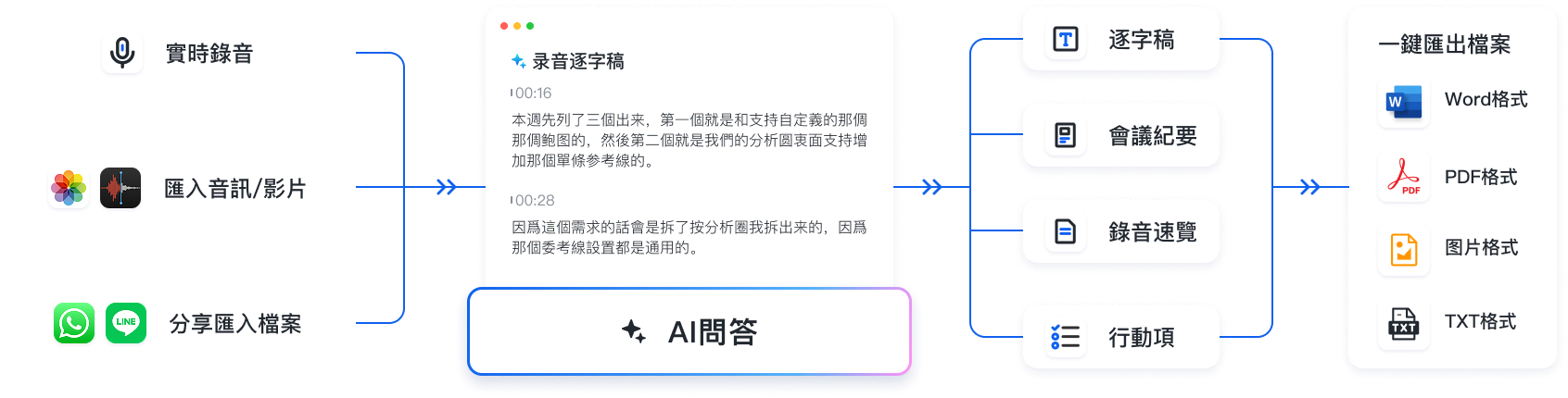
Beyond simple transcription, modern workers need to extract value from recordings. Using Tinrec as an example, here's how to turn a 1-hour Cantonese-English mixed meeting into actionable notes in 5 minutes.
Step 1: Choose Recording or Import Method
Tinrec offers flexible entry points based on your situation:
- Live Meeting: Open the mobile app or web version, click Record & Transcribe in Real Time, and the system will instantly convert speech to text and identify speakers.
- Existing File: If you already have a recording, use the Audio File to Text feature to upload it.
- Online Learning: To transcribe a Cantonese tutorial video from YouTube, simply paste the URL into Podcast/Online Video to Text.
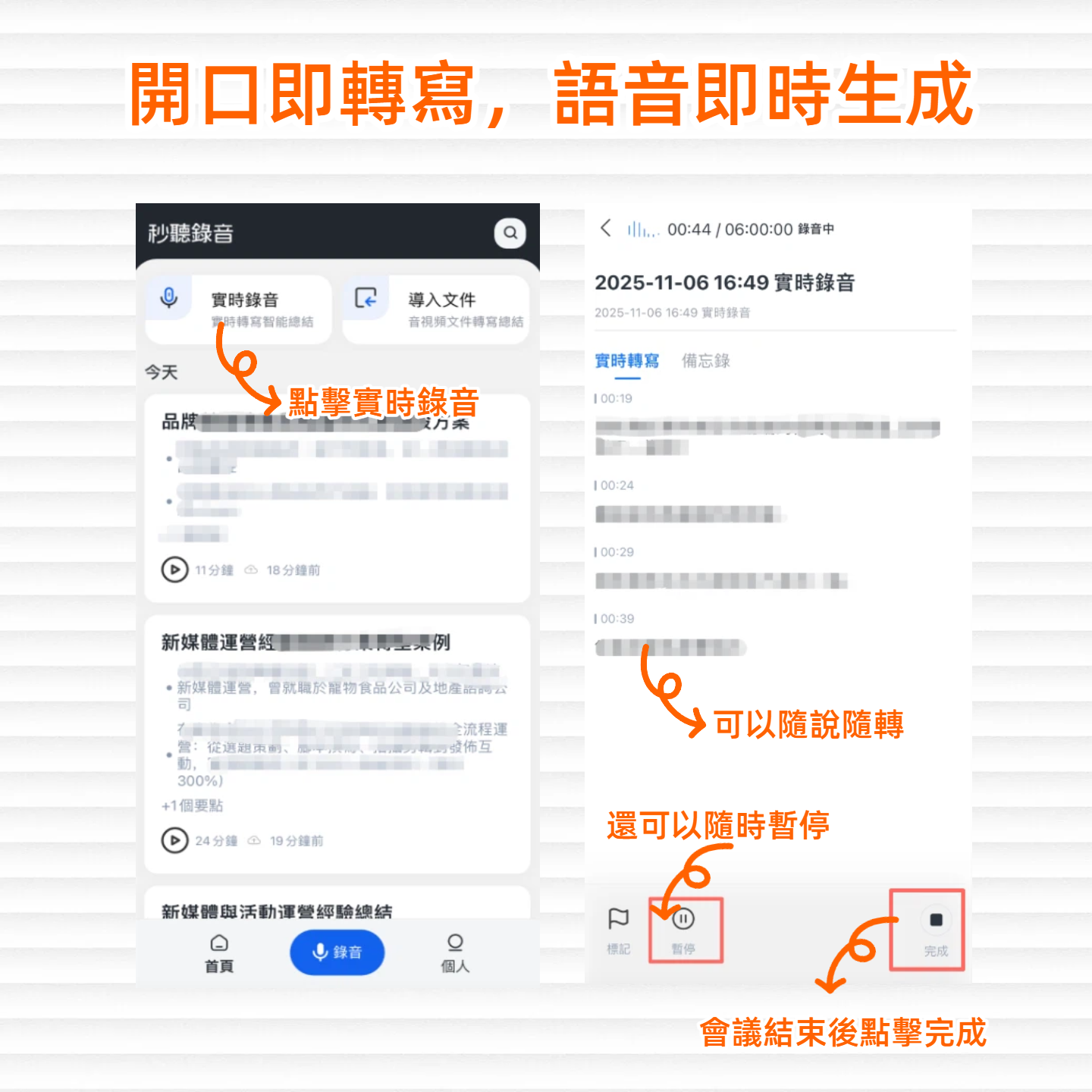
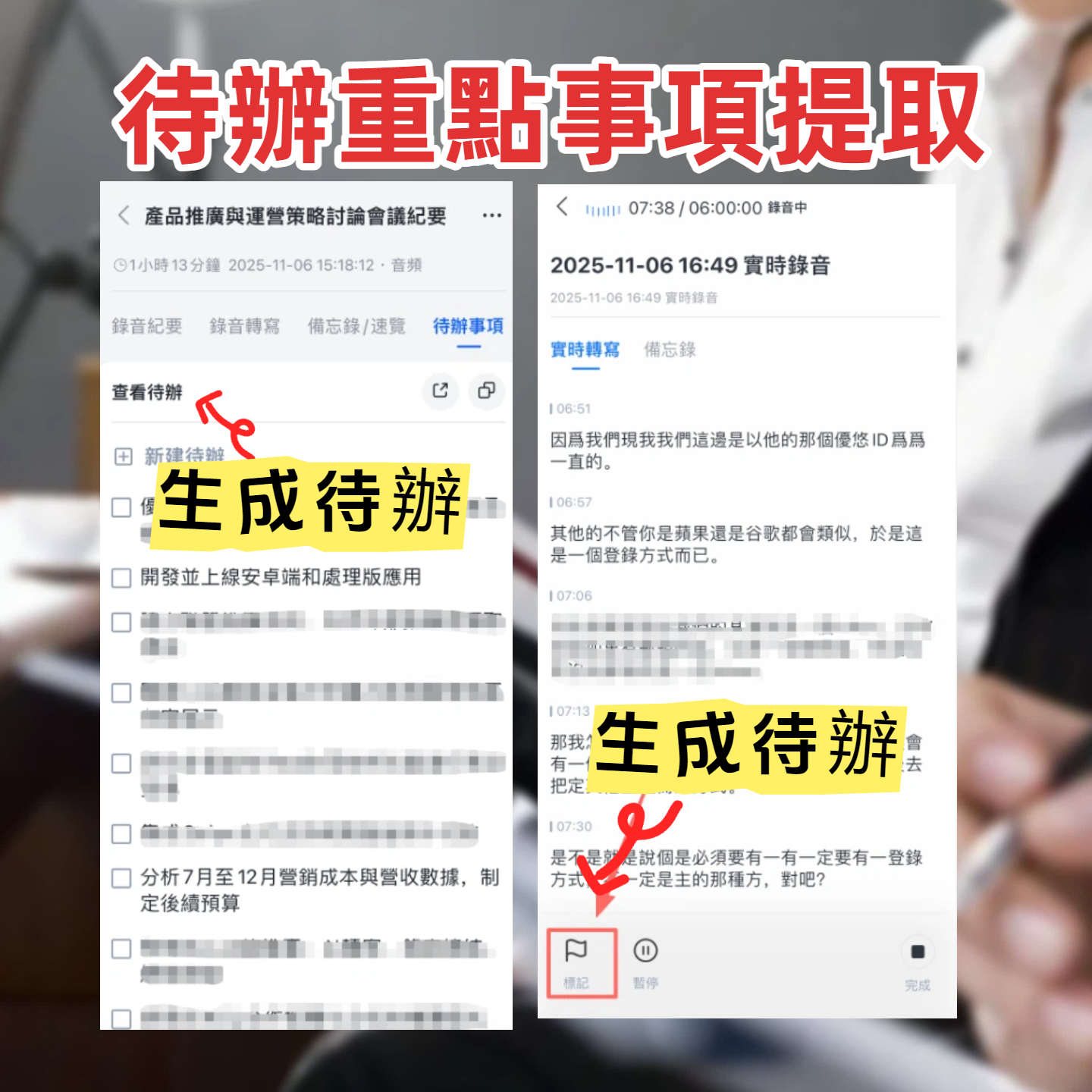
Step 2: Auto-Generate Summary and Action Items
Once the recording ends, traditional tools only give you a wall of text. In Tinrec, AI automatically analyzes the content and produces:
- Full Summary: Quickly grasp meeting highlights.
- Action Items (To-Do List): The system identifies phrases like "Peter needs to submit the report by next Friday" and lists them as to-dos.

Step 3: Use AI Chat to Query Details
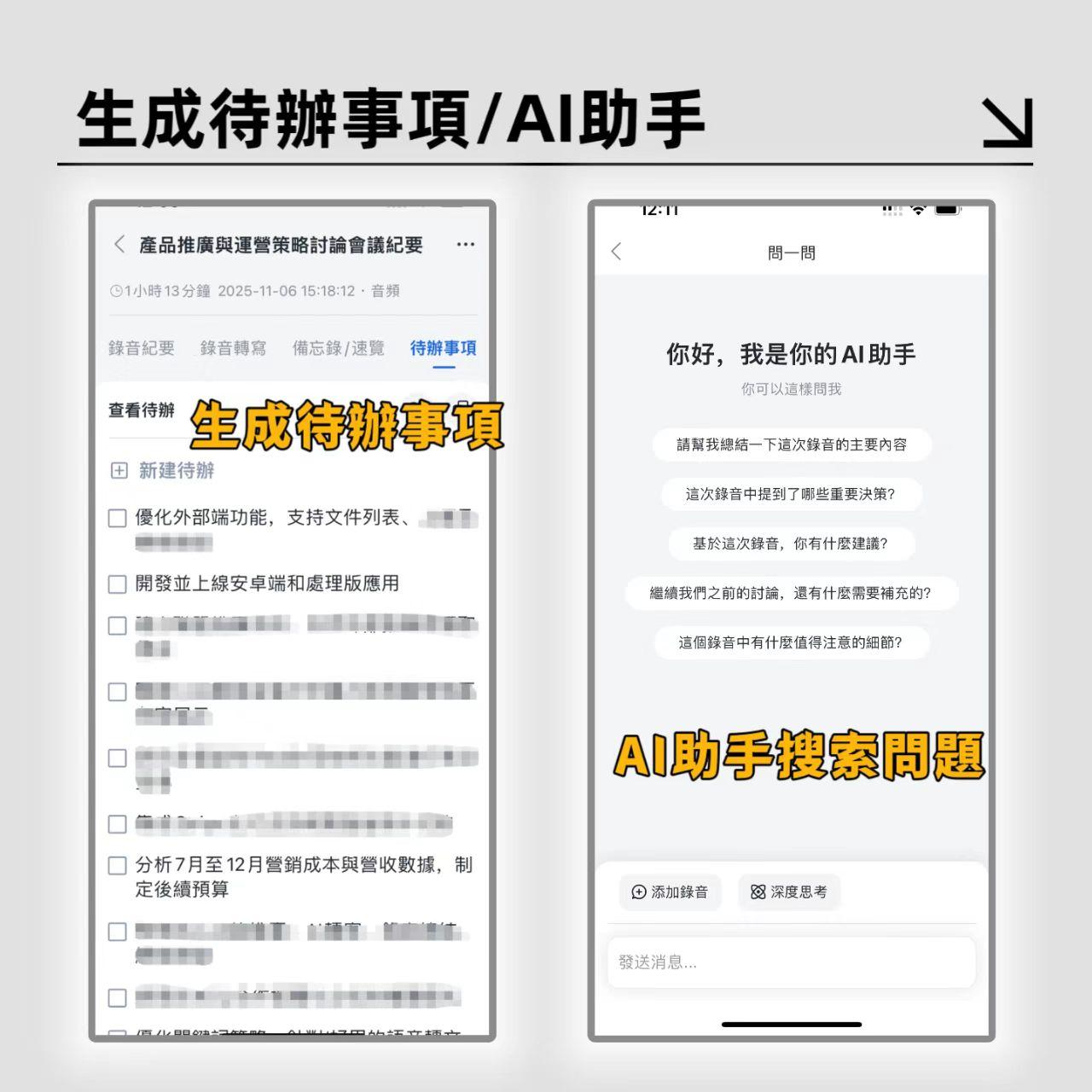
If you forget a specific detail (e.g., "What was the budget limit the boss mentioned?"), you don't need to replay the entire recording. Use the AI Chat Query feature – just ask like a chatbot: "What was the budget limit mentioned earlier?" and the system will answer precisely based on the recording content.
Frequently Asked Questions (FAQ)
Q1: Can these tools handle code-switching (Chinese-English mixing) in Cantonese? A: Yes. Subanana performs best in this area, especially with brand name recognition. Tinrec also supports multilingual mixed recognition, suitable for workplace meetings. Premiere Pro and pyTranscriber are more prone to garbled characters or missing words when switching languages.
Q2: Can the AI still transcribe if my recording environment is noisy? A: Noise does affect accuracy. According to tests, Subanana has stronger noise resistance. We recommend recording close to the microphone, or ensuring your phone's mic isn't blocked when using tools like Tinrec.
Q3: What options do iPhone users have? A: Many tools like Premiere Pro or pyTranscriber are computer-only. iPhone users should choose Tinrec (has an iOS app) or use web-based Subanana/Taption for on-the-go recording and organization.
Q4: Are these tools free? A: pyTranscriber is completely free open-source software. Subanana and Tinrec offer free trial quotas (e.g., Tinrec 100 minutes/month) suitable for light users. For heavy needs, paid subscriptions usually provide faster processing and advanced AI features.
Q5: Can I directly convert a YouTube link into text? A: Yes. Subanana, Taption, and Tinrec all support inputting a YouTube link to generate a transcript directly, which is very convenient for organizing online courses or news content without downloading the video file.
Q6: Can I export the transcribed text? A: Most tools support export to TXT, SRT (subtitle), or Word format. Tinrec even allows exporting the generated meeting minutes and action items together for easy follow-up.
Turn every recording into actionable outcomes
Get 60 free transcription minutes when you sign in. No credit card required.
Related Reading
You might also like
Tinrec Speech-to-Text Tutorial 2026: 3 Steps to Transcribe Audio + AI Auto-Summarization
Wondering which speech-to-text tool is easy to learn? This guide uses Tinrec (秒听录音) as an example to show how to turn recordings into transcripts and key summaries in 3 steps, plus 4 criteria for choosing an easy-to-use tool—perfect for beginners.

Best Recording-to-Text Apps in 2026: We Tested 4, and This Free Version Is the Best Value
We tested 4 recording-to-text tools, and Tinrec's free version is sufficient, with the most reliable Cantonese recognition, plus AI Q&A and team spaces, so office workers no longer need to work overtime transcribing.

3 Best Voice-to-Text Apps Tested in 2026: Stop Wasting Time on Meeting Notes
A mid-level manager tests voice-to-text apps for accuracy, AI summaries, cross-platform support, and team collaboration to find the biggest time-saver.
2026 Test: 4 Best Free AI Transcription Tools Compared – Which Saves You the Most Time?
We tested several free AI transcription tools for Cantonese meetings, interviews, and lectures commonly used by Hong Kong office workers. We compared free quotas, transcription accuracy, AI summarization, and cross-platform support to help you pick the most time-saving tool.
How to Convert Audio to Text for Free in 2026: A 5-Step Guide
Looking for a free audio-to-text tool? This article uses Tinrec as an example to explain what the free plan offers, real-world use cases, and a 5-step guide to quickly turn recordings into searchable, organized transcripts. It also covers key considerations and FAQs.

2026 Hands-On Comparison of 4 Meeting Transcription Tools: Which AI Notes Really Save You Time?
Recent discussions on Dcard show many people struggling with two-hour meetings followed by two hours of note-taking. This article takes a purchasing decision perspective, comparing Tinrec, Otter, Notta, and PLAUD in terms of accuracy, AI summaries, cross-platform support, and free tiers to help you choose a tool that truly saves time.

5 Best Meeting Transcription Apps in 2026: Which AI Notes Really Save You Time?
We tested multiple meeting transcription tools, and Tinrec stood out for its bot-free recording, strong Chinese support, and team collaboration features—ideal for professionals who need quick meeting notes.

5 Meeting Transcription Tools Tested in 2026: Which Saves the Most Time for Chinese Meetings?
We tested multiple meeting transcription tools, evaluating Chinese speech recognition, AI summaries, action item extraction, and team collaboration to help you find the best choice for office workers.

Tinrec vs Otter 2026: 5-Dimension Hands-On Comparison – Which Is Better for Chinese Meeting Notes?
When it comes to meeting recording transcription, Tinrec and Otter are both popular choices. This article compares them across 5 dimensions: bot-free recording, Chinese transcription, post-meeting organization, team management, and pricing, to help you decide which is better for Chinese-speaking users and team collaboration.