
Turn recordings into transcripts and summaries in minutes
Upload audio or video for multilingual transcription, AI notes, and action items
2026 AI Recording Tools Comparison: Tinrec vs PLAUD Note – Which Is Better for Organizing Your Audio Files?
Modern people are overwhelmed daily by meetings, courses, interviews, and online videos. The need to quickly convert speech to text and organize it into usable notes is nothing new. But stepping into the market, you'll find that AI recording tools have split into two camps: the software side, represented by Tinrec (formerly known as Miao Ting), which can be done with just a smartphone, and the hardware side, represented by PLAUD Note, which focuses on standalone one-touch recording. Should you spend hundreds on a portable recorder, or just download an app? This comparison breaks down the five key dimensions to help you avoid wasting money.
Tinrec vs PLAUD Note: Quick Overview
Although both products claim to 'turn recordings into text,' their core logic is completely different. Tinrec is a software-first AI audio and video data organization platform, supporting mobile, desktop, and web versions; PLAUD Note is an external recording hardware that connects via Bluetooth to a phone and then uploads for transcription.
- Positioning: Tinrec is a 'cross-source audio/video organization platform'; PLAUD Note is an 'AI portable recorder.'
- Pricing: Tinrec offers a free plan and flexible weekly, monthly, and yearly subscriptions; PLAUD Note hardware costs about $179, with additional yearly fees for transcription.
- Key difference: Tinrec can handle local files, online videos, and even AI Q&A and mind maps; PLAUD Note focuses on hardware battery life and one-touch start.
Below, we objectively compare their actual performance across five dimensions: input sources, AI post-processing, pricing flexibility, platform support, and use-case coverage.
Dimension 1: Input Sources and Flexibility
PLAUD Note's recording process is very simple: press the hardware button to start recording, then upload through the app for transcription. It suits live meetings, classes, and other 'direct recording' scenarios. But if you want to process a YouTube video, a WhatsApp voice message, or even an audio file recorded on your phone last month, PLAUD can't help.
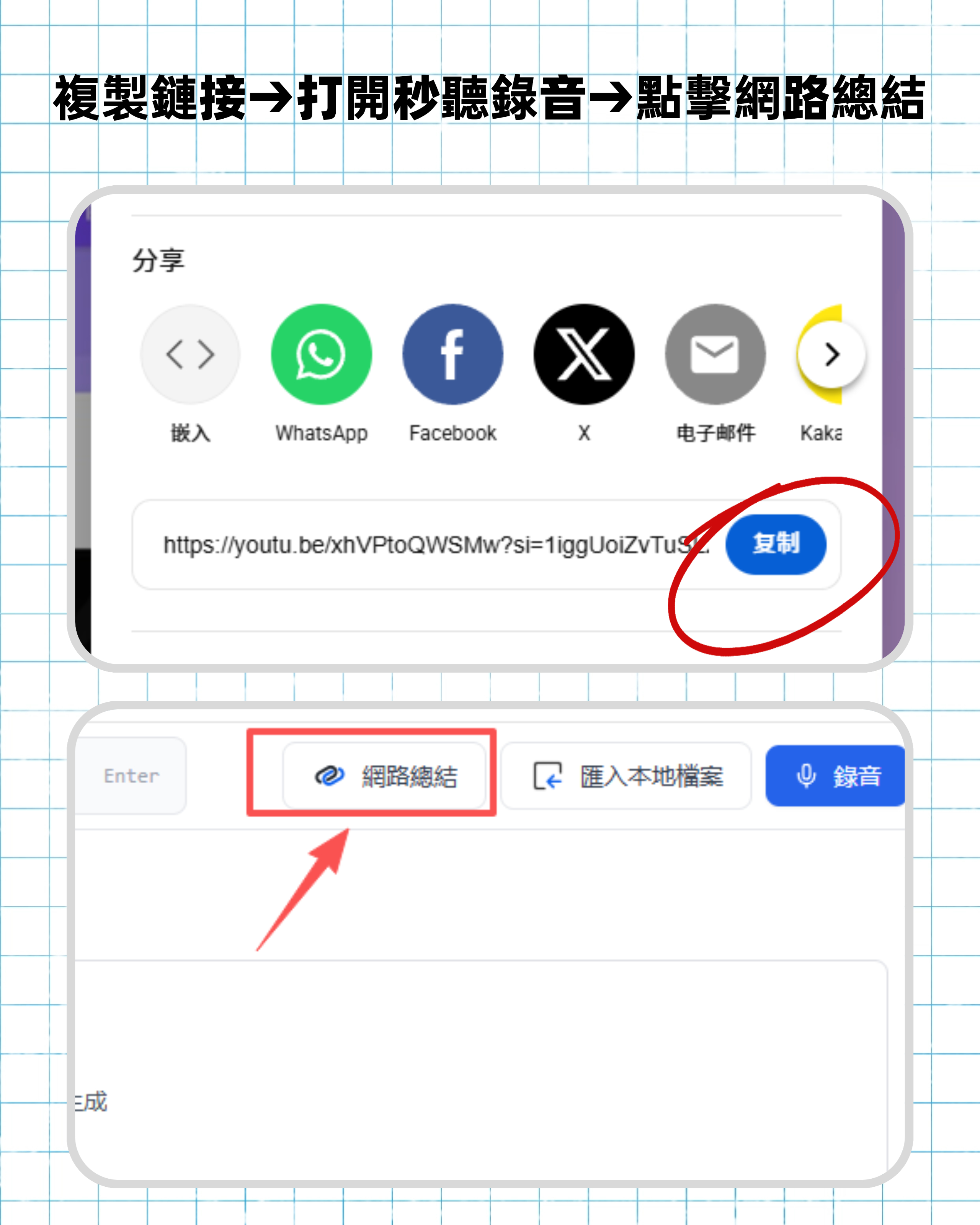
Tinrec is like an 'audio/video hub': you can record in real time, upload audio files from your phone or computer, paste links to online videos from YouTube, Bilibili, TikTok, Xiaohongshu, and even capture system audio from online meetings. No matter where the content comes from, Tinrec can handle it and turn it into text.
→ This dimension: Tinrec clearly wins. For those who need to organize diverse audio and video materials, Tinrec's source coverage far exceeds hardware-based solutions.
Dimension 2: AI Organization and Applications After Transcription
Transcription is just the basics; the key is whether a one-hour recording can be turned into 'readable, usable data.'
PLAUD Note includes built-in AI summaries, chapter division, and recording-based Q&A, meeting basic meeting highlight extraction needs. But it leans toward one-time use; exporting and collaborating on transcribed content has limited formats and channels.
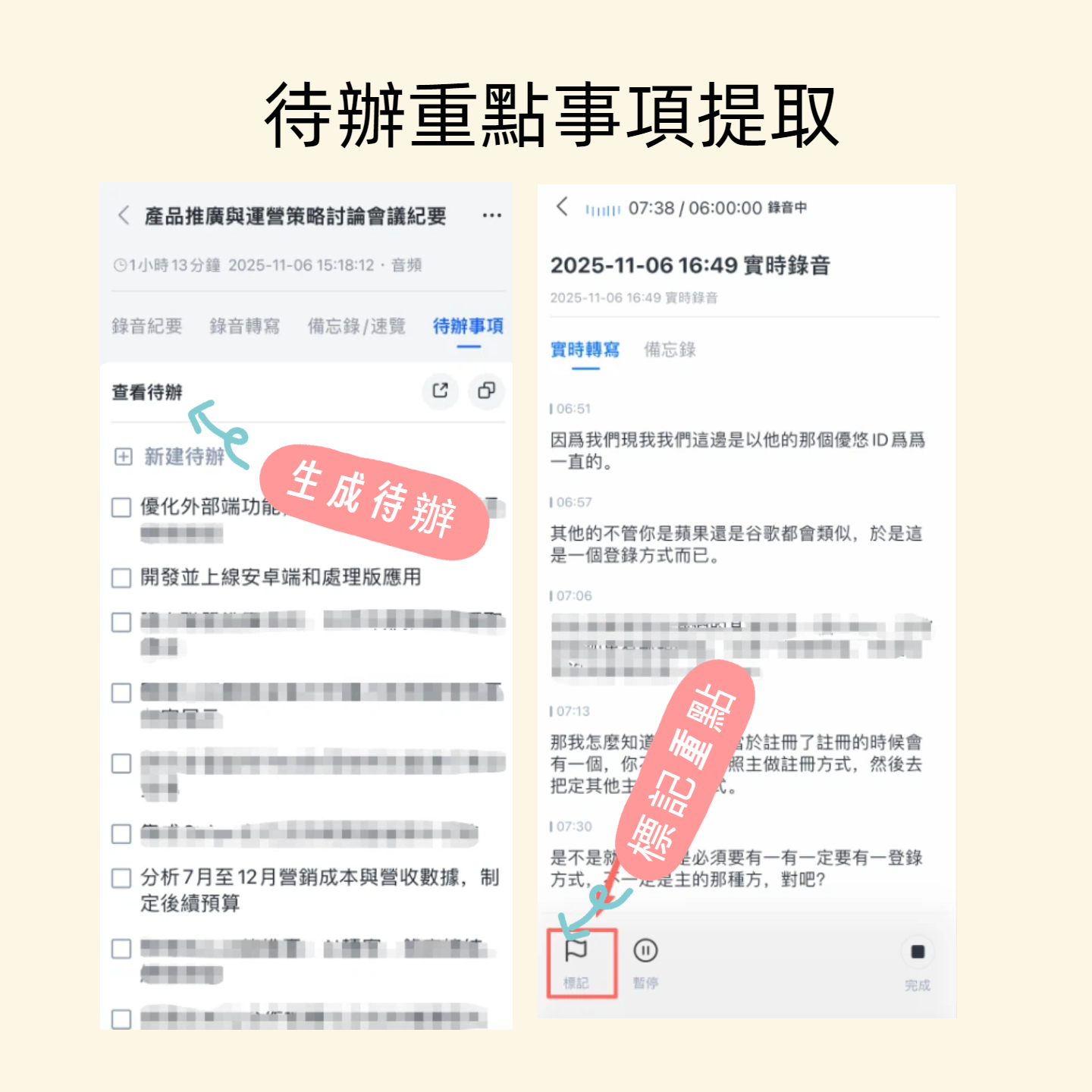
Tinrec goes a step further in post-processing: besides auto-extracting summaries, chapters, and to-dos, it supports 'dialogue-based follow-up on recording content'—for example, you can directly ask 'What exam points were mentioned in this class?' More importantly, Tinrec can generate deliverables like meeting minutes, mind maps, and report tables, and export them to Notion, Google Docs, OneNote, etc., with one click.
→ This dimension: Tinrec clearly wins. From 'getting a transcript' to 'producing a deliverable,' Tinrec offers a more complete layer of AI applications.
Stop organizing recordings by hand
Upload audio or video and automatically get a transcript, summary, and action items
Dimension 3: Pricing and Long-Term Cost of Ownership
PLAUD Note's entry barrier is the hardware: the device costs about $179 (pre-order price), including 300 minutes of free transcription per month. To upgrade to 1200 minutes, you need an additional $99.99 yearly; for unlimited transcription, it's $239.99 per year. This doesn't include the depreciation cost of future device replacements.
Tinrec requires no hardware investment—just download the app or open the website to use it. The free version already provides a basic monthly transcription quota, sufficient for occasional meeting notes. Frequent users can choose a weekly, Pro monthly, or yearly plan, with monthly costs much cheaper than buying a hardware device. Plus, you can adjust your plan anytime, so there's no risk of buying a device you seldom use.
→ This dimension: Tinrec clearly wins. Especially for users with limited budgets or irregular usage, the total cost of ownership for a software solution is far lower than hardware.
Dimension 4: Platform Support and Cross-Device Use
PLAUD Note's main operation relies on the phone app; recording data must be uploaded via phone, and desktop users have limited management capabilities. It is a 'phone-centric' recording tool.
Tinrec natively supports iOS, Android, and web versions. Whether you use an iPhone for meetings, a Windows laptop for classes, or an iPad for watching videos, you can switch seamlessly. All recording data syncs to the cloud; you can continue organizing on your computer at home without transferring files back and forth.
→ This dimension: Tinrec wins. For those who work across both phone and computer, cross-platform consistency saves a lot of effort.
Dimension 5: Real-World Use-Case Coverage
We listed common high-frequency audio/video organization tasks to see how many each tool can cover:
| Common Task | PLAUD Note | Tinrec |
|---|---|---|
| Live meeting recording | ✅ Excels | ✅ Supported |
| Online meeting system audio transcription | ❌ Requires phone speaker | ✅ Can directly capture |
| Old audio/video file to text | ❌ Not supported | ✅ Import locally |
| YouTube, TikTok, etc. online video organization | ❌ Not supported | ✅ Paste link |
| Organize recording into report/mind map | ❌ Limited functionality | ✅ Auto-generates |
| Long-term database management and Q&A | ❌ Lacks depth | ✅ Can search history recordings and ask questions |
From the table, it's clear that PLAUD Note's strength lies in 'on-the-spot recording' scenarios, while Tinrec's coverage extends to pre- and post-event data processing.
→ This dimension: Tinrec wins. Modern audio/video information comes not only from meetings but also from courses, videos, and social content. A software solution better meets diverse organization needs.
Unique Advantages of Each
Tinrec's Unique Advantages
- Multi-source input: Unified transcription for recordings, local files, and online links, reducing time switching between tools.
- AI workspace mindset: After transcription, you can continuously ask questions, generate charts and documents, and export to third-party services, integrating organized content directly into your workflow.
- No hardware dependency: Only need a phone or computer, no extra charging or carrying devices; zero risk of loss.
- Flexible pricing: From free to yearly plans, adjustable based on usage, making long-term costs more manageable.
PLAUD Note's Unique Advantages
- Standalone recording experience: Press a button to start recording, without interfering with other apps; battery life can last tens of hours, ideal for long seminars.
- Hardware-level security: Some users prefer physical device control over recording authorization, reducing privacy concerns on the phone.
Conclusion: Which One Should You Choose?
This is a choice between 'software integration capabilities' and 'hardware convenience.' If the following scenarios apply to you, Tinrec is the smarter investment:
- You need to organize not only meetings but also online courses, videos, and interviews.
- You want transcription to auto-generate summaries, to-dos, mind maps, and even reports.
- Your work environment spans phone, tablet, and computer, and you want to easily search historical files.
- You don't want to spend nearly a hundred dollars on a single-function device and prefer a lower monthly fee for higher audio/video productivity.
Conversely, if you only want the simplest 'one-button recording' and rarely need to organize old files or online content, then PLAUD Note's hardware smoothness still has its appeal.
In a nutshell: For 90% of users, Tinrec offers a more comprehensive audio/video organization capability at a lower cost. We recommend downloading the free version and testing it with your own meetings or courses to experience the complete workflow from recording to knowledge base.
Turn every recording into actionable outcomes
Get 60 free transcription minutes when you sign in. No credit card required.
Related Reading
You might also like

2026 In-Depth Comparison of 4 Speech-to-Text Tools: Beyond Notta and Otter, Why Tinrec Is Worth a Try
A thorough hands-on test of 4 major speech-to-text tools, from free to paid versions. As a small team manager, I'll tell you directly which one saves you the most time, so you won't be fooled by vendor hype.

2026 Comparison of Two French Transcription Tools: Good Tape vs. Tinrec – Which One Is Right for You?
Good Tape is a solid tool for French transcription, but if you need multilingual support, AI summaries, and cross-platform compatibility, Tinrec is the more comprehensive choice. This hands-on comparison helps you decide quickly.

2026 Ultimate Guide to Transcription Tools: Beyond Good Tape, Discover Better Options
Hands-on review for small to mid-sized team leaders: If you're looking for a Good Tape alternative, this explains why Tinrec is better for meetings, courses, interviews, and content creation—handling everything from recording to organizing in one go.

2026 Comparison of 6 AI Transcription and Note-Taking Tools: From Free to Paid, Which One Is Your Work Accelerator?
Meetings, lectures, and interview recordings piling up? Which AI note-taking tool can really save you time? This article compares 6 popular solutions, evaluating real-time transcription, AI summaries, and multi-source support. After reading, you'll know which one to choose.

How to Choose a Speech-to-Text Tool in 2026: A Complete 5-Step Guide
This article starts from the pain point of accumulating recordings, shares 5 speech-to-text tools I've tested, and uses Tinrec as an example to teach you a method for selecting and using these tools, turning recordings into usable knowledge.
2026 Comparison of 5 Audio-to-Text Tools: From Free to Paid, Which One Is Worth Trying?
Looking for a reliable audio-to-text tool in 2026? I tested 5 popular apps including Tinrec, Notta, Otter, etc., comparing features, pricing, Chinese support, and multi-scenario usability. A must-read for small team leaders and solopreneurs.

2026 Comparison of 3 Speech-to-Text Tools: Which Is Best for Chinese Users?
A hands-on comparison of three leading speech-to-text tools, evaluating language support, cross-platform compatibility, AI features, and pricing to determine the best fit for Chinese users.

2026 Side-by-Side Comparison of 2 Speech-to-Text Tools: Good Tape vs. Tinrec - Which Free Plan Is the Best Deal?
Looking for a Good Tape coupon? Check out Tinrec's free plan instead. This article tests two speech-to-text tools head-to-head, comparing free credits, Chinese recognition, multi-source support, and AI Q&A to help small teams decide.

2026 Recording Tool Comparison: Which One Saves You More Money?
Looking for a recording tool but don't want to spend big money? This article compares Tinrec and PLAUD NOTE across price, input sources, post-processing, cross-platform support, and Chinese language support to help you find the best value.